
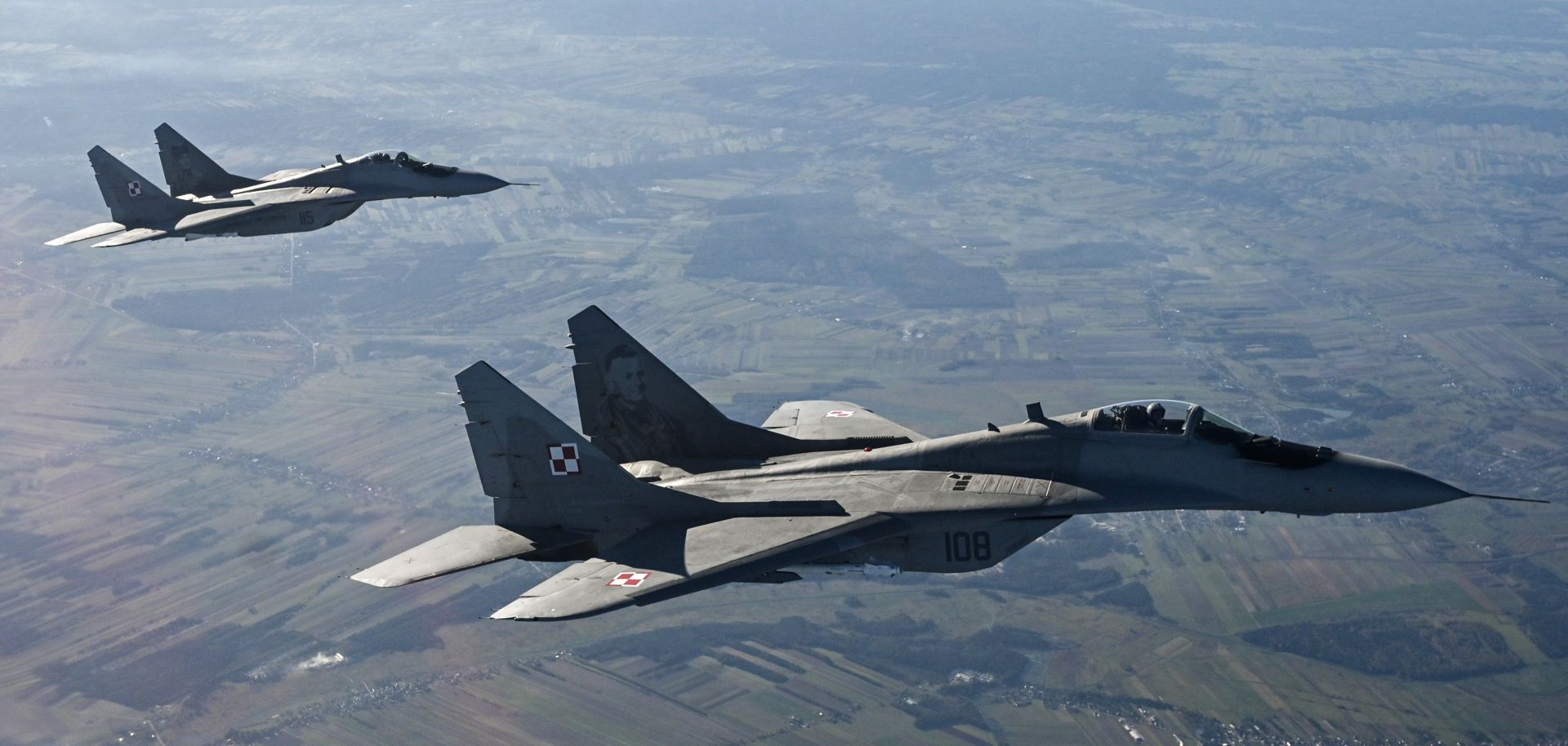
Russia's drone incursion into Poland underscores Moscow's growing willingness to test NATO's resolve and raises the risk of an escalation that could edge both sides closer to direct confrontation. In the early hours of Sept. 10, Russian drones entered Polish territory during an attack on Ukraine, which Ukrainian President Volodymyr Zelensky said involved some 414 drones and 40 missiles. Warsaw estimates that 19 drones crossed into its airspace, of which four were downed. The defensive operation was carried out jointly by Dutch F-35s and Polish fighters, with Italian airborne early-warning aircraft providing surveillance support and German Patriot missile systems placed on standby. Polish authorities reported that one drone traveled roughly 250 kilometers (155 miles) within Polish territory before crashing in a field near Mniszkow in the Lodz region, while another drone fragment was recovered in Czosnowka, about 50 kilometers from the Belarusian border. Although no casualties were reported in any of these incidents, Poland temporarily suspended air traffic at Warsaw's Chopin Airport and three other regional airports to allow for military operations. Prime Minister Donald Tusk described the incursion as a deliberate "provocation" by Russia but stressed that Poland and its NATO allies had effectively neutralized the threat. Tusk also said that Warsaw would invoke NATO's Article 4, requesting a formal consultation within the alliance.
- NATO issued a statement reaffirming its commitment to defend "every kilometer" of allied territory. European Commission President Ursula von der Leyen condemned the incident as a reckless and unprecedented breach of European airspace, pledging solidarity with Poland. U.K. Prime Minister Keir Starmer described the incident as "an extremely reckless move by Russia" and as an "egregious and unprecedented violation of Polish and NATO airspace." French President Emmanuel Macron said the attack was "simply unacceptable."
- On Sept. 10, Kremlin spokesman Dmitry Peskov said the Russian government "wouldn't like to comment" on the episode. Separately, Russia's temporary charge d'affaires to Poland, Andrey Ordash, told Russian state news agency RIA Novosti that "there has been no evidence that these drones are of Russian provenance."
- NATO's Article 4 provides for consultations among member states whenever one of them feels that its territorial integrity, political independence or security is threatened. Unlike Article 5, the bloc's mutual self-defense clause, this only requires consultations and does not commit the alliance to a military response.
Russia's drone incursion into Poland highlights Moscow's increasing willingness to test Western resolve as it continues mass airstrikes on Ukraine, prepares for war games in Belarus and negotiations to end the war are stalled. Russia has increasingly relied on mass drone and missile strikes to overwhelm Ukraine's air defense systems, launching attacks involving between 600 and 800 drones at a time as well as cruise and ballistic missiles in recent weeks. The drone intrusion occurred just days before large-scale "Zapad" (West) Russian-Belarusian military exercises are set to take place in Belarus between Sept. 12 and 16, further heightening regional tensions. Finally, the incident also comes as U.S.-led peace efforts have stalled. European leaders are pressuring Washington to adopt a tougher line against Moscow but making slow progress in their pursuit of security guarantees for Ukraine in the event of a peace agreement. Combined, these factors suggest that even if the Sept. 10 incident was an accident — though the high number of drones entering Poland and the distance into its territory at least some traveled suggest this is unlikely — Russia feels confident that it can increase its air attacks against Ukraine, conduct military exercises close to NATO's borders and make more brazen moves that risk violations of NATO airspace without suffering any meaningful retaliation from the West.
- In recent days, U.S. President Donald Trump and other top officials have suggested that the United States could increase economic pressure on Russia to force Moscow to reach a peace agreement with Ukraine. In August, the White House imposed a 50% tariff on goods from India, which included a 25% penalty for its purchases of Russian oil. While the United States has threatened to impose similar penalties on China, the main purchaser of Russian oil, the United States will be reluctant to punish Beijing over its ties with Moscow at a time when Washington and Beijing are engaging in broader trade negotiations.
- EU officials have debated ways to expand the use of the profits generated by the roughly €200 billion ($234 billion) in frozen Russian assets, with some countries suggesting that the bloc should actually seize the principal and not only the profits. However, the bloc remains internally divided over the issue, which suggests that no drastic actions are likely in the short to medium term.
While neither NATO nor Russia want a direct confrontation, the Sept. 10 episode underscores the risk of unintended escalation. The incursion was likely less an attempt to provoke a clash with NATO than a test of the alliance's resolve and unity. Yet incidents of this kind, as well as other frequent kinds of Russian provocation, including cyberattacks, sabotage and other forms of asymmetric aggression, carry a real danger of miscalculation and unintended consequences. Russia's violation of Poland's airspace and similar future incidents are unlikely to trigger an Article 5 response as NATO will try to prevent a direct confrontation with Russia with unforeseeable consequences. However, each new Russian provocation increases the chance of a crisis — especially if an incident causes heavy casualties or destroys critical infrastructure in a NATO member state, even without deliberate intent from Moscow. More broadly, the incident is likely to further harden NATO's posture on its eastern flank, speed up efforts to integrate air and missile defenses and reinforce Poland's role as a frontline state. At the same time, it raises the risk that future Russian provocations and NATO's increasing willingness to respond more assertively could set off an escalation spiral that neither side can easily control.
- According to Tusk, the prospect of a large-scale military conflict between Russia and NATO is "closer than at any time" since World War II.
- This Sept. 10 incident is the first time Polish and NATO forces have directly intercepted and downed Russian drones. While the incident was the highest profile such event since the start of the war in Ukraine, it was far from the first one. On March 24, a Russian missile crossed into Poland for 39 seconds (NATO did not intercept it to avoid escalation). In September 2023, a Russian Shahed drone crash-landed in Latvia's Rezekne region after entering from Belarus. In March 2025, Romania found drone fragments on its territory during Russian strikes on Ukraine. In June 2024, Finnish authorities detected four Russian military aircraft entering Finnish airspace near Loviisa by about 2.5 kilometers. While some of these episodes may have been accidental, they could have also been explicit provocations from Russia.
- The Sept. 10 incident happened as NATO countries along the Baltic Sea are becoming more assertive in the protection of their air and maritime spaces. This is increasing their resolve in responding more firmly to incursions.
