
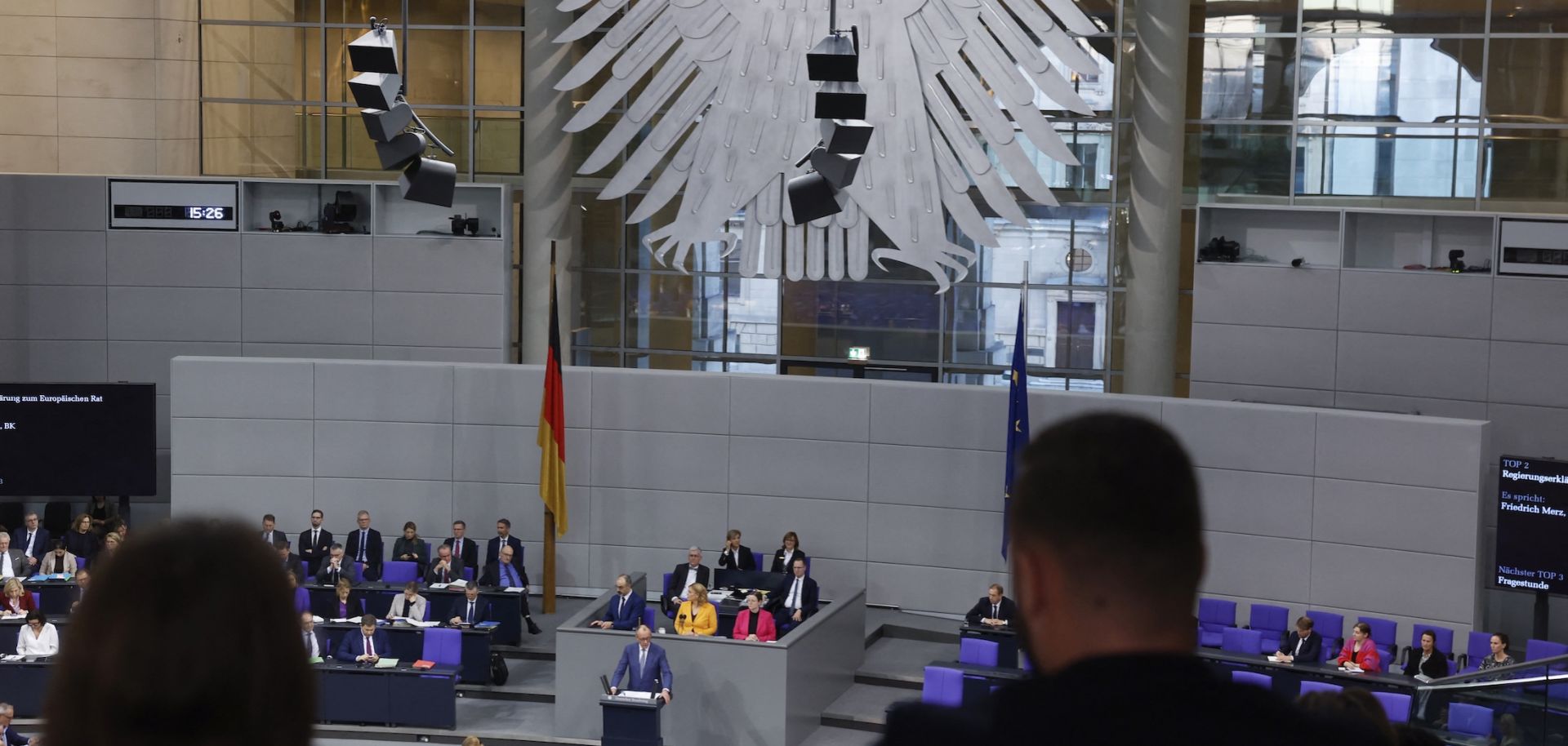
Germany's governing coalition is increasingly constrained by internal divisions, weak party discipline and falling approval ratings. While a government collapse or early elections remain unlikely, these pressures are slowing down and diluting reforms and causing uncertainty over Chancellor Friedrich Merz's ability to restore stability and deliver economic growth. Germany's coalition government is showing increasing signs of fragility, with a series of tight parliamentary votes since taking office exposing difficulties in maintaining party discipline and assembling stable majorities. On Dec. 5, the Bundestag only narrowly approved Merz's contested pension reform with just 318 votes, 10 fewer than the coalition's nominal majority and just two more than a majority, the result of defections and abstentions on a core social policy file for the ruling coalition from within his own Christian Democratic Union (CDU). The same day, lawmakers passed a contested military service bill designed to expand Germany's armed forces through a hybrid model prioritizing voluntary enlistment but allowing for limited conscription if recruitment targets are missed. The bill was passed only after months of contentious negotiations and internal disagreements that exposed deep-seated divisions within the coalition over defense reforms and the political costs of reintroducing compulsory service mechanisms.
- Merz's CDU and its Bavarian sister party, the Christian Social Union (CSU), won the Feb. 23 federal elections and subsequently secured a coalition deal with the center-left Social Democratic Party (SPD) of former Chancellor Olaf Scholz. The coalition holds a 12-seat majority in the Bundestag.
- The pension bill aimed to stabilize Germany's pension system through 2031. The measure is estimated to add roughly 120 billion euros ($140 billion) to the federal budget by 2031. Rising fiscal pressures, weaker growth forecasts and International Monetary Fund warnings about long-term competitiveness intensified scrutiny of the bill. Resistance from about 18 lawmakers affiliated with the CDU youth wing threatened to derail the measure over concerns about shifting costs to future generations, ultimately resulting in a few defections that nearly derailed the vote in the Bundestag.
- The military service bill was proposed by Defense Minister Boris Pistorius in late August with the goal of reaching 270,000 soldiers in the Bundeswehr — up from around 183,000 today — and building a reserve of at least 200,000 by 2035, relying primarily on voluntary service supported by financial incentives to meet new NATO capability targets amid heightened tensions with Russia and growing uncertainty over long-term U.S. security commitments in Europe. The proposal drew criticism for being overly cautious and thus unlikely to meet the ambitious target, with critics arguing it lacked credible enforcement mechanisms. Even before its first reading in the Bundestag, the CDU/CSU pushed for a stronger fallback option involving forms of limited conscription (suspended in 2011), despite the bill having already been jointly approved by the Merz government. This disagreement resulted in the unusual step of amending the draft through an intra-coalition political compromise between the CDU/CSU and SPD even before formal parliamentary debate began.
- Merz's authority was already tested from the outset when he failed to secure a Bundestag majority in the first vote to elect him as chancellor on May 6, forcing an unprecedented second ballot. The initial shortfall reflected dissent or abstentions from within the governing parties under a secret vote, leaving it unclear whether dissent came from CDU/CSU members frustrated by Merz's fiscal policy U-turn or from SPD lawmakers — or potentially a combination of both. Although the second round eventually secured his election, the episode signaled early discipline problems and foreshadowed the coalition's later difficulties in securing reliable majorities on contentious legislation.
Substantial ideological differences within the ruling coalition and growing unease inside Merz's own party have slowed policymaking, watered down flagship reforms and undermined business confidence. Merz's government took office on a pledge to restore stability after the deeply unpopular and divided Scholz government, relaunch Germany's economic model and revive growth after years of stagnation. The new government promised sweeping reforms, large-scale fiscal stimulus and accelerated rearmament and modernization of the country's armed forces in response to global geopolitical volatility and regional insecurity. So far, however, progress has been limited. The reform agenda has advanced slowly and its effects have yet to translate into meaningfully improved economic performance or business confidence, with the German economy having stagnated in 2025 and projected to barely grow in 2026. One of the main challenges stems from ideological friction within the ruling coalition. While relations at the leadership level have so far remained broadly positive, deep differences over social, fiscal, climate and migration policy have repeatedly narrowed the scope for agreement and slowed down the pace of reforms, with several flagship campaign pledges stalled or diluted. Welfare reforms, for instance, were blocked by SPD resistance. Efforts to cut bureaucracy have produced little tangible change and corporate tax relief and tighter migration controls have largely been limited to incremental adjustments that fall short of the coalition's original reform commitments. Meanwhile, Merz has been facing growing unease within his own CDU/CSU alliance, with critics pointing to excessive concessions to the SPD and to his break with decades of traditional fiscal conservatism through looser constitutional borrowing limits to finance defense and infrastructure investment. Against this backdrop, public frustration with the government has increased, further boosting support for the far-right opposition Alternative for Germany (AfD) party in the polls.
- Surveys show Merz is one of the least popular chancellors in recent history. As of December, his personal approval ratings stood at just 23-29%, depending on the poll, roughly 20 points lower than when he took office in May and well below the levels recorded by even his heavily criticized predecessor Scholz over the same period. Political divisions are also visible within his support base. One poll published in late November found that 40% of CDU supporters were dissatisfied with Merz's performance, rising to 70% among SPD voters. Support for the CDU/CSU has fallen from 29% in the February election to around 25%, while SPD support has slightly edged down from 16% to about 14%. By contrast, the AfD has surged to roughly 26%, up from below 21% in February, becoming Germany's leading party in the polls amid public frustration over immigration, economic stagnation, high energy prices and growing distrust in the political establishment.
- In November, Merz publicly reaffirmed his refusal to cooperate with the AfD, amid an intensifying internal debate within the CDU over how to handle the far-right party. Speaking at the CDU youth congress in Rust, he said the two parties had "absolutely nothing" in common. His intervention came as the AfD continues to poll around 40% in several eastern states. The governing coalition faces a critical electoral test in 2026, with state elections scheduled in five states. Baden-Württemberg and Rhineland-Palatinate vote in March, followed by Saxony-Anhalt in June and Berlin and Mecklenburg-Vorpommern in September. The AfD is polling first by a wide margin in Saxony-Anhalt and Mecklenburg-Vorpommern, though the continued refusal of mainstream parties to cooperate with it — including at the state level — means it may still be unable to enter regional government even if it places first.
As Germany's government struggles to maintain discipline on contentious issues, policymaking is likely to remain slow and uncertain, eroding confidence in Berlin's ability to deliver structural economic reforms to put the country on a stronger medium- to long-term growth trajectory. With only a narrow majority in the Bundestag, the government remains highly vulnerable to internal rebellions, meaning major reforms will continue to require protracted negotiations and constant compromise to preempt defections, slowing decision-making and increasing the risk that key initiatives are delayed, diluted or abandoned altogether, particularly in politically sensitive areas such as pensions, welfare, defense, borrowing and public investment, where CDU/CSU and SPD priorities diverge most sharply. Any renewed revolt among conservative lawmakers — or a U-turn by Merz on measures agreed with coalition partners to quell internal party pressure — could derail core reforms in the coming months, amplifying concerns about the government's ability to revive growth, strengthen security and modernize infrastructure. This, in turn, is likely to heighten policy uncertainty for businesses, investors and regional governments seeking clarity on taxation, labor costs, defense procurement and infrastructure funding and further weigh on the coalition's standing in the polls. While the large fiscal stimulus package unlocked in March will help lift Germany out of its three-year stagnation, most forecasts still point to only modest growth of around 1-1.25% per year in the coming years, absent deeper reforms. Without sustained progress on cutting red tape, easing labor market costs and rigidities, addressing demographic pressures, improving investment incentives and raising productivity, higher spending alone is likely to deliver only a limited and short-lived boost, constraining productivity gains and keeping the medium-term growth outlook weak.
- Germany has now experienced three consecutive years of economic stagnation. Over the past decade, real GDP growth has averaged under 1% per year and was negative in both 2023 and 2024, reflecting the cumulative impact of the COVID-19 pandemic and the war in Ukraine and placing Germany among the weakest-performing advanced economies.
- Until March 2025, fiscal policy was constrained by constitutional borrowing limits under the "debt brake," which capped the structural deficit at 0.35% of GDP. A subsequent reform introduced greater flexibility by exempting defense- and security-related spending above 1% of GDP, including aid to Ukraine, from the deficit calculation. It also established a 500-billion-euro public investment fund, with 100 billion euros earmarked for climate mitigation and infrastructure over the next 12 years, unlocking a large stimulus package.
- Despite this shift, business sentiment remains fragile. The Ifo Business Climate Index, Germany's leading gauge of private-sector confidence, edged down to 87.6 in December from 88.1 in November, its weakest reading since May (though still above its pre-election level of 85.1 in January), signaling a renewed deterioration in expectations despite the government's reform agenda and fiscal stimulus plans.
While a government collapse and early elections remain unlikely, as neither coalition partner has an incentive to trigger a snap vote, prolonged gridlock and internal dissent could gradually raise the risk of a coalition break-up and set the stage for a far-right victory and even deeper fragmentation. Neither the CDU/CSU nor the SPD has an incentive to exit the coalition and trigger early elections, as opinion polls point to significant losses for both parties and further gains for the far-right AfD, meaning a government collapse and early elections remain unlikely in the short to medium term. A coalition break-up and CDU minority government is also unlikely, as it would further complicate policymaking and risk forcing reliance on AfD support to pass legislation, something Merz has explicitly ruled out. Still, if legislative gridlock were to persist and intensify, a growing number of influential voices within the CDU/CSU could push to break up the coalition with the SPD and reconsider the party's longstanding refusal to cooperate with the AfD, particularly if the CDU were to suffer successive defeats in several key state elections next year. Such a debate would likely fracture the party, potentially triggering mass defections and sharply increasing pressure on Merz to break up the coalition with the SPD and step aside. With no clear majority emerging to continue with the current coalition or to form a new governing alliance with the AfD, the likelihood of early elections would rise significantly. This would open the door to a potential AfD victory, which would intensify pressure on the CDU/CSU either to abandon its policy of nonengagement or to construct an even broader, less stable and more ideologically fragmented coalition aimed at preventing the far right from gaining power, further deepening political instability and policy uncertainty.
