
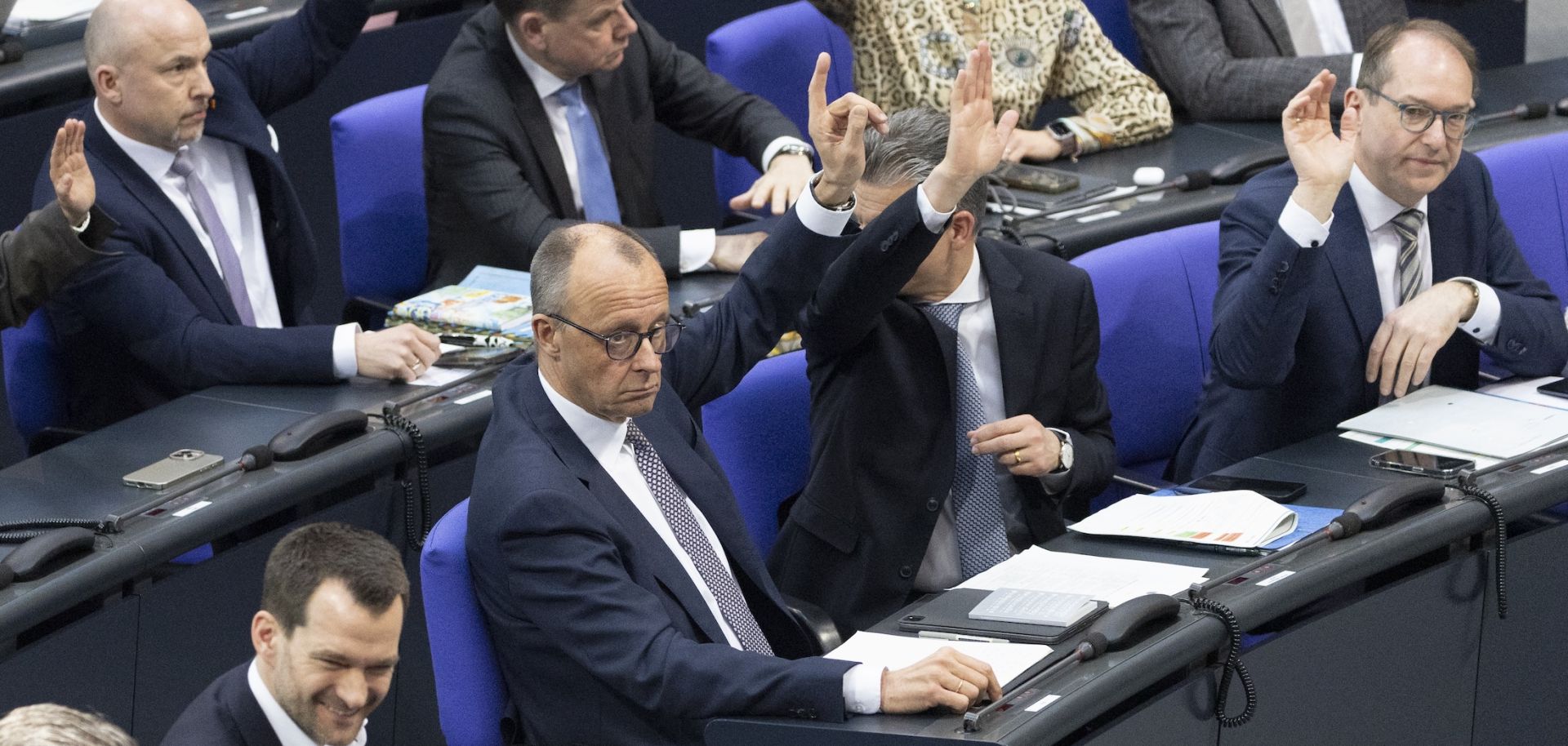
After years of stagnation, the German economy will receive a boost from increased government spending on defense and infrastructure, but a failure to implement flanking structural reform will mean that the boost to medium-term economic growth will be limited. In recent weeks, numerous media reports have cast doubt on German Chancellor Friedrich Merz's ambitious plans to reform the economy. Since taking office in May after forming a coalition with a slim parliamentary majority between his center-right Christian Democratic Union or CDU and the center-left Social Democratic Party or SPD, Merz's government has reformed the constitutionally mandated limits on government deficits and has committed to significant increases in defense expenditure and infrastructure, especially of transport. The new government has also agreed to implement reforms aimed at reducing growth-impeding bureaucratic rules governing product markets and infrastructure investment. However, despite these goals, thus far intra-coalition disagreements have translated into more limited practical results than anticipated. For example, significant welfare reform — needed to maintain long-term financial stability and to increase labor market participation — is only half-heartedly supported by the CDU.
- The CDU-SPD coalition controls 328 out of 630 seats in the Bundestag, where the next elections are not due to be held until March 2029. The coalition does not have a majority in the upper house. Varying coalition governments are in place at the state level. But there is no majority opposing the federal government in the sense that state governments where either the CDU or SPD is part of a coalition will not vote against legislation supported by the lower house. Only legislation that affects the constitution, state finances or shared federal-state administrative responsibilities requires approval by the upper house.
- Real GDP growth has averaged less than 1% per annum over the past decade and was negative in 2023 and 2024, making Germany one of the worst performers globally. Economic output decreased in three out of the past five years due to the exogenous shocks of the COVID-19 pandemic and Ukraine war. The government had limited policy flexibility due to the debt brake that, prior to its revision in March 2025, required the government to run a structural deficit no greater than 0.35% of GDP.
- Constitutional reform of the debt brake now allows for greater fiscal flexibility by exempting spending on defense and security, encompassing intelligence agencies and assistance to Ukraine, exceeding 1% of GDP from the calculation of the 0.35% of GDP deficit limit. As part of the reform, the German government has established a 500 billion euro ($579 billion) fund, of which 100 billion euros will be allocated to mitigating the impact of climate change and funding infrastructure over the next 12 years.
Compared with other industrialized countries the German government is well-positioned to run larger fiscal deficits, even for an extended period of time, without leading to a significant weakening of its financial position. German government debt, which stands at 64% of GDP, remains low by international standards. The IMF projects the government debt-to-GDP ratio to increase by two percentage points a year, with debt reaching 75% of GDP by the end of the decade. This would still place Germany well below average debt in the G-7 and G-20, which stood at around 120% of GDP in 2024 (debt in France, Italy, the United Kingdom and the United States exceeds 100% of GDP). Although Germany, like all other NATO members, has committed to increasing defense and related security expenditure to 5% of GDP by 2035, it is unlikely that Germany or any other government will meet this deadline. Moreover, despite significant warnings that European countries need to prepare for a potential confrontation with Russia in the next decade, Moscow will not be able to sustain defense spending at current levels and its economy is stagnating. This may over the longer term diminish the need to maintain extraordinarily high defense expenditure, allowing for greater budgetary flexibility once Germany has significantly modernized its armed forces. Similarly, infrastructure spending, once the 500 billion euro special infrastructure fund set up in March 2025 to finance infrastructure has been exhausted, will be self-liquidating from a budgetary point of view. The German government will be forced to keep non-defense deficit spending to 0.35% of GDP, which will help limit the size of fiscal deficits over the next few years.
- The IMF projects government pension and healthcare expenditure to each increase by 0.4% of GDP between now and 2030. It estimates the net present value of pension and healthcare expenditure at 13% and 35% of GDP, respectively, meaning Germany, like most other advanced economies, will face significant increases in social welfare spending over the next few decades.
- The government has established a commission to provide proposals on welfare spending reform by 2027, which suggests that the government is not serious about near-term reform. The SPD largely opposes spending-related reform while the CDU is not keen on antagonizing a large share of the electorate by curtailing social welfare spending.
A significant increase in government spending in the next few years will lift short-term economic growth, but the medium-term effect will be limited if the government fails to implement accompanying structural and administrative reform. Increasing government spending will lift the economy in the coming years, meaning it will exit its three-year period of zero growth. Still, 1-1.25% annual growth would be modest at best. Unless the government streamlines bureaucratic rules, increases incentives for labor market participation and implements wider growth-supporting structural reform, the medium-term effect will be limited as simply increasing demand will have limited effects because of bureaucratic and legal rules that impede investment, stifle the labor market and limit entrepreneurship. Significant labor market rigidities and costly bureaucratic rules will dampen the stimulatory effect of higher spending and limit the fiscal multiplier effect. To the extent that increased defense outlays increase demand, this will help lift output, but the multiplier effect of defense spending will also be limited. Finally, the government coalition will also be forced to limit non-defense spending over the next few years to remain compliant with the debt brake. Longer-term non-defense spending will need to be brought under control and this will moderately offset spending increases over the medium term.
- Economic surveys point to a slowly improving outlook from a low base. The ZEW Economic Sentiment Index, a survey-based indicator measuring economic expectations, reached 39.3 in October, up from 37.3 in September, though far from the levels of 50 and above seen in March and July. Moreover, the assessment of current, as opposed to expected, conditions continued to worsen in October with the index declining 3.6 points to -80.
- The IMF projects real GDP growth to average 1% of GDP between 2026 and 2030. The German Ifo Institute, one of the country's largest economic research centers, forecasts real GDP growth of 1.3% next year.
- In September, the government passed its first budget under the new debt rules. The government plans to borrow 174 billion euros, more than triple the previous year's amount. The budget includes 83 billion euros for defense spending (117 billion if spending from the special funds is included). Total defense spending will amount to nearly 3% of GDP next year.
- The coalition government has agreed to pass administrative reforms to reduce regulations and reporting requirements, but whether they can overcome bureaucratic resistance to their implementation remains to be seen. The corporate income tax rate is to be reduced by one percentage point in each of five steps, starting on 1 January 2028, meaning the corporate tax rate will fall from 15% today to 10% by 2032, helping support investment.
Expected significant increases in defense spending over the next few years will lead the German government and German industry to play a leading role in intra-European economic and defense-related cooperation and especially defense-industrial cooperation. Germany currently plans to increase defense expenditure by 70% by 2029 to exceed 160 billion euros, which in the context of expected economic growth and capacity to run deficits will prove sustainable financially. With the mainstream political parties generally supporting higher defense spending, the increase should prove sustainable politically, too. Even if Berlin does not hit this target, the trend toward higher defense expenditure is clear and will create greater incentives for the private sector. German defense companies will benefit greatly from increased spending, which will lead to significant innovation given Germany's large industrial-technological base. Increased defense spending will also benefit Europe's defense-industrial base in terms of demand, planning horizons and investments. Compared to France, Italy and the United Kingdom, Germany will benefit from far greater budgetary flexibility in terms of spending increases, despite the former governments' official commitment to increase defense and security expenditure to 5% of GDP by the middle of the next decade. Germany's financial flexibility will put it in a position to strongly shape future EU and European defense- and defense-related policies. However, it will continue to oppose the issuance of common debt to finance EU defense expenditure, beyond the financial agreements already reached. With Germany taking the lead, however, European initiatives will be more open to cooperation, including production, development and procurement, with non-EU countries.
- The European Union helps finance European defense spending through a variety of financial and non-financial instruments. The European Defense Fund (EDF) provides funding for defense research and development as well as capability development projects, promoting cooperation among EU defense companies. The Security Action for Europe program provides 150 billion euros of "loans for arms" to provide financial assistance to member states for defense investments. Finally, the European Union now also provides greater flexibility under the Stability and Growth Pact by allowing members to activate the National Escape Clause for higher defense spending.
