
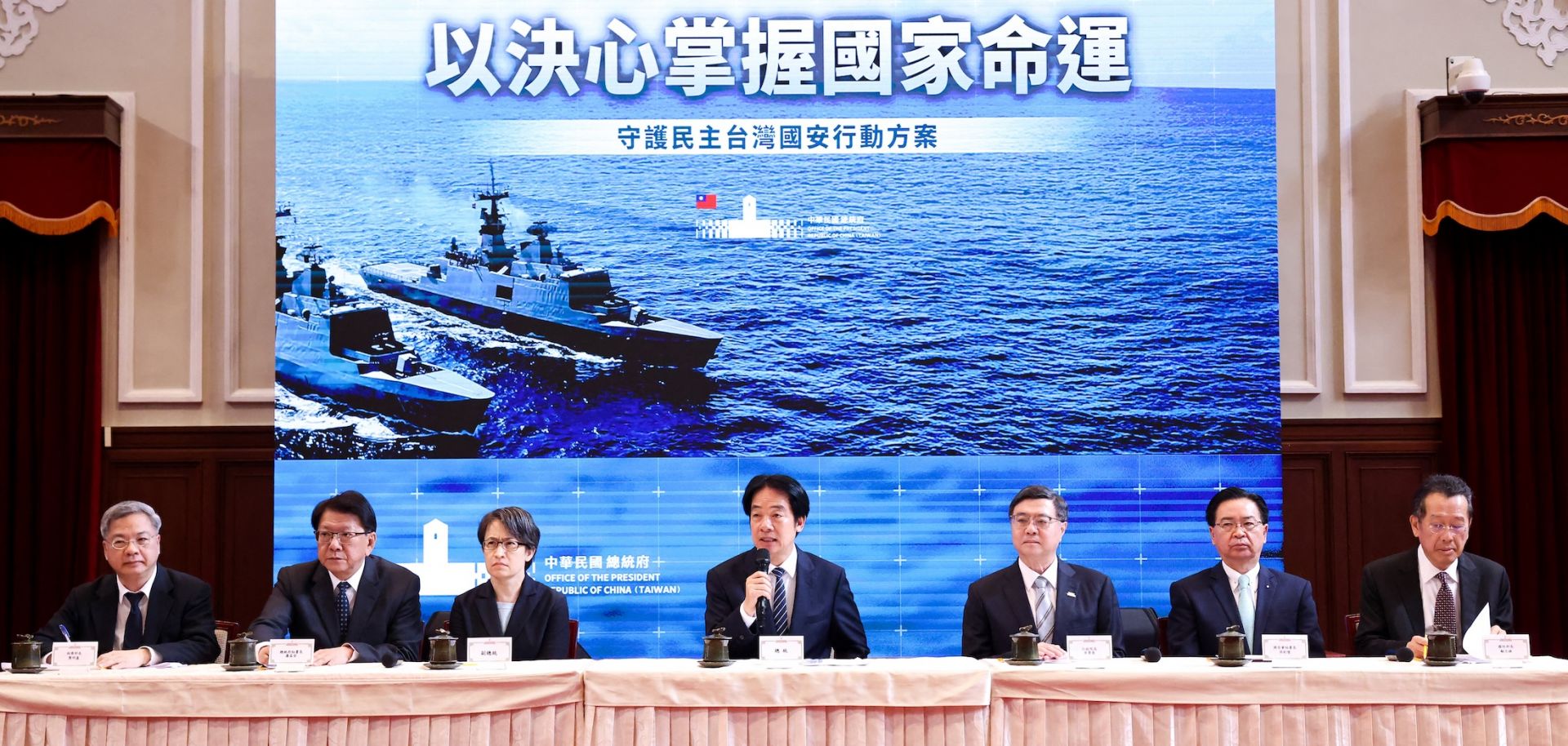
In October, Taiwan's Ministry of National Defense published its biennial National Defense Report (NDR), which describes the state of Taiwan's security environment, as well as the goals for and challenges to developing the island nation's military. Much geopolitical analysis about Taiwan focuses on the motivations and capabilities of the United States and China, given the likelihood that a Chinese attempt to invade Taiwan would bring the two into conflict. This ministerial report, however, provides an opportunity to examine the Taiwanese government's view on the matter, which will inform Taipei's engagement with China and the West during the second half of President William Lai's four-year term, the last two years of Chinese President Xi Jinping's third (but not final) five-year term, the next two years of Donald Trump's unpredictable presidency in the United States — and a period involving 2027, the oft-cited date by which Xi has ordered the Chinese military to have the capability to invade and hold Taiwan, if ordered to do so. This Taiwanese lens is particularly useful in 2025, given Lai's expanded efforts (in word and in deed) to bolster Taiwan's de facto sovereignty claims and international partnerships since he was elected in January 2024. These include his speeches in May and October 2024 and April 2025 that jettisoned rhetorical sensitivities about country naming, contradicted China's historical narratives about Taiwan, and singled China out as a "foreign rival."
The report suggests the Taiwan military's arms procurement and recruitment capabilities are growing to help it deter and defend against a Chinese invasion. But it is still unclear how well Taiwan could coordinate a whole-of-society defense effort, necessitating deeper informal ties with the West and the broadcasting of China's aggressive gray-zone activities to gain Western support. Likewise, Taiwan's ability to deter Chinese aggression shy of an invasion (e.g., a blockade) depends as much on political signals and Lai's willingness to escalate as it does on Taiwan's military capabilities. The upshot is that Taipei is demonstrating growing intent and tactical capabilities but not yet the administrative capacity to carry out a sustained defense. Moreover, perhaps ironically, the signals Taipei is trying to send to Beijing may not be received or interpreted as Taipei intends for them to be. All the while, the risks of conflict are growing.
Growing Western Engagement
Alongside traditionally strong engagement with the United States, Lai has, in his first two years in office, pursued extensive diplomatic outreach, including military outreach, to the rest of the West, where concerns about Chinese threats to maritime and supply chain security have risen. Taiwan's general diplomatic engagement was recently exemplified by Lai's dispatch of former President Tsai Ing-wen (an unofficial envoy) and Vice President Bi-Khim Hsiao to speak at a pro-democracy forum in Berlin and to a pro-Taiwan group of lawmakers at the European Parliament in Brussels in early November. Regarding military diplomacy, the 2025 NDR shows that Taiwan conducted around 630 such military diplomatic activities (e.g., senior leadership talks, joint training, etc.) with the United States in the two years through August 2025, compared to roughly 430 such engagements with all other countries combined during that same period. At the same time, Trump is seemingly downplaying disputes with China over Taiwan in a bid to secure a comprehensive trade deal, as seen in his refusal in public interviews to denounce or respond to China's economic retaliations against Japan since mid-November over new Japanese Prime Minister Sanae Takaichi's Nov. 7 claim that Japan could intervene militarily to stop a Taiwan invasion. Neither this quietude nor Trump's narrow focus on a China trade deal has meaningfully reduced the U.S. defense commitment to Taiwan, as evidenced by the $1 billion in U.S. arms sales to Taiwan announced between Nov. 13-19. But they do underline the importance of tracking how Taiwan approaches fulfilling its own defense strategy during periods of relative U.S. inattention.
The Chinese Threat and Taiwan's Response
Since Taiwan's previous NDR was released in 2023, China's primary means of engaging with Taiwan has been escalating multiple forms of military coercion in a bid to highlight to Taiwanese and Western peoples and governments the potential costs of resisting China's efforts to unify with Taiwan. This coercion includes steadily expanding, daily aerial and naval crossings of the median line in the Taiwan Strait. Similarly, China conducts larger "joint combat patrols" a few times per month, often involving assets from across military branches and newer technologies like drones, as well as incursions closer to Taiwan or in less common areas (e.g., east of Taiwan). Less common still are large-scale Chinese drills once or twice per year that involve hundreds of assets, joint forces, China Coast Guard (CCG) integration, and simulations of various aspects of an invasion or blockade scenario. These include the Joint Sword 2024A/B drills of May and October 2024 and Strait Thunder 2025A drill of April 2025, each a response to the aforementioned speeches by Lai.
Taiwan's 2025 NDR highlights particularly concerning developments from these Chinese military activities, noting that China intends to normalize its military presence around Taiwan, desensitize the West to China's territorial predations, drain Taiwan's limited military budget, and provide a perpetual pretext for rapid escalation to war. Tactically, the report noted particularly concerning aspects of these drills and their implications for security, including: regular fly-overs of Chinese high-altitude surveillance balloons over Taiwan proper that weaken Taiwan's concept of land sovereignty; Chinese drones used to probe Taiwan's early warning systems; Chinese missile strikes against replicas of Taiwan's natural gas storage facilities, hinting at future energy strikes; CCG incursions around the Taiwan's outlying Kinmen Islands that seek to weaken Taiwan's sovereignty around this isolated feature close to China's coast; and China's use of PLA Navy and CCG vessels during large-scale exercises to practice identifying, inspecting and capturing commercial vessels, instrumental for enforcing a blockade.
The rest of the NDR focuses on how best to develop Taiwan's defense posture to preserve its sovereignty, with implications for Taiwan's military readiness, ability to overcome domestic constraints, foreign engagement and efficacy at deterring Chinese aggression. Regarding military readiness, the NDR emphasized the importance of deterrence by denial, also known as "multi-domain denial," which involves preventing China from carrying out a blockade or invasion, as opposed to deterrence by punishment (i.e., striking key mainland Chinese infrastructure). Key aspects of this deterrence include being prepared to wage a war of attrition with a growing share of mobile, low-cost and stealthy asymmetric platforms that enable Taiwan's military to fight a distributed, sustainable war — even if island-wide communications are knocked out, as is likely in the early stages of a Chinese invasion. The NDR's five-year force buildup plan involves acquiring and expanding existing supplies of man-portable Javelin anti-armor and Stinger anti-air missiles systems; road-mobile Sky Bow II/III, PAC-3 and NASAMS air defense systems; road-mobile Hsiung Feng II/III surface-to-surface missile systems; road-mobile HIMARS rocket artillery systems; and Chien Hsiang loitering munition UAVs. More broadly, it envisions acquiring 5,000 units from among 13 classes of military drones by 2028, versus a current stockpile of 1,600. Traditional systems remain a key component of defense, too, partly a legacy of decade-long procurement pipelines (e.g., U.S. M1A2T Abrams battle tanks) and partly out of necessity, including ship-based Phalanx close-in anti-missile systems and Harpoon anti-ship missile systems, and Taiwan's first indigenous diesel-electric attack submarine, currently undergoing sea trials.
Local Constraints
The NDR also highlighted, however, that Taiwan's budget for acquiring these military systems in 2025 was around $4.42 billion (29% of the total defense budget), with around half of that portion allocated for domestic production and half for foreign (U.S.) procurement. Thus, Taiwan's five-year arms wish list far outstrips its budget; for instance, one PAC-3 missile battery is roughly $1 billion. This means effective implementation will depend upon how rapidly Taiwan can switch to mobile, domestic and distributable systems, and on how quickly Taiwan can achieve Lai's goal of raising defense spending from 2.36% of GDP in 2025 to 5% in 2030. Lacking additional funding, and given the slow pace of U.S. deliveries and Taiwan's lack of alternative arms suppliers, many of these goals would likely remain incomplete. However, Lai revealed on Nov. 26 in a Washington Post op-ed that he planned to propose a $40 billion supplemental defense budget to fund foreign arms acquisitions and domestic arms production in the coming years (at an estimated pace of $5 billion annually), which if realized would help close this gap between defense ambitions and reality by effectively doubling the military's arms procurement budget.
Legislative opposition and societal preparedness will impede these goals as laid out in the NDR, although U.S. pressure may help alleviate the former. Taiwan's budget goal of more than doubling defense spending in five years will require legislative support, but the political opposition — including the long-standing, relatively pro-China Kuomintang (KMT) party and the new Taiwan People's Party (TPP), which bills itself as a centrist party between the KMT and the Lai's Democratic Progressive Party (DPP) – holds a majority in the legislature. That opposition has shown a propensity for cuts with its 2025 budget adjustments, including a record 6.6% cut from the executive branch's proposal for the national budget and the freezing of some funding, pending progress checkpoints, of defense procurement projects like the indigenous submarine program. Lai has already proposed a defense budget of 3.32% of GDP for 2026, but the legislature has yet to approve it. Nonetheless, Lai's Nov. 26 op-ed was meant to show Washington that Taipei is aligning with U.S. requests for Taiwan to rapidly scale up defense spending, garner U.S. support by pitching large-scale U.S. arms purchases, and put pressure on the KMT to pass the supplemental budget despite the party's skepticism. Thus, though Lai will have to continually fight with the legislature to pass defense spending over the next few years, he may be able to leverage U.S. pressure to weaken KMT legislative obstructionism.
The NDR laid out plans to bolster Urban Resilience exercises aimed at training citizens and organizing civil-military efforts at infrastructure protection, shelter provision and rationing. It also emphasized building "whole-of-society resilience" to various disasters, including natural disasters, partly by distributing new disaster response pamphlets to the public. This author's engagement with leading civil society mobilization groups in Taiwan, however, suggests Taiwan's military jealously guards its monopoly on efforts to ready society to respond to martial contingencies and remains hesitant to support wide-scale efforts to arm citizens, beyond the national conscription program. As understandable as this may be, given every government's imperative to maintain internal order, it also limits the ability of Taiwanese citizens to ready themselves for conflict by bottlenecking such efforts to what the military has the time and budget to organize. This is a luxury Taiwan may not have, given that the NDR expects Taiwan to experience "whole-of-society" conflict in the event of a Chinese invasion, as exemplified in the aforementioned NDR remarks about China's simulated strikes on Taiwan's gas storage facilities.
Espionage and the talent pipeline are also military constraints. The NDR highlights the need to implement Lai's goal of reviving Taiwan's military trial system to strictly punish espionage, following high-profile scandals about staffers in Lai's office and senior military officials being on Beijing's payroll. Somewhat relatedly, insofar as Taipei can insulate itself from Chinese bribery and expand the military's ranks, Taiwan has tried to improve conditions for soldiers. This includes giving conscripts a minimum wage and voluntary soldiers an additional $1,000 monthly stipend, as well as improving living quarters and relaxing requirements for paid time off and duty check-ins. This led the defense ministry to declare in late October that it had exceeded its recruitment goal for the first nine months of 2025 by 9%, reaching 13,030 new voluntary troops, and that it had recruited 1,687 cadets (officers in training), surpassing its goal by 14%. China's recruitment numbers are likely optimistic, but they nonetheless dwarf Taiwan's, with China's Central Military Commission (CMC) noting in its annual recruitment plans that it had surpassed "99%" of its goal of recruiting over 17,000 high-school graduates to military academies (officers' programs) in 2023 and in 2024. This CMC figure shows the order of magnitude difference in China's officer recruitment capabilities over Taiwan. At a tactical level, the NDR noted that Taiwan's military in July began offering additional pay for high-skilled duties, like cyber warfare, electronic surveillance and air traffic control, suggesting talent acquisition and retention difficulties but also Taiwanese plans to address these issues.
Foreign Implications
Taken together, the picture that the NDR paints — one of Taiwan making progress on recruitment and developing the defense industrial base but also facing budgetary, legislative and civilian readiness constraints, as well as the unavoidable issue of scale relative to China's military — informs Taiwan's foreign policy in the coming years. The government will likely seek to build out Taiwan's civilian-military supply chain for producing low-cost, asymmetric platforms like mobile aerial defense systems and surveillance and strike drones. To do so, and given domestic political budget constraints, Taipei will seek to expand trade ties with the West and Western allies (like Japan and South Korea) to procure parts and intellectual property (e.g., licensing for drone engines) that fall short of arms sales, as no other nation besides the United States is willing to sell arms to Taiwan. In particular, Taipei will seek to deepen trade ties with Japan, with which Taiwan has close historical and political ties. But Japan's restrictive laws surrounding defense technology exports will constrain the pace of this engagement, even as new Prime Minister Takaichi tries to amend those laws. Still, China's ability to shut those same foreign suppliers out of the Chinese drone market will limit Taiwan's supply chain options.
Taiwan will also expand Western university exchange and Mandarin language programs, as well as efforts like its golden visa and expedited Taiwan residency programs, to attract foreign labor to build out domestic defense industrial supply chains and deepen civil society ties to Western nations most likely to support Taiwan economically and militarily. Complementary to these civilian exchanges, Taiwan will expand diplomatic engagements with the West — like the vice president's November visit to Brussels — as quickly as Western nations will allow. However, the aforementioned Western hesitance to sell arms to Taiwan, which risks sinking relations with China, as well as China's recent economic retaliations against Japan for Takaichi's suggestion that Japan could intervene to stop a Chinese invasion of Taiwan, shows the high costs for Western reciprocation of Taiwan's entreaties, and will thus likely slow the pace of such reciprocation.
Given the difficulty of matching China's military scale directly, Taiwan is likely to focus on broadcasting China's military incursions around the main island and the Kinmen Islands to Western audiences. This will allow Taipei to highlight the urgency of the Chinese threat to Taiwan's sovereignty, and it will hasten the willingness of Western legislators, like European lawmakers, to meet with Taiwanese officials, eroding Taiwan's diplomatic isolation and highlighting to Beijing the economic costs (e.g., via sanctions) of invasion. By contrast, the first two years of Lai's presidency have shown Taiwan's military to be cautious about directly confronting China's navy, coast guard and maritime militia in their daily, monthly and yearly drills (e.g., by attempting to expel, shoot at or detain Chinese armed personnel), lest Taiwan give China a casus belli. This trend is unlikely to change unless China markedly escalates its drills by directly impeding commercial, civilian or military operations between Taiwanese islands, such as via vessel or personnel detentions or ship rammings. For now, however, China too seems unwilling to normalize such disruptive activity (as opposed to its current mostly demonstrative activities), lest it give the West sufficient reason to rapidly expand economic retaliation against China for its threats to key global shipping lanes or to significantly step up direct military aid to Taiwan.
Can Taiwan Stop a Chinese Invasion or Shy-of-War Escalation?
Despite constraints, Taiwan's capacities are growing, including its arsenal of weapons to monitor Chinese threats, deter first strikes and carry out deterrence by denial, all the more if Lai's massive supplemental defense budget is passed. Likewise, military recruitment and civil society readiness programs are accelerating, if at uneven paces. Taiwan is also steadily transitioning from its old addiction to high-value platforms with narrowly scoped use cases (e.g., main battle tanks) to cheaper, multi-use, distributable platforms more suitable for a Taiwan contingency in the era of drone-saturated wars. These developments will facilitate Taiwan's deterrence by denial strategy by raising the perceived costs for Beijing of attempting an invasion — in terms of money, arms, life and global reputation. Yet Taiwan's main security dilemma remains the same as China's: it is untested in modern conflict, no less in an all-of-society defense effort.
Following the first stage of a Chinese invasion — like a swarm missile attack, a cyberattack that knocks out island-wide communications, or an energy blockade — it is unclear whether all the moving parts of Taiwan's defense strategy can work in sync. If Lai can successfully accelerate defense procurement funding, it would provide the Taiwanese military units with the tools to carry out decentralized defensive missions. But coordination questions remain. Can Taiwanese military units designate and defend second-tier, high-value assets (HVAs) without coordination from Taipei, assuming first-tier HVAs are destroyed in an initial Chinese salvo? Can citizens coordinate aid and maintain civilian infrastructure without panic or a rush to stockpile goods that exacerbate shortages?
If Taiwan expands the scope and realism of drills focused on the second stage of battle (i.e., assuming coastal defense has failed), this would entail that genuine readiness is improving. Such drills would include military exercises with limited communications and small-scale (battalion or company) units acquiring and intercepting targets, as well as fending off randomized enemy threats on a short timeline (e.g., within 24 hours). It would also involve randomized disaster simulations with minimal government communication (e.g., emergency radio) to test civilian responsiveness and pressure test the Urban Resilience programs.
Taiwan's growing capabilities serve as deterrence signaling to China, but it is unclear how much Beijing is listening to these signals. China's military is undergoing another round of purges of high-level officials, with the administrative and political heads of almost every military branch ousted in the last year. And President Xi's circle of trusted political allies seems increasingly small, limited to the likes of fellow septuagenarians Foreign Minister Wang Yi and director of the Chinese Communist Party General Office Cai Qi. Thus, the military and political briefings reaching Xi's ears are increasingly subject to confirmation bias and hyper-politicization. Taiwanese deterrence signaling may be less of a factor in Beijing's calculations than the 72-year-old Xi's own mortality and his framing of unification with Taiwan as a precondition for China's national rejuvenation to great power status, a goal for which Xi has posited himself as the sole capable helmsman. Chinese foreign ministry rhetoric and retaliatory military drills in recent years have indicated that what is now more concerning to Beijing than Taiwan's military capabilities is political signaling, including pro-sovereignty speeches by Lai and signs that Taiwan's diplomatic isolation is weakening (e.g., then-U.S. House Speaker Nancy Pelosi's August 2022 meeting with Taiwan's then-president Tsai Ing-wen). Thus, Taiwan's ability to prevent Chinese escalation shy of war seems to be driven just as much by political signals as by military deterrence.
To that end, Taiwan's ability to militarily stop the most likely shy-of-war Chinese action, a blockade, seems to be driven not only by capabilities and readiness, but also by Taipei's willingness to escalate. In the case of a blockade, this entails Taiwan's military and coast guard directly intervening to prevent the CCG from enforcing the blockade. Though Taiwan's military under Lai has elevated its monitoring activities, particularly its video documenting of CCG and fishing fleet grayzone activities, it has exhibited a clear aversion to kinetic action (e.g., shots fired). This aversion is partly to maintain Taiwan's image in the West as the victim and not as the aggressor in Taiwan Strait affairs, but also to avoid giving China an excuse for escalation under the guise of protecting Chinese citizens. For now, it seems this dynamic would likely hold in a blockade as well, with Taipei eager to break a blockade by escorting commercial vessels but hesitant to interfere kinetically — i.e., in the event China physically interdicts such escorts — lest China elevate to a hot conflict. Nonetheless, Lai's appetite for intervention in new disputes over undersea cables, along with CCG incursions around the Kinmen Islands and Chinese air or sea crossings into Taiwan's 24-mile contiguous zone or 12-mile territorial zone during major PLA drills in the last two years of his presidency, will inform Beijing's willingness to escalate and its perception of the risk that a blockade would escalate (perhaps unintentionally) to all-out war.
The Rising Risk of War
Amid this context, the risk of a war in the Taiwan Strait is low but will continually rise through at least the end of Lai's first term in May 2028. This rising risk is driven by: Beijing's growing military drills aimed at perfecting blockade and invasion capabilities; Xi's aging and winnowing of his cohort of trusted advisors; the growing need in Beijing and Taipei to demonstrate deterrence and warfighting capabilities; and Lai's pro-sovereignty rhetoric and efforts to strengthen Western partnerships, which to Beijing risk further internationalizing the "Taiwan issue," as evidenced by Japanese leader Takaichi's November comments about military intervention. Moreover, as both sides prepare for war, the escalation ladder between Chinese gray zone activities and kinetic action in the Taiwan Strait is shortening, portending sudden incidents (for instance, those that cause maritime deaths) that are neither the intention of Beijing nor Taipei but that nonetheless move the two closer to war and galvanize Western- and Chinese-aligned defense blocs.
