
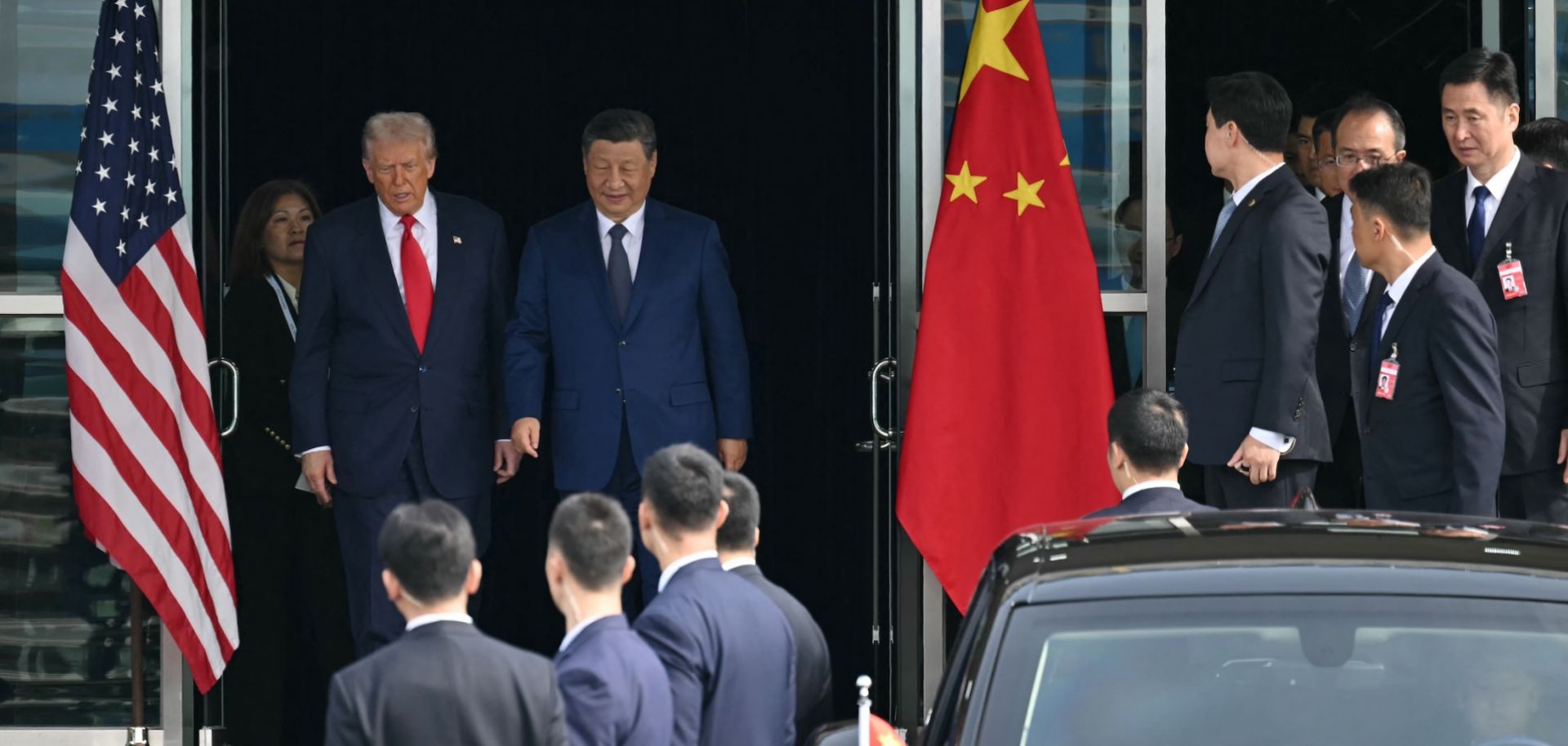
The U.S.-China talks in South Korea produced a framework deal favorable to China, with future trade war escalations likely over the next year as Washington and Beijing seek to enforce their own interpretations of the new measures. On Oct. 30, U.S. President Donald Trump met with Chinese President Xi Jinping to discuss trade matters in Busan, South Korea. They announced that the United States will reduce its 20% fentanyl tariff on China to 10%, in exchange for Chinese cooperation on curbing the flow of fentanyl precursor exports. The United States will also forgo its previously threatened 100% additional tariff on China, and has agreed to pause its Section 301 investigation into Chinese shipping, which presumably includes suspending hefty U.S. fees on China-built, -operated or -owned vessels. The U.S. Commerce Department's decision to target all majority-owned subsidiaries of Entity List companies will be suspended for one year as well. China, for its part, agreed to resume purchases of U.S. soybeans, suspend its expanded extraterritorial rare earth export curbs for a year and reexamine them thereafter, and to work with the United States to ''properly resolve'' the issue surrounding the forced Chinese divestment from short-form video application TikTok. Additionally, Trump claimed China had agreed to begin purchasing U.S. energy products, including from Alaska, pending discussions between the countries' energy teams, though China has yet to confirm this. The two sides also agreed to extend their suspension of 24% reciprocal tariffs (on top of the U.S. 10% baseline tariff) for one year beyond the Nov. 10 expiration date.
- Trump also agreed to visit Xi in China in April, while Washington claims Xi agreed to a U.S. visit as well, with timing unclear.
- U.S. Treasury Secretary Scott Bessent claimed on Oct. 30 that China agreed to purchase 12 million tons of U.S. soybeans in 2025, with an additional 25 million tons to be bought annually for the next three years.
These talks follow a tumultuous year of new tariffs and export restrictions, which produced an uneasy truce in May that has repeatedly been tested by escalatory actions on both sides. Just weeks after returning to the White House in January, Trump reignited trade tensions with China on Feb. 1, when he announced a decision to add a 10% tariff on U.S. imports of Chinese goods, citing China's role in the U.S. fentanyl crisis. In the months after, China added a new licensing regime on its exports of key rare earth elements, disrupting supplies of inputs for countless global industrial goods. Meanwhile, new U.S. tariffs ballooned to 145% and Chinese tariffs rose to 125%. These escalations drove Washington and Beijing to agree on May 12 to temporarily reduce new tariffs (to 30% on China, 10% on the United States) and to ''suspend'' China's rare earth curbs since April. In the following months, the two sides attempted to flesh out this informal agreement, but new U.S. export curbs on technologies, including high-end chips and related technologies, continued to strain their uneasy trade ceasefire, with the May 12 tariff truce set to expire on Nov. 10. Between August and early October, the United States announced several new or expanded export controls, while China made no new purchases of U.S. soybeans for the fall harvest season, raising concerns in Washington about the potential need to bail out American farmers. As a result of U.S. policies, China announced on Oct. 9 that it was expanding its rare earth export licensing regime to be extraterritorial in scope, requiring an application for any overseas producer that aimed to export a good for which at least 0.1% of its value was derived from Chinese rare earth inputs. The following day, Trump retaliated by threatening 100% tariffs on Chinese goods and export curbs on U.S. critical software. These latest moves risked scuttling the long-planned Xi-Trump summit in South Korea, but the Oct. 30 meeting ultimately proceeded as scheduled due to a mutual desire to de-escalate and preempt the looming economic and industrial impacts on both countries.
The new deal favors China by increasing its export competitiveness in exchange for relatively limited concessions, highlighting Beijing's current leverage in the trade war. But future escalations are likely, whether in response to new export curbs or perceived violations of the deal by either side, which will keep business uncertainty high. China's vague promise to cooperate on fentanyl precursors — something Beijing has promised in the past — is a seemingly significant concession from the Trump administration, which in April had made tariff relief contingent on Chinese action that extended beyond merely curbing precursors, including pursuing criminal charges against fentanyl producers. The new level of U.S. tariffs, totaling 20% since January 2025 (10% for fentanyl and 10% for the baseline), also now puts Chinese goods on par with most Southeast Asian goods in terms of new U.S. tariffs, improving China's export competitiveness; the potential suspension of U.S. shipping fees would further facilitate Chinese exports as well. The rare earth deal marks another concession from the U.S. trade team, which had been demanding that China cancel, not suspend, its Oct. 9 rare earth restrictions. This demand was made partly due to the fact that China's May agreement to ''suspend'' its April 2025 rare earth export restrictions has not kept Beijing from severely limiting such exports to the U.S. defense industry. And given the Oct. 9 restrictions included a clause banning exports to foreign defense applications, China will likely continue to restrict rare earth flows to the U.S. defense industry, regardless of the deal. Beijing's failure to sufficiently cooperate on issues important to the White House will probably result in new U.S. tariffs over the next year, as the political pressures surrounding the U.S. midterm elections in November 2026 drive Trump to prove he secured a favorable deal with China. As happened after the May truce, the United States will likely continue to impose national security-related trade restrictions on China, which Beijing will likely respond to with further export curbs. This potential for future escalation will sustain a high level of business uncertainty regarding the costs and benefits of engaging in trade or investment with the United States or China. Ongoing concerns over U.S. Entity List restrictions and Chinese rare earth curbs will also elevate perceived compliance risks for businesses that engage with third countries with industrial links to either global power.
- Assuming Trump's assertion is true, China's agreement to purchase more U.S. energy products is also vague and may become a source of future trade tensions, though both sides will likely publish follow-up details in the coming days.
- On Oct. 30, the same day as the Xi-Trump talks, China's commerce ministry announced plans to institute application requirements for state-owned companies exporting tungsten, antimony and silver — demonstrating China's propensity for new export curbs.
