
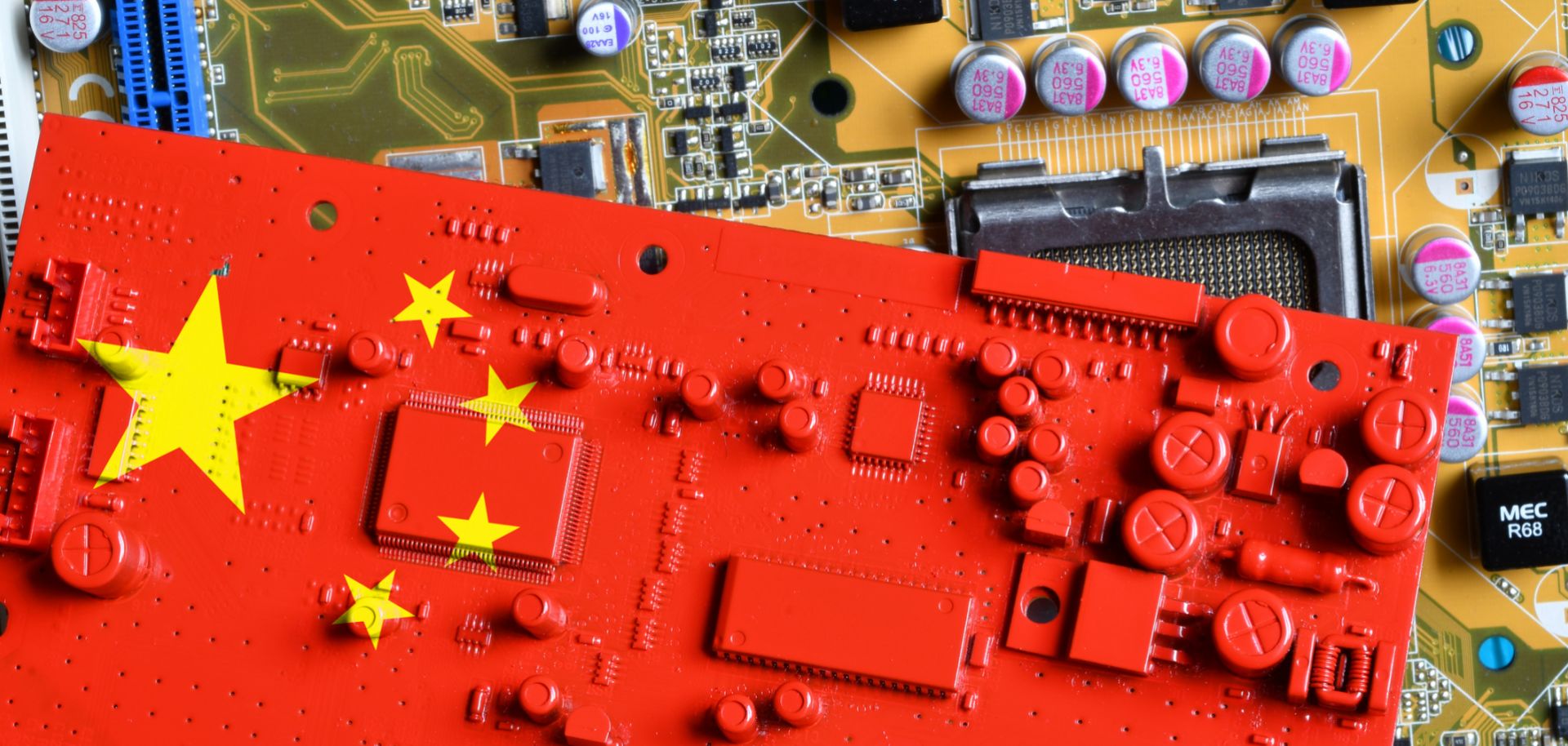
Although still plagued by a handful of technological bottlenecks and scalability constraints, China's domestic AI software and semiconductor supply chain is growing in sophistication, giving China confidence to take more aggressive action against Western technology companies. On Sept. 15, China's antitrust regulator, the State Administration for Market Regulation, said American semiconductor giant Nvidia had violated the country's anti-monopoly law in relation to its 2020 acquisition of Israeli-American networking product company Mellanox. Later that week, Chinese authorities reportedly pressed Chinese companies to halt testing and placing orders for Nvidia's RTX Pro 6000D graphics processing units, one of the lower-performance chips Nvidia designed for the Chinese market to comply with U.S. export controls. These moves came alongside several recent steps forward for China's overall semiconductor supply chain. The Financial Times reported Sept. 17 that China's Semiconductor Manufacturing International Corp., or SMIC, had recently begun testing a deep ultraviolet immersion lithography machine developed by startup Shanghai Yuliangsheng Technology Co. that could eventually be used to develop 5-nanometer or 7-nanometer chips. Currently, China's access to deep ultraviolet immersion tools — produced only by the Netherlands' ASML — is limited by U.S. and Dutch export controls. Separately, Chinese media reported the week of Sept. 15 that Alibaba reached a deal with China Unicom to deploy its T-Head, or Pingtouge, AI accelerators to its data centers, a significant vote of confidence in Alibaba's AI chip capabilities. Finally, Huawei unveiled on Sept. 18 a number of new AI-focused products, including a plan to use its own high-memory bandwidth chips in AI accelerators, as part of its long-term chip strategy.
- Nvidia has spent months under the microscope of U.S. and Chinese regulators, with both sides taking steps against the company over national security concerns amid their ongoing tech competition. China has been aiming to limit the domestic use of Nvidia's chips over concerns about becoming too reliant on Western technology, and the United States has been trying to limit the export of Nvidia's most advanced technology to constrain the development of China's AI and technology sectors.
- In recent months, multiple reports have found that Chinese companies have questioned the value of Nvidia's high-priced RTX Pro 6000D GPU, with some reports suggesting that its performance in AI-related applications has fallen behind that of Nvidia's RTX 5090 GPU, a cheaper chip that Nvidia is technically not allowed to sell in China but is still being sent to China via the black market.
- On Sept. 13, China's Ministry of Commerce also opened up an investigation into U.S. trade and export control policy and whether or not it discriminates against Chinese chipmakers. The ministry also launched an anti-dumping investigation into the import of less advanced analog chips.
China's restrictions on Nvidia and the successes that Chinese tech companies have had in recent days demonstrate China's growing confidence in its domestic AI supply chain, even if, on a purely performance basis, international alternatives are still often better. For more than a decade, China has spent hundreds of billions of dollars in subsidies and other financial support mechanisms as part of its Made in China 2025 initiative launched in 2015. Until recently, however, Chinese companies have largely preferred to use foreign, rather than Chinese, semiconductors in high-end applications, as Chinese domestic semiconductor producers like SMIC remain behind international peers, such as Intel, Samsung, SK Hynix and TSMC. However, that gap has closed and, as U.S. export controls on high-end AI chips produced outside China limit their availability inside China, Chinese homegrown rivals have been forced to create chips that are more comparable to those being built and sold by foreign companies. Moreover, China is growing increasingly concerned about relying on foreign chips as Chinese companies build out data centers and AI capacity. These concerns are accelerating Beijing's drive to accept more homegrown chips since they are not at risk of being disrupted by U.S. export controls, as happened from April to August with Nvidia's H20 AI accelerator.
- In 2024, China's state banks invested $47.5 billion in a new fund to pursue investments in the semiconductor sector.
- China's Huawei Technologies' most advanced Ascend AI accelerators perform well in several areas compared with Nvidia's H20 AI chips designed for the Chinese market, particularly in computational power, where they outperform the H20.
Despite China's growing confidence in its domestic industry, there are still several technological and capacity chokepoints, including China's ability to manufacture high-performance memory chips, develop an ecosystem comparable to Nvidia's and produce chipmaking gear. Although SMIC is starting to test a homegrown deep ultraviolet immersion tool, that tool can only be used to manufacture 5-nanometer and 7-nanometer chips. These chips are more advanced than those SMIC produces today, but they still fall behind the 3-nanometer and 2-nanometer families that Intel, Samsung and TSMC are developing using more advanced extreme ultraviolet lithography machines that only ASML produces, and China is unlikely to be able to build such machines domestically for years to come. Even the deep ultraviolet immersion lithography machine that SMIC is testing is expected to take more than a year to ramp up and, given that it is an unproven piece of technology domestically produced by a three-year-old startup, the tool may run into technological and performance issues. Additionally, the developer, Yuliangsheng, would need to scale up its production of the machines to meet growing capacity demand for more chips, further delaying China's ability to produce advanced chips at scale. Moreover, compared with international peers like SK Hynix, Samsung and Micron, Chinese companies have not had the same level of success thus far in building high-bandwidth memory stacks, which are combined with processors on AI accelerators. While Huawei's Ascend chips, for example, match Nvidia's H20 in total computing performance, the H20 outperforms in memory bandwidth due to its ability to utilize better-performing high-bandwidth memory chips. Furthermore, none of China's domestic chip designers or manufacturers, including Huawei, Alibaba, SMIC and others like Biren Technology or Cambricon Technologies, has built up an entire ecosystem of technologies surrounding their chip families like Nvidia, which has been perfecting its proprietary CUDA parallel computing platform for nearly two decades. China's alternatives are all relatively new, less mature software ecosystems, with more bugs and less optimization — particularly for large-scale training of AI models. Finally, China is also reportedly dealing with capacity constraints in building the most advanced AI chips due to Western export controls limiting deep ultraviolet machines and other chipmaking tools, constraining China's ability to scale up and produce domestic chips at the same scale as foreign counterparts. Though SMIC aims to triple its output of 7-nanometer chips in 2026 as more capacity comes online, this new capacity will leverage deep ultraviolet machines acquired from ASML before export controls tightened in 2024.
- In June, a U.S. official estimated in a congressional hearing that Huawei is likely only capable of producing around 200,000 advanced AI chips in 2025 due to manufacturing constraints.
Even modest success in developing and deploying homegrown technologies will help China push back against the use of U.S. technology and enable Chinese AI developers to match the progress made by U.S. rivals. Over the last year, Chinese AI companies have released AI models that perform well compared with models developed by the United States, despite not having the same level of access to advanced chips. Earlier in September, for example, TikTok developer ByteDance released its Seedream 4.0 text-to-image model, and it is currently outperforming all other image generation models on crowdsourced AI model comparison site LMArena, including Google's "Nano Banana" AI image generator that went viral after its release in August. Similarly, DeepSeek's AI models are near the top of rankings for web development and code piloting, and DeepSeek published the first peer-reviewed methodology paper for a large language model in Nature on Sept. 17, in what is likely to be a landmark paper due to its novel findings. The facts that Chinese AI applications are succeeding in the current market and that China's chip manufacturing capabilities are progressing — especially as more capacity comes online for SMIC in 2026 — mean China has far more room to push its domestic companies away from Nvidia and other Western chipmakers to domestic counterparts, giving it more freedom to pursue other objectives in talks with the United States, such as on more important chokepoints in its AI and semiconductor supply chain, like high-bandwidth memory chips. It also reduces the United States' ability to use technology controls as a pressure tactic against China or to degrade its ability to compete in AI, defense and other tech using advanced semiconductors. Moreover, as China relies less on foreign technology, it is also increasing revenue for domestic companies to invest in research and development. This investment could help Chinese companies close technological gaps with the West, particularly in areas where they are trying to design around — not design out — restricted technologies, as design-around innovations can effectively push Chinese companies to the forefront of innovation in some areas if they are successful. Nevertheless, the United States will likely counter China's efforts with aggressive policies targeting these intermediate areas — not fully finished chips — due to U.S. concerns that approving exports of high-bandwidth memory chips or relaxing controls on semiconductor manufacturing equipment will only lead China's domestic chipmaking industry to improve more rapidly.
