
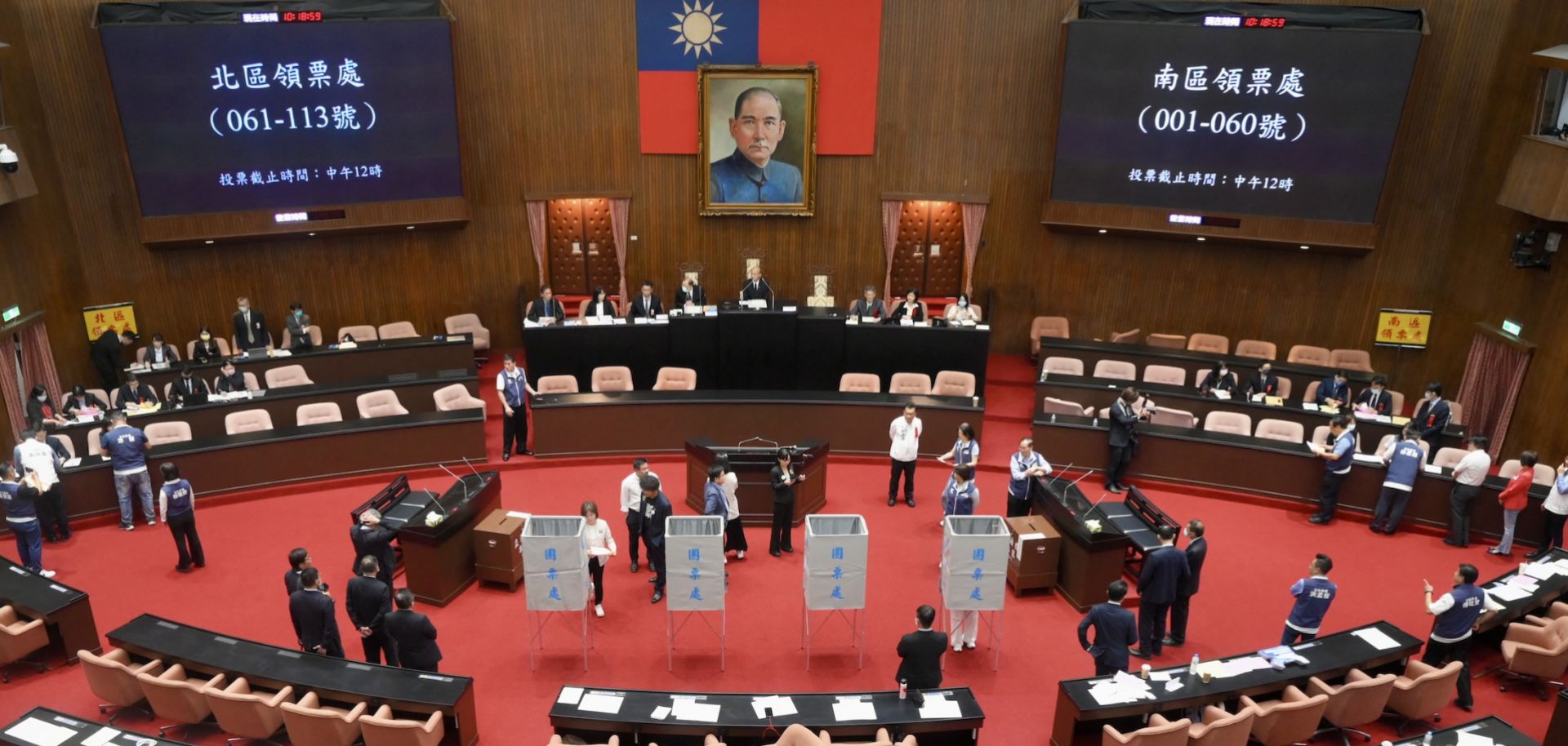
Political infighting since President William Lai's inauguration has impeded Taiwan's efforts to bolster military spending and has prompted Chinese military and economic retaliation. Going forward, this dysfunction will imperil the fulfillment of U.S.-Taiwan trade and arms deals. May 20 marked one year in office for Taiwanese President William Lai of the center-left Democratic Progressive Party, or DPP. Four months before his May 2024 inauguration, RANE forecasted that the results of the January 2024 general election — which secured Lai's presidency but also put the conservative Kuomintang and center-right Taiwan People's Party in charge of the legislature — would bring about tortuous policymaking and institutional obstacles. Reality has been even more dysfunctional than projected. The opposition has attempted to erode the separation of powers in favor of the legislature, threatening a constitutional crisis for the nation's top court, and pushed through a budget with historic cuts aimed at hobbling the implementation of President Lai's agenda through the Executive Yuan (the executive branch) and the foreign ministry. Moreover, the opposition has threatened to table a no-confidence vote against Premier Cho Jung-tai now that the mandatory one-year waiting period for such votes has elapsed.
- In May 2024, the legislative opposition passed reforms that empowered the legislature to call in the president, other government or military officials, and even citizens and companies for mandatory legislative questioning, with criminal liability for contempt. This drew over 100,000 protesters in downtown Taipei as a wide array of citizens (not just DPP supporters) decried an erosion of Taiwan's democracy. In July 2024, at the request of the president and DPP lawmakers, the Constitutional Court filed an injunction against the reforms, and in October it overturned most of those reforms.
- In December 2024, the KMT and TPP passed reforms that required at least 10 out of 15 justices on the Constitutional Court to hear a case (previously, there was no minimum), and it required the agreement of at least nine justices (previously, a simple majority) to rule something unconstitutional. These reforms passed at a time when the Constitutional Court only had eight justices (after seven retired in October) and as KMT and TPP lawmakers were refusing to confirm the appointments of new justices nominated by Lai. Thus, they risked making the nation's top court defunct. On May 16, 2025, the court voted to review the constitutionality of these reforms, in response to a DPP petition.
- In January 2025, the KMT and TPP passed a NT2.92 trillion ($97 billion) budget, 6.7% less than the NT3.13 trillion budget the Executive Yuan proposed in August 2024. This marked by far the largest cut to the Executive Yuan's budget proposal in the legislature's history. At just 2.4% larger than last year's budget, it also marks the lowest annual budget increase in at least 25 years and a growth rate lower than Taiwan's 4.3% GDP growth in 2024. These cuts included a 70% cut in the Executive Yuan's operating budget, a freeze of 50% of the foreign ministry's operating budget, pending legislative review, and a 1.3% cut and 14% freeze of the proposed defense budget of $19.7 billion.
- The KMT and TPP could, without any DPP support, pass a vote of no confidence against Premier Cho, resulting in Cho's removal. However, this decision would also permit President Lai to call an early election for the Legislative Yuan, if he so chose.
In response to the opposition's legislative offensives, Lai and the DPP have retaliated with legislative recalls, local government subsidy cuts and curbs on KMT ties to China. In March 2025, the founder of Taiwanese chip giant UMC, Robert Tsao, and various DPP-friendly civic groups initiated the "Great Recall," targeting 34 of the KMT's 39 directly elected lawmakers with recall petitions, after DPP caucus whip Ker Chien-ming called for such a campaign in January 2025. As of May 23, 30 of the recall campaigns have successfully passed the second stage (obtaining signatures from 10% of eligible voters) and will go on to the third and final stage of a recall vote. On May 22, the Executive Yuan under Lai announced that it planned to cut subsidies to local governments by 25%, asserting that it had few other options to reduce the negative impacts of the legislature's budget cuts on national security, diplomacy and education. In response to the KMT's backchannel diplomacy channels with China, Lai in March 2025 laid out a 17-point plan to curtail Chinese influence in Taiwan, including requiring public officials to register their engagements with China and auditing Chinese connections to Taiwan's sociocultural institutions, like its massive network of religious temples, which are well-known for organizing voting and funding campaigns for the KMT.
- In Taiwan, recalling a legislator is a three-step process. The first step involves gathering physical signatures from 1% of the electorate testifying that they support the recall. The second step requires signatures from 10% of the electorate. The third and final step is a vote on whether to recall the legislator, for which more participants must vote "yes" than "no," and for which at least 25% of eligible voters must vote "yes." If the legislator is recalled, there will be an election to replace the legislator within 60 days.
- The Great Recall is of an extraordinary scale, given that only a handful of recall initiatives in the legislature's history have reached the final voting stage, and only one has been successful, against Chen Po-wei from the Taiwan Statebuilding Party in 2021. Moreover, most recall campaigns occur against individual lawmakers, not in batches.
- The Executive Yuan's local government subsidy cuts are likely at least partially aimed at reducing funding for KMT politicians, as the party is traditionally dominant in local elections due to its widespread funding networks. To wit, the KMT won 14 out of 22 mayoral seats in Taiwan's most recent local elections in 2022, with the DPP winning just five. That balance was 15 to six, respectively, in the previous local election in 2018.
Risk of Protests in Taiwan
The Taiwanese public has expressed strong concern over the KMT and TPP's legislative actions, particularly the reforms passed in May 2024, which sparked weeks of protests involving over 100,000 people outside the legislature in Taipei, including many non-DPP voters. While protests are not uncommon in Taiwan's vibrant democracy, demonstrations of this scale are rare. Major unrest typically arises when the government appears to bypass opposition or public input, as in the 2014 Sunflower Movement. Then, KMT legislators tried to push through a China trade agreement without honoring a promise to involve the DPP, triggering massive protests. These protesters occupied the legislature and attempted to do the same for the Executive Yuan before a police crackdown, which spurred public backlash against President Ma Ying-jeou.
Taiwan's politics will likely remain dysfunctional at least through 2028, and though the judiciary will curb structural power shifts, the opposition's legislative dominance still portends disruptive policies and protest risks. The DPP's recall campaign is unlikely to shift the balance of the legislature over the remainder of 2025. To do so, it would have to unseat and replace at least nine KMT lawmakers with DPP legislators in subsequent elections; that number would have to be even higher if any of the KMT's retaliatory recall campaigns against DPP lawmakers succeed. Given the rarity of successful recalls in Taiwan's legislative history, the requirement that at least 25% of eligible voters vote "yes" on a recall in an off-cycle election, and the KMT's traditional funding and voter mobilization advantages in local elections, it seems highly unlikely the DPP will meet this goal of flipping nine seats. The recall of one or two seats would be more attainable and could relay to other KMT lawmakers that their actions are not without consequence, pushing some to moderate their legislative proposals. However, the healthy nine-seat opposition advantage and the KMT's intransigence following the May 2024 protests suggest not many KMT or TPP lawmakers will moderate, particularly as long as Lai is president. Likewise, the opposition's threat to cast a vote of no confidence against Premier Cho is unlikely to manifest, given the risk that Lai could call a snap general election that would likely weaken or eliminate the opposition's majority. Thus, political dysfunction will likely continue in Taiwan at least until new presidential and legislative elections in January 2028. As a result, the KMT and TPP will continue to pass policies without DPP support, such as curbing the budget or even deepening economic ties with China, though the latter would risk protests on the scale of the Sunflower Movement. However, the Constitutional Court's October 2024 ruling against the opposition's legislative reforms and its May 2025 decision to review the opposition's judicial reforms suggest the courts will curb the opposition's ability to structurally shift power in its favor.
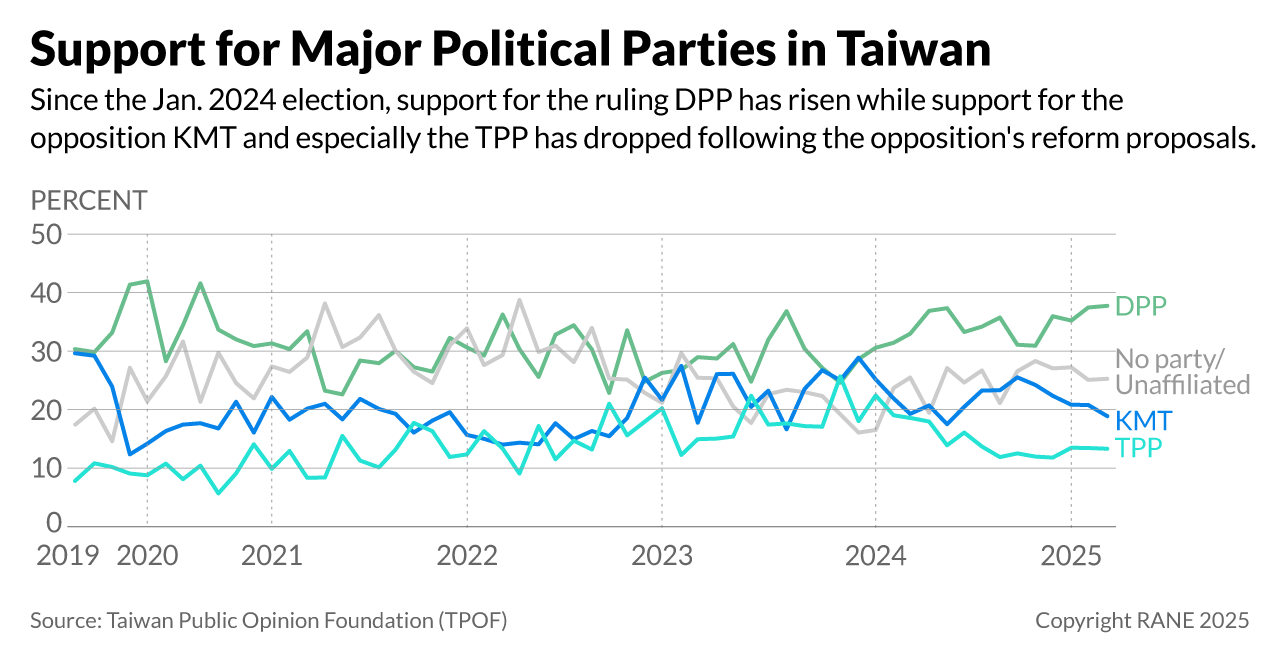
- The Taiwan Public Opinion Foundation, which has been conducting monthly surveys of public support for political parties since 2016, revealed that in May, the DPP's support rate stood at 35.9% versus the KMT's 20.9% and the TPP's 12.6%. This data marks a significant change from the KMT's 28.5%, the DPP's 28.3%, and the TPP's 18.2% support rates in December 2023, one month before the January 2024 election in which the KMT and aligned independents took 54 out of 113 legislative seats compared with the DPP's 52 and the TPP's eight.
Taiwan's political dysfunction may impair the implementation of a U.S.-Taiwan trade deal and drive more U.S. security cooperation with Taiwan's neighbors, like Japan and the Philippines. Taiwan's domestic squabbles come amid a challenging external environment, with U.S. sectoral tariffs threatening Taiwan's dominant export industries, particularly its world-leading advanced semiconductor fabrication and (to a lesser degree) its auto parts producers. Lai is taking a constructive approach to trade talks, namely by refusing to consider retaliation and proposing various purchases of U.S. arms and energy products in return for tariff relief, but the terms of a trade deal may need legislative approval, particularly any aspects that pertain to raising spending, reallocating existing funds or making new large-scale arms purchases. The KMT and TPP, which seem intent on wielding the budget to impose political pain on Lai, will likely demand steep concessions in return for supporting a trade deal, such as cuts to state media activities — seen to disadvantage the opposition — and reduced regulatory scrutiny of opposition political connections to China. Likewise, Lai's pledge to raise defense spending from 2.45% of GDP to 3% will be quite difficult under the opposition's defense budget cuts, which may impede Washington's efforts to ramp up arms sales and other defense support aimed at helping Taiwan deter a Chinese invasion, the Pentagon's top priority. Though some of Taiwan's defense funds will likely be unfrozen, political disputes about how to spend that money will further hamper Washington's efforts to coordinate an asymmetric defense strategy with Taipei. This, in turn, may lead Washington to focus on bolstering defense cooperation with regional partners less (although not un-) impeded by budgetary and political constraints, like Japan and the Philippines, particularly via the expansion of U.S. missile system deployments therein.
- The KMT has proposed importing more foreign (including non-U.S.) weapons systems, while the DPP has focused on domestic arms development.
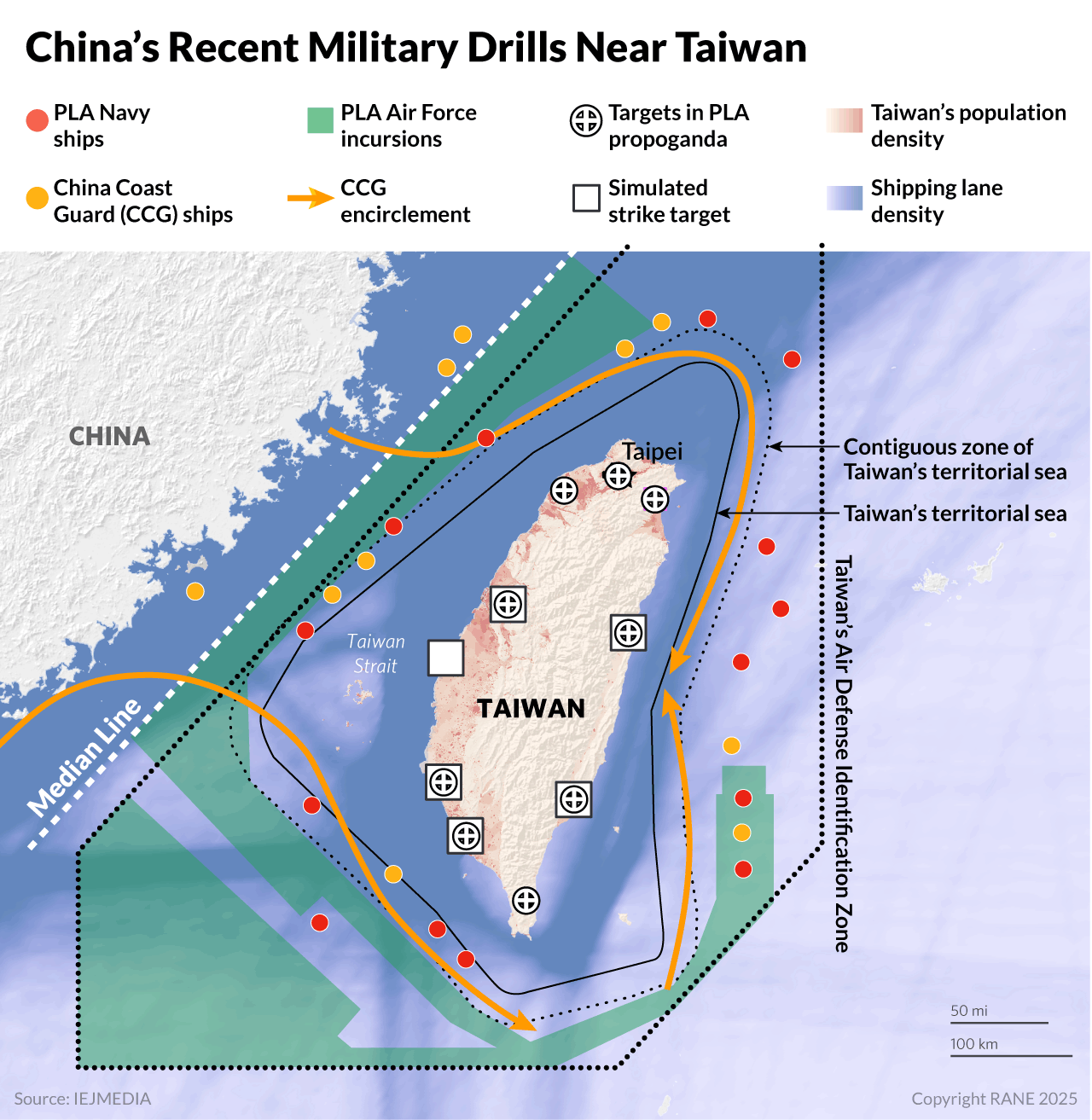
Amid Taiwan's political tumult, China will deepen political ties to the KMT and alternatively wield economic concessions and restrictions in response to KMT and DPP actions, but legislative impediments to U.S. arms sales to Taiwan are unlikely to alter China's military coercion trajectory. While China rarely issues official statements on Taiwanese domestic political disputes, as Taiwan's political infighting persists, Beijing will likely weigh in more on issues that directly impact China (like Taipei's scrutiny of religious institutional ties to China). For instance, China will likely deepen diplomatic ties to the KMT by meeting with the party's unofficial China envoy, former President Ma Ying-jeou. Additionally, Beijing will likely issue more pledges to ease economic restrictions on Taiwan — following KMT-led delegations to China — in an attempt to signal to the Taiwanese that a KMT-led government would be better for their prosperity. As long as the DPP holds the presidency, China will continue wielding military coercion against Taiwan via daily aerial and naval incursions as well as occasional large-scale drills. This coercion will hurt China's diplomatic ties with the KMT only minimally as long as Beijing avoids excessive military provocations, such as sending missiles over Taipei, as it did in August 2022. Chinese military coercion is likely to follow speeches or policies by President Lai that Beijing views as facilitating Taiwan's de facto independence. If Lai diligently implements his plan to root out CCP influence in Taiwanese civil society — e.g., by pursuing legal cases against Taiwanese temples or KMT officials perceived as having untoward connections to China — China will likely retaliate economically, for example by removing more tariff exemptions on Taiwanese imports. Though KMT and TPP legislative obstructionism may impede the DPP's ability to fulfill its pledges to expand arms deals with the United States, this would not portend any concomitant easing of Chinese military pressure on Taiwan, given Beijing's predilection for conducting drills around Taiwan in response to political and diplomatic (not military) triggers.
- In early April 2024, former Taiwanese president and KMT party elder Ma Ying-jeou visited Beijing, where he shook hands with President Xi Jinping and reiterated his opposition to Taiwanese independence. Later that month, China removed import restrictions on various Taiwanese agricultural imports put in place in August 2022, following then-U.S. House Speaker Nancy Pelosi's visit to Taiwan. Ma again visited China in late December 2024, where he met with the head of China's government department in charge of Taiwan affairs. Then, in January 2025, China announced it would resume allowing Chinese tourism operators to organize group visits by Chinese tourists from Fujian and Shanghai to Taiwan, a move that Ma praised.
- China has, in recent years, reneged on tariff exemptions for Taiwanese goods, outlined under the 2010 cross-strait Economic Cooperation Framework Agreement, as a means of economic retaliation. In December 2023, China revoked said exemptions for 12 Taiwanese chemical compound exports one month ahead of the Taiwanese election that would bring Lai to power. In late May 2024, China did the same for 134 more Taiwanese exports (including various industrial inputs) following Lai's inauguration. In September 2024, China revoked exemptions for 34 Taiwanese agricultural exports after a German warship and U.S. surveillance aircraft transited the Taiwan Strait within days of one another.
- China's three latest large-scale military drills around Taiwan have come in response to speeches made by Lai. In late May 2024, China launched the Joint Sword 2024A drills after Lai, in his May 20th inauguration day speech, asserted that neither side of the strait was subordinate to the other. Then, in mid-October 2024, China launched the Joint Sword 2024B drills following a speech by Lai in early October in which he asserted it was historically impossible to consider China the motherland of Taiwan, but rather the opposite was true. In early April 2025, China launched the Strait Thunder 2025A drills following a late March speech by Lai in which he laid out the aforementioned 17-point plan to counter national security threats posed by China.
