

China's latest military drills around Taiwan lower the threshold for the still unlikely prospect of a blockade and highlight Beijing's military coercive strategy toward Taiwan through 2028, which will galvanize Western commitment to military deterrence in the Indo-Pacific and contribute to slow business decoupling from China and Taiwan. On Oct. 14, China's People's Liberation Army (PLA) Eastern Theater Command (ETC) carried out Joint Sword 2024B joint military drills around Taiwan that involved the Chinese army, navy, air force, rocket force and coast guard. An ETC spokesperson said the drills ''fully tested the integrated joint operation capabilities of its troops'' and focused on ''combat readiness patrols, blockades of key ports and key areas,'' and ''sea and land strikes.'' The spokesperson further noted that ETC troops will ''resolutely thwart the separatist activities of 'Taiwan independence.''' All six main drill areas around the main island overlapped with Taiwan's claimed de facto contiguous zone (12-24 nautical miles from the coast, under the U.N. Convention on the Law of the Sea), though China does not recognize Taiwan's claim. China's Liaoning aircraft carrier took part in the drills east of Taiwan, while ETC video shows launches of drones, surveillance aircraft and fighter jets for the drills. The Chinese coast guard also took part in drills around the main island of Taiwan, seemingly to help with practicing blockade enforcement near key ports. Taiwan's coast guard reported expelling four Chinese coast guard ships around the Matsu Islands, while a Chinese citizen on an inflatable boat was also detained around the Kinmen Islands' Menghu Islet after Taiwan's coast guard spotted him. Though the man claimed to be seeking freedom from political persecution, Taiwan's coast guard said it could not rule out his activities being part of China's broader Oct. 14 military drills.
- Separately, China's commerce ministry stated on Oct. 12 that it was considering placing additional trade restrictions on Taiwan due to Taiwan's failure to lift trade restrictions on China. In addition, Chinese state-owned media Xinhua announced on Oct. 14 that the government had sanctioned Taiwanese lawmaker Puma Shen, founder of Taiwanese civil defense group Kuma Academy, and Taiwanese billionaire Robert Tsao, a key donor of Kuma Academy, over what Beijing called ''separatist acts.''
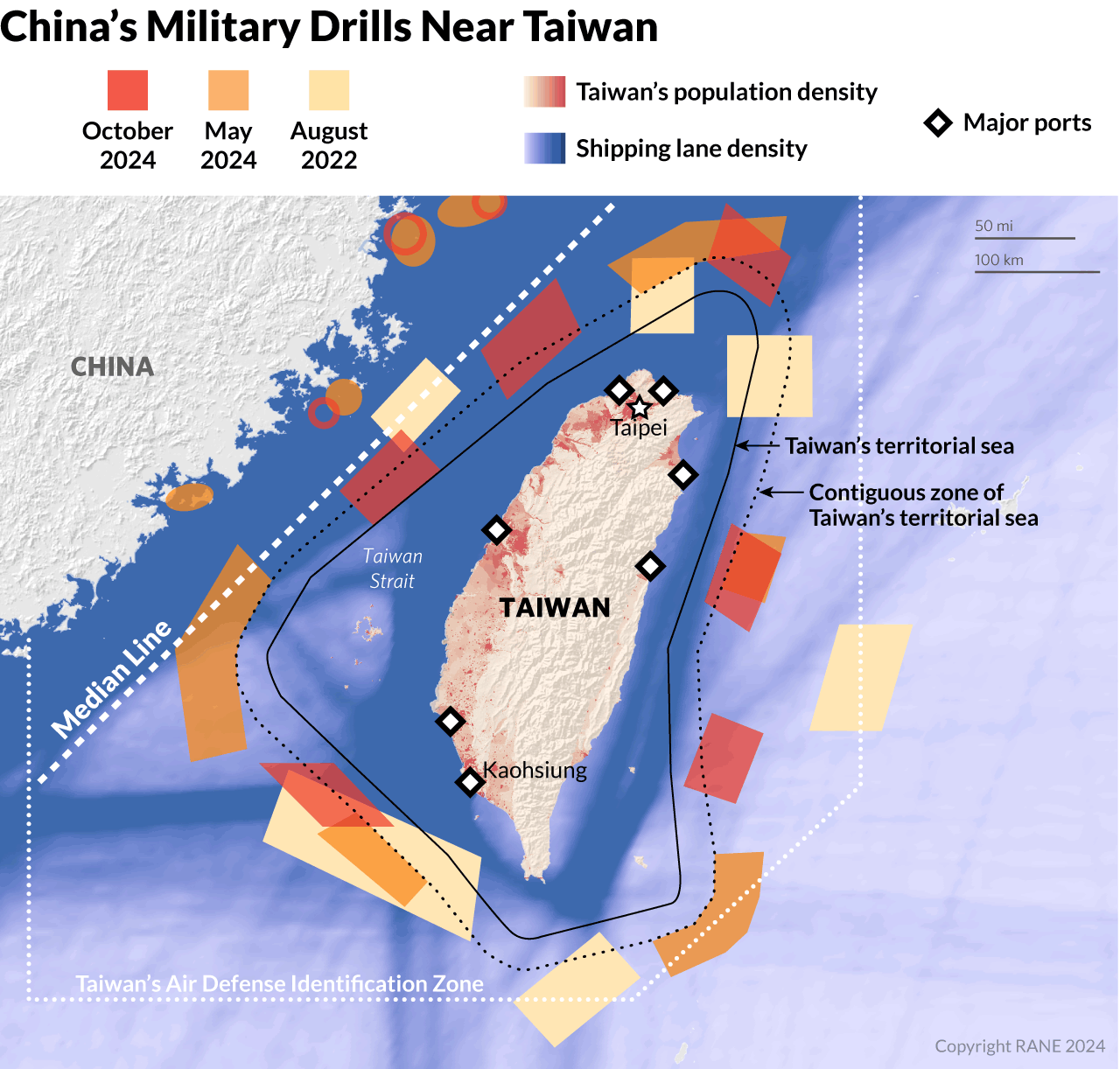
The latest Chinese drills near Taiwan indicate Beijing's predilection for responding punitively to perceived diplomatic slights and its intent to erode Taiwan's de facto sovereignty, like the sanctity of its maritime contiguous zone. The drills, as well as the threat of economic retaliation and the sanctions against Kuma Academy, come in response to recent pro-sovereignty remarks made by Taiwanese President William Lai in celebration of Taiwan's National Day on Oct. 10. In an Oct. 5 speech, Lai asserted that China is not the ''motherland'' of Taiwan, but suggested the reverse could even be true. Then, in an Oct. 10 speech, Lai noted that Taiwan and China are ''not subordinate to each other'' and that China has ''no right to represent Taiwan,'' adding that he would protect Taiwan from annexation and territorial encroachment. As seen previously, Beijing tends to launch military drills around Taiwan in response to sovereignty-affirming speeches by Taiwanese presidents from the ruling Democratic Progress Party (DPP), like Lai and his predecessor Tsai Ing-wen (2016-2024), as well as in response to high-level Western diplomatic engagement with Taiwan, like then-U.S. House Speaker Nancy Pelosi's meeting with Tsai in August 2022, which prompted China to conduct 11 days of expansive drills. The Oct. 14 drills produced the largest single-day Chinese incursion into Taiwan's extended airspace, with Taiwan's defense ministry counting 125 military aircraft and 17 warship incursions. However, they were also shorter than previous live-fire drills China conducted around Taiwan in August 2022, April 2023 and May 2024 — assuming the ETC does not extend the drills on Oct. 15 as it did multiple times during the August 2022 drills. The latest exercises were also closer to Taiwan's coast than previous exercises, as all six drill areas overlapped with Taiwan's contiguous zone,
- Lai's Oct. 10 speech also announced the establishment of the Whole-of-Society Defense Resilience Committee, aimed at bolstering Taiwan's civilian response capabilities to disasters and conflicts — hence China's sanctions of the Puma Academy, a group whose remit aligns with Lai's societal defense committee.
- Should Chinese economic retaliation occur in the next few weeks, it would likely involve revoking the tariff exemptions outlined under the 2010 Economic Cooperation Framework Agreement — a cross-strait trade agreement on goods — for dozens of Taiwanese imports. In December 2023, China revoked such exemptions on 12 Taiwanese chemical products ahead of Taiwan's January 2024 elections. In late May China also revoked tariff exemptions on 134 other Taiwanese products following Lai's May 20 inauguration speech; that same speech sparked China's Joint Sword 2024A drills, whose naming convention suggested the potential for follow-up drills, like the Joint Sword 2024B drills on Oct. 14.
Through 2028, Beijing will primarily wield drills and other forms of military coercion, largely forgoing diplomatic engagement with Taiwan, which will galvanize Western military efforts to deter China and erode the ability of Taiwan's more Beijing-friendly opposition parties to gain office. As with previous drills, the Joint Sword 2024B drills further suggest that China will primarily wield military coercion, and secondarily trade restrictions and sanctions against individuals, to engage with Taiwan through the remainder of Lai's term, which ends in 2028. This is because, despite rhetoric by Lai and the DPP leadership claiming Taiwan already has de facto sovereignty and thus does not need to pursue de jure independence (i.e., constitutional change), Beijing views Lai and other DPP members as inveterate ''separatists'' with whom amicable diplomatic engagement or even tense negotiations are untenable. Such drills, when paired with rhetoric in Lai's recent speeches about the need for Taiwan's global partners to cooperate in fighting authoritarianism and territorial revanchism, will only further compel Taiwan's allies and partners — especially those in the United States, Australia, Japan and Western Europe — to modernize their own militaries and strengthen defense (including defense industrial) cooperation in the Indo-Pacific to deter Chinese aggression against Taiwan and concomitant disruptions to global trade. Furthermore, each time China launches such drills, it incrementally undermines the pro-engagement stances of Taiwanese opposition parties, namely, the Kuomintang and Taiwan People's Party. This dynamic makes it harder for these opposition parties to win elections and rekindle diplomatic engagement with China, as the Taiwanese people grow more skeptical of China's trustworthiness as a diplomatic partner and more committed to strengthening Taiwan's national security and ties with Western nations.
- If former U.S. President Donald Trump returns to office and chooses to use the issue of Taiwan's sovereignty as a bargaining card in broader negotiations with China, it would briefly reduce the prospect of a growing Western-led deterrence campaign against China. However, the U.S. defense establishment and U.S. Congress remain united in their commitment to discouraging Chinese actions against Taiwan, which would likely curb the efficacy of any such efforts by Trump. Moreover, the broader Western deterrence campaign would persist even if Trump temporarily wavers.
While China remains unlikely to launch a naval blockade of Taiwan in the next few years, China is slowly lowering the threshold for such an action by giving its military the opportunity to practice the drills, which will further incentivize foreign multinationals to steadily move their supply chains away from China and Taiwan. As with the August 2022 drills, China's ETC explicitly stated during the Oct. 14 exercises that it was practicing for a naval blockade that would cut off global trade with Taiwan; confirming this claim, China held the drills in areas closer to key Taiwanese ports, integrated the coast guard for patrolling the waters around Taiwan, and potentially mobilized a small civilian unit around Kinmen. This aligns with Chinese President Xi Jinping's admonition for the PLA to be prepared (i.e., to have the capabilities, if not the intent) to invade Taiwan by 2027, an action that would likely be preceded by a blockade. It also aligns with a key goal of previous PLA drills, namely to give the military more battlefield experience (or as close as it gets in peacetime) by integrating all PLA branches and defense platforms for joint action, thus perfecting China's ability to carry out a blockade in the future if it so chooses. But despite its highly adversarial stance toward Lai and the DPP, China remains unlikely to launch such a blockade anytime soon, which would risk further undermining China's already shaky post-COVID-19 economic recovery. For one, a formal blockade would technically constitute an act of war and invoke proportionately heavy Western sanctions on China that would hurt all the more during the Chinese economy's ongoing slowdown. Secondly, even if China opted for a de facto blockade that prevented port activity with long-duration military drills, which Beijing previewed in the August 2022 drills, it would still risk accelerating the West's expanding military deterrence campaign against China by alerting the countries that rely on Indo-Pacific trade routes or their economic prosperity to China's intentions regarding Taiwan. Countries in Western Europe that have so far been hesitant to confront China's regional aggressions would be particularly likely to step up deterrence. Nonetheless, China is clearly keen on perfecting its capability to launch a blockade of Taiwan, meaning this remains a low-likelihood, high-impact scenario whose probability will gradually grow over time and which could severely disrupt global trade flows — especially for high-end electronics that need the most advanced semiconductors, which Taiwan produces. As future drills like Joint Sword 2024B occur, they will also slowly accelerate the decoupling of Western business operations in Taiwan and China, even if China remains too constrained to escalate.
