
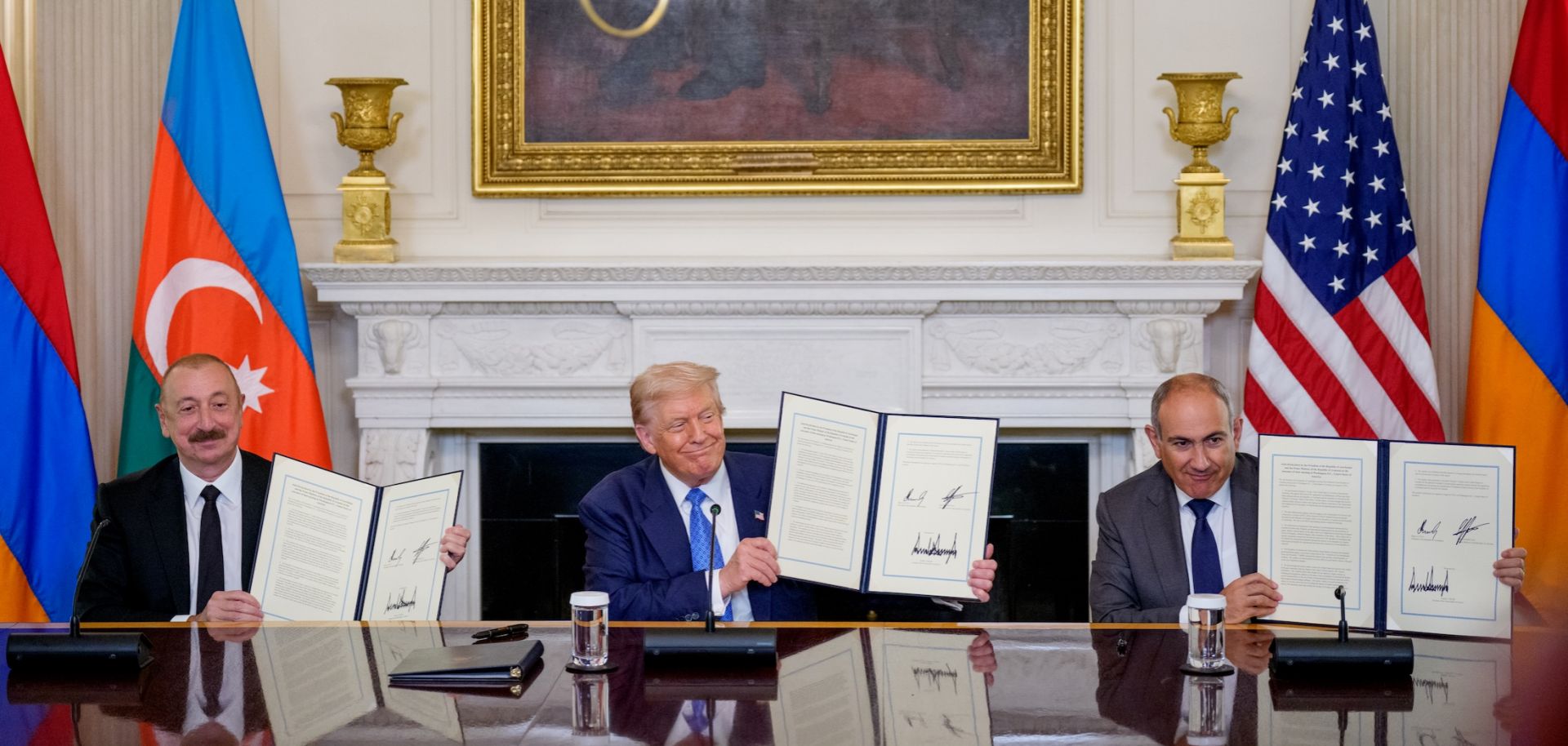
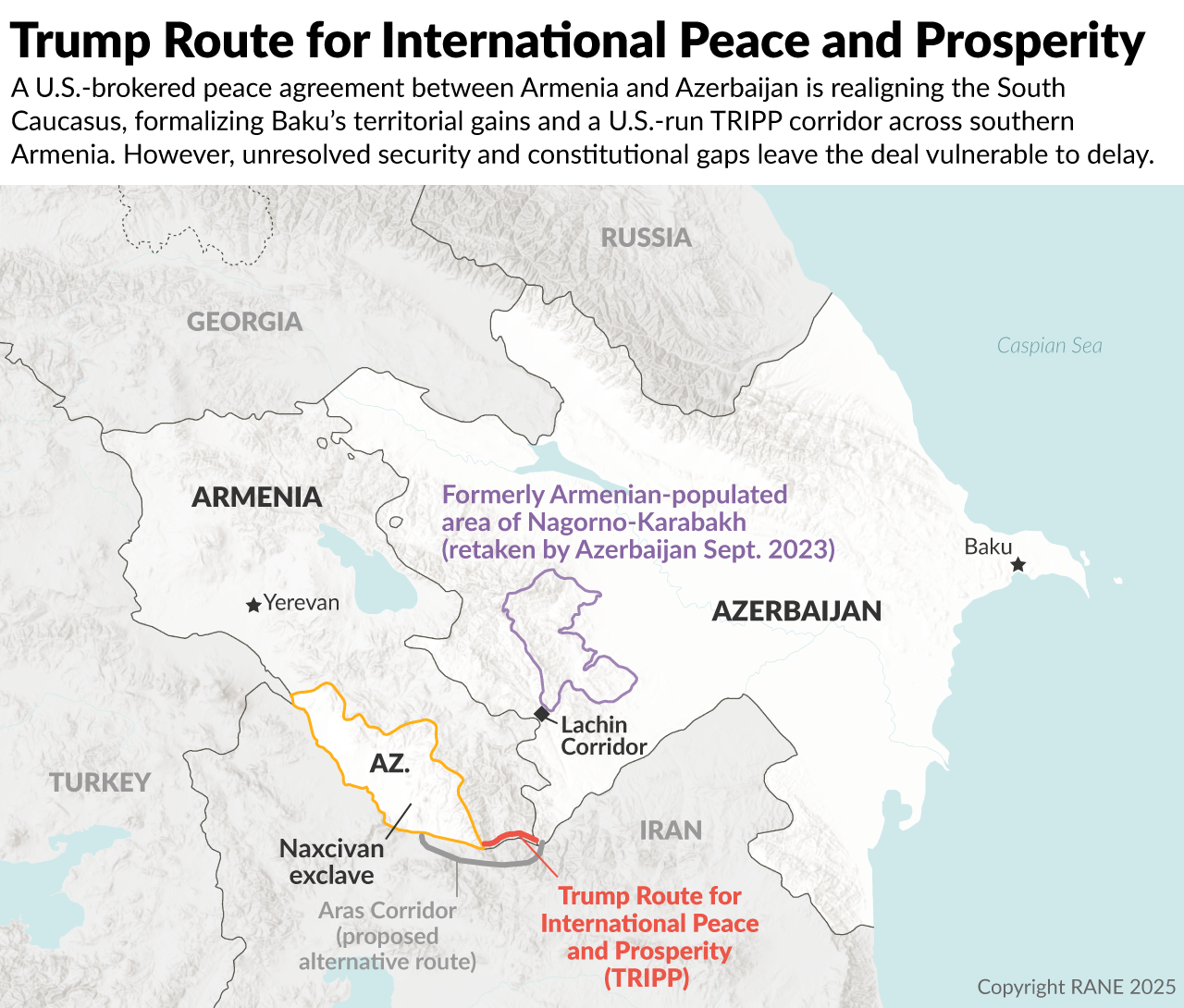
A U.S.-brokered peace deal between Armenia and Azerbaijan has ushered in a strategic realignment in the South Caucasus by cementing Baku’s territorial gains, sidelining Russia and Iran, and planting a long-term U.S. commercial footprint in the region. But the treaty will remain fragile amid unresolved security guarantees and implementation challenges, and could unravel within the next 12-18 months. On Aug. 8, U.S. President Donald Trump hosted Armenian Prime Minister Nikol Pashinyan and Azerbaijani President Ilham Aliyev at the White House, where the three leaders issued a joint declaration outlining the outcomes of their trilateral summit. According to the declaration, the leaders witnessed the initialling of a draft peace agreement by the foreign ministers of Armenia and Azerbaijan, aimed at ending decades of conflict between the two countries. They also endorsed a joint appeal to terminate the OSCE Minsk Group and its associated mechanisms. Additionally, the joint declaration committed Armenia, the United States and “mutually determined third parties” to develop a 42-kilometer (27-mile) transit corridor across southern Armenia to connect mainland Azerbaijan with its Nakhchivan exclave. This route, which is locally known as the Zangezur Corridor, was rebranded as the Trump Route for International Peace and Prosperity (TRIPP). According to media reports, the United States was granted 99-year exclusive development rights over the route. The sides also affirmed mutual recognition of sovereignty, renounced future territorial claims and explicitly rejected “any attempt [at] revenge.” Additionally, Armenia and Azerbaijan committed to a formal border delimitation process and pledged to prohibit the deployment of “third-party forces” along their shared frontier.
- In March 2025, Armenian and Azerbaijani foreign ministers met in Abu Dhabi and agreed on a preliminary framework agreement on normalization and mutual recognition, marking the start of the current U.S.-mediated track that culminated in the August summit.
- The OSCE Minsk Group, established in 1992, was tasked with mediating a resolution to the Nagorno-Karabakh conflict between Armenia and Azerbaijan. Co-chaired by Russia, France, and the United States, the group has consistently been criticized for its ineffectiveness and perceived bias. Azerbaijan, in particular, has rebuked the group for its alleged failure to pressure Armenia into withdrawing from occupied Nagorno-Karabakh territories and for its lack of tangible results after decades of negotiations. Following its military successes in 2020, Azerbaijan grew openly dismissive of the Minsk Group, viewing it as outdated and irrelevant, and rejecting its renewed involvement in post-war negotiations.
Armenia and Azerbaijan’s decision to accept U.S. mediation is the result of a confluence of trends that have recently reshaped the strategic landscape of the South Caucasus, including a diminished Russian presence and a weakened Iran. Most significantly, Russia’s deepening military entanglement in Ukraine has curtailed its capacity to act as a regional guarantor or mediator. This has, in turn, reduced Moscow’s ability to project power in the South Caucasus, creating space for other actors (like the United States) to influence the regional order. The shoot-down of an Azerbaijani civilian airliner by a Russian anti-aircraft missile in December 2024 also triggered a major diplomatic crisis, accelerating Baku’s strategic distancing from Moscow. For Armenia, this erosion of Russian security guarantees — combined with long-standing economic isolation amid its closed borders with Turkey and Azerbaijan — has driven a foreign policy rethink by altering its risk calculus. In this context, the promise of U.S. economic support, coupled with the potential reopening of the Turkish border and future EU accession prospects, has become increasingly attractive for Armenia — particularly as Pashinyan seeks to offset the risk of losing power in the 2026 elections and advance Armenia’s EU membership aspirations. Meanwhile, the strategic weakening of Iran following its war with Israel earlier this year has constrained Tehran’s capacity to respond forcefully to more proactive U.S. involvement in the peace process between Azerbaijan and Armenia, whether through economic pressure or transit blockades. This new reality has undercut Iran’s leverage in the South Caucasus and the viability of Iranian-backed alternatives for regional transit. This has, in turn, tilted the balance in favor of frameworks that involve U.S. stewardship, which the Trump administration has capitalized on to gain a commercial foothold on the Caspian-Turkey corridor, reorient Azerbaijan and Armenia toward Western markets, and further curb Russian and Iranian influence.
- In addition to engaging in talks with Azerbaijan, Armenia has also sought to improve ties with Turkey in recent months. This is particularly notable given that the Armenia-Turkey border has been closed since 1992, with no diplomatic relations or significant cross-border transit. On Aug. 11, the Armenian prime minister’s office said that Pashinyan phoned Turkish President Recep Tayyip Erdogan to brief him on the U.S.-brokered talks with Azerbaijan. During the call, Pashinyan and Erdoğan also reviewed plans to reopen regional transport links on the basis of territorial integrity and reciprocity, assessed the improved climate for implementing earlier Armenia-Turkey agreements, and agreed to keep their political dialogue active.
- Armenia’s reported, though unconfirmed, decision to lease corridor land to a U.S.-backed operator aligns with its “Crossroads of Peace” strategy, which envisions transforming the country from a regional cul-de-sac into a crucial Eurasian transit hub.
- Iran has proposed establishing a so-called "Aras Corridor,” a link along the south bank of the Aras River that would connect mainland Azerbaijan to Nakhchivan through Iranian territory, thereby bypassing Armenia. Tehran ultimately intends to integrate this route into an extended branch of the Russian-backed International North-South Transport Corridor. However, the proposed Aras Corridor faces several challenges: it relies on Iran's sanction-affected infrastructure, would make Baku reliant on a rival transit provider, offers Yerevan no direct access to European markets, and lacks sufficient financing.
The implementation of the new U.S.-brokered peace deal will be tenuous amid domestic resistance in Armenia and Azerbaijan’s military superiority. As a prerequisite for implementing the peace agreement, Azerbaijan has stipulated that Armenia must remove all territorial claims to Nagorno-Karabakh from its constitution. But this is highly controversial in Armenia, where people last year staged weeks of mass anti-government protests against making concessions to Azerbaijan. Against this backdrop, Pashinyan — whose approval rating is already very low, and who is increasingly clashing with political rivals (including the powerful Armenian Apostolic Church) — has slow-walked the constitutional amendments, which require a national referendum. Pashinyan will likely stage the referendum after the 2026 election, which he would bundle with a vote on whether Armenia should join the European Union. If he loses power, the future of the referendum or its outcomes would become uncertain; if he wins but emerges politically weakened, he may struggle to quickly advance the constitutional amendments. This will, in turn, leave Azerbaijan with a ready pretext to postpone or suspend prisoner-of-war exchanges and humanitarian cooperation, and keep military pressure on Armenia’s border until the constitutional changes are complete. Furthermore, Pashinyan’s “Crossroads of Peace” platform hinges on early TRIPP revenue and a Turkish border reopening. If U.S. financing slips, interest fades or Ankara hesitates to reopen the border, Armenian hard-liners will argue that Yerevan has traded sovereignty for empty promises, eroding the political base the Pashinyan government needs to push the treaty through parliament. In addition, the text of the U.S.-brokered draft treaty creates an enforcement vacuum. With the forthcoming dissolution of the OSCE Minsk Group, the yet-to-be-established new bilateral commission will have no coercive authority, and there is no neutral monitor to police incidents along a still-undemarcated frontier. Any skirmish between Azerbaijani and Armenian forces could therefore spiral out of control before any commission members even arrive.
- A July 2024 Gallup poll showed only 13% of Armenians view Pashinyan’s performance as “completely positive,” while 80% oppose the constitutional changes demanded by Azerbaijan, underscoring the significant domestic resistance to treaty implementation.
- On Aug. 8, following the signing ceremony at the White House, both Pashinyan and Aliyev declined to answer questions from the media regarding the future of the more than 100,000 ethnic Armenian refugees displaced from Nagorno-Karabakh. The draft agreement also made no mention of the issue, leaving it politically unresolved and susceptible to manipulation by domestic hard-liners and external actors.
- The draft treaty’s Article XV mandates the withdrawal of interstate legal actions, but implementation remains uncertain. Armenia and Azerbaijan continue to pursue opposing cases at the International Court of Justice, including claims of ethnic cleansing and terrorism. Without a defined timeline or mutual agreement on suspension, these unresolved proceedings may fuel nationalist narratives and complicate the political environment for ratification and follow-through.
- On Aug. 11, the foreign ministers of Azerbaijan and Armenia submitted a joint letter asking the OSCE Chairperson-in-Office to dissolve the Minsk Group and its related bodies. A draft Ministerial Council decision has also since been circulated to the other OSCE member states for formal approval, signaling both Baku and Yerevan’s intention to settle their disputes without further external mediation. Article 13 of the draft agreement calls for the creation of a bilateral commission to oversee implementation and border delineation, but leaves the modalities of its operation to be agreed upon by the parties, indicating that significant details remain to be negotiated.
- On Aug. 11, a Turkish diplomatic source told a Russian state news agency that there is no set timeline for opening the Turkish-Armenian border, and that the normalization of relations between Ankara and Yerevan will proceed in parallel with the peace process between Baku and Yerevan.
Russia and Iran, though strategically weakened, will exploit the ambiguities in the U.S.-brokered peace deal to preserve key levers in the South Caucasus and challenge the TRIPP corridor’s implementation. Despite formal expressions of support, both Russia and Iran will seek to test the U.S. corridor’s operational viability. Russia, in particular, will continue to exploit Armenia’s energy dependence and its membership in the Eurasian Economic Union to argue that the TRIPP corridor falls within the bloc’s customs space, giving it a legal pretext to regulate, delay or disrupt operations. The Kremlin will also push for alternative routes through the northern part of Armenia that could potentially divert traffic from the TRIPP. Additionally, Russia could leverage its control over Armenia’s sole railway company, South Caucasus Railways (which is 100% Russian-owned), to technically and commercially insert itself into the construction of the TRIPP segment running through Armenia’s southernmost Syunik province. Moscow could also promote a joint Russian-Iranian Aras Corridor, which, if integrated into the Russian-backed North-South Transport Corridor, would enable it to influence tariffs, scheduling, and thereby maintain control over east-west transit routes. Moreover, Russia will likely ramp up retaliatory actions against Azerbaijan over its support for Ukraine and growing alignment with the West. Because the TRIPP corridor’s operational viability depends on trans-Caspian feeder routes, sustained Russian pressure on Baku (via trade measures, customs friction or influence over Central Asian transit partners) would diminish TRIPP’s expected volumes, raise investor risk and slow implementation. Iran, meanwhile, will adopt a similarly calibrated posture, viewing a sustained U.S. presence along its border as strategically unacceptable. During his upcoming visit to Yerevan on Aug. 18-21, Iranian President Masoud Pezeshkian will likely try to extract formal guarantees that TRIPP remains a strictly civilian project, leveraging gas-for-power swaps to incentivize Armenian compliance while inserting additional negotiation layers into the implementation process of the TRIPP arrangements.
- In an Aug. 9 statement, Russian Foreign Ministry spokeswoman Maria Zakharova said Moscow “welcomes” the U.S.-brokered Baku-Yerevan meeting but emphasized that the 2020-22 Russia-led accords, Armenia’s Eurasian Economic Union customs obligations, and the Russian border-guard mission on the Iranian frontier all remain in force, underscoring that Russia still holds tangible levers over any new regional transport or peace arrangement.
- On Aug. 11, following Azerbaijan’s decision to provide $2 million worth of humanitarian assistance to Ukraine, Russian lawmakers publicly threatened to impose import restrictions on the country’s goods and apply pressure on its businesses operating inside Russia.
- In an Aug. 9 statement, Iran’s foreign ministry said Tehran welcomes a prospective Azerbaijan-Armenia peace agreement and stands ready to cooperate, through bilateral channels or the 3+3 format (Turkey, Russia, Iran, Azerbaijan, Armenia and Georgia), to boost regional stability. But the statement also warned that any foreign military or political presence near Iran’s borders, or any transport projects that disregard sovereignty and mutual benefit, “could undermine the security and lasting stability of the region” and could trigger “all political, legal and economic measures to safeguard its national rights and interests”. On Aug. 13 the Armenian foreign minister confirmed that Pezeshkian will pay an official visit to Yerevan on Aug. 18-21.
- Since 2009, Armenia and Iran have operated a gas-for-electricity swap agreement under which Iran supplies natural gas to Armenia, which converts it into electricity and sends it back. The deal has served as a strategic energy lifeline, enabling Armenia to diversify its imports beyond Russia and offering Iran a sanctions-resilient way to monetize its gas. While modest in volume, the arrangement has been repeatedly renewed and in 2023 was formally extended through 2030. It remains a critical element of Armenia’s energy security calculus, particularly amid closed borders with Turkey and Azerbaijan and ongoing regional transit realignments.
