
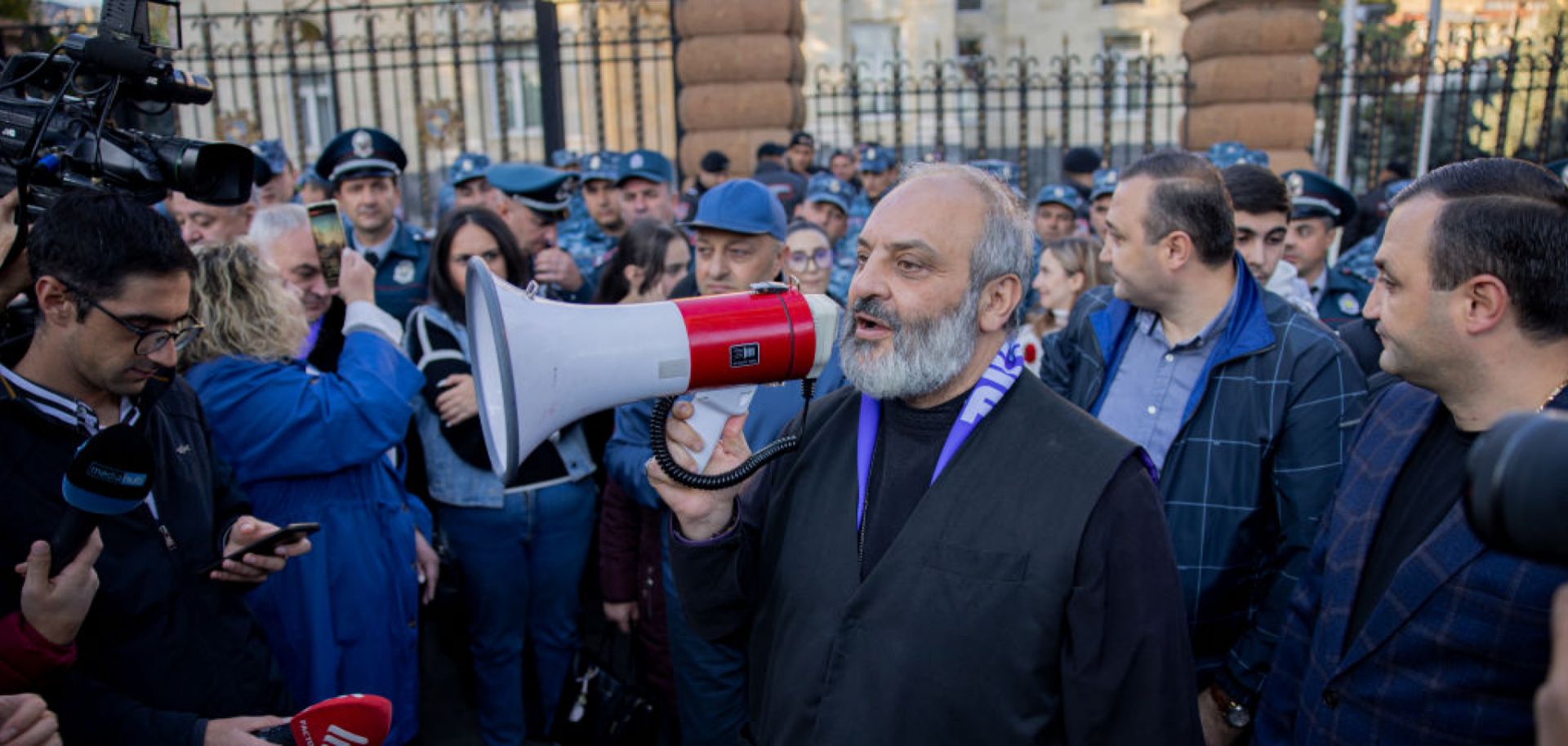
In Armenia, an escalating dispute between the prime minister and the country's national church threatens to generate unrest and derail already delayed efforts to implement a contentious peace deal with rival Azerbaijan, raising the risk of another military confrontation. On June 25, Armenian authorities arrested Archbishop Bagrat Galstanyan and 13 other people on charges of plotting violence and other destabilizing actions to overthrow the government and seize power. According to the country's top criminal investigative agency, the conspirators had recruited more than 1,000 people since the start of the year, and investigators allegedly have already recovered firearms, ammunition and other items linking them to the plot. The arrests, which the archbishop's supporters have called politically motivated, are the most severe developments in an escalating feud between Prime Minister Nikol Pashinyan and the Armenian Apostolic Church, one of the most influential institutions in the country. The standoff began in late May, when Pashinyan, seemingly angry over public criticism from clergy, leveled a series of harsh rebukes against the church, including allegations that primate Catholicos Karekin II and other senior clergymen had broken their vows of celibacy and secretly fathered children. Since then, the prime minister has repeatedly issued other blistering criticisms and accusations. Pashinyan has also taken a number of controversial actions, including announcing the creation of an unprecedented special body designed to remove Karekin and ordering the arrest of Samvel Karapetyan, a high-profile Armenian billionaire who is a large benefactor of the church, due to Karapetyan's alleged anti-state activities. Pashinyan and his supporters have defended these and other moves as a justified response to Karekin and other clergymen's alleged interference in Armenian politics. However, the Armenian Apostolic Church and various leading anti-government figures have lambasted Pashinyan's actions, claiming they are part of the government's broader efforts to silence dissent.
- According to the Armenian Investigative Committee, which released audio recordings and photos as evidence, the so-called "Holy Struggle" conspirators had recruited mainly former soldiers and police officers, and divided them into "strike groups" with assigned tasks. Among other things, the plotters allegedly had already acquired precursor materials to make incendiary and explosive devices, and had created lists of people who would take over different parts of the government after seizing power. Galstanyan's lawyer and multiple opposition leaders have condemned the charges as politically motivated.
- Pashinyan came to power in 2018 and initially enjoyed close ties with the Armenian Apostolic Church. But Karekin and other senior clergymen began steadily increasing their critiques of the prime minister after Armenia's defeat to rival Azerbaijan in their 2020 war. Since then, the church has emerged as one of the leading anti-government critics, accusing Pashinyan of capitulating to Azerbaijan and eroding the rule of law in Armenia. This comes as the main opposition political parties have struggled to counter Pashinyan.
The worsening standoff with the church comes as Pashinyan's government has delayed implementing an unpopular peace deal with Azerbaijan ahead of general elections scheduled next year. The feud between Pashinyan and the Armenian Apostolic Church is largely driven by their split over Armenia's ties with Azerbaijan. On March 13, the two countries reached a peace agreement in an effort to settle their longstanding territorial and other disputes that have led to a series of wars and smaller skirmishes in recent decades. In the most recent conflict in September 2023, Azerbaijan took control of Nagorno-Karabakh, a region within Azerbaijan that had a large Armenian population — cementing Azerbaijan's military superiority over Armenia, which had already been demonstrated in their war in late 2020. As a condition of implementing the deal, Baku has since demanded that Yerevan remove what Azerbaijan perceives as lingering Armenian territorial claims to parts of its territory. This has since become highly controversial in Armenia, where people last year staged weeks of mass anti-government protests against making concessions to Azerbaijan. The protests were led by Archbishop Galstanyan and vocally supported by Karekin. This helps explain not only Pashinyan's current feud with the church, but also his efforts to slowwalk the process of amending the constitution, which will require not only a two-thirds approval by the legislature, but also a national referendum due to the magnitude of the changes. In May, Armenia's justice minister said the new draft constitution would be ready within 10 months, which indicates Pashinyan's government is likely trying to delay making the required constitutional changes until after Armenia's June 2026 elections, in an effort to avoid triggering popular blowback that could harm its electoral prospects.
- According to the agreement in March, Armenia and Azerbaijan would recognize each other's territories as defined by Soviet-era maps, renouncing any future territorial claims. However, the deal did not cover Azerbaijan's demand for direct land access to its Nakhchivan exclave in Armenia. This land connection, known as the Zangezur Corridor, would link Azerbaijan to its historic partner, Turkey. Implementing the peace deal would ease talks over the corridor, but either way, it remains a highly controversial topic in Armenia.
- Armenia's unicameral parliament has 107 seats, of which Pashinyan's Civil Contract party and its allies have 69. This puts it just shy of a two-thirds supermajority but with still firm control of the legislature.
The escalating feud threatens to spark potentially violent unrest in Armenia, thwart the implementation of the peace deal, and could lead Azerbaijan to conduct another military escalation. Until now, Pashinyan's highly public dispute with the Armenian Apostolic Church has not resulted in anything resembling the large-scale protests that occurred last year. However, the June 25 arrests indicate there has been significant behind-the-scenes plotting against his government. Pashinyan is showing no signs of toning down his increasingly brazen critiques of the church and its leaders, and the arrests will likely exacerbate the grievances of his opponents, who believe he has gone beyond enforcing the law to instead take politically-motivated actions to quash dissent. This indicates the feud is poised to only worsen in the coming weeks and months, raising the risk of another round of potentially violent mass anti-government protests. Judging from the alleged coup attempt disrupted on June 25, there is also a more extreme scenario in which there is some sort of military-backed coup and/or other extralegal move to oust Pashinyan. Even if less likely, such a scenario is not without recent precedent: Armenia's February 2021 crisis saw top military leaders call on Pashinyan to resign over anger at his handling of the 2020 war with Azerbaijan, leading to a multi-week standoff in which Pashinyan accused the military of attempting a coup. The prime minister's policy agenda will likely also face greater pushback from opposition parties in the legislature, but these parties do not have the numbers to bring forth a no-confidence vote, let alone win one, further incentivizing Pashinyan's opponents to use other means to try to pressure him. With the government already delaying implementation of the peace deal with Azerbaijan, and with growing popular pushback against Pashinyan, another Azerbaijani military escalation will remain on the table as well, as Baku may judge that Yerevan is unwilling and/or unable to meet its demands for constitutional changes. A full-scale invasion of Armenia is less likely, as this would risk scuttling Azerbaijan's vastly improving ties with the West, drawing other regional countries into the conflict, and potentially bringing to power a figure in Armenia who is less willing than Pashinyan to make concessions. However, it cannot be ruled out given Azerbaijan's past risk tolerance, even if limited ground incursions and a heightened pace of cross-border shelling are comparatively more likely as Azerbaijan tries to coerce Armenia.
- In recent weeks, there has been an uptick in alleged Azerbaijani violations of the ceasefire along the Armenian border, suggesting that Baku is already growing impatient with Yerevan's delayed implementation of the peace deal. If Azerbaijan sought a larger invasion, it would most likely try to secure land access to its Nakhchivan exclave in Armenia via the Zangezur Corridor. However, Iran strongly opposes the idea, and Russia would likely look unfavorably on greater Turkish influence in its perceived sphere of influence.
- A scenario in which Russia secretly coordinates or opportunistically backs any sort of anti-government movement against Pashinyan also cannot be ruled out. In response to recent developments, the Kremlin has said it wants stability in Armenia, which has historically depended on Russia for defense, energy and trade. However, there have been growing frictions between Yerevan and Moscow, as Pashinyan has accused Russia of not providing sufficient military support, particularly when Russian peacekeepers did not intervene during the 2023 Azerbaijani takeover of Nagorno-Karabakh. This has led Pashinyan to reach out to Western countries, including France and the United States, irking Russia. Already, in September 2024, Armenian authorities announced that they had thwarted an alleged Russian-backed coup attempt.
