
Despite the prospect of Azerbaijan seizing southern Armenia and the so-called Zangezur corridor by force, Baku is more likely to conduct comparatively smaller territorial incursions and cross-border shelling to pressure Armenia into an agreement. On Oct. 16, a spokesperson for the U.S. Department of State strongly denied an Oct. 13 Politico report that Secretary of State Antony Blinken had warned a group of U.S. lawmakers that his department was tracking the possibility of Azerbaijan invading southern Armenia in the coming weeks. While the spokesperson stated the article was inaccurate and ''in no way reflects what Secretary Blinken said to lawmakers,'' the report added to preexisting speculation that a renewed Armenia-Azerbaijan war may be more likely than previously expected.
- The statements came after the newly appointed Armenian ambassador to the European Union, Tigran Balayan, said on Oct. 8 that there was an ''imminent threat'' of an Azerbaijani invasion of Armenia that could occur in weeks. The same day, Azerbaijani President Ilham Aliyev said France's decision to send military aid to Armenia would ''make it responsible for any new conflict with Armenia.'' Both statements added to fears in Western capitals that further military confrontation between Armenia and Azerbaijan is possible despite Azerbaijan restoring its internationally recognized territory following its September seizure of Nagorno-Karabakh.
- The authorities of Nagorno-Karabakh surrendered to Azerbaijan's demands to disband their armed forces and leave the region via humanitarian corridors on Sept. 20, a day after Azerbaijan launched a military operation to seize the territory.
- Aliyev has previously warned that the ''one condition for [Armenians] to live comfortably'' in Armenia is that Yerevan must accept Baku's demands for transit across the Zangezur corridor. Aliyev has also threatened to not recognize Armenia's territorial integrity, an implicit threat to seize southern Armenia to establish a land corridor to Azerbaijan's Naxcivan exclave.
A peace agreement remains out of reach as missed meetings between high-ranking Armenian and Azerbaijani officials are exacerbating tensions, as Yerevan and Baku diverge in their geopolitical tilt. Armenian Prime Minister Nikol Pashinyan and Azerbaijani President Aliyev last met in July, well before Azerbaijan's seizure of Nagorno-Karabakh. Since then, two meetings where the leaders would have already met under normal circumstances have passed, including the European Political Community Summit on Oct. 5 (which was attended by Pashinyan but not Aliyev) and the Commonwealth of Independent States summit on Oct. 12 (which was attended by Aliyev, along with Russian President Vladimir Putin and various other Eurasian heads of state, but not Pashinyan). Each leader's choice to skip the respective gatherings signals their countries' different geopolitical trajectories, with Armenia geared toward the West and Azerbaijan geared toward Russia, Iran and Turkey. On Oct. 17, Pashinyan signaled his desire to reorient Armenia's foreign policy away from Russia and toward the West during an impassioned speech to the European Parliament, where he said Armenia was ready to be closer to the European Union, as much as the bloc considers possible. This divergence between Yerevan and Baku will likely continue until the two reach a comprehensive peace deal, as Azerbaijan will likely try to rally the region's primary stakeholders — namely, Turkey, Russia and Iran — to support its vision for a peace settlement and pressure Armenia, while Armenia will likely try to secure support from the United States and European countries. This will keep tensions high, especially if meetings between Pashinayan and Aliyev and/or other high-level officials and delegations (such as the two countries' deputy prime ministers or foreign ministers, or their joint border demarcation commission) fail to materialize, as this would show that a peace deal and operationalization of the Zangezur corridor is still not a possibility. However, concerns are growing that Azerbaijan could soon resort to force since it does not appear that significant peace or border demarcation talks are taking place.
- During the Oct. 5 European Political Community Summit, Prime Minister Pashinyan, European Council President Charles Michel, French President Emmanuel Macron and German Chancellor Olaf Scholz signed a statement reaffirming their intent to recognize the territorial integrity of Armenia (with a 29,800 square kilometer area) and Azerbaijan (with an 86,600 square kilometer area). But Azerbaijani President Aliyev did not sign the agreement after he backed out of the summit at the last minute, with Azerbaijan's foreign ministry indicating that Baku wanted Turkey to also attend any meeting with Armenia and European officials.
- On Oct. 6, Aliyev announced Baku's intent to organize a meeting in the ''3+3'' format (Russia, Turkey and Iran + Azerbaijan, Armenia and Georgia) in the near future. In his announcement, the Azerbaijani president stressed that regional issues should be resolved by regional countries without the intervention of farther-flung powers, an idea echoed by Russian officials. This statement reflects Baku's desire to pressure Yerevan into accepting its terms by bringing Russia and Iran, which support Armenia's territorial integrity and are skeptical of the Zangezur corridor, closer to Azerbaijan's position.
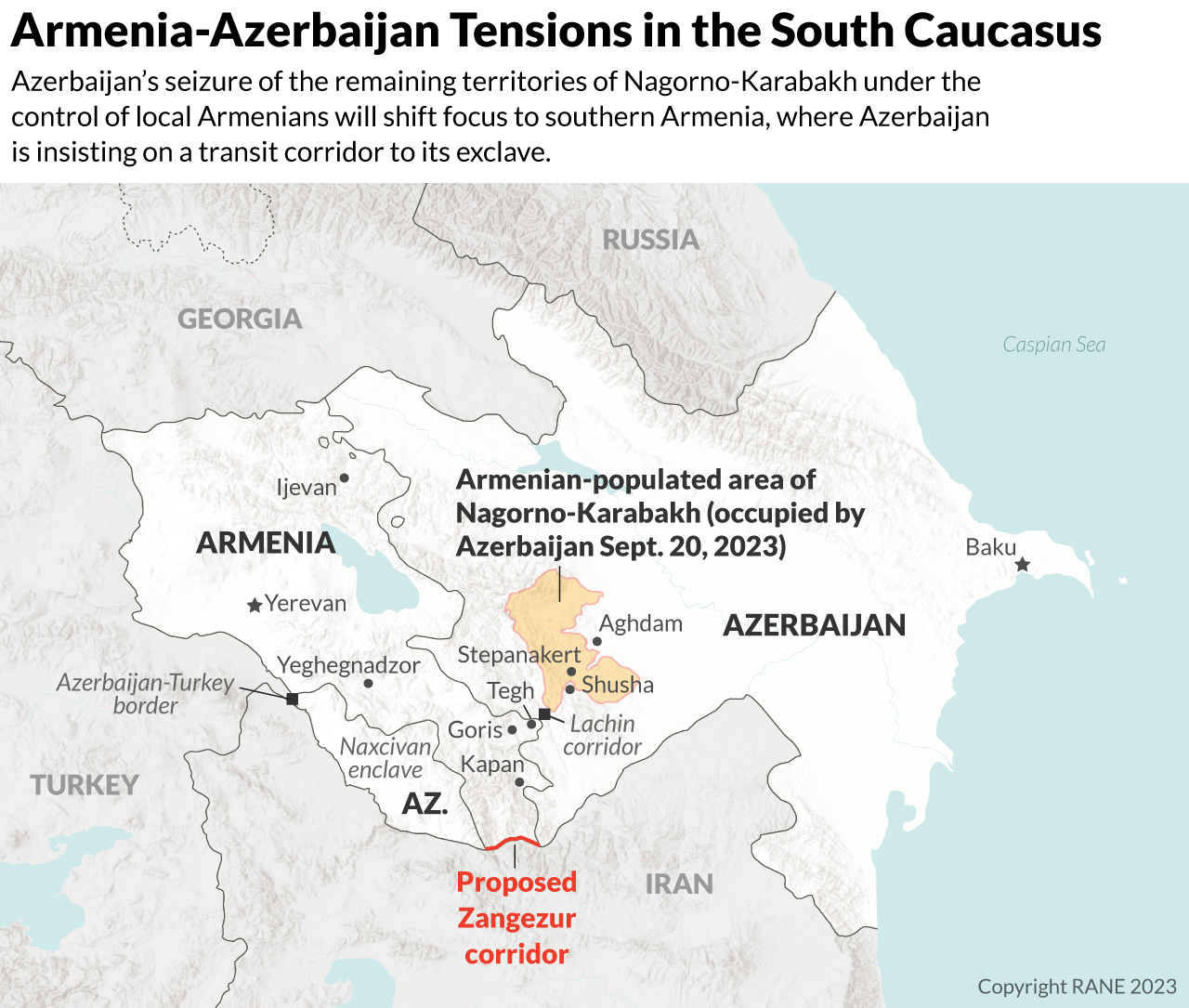
Baku will prioritize operationalizing the Zangezur transit corridor in the coming weeks and months to pressure Yerevan and maintain leverage. With its internationally recognized borders restored, Azerbaijan's next goal is to begin transit between Azerbaijan and its Naxcivan exclave across the so-called Zangezur corridor through Armenia. Azerbaijan wants to use the extraterritorial corridor for many reasons, most importantly to make it easier and cheaper to access its exclave and improve Naxcivan's economy via the use of a more direct route for East-West trade with Turkey along the so-called Transcaspian or Middle Corridor. As part of this aim, Baku wants minimal security and checks on the route, as well as no tariff or transit fees for, at a minimum, goods only moving between Azerbaijan and its exclave (and not onward to other markets). To achieve this, Azerbaijan will take numerous measures, including threatening to condition the conclusion of any peace deal with Armenia on eventually granting Azerbaijan commercial transit use of the Zangezur corridor and developing an alternative transit route through Iran in order to pressure Armenia into an agreement.
- Russia is less interested in peace talks that could result in the creation of the Zangezur corridor if Moscow is not involved in the corridor's operation. Per the November 2020 cease-fire agreement that ended the last war between Armenia and Azerbaijan in Nagorno-Karabakh, Russia's Federal Security Service (FSB) was given explicit permission to regulate traffic along the proposed Zangezur corridor. But with that cease-fire now defunct as a result of Russia and its peacekeepers' failure to uphold it, Armenia would likely be wary of allowing the FSB to have a role in securing the corridor unless Moscow gives something to Yerevan in exchange, meaning a permanent Russian role in the corridor is doubtful.
With the world distracted by other crises and Armenia in a comparatively weaker position, there's a chance Azerbaijan may believe that now would be the most opportune time to launch an invasion and seize the Zangezur corridor by force. An imminent Azerbaijani incursion into Armenia remains a comparatively unlikely scenario. However, there are several reasons why Baku may assess that such a military operation could achieve its goals with relatively fewer potential consequences compared with previous years. For one, Azerbaijan has a larger and better-equipped military than Armenia and may thus believe that it can successfully seize and hold sufficient Armenian territory to quickly force a peace negotiation; Baku may also believe that this military advantage and, in turn, the potency of using force to seize the corridor, will fall over time as Armenian forces gradually build fortifications in the region and acquire higher-quality Western weapons, thereby adding a sense of urgency to the issue. Second, Baku may believe that launching an invasion right now would be less likely to trigger sweeping economic sanctions from the West, as Europe and the United States have increased their purchases of Azerbaijani oil and natural gas supplies amid their efforts to replace Russian supplies following the invasion of Ukraine and are too concerned about spiking global energy prices. Third, Azerbaijan likely believes that regional players and the international community are distracted by other ongoing crises in Ukraine and the Gaza Strip (and the latter conflict’s possible expansion), and would thus have no appetite to involve themselves in reversing an Azerbaijani military action. And finally, having executed an uninterrupted streak of military and diplomatic successes since 2020, President Aliyev may be overconfident in such a military operation's ability to secure a quick victory given the above factors. Further contributing to this risk is the echo chamber created by Azerbaijan's highly authoritarian and personalist governance system, which means Aliyev could be overestimating the potential success of an invasion and/or underestimating the potential international response based on poor information.
- Focused on its war in Ukraine, Russia has failed on multiple occasions to uphold its formal commitments to protect Armenia in response to Azerbaijani threats. In September 2022, Azerbaijan captured and still occupies about 220 square kilometers of Armenian territory along their un-demarcated border. While the land grab and shelling deeper into Armenia drew international condemnation, it did not trigger a response from the Russia-led Collective Security Treaty Organization, nor did it trigger decisive military support for Armenia from the West.
But given the inherent risks of such a major invasion, as well as the lack of a pressing need to establish a transit route through Armenia, Baku is still more likely to continue smaller-scale incursions and shellings akin to those seen last year. While there are several reasons why Azerbaijan may currently be mulling an invasion of southern Armenia, there are arguably more reasons for Baku to stick to military skirmishes well short of an invasion. First, a transit corridor through Armenia, while highly desirable for Azerbaijan, is not strictly necessary. Azerbaijan maintains its connection with its Naxcivan exclave through Georgia and Turkey, in addition to through Iran, with which Baku is now claiming to examine an alternative to Zangezur bypassing Armenia. Should Iran and Azerbaijan normalize relations, it would only further isolate Armenia from its regional partners and cause it to lose out on growing East-West trade in the region, which Yerevan may make concessions to Baku in order to avoid. Second, Turkey, Azerbaijan's closest ally, is occupied with its military intervention in Syria and a host of other regional and domestic issues. Ankara would thus likely advocate against a full-scale invasion of Armenia, which would risk upsetting the regional balance of power and simultaneously harming Turkey's relations with the West, Russia and Iran, while undermining Ankara's goal of Armenia eventually falling into its sphere of influence. Seizing the corridor would also complicate Turkey's international standing and Azerbaijan's relations with Turkey, which for Baku may outweigh the benefits of occupying southern Armenia. Third, another full-scale war with Armenia triggered by an Azerbaijani invasion would likely be much more deadly and unpredictable than the two countries' previous war in 2020. This is because it would take place on Armenia's internationally recognized territory (and not the disputed region of Nagorno-Karabakh), which means the Armenian military would be willing to take higher losses to hold its ground and retake any territory seized by invading Azerbaijani troops. Fourth and finally, precisely because President Aliyev now enjoys peak popularity, and has justified his family's decades of nepotistic and authoritarian rule by successfully restoring Azerbaijan's complete dominance of Nagorno-Karabakh, another war would unnecessarily put his regime's currently secure future at risk.
