
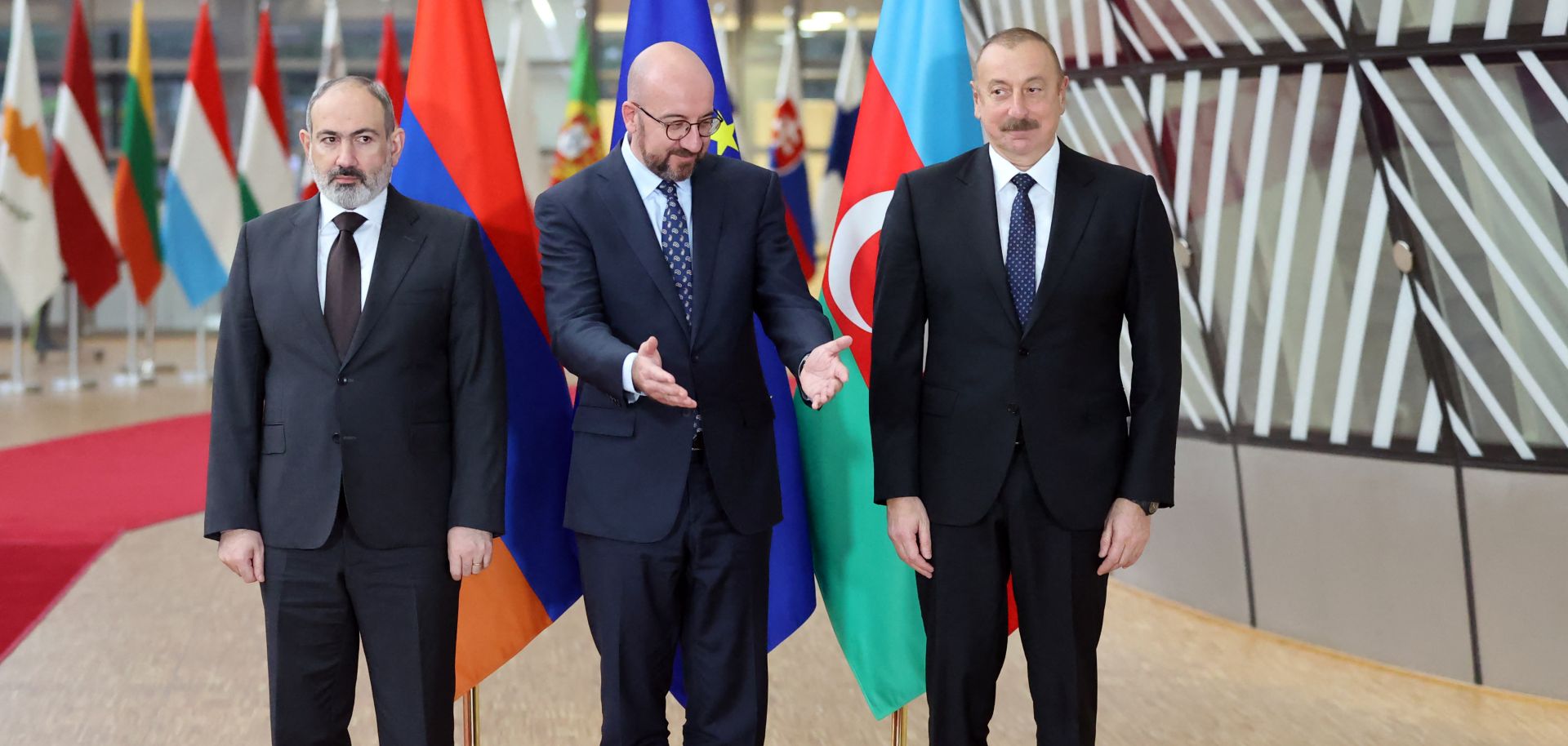
Armenian Prime Minister Nikol Pashinyan (left), European Council President Charles Michel (center) and Azerbaijani President Ilham Aliyev (right) pose for a photo in Brussels on April 6, 2022, before participating in EU-mediated talks on the Nagorno-Karabakh dispute.
A possible peace treaty between Armenia and Azerbaijan would bring stability to the South Caucasus and weaken Russia's influence in the region, creating opportunities for a growing economic presence of Turkey and the West. On Aug. 31, Armenian Prime Minister Nikol Pashinyan and Azerbaijani President Ilham Aliyev met in Brussels for talks mediated by European Council President Charles Michel, the fourth discussion in this format. No concrete policy changes regarding the disputed Nagorno-Karabakh region nor breakthroughs in broader peace negotiations were announced, but the two leaders agreed to ''continue substantive negotiations'' at the level of foreign ministers on drafting a peace treaty. Armenia and Azerbaijan's foreign ministers will meet next month; the two countries' presidents are also slated to meet again in November. The ongoing flurry of diplomatic activity is related to the scheduled departure of Armenian soldiers from Nagorno-Karabakh by the end of September, which will complete the main stipulations of the 2020 cease-fire agreement that ended the six-week war between Armenia and Azerbaijan.
- The Azerbaijani and Armenian commission tasked with determining the borders between the two countries met in Moscow on Aug. 30. The commission, which held its first meeting in Moscow on May 24, was set up to delimit Azerbaijan and Armenia's joint border as part of their peace process and is next scheduled to meet in Brussels in November.
The likely withdrawal of Armenian troops from Nagorno-Karabakh in the coming weeks will further cement Azerbaijan's advantage in the bilateral dispute. A complete withdrawal of Armenian troops from the region is a precondition for further progress on a peace treaty with Azerbaijan. Such a withdrawal would leave the self-proclaimed Nagorno-Karabakh Republic's ethnic Armenian defense forces vulnerable to Azerbaijani forces, who have retained a decisive advantage in personnel, equipment and positioning in Nagorno-Karabakh since the end of the latest armed conflict in November 2020. Limited transportation routes due to the region's mountainous terrain would also make it militarily unfeasible for Armenian forces to return to the region by seizing a corridor if Azerbaijan launches a large-scale military action against Nagorno-Karabakh. But despite these risks, Armenia will likely still stick to the pledge it made in July to pull out all of its conscripts in Nagorno-Karabakh by September, as not doing so could trigger additional clashes or even another full-scale war with Azerbaijan — which, given Baku's more powerful forces, would be costly and likely yield little benefit for Yerevan.
Even if Armenia reneges, Azerbaijan is unlikely to trigger a greater conflict in Nagorno-Karabakh, but will retain this option should diplomacy and more targeted use of force fail to change Armenia's course. Azerbaijan is unlikely to pursue seizing control of the region by force — at least for now. Instead, Baku will attempt to use its current leverage to convince Yerevan to conclude a peace deal almost entirely on Baku's terms that allows it to gain control of Nagorno-Karabakh at a much lower cost. To demonstrate that leverage, Azerbaijan may conduct small-scale military operations against Armenian forces in Nagorno-Karabakh. But in the near term, it will avoid any aggressive military action that would mark a greater violation of the 2020 cease-fire and derail peace talks.
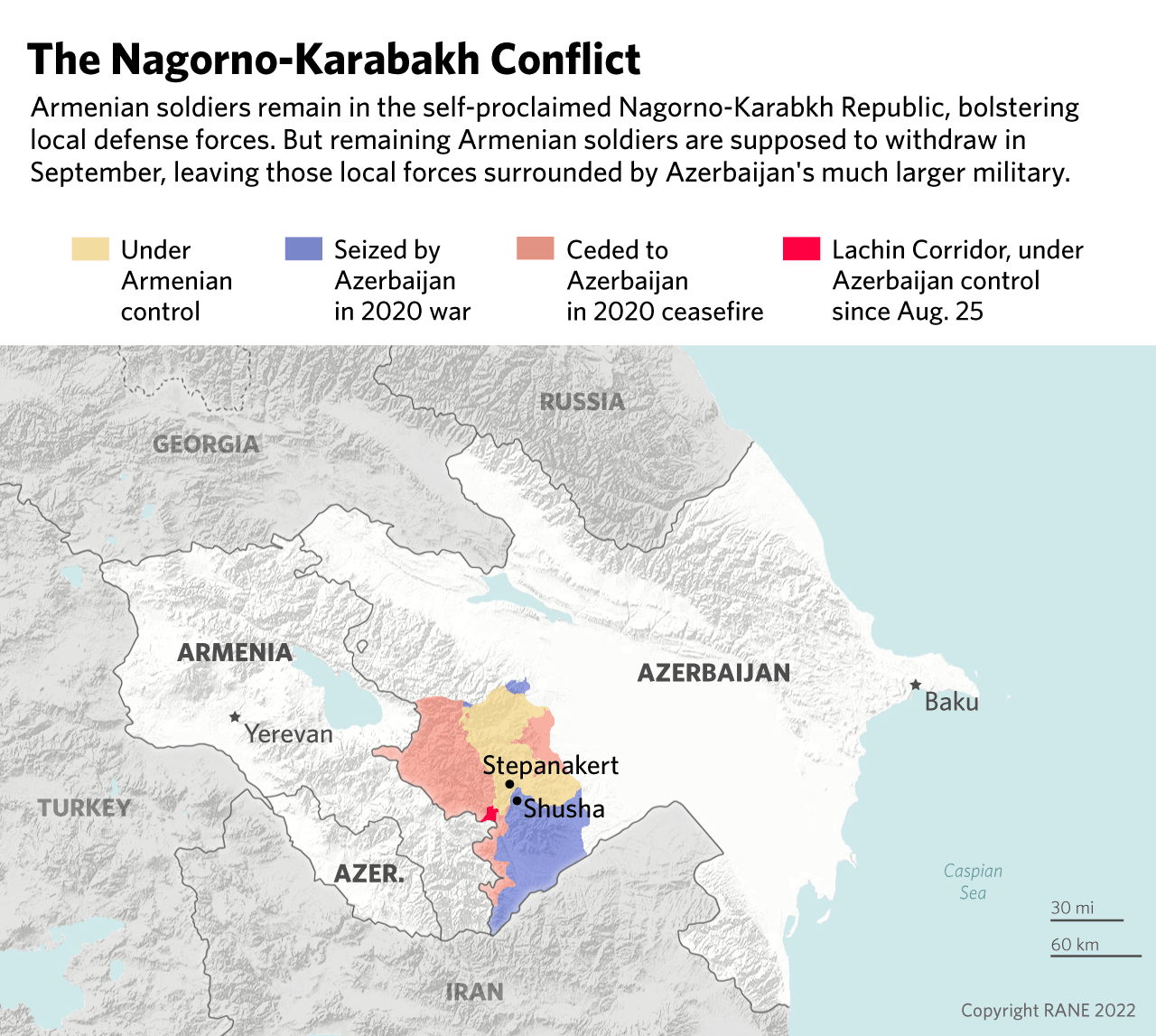
While the implementation of Azerbaijan and Armenia's cease-fire will incentivize both sides to make progress on a peace treaty, immense obstacles to a comprehensive deal remain. A peace deal is necessary to clarify numerous issues regarding the future of the region and Armenian-Azerbaijani relations that the 2020 truce did not address. Among those questions are basic mechanisms to assure the rights and safety of the Armenians who choose to remain in Nagorno-Karabakh, fully aware of Azerbaijan's authoritarian tendencies. Accordingly, both Baku and Yerevan will struggle to convince the Armenians in the self-proclaimed Nagorno-Karabakh Republic to lay down their arms, meaning Baku's demands for the region's ''full demilitarization'' will likely go unheeded unless a comprehensive peace treaty can provide a convincing guarantee for Armenians' safety. Nagorno-Karabakh's economic future also remains uncertain following Azerbaijan's Aug. 25 capture of the Lachin corridor, which Armenia formerly used to supply the region with all of its electricity and internet, and most of its natural gas. New infrastructure along the recently-built alternative highway from Armenia could theoretically enable Nagorno-Karabakh to keep purchasing these necessities from Armenia. But Azerbaijan is unlikely to allow such construction, as Baku wants to make Nagorno-Karabakh dependent on its financial and legal systems to speed its integration into Azerbaijan.
Stalled progress toward a peace deal could prompt Azerbaijan to use force to coerce Armenia into giving additional concessions. Azerbaijan has demonstrated its willingness to use force and threaten violence if Armenia stalls on upholding its end of the 2020 cease-fire or any commitments made in ongoing peace talks. In March, Azerbaijani forces crossed the line of contact with the unrecognized Nagorno-Karabakh Republic, capturing the village of Parikh. In August, Azerbaijani armed forces then captured strategic heights in the Nagorno-Karabakh region's Lachin corridor. Together, these two incidents are examples of Azerbaijan using force in different contexts to demonstrate Armenia's powerlessness to respond in kind.
- In April, Azerbaijani President Aliyev called for swift peace negotiations and threatened to officially not recognize Armenia's territorial integrity should a deal not be signed. This statement constituted Baku's formalization of a long-standing threat to militarily seize part of Armenia's southeastern Syunik province to create a corridor to its Nakhichevan exclave. Although Armenia proper is part of Russia's security umbrella through its membership in the Collect Security Treaty Organization, some Armenians are skeptical that Moscow could and would be willing to help Armenia in the case of a renewed war amid Russia's invasion of Ukraine.
Armenia and Azerbaijan have also remained secretive regarding their exact proposals for a permanent peace treaty, likely to prevent political backlash in either country from undermining talks. But this secrecy breeds distrust, which could eventually endanger a deal by increasing the risk of violence. This risk of backlash is especially pronounced in Armenia, where many are distrustful that their government will give too many unsavory concessions to Baku, who they believe is not even negotiating in good faith anyway. Since the 2020 war, Azerbaijani President Aliyev has done little to show he is preparing his people for peace with Armenia and to accept Armenians in Nagorno-Karabakh. Given this, many Armenians are distrustful of Azerbaijan's commitment to negotiations and believe the Aliyev regime is instead planning to rely on its military to achieve its goals in the region after imitating commitment to talks. They argue that a peace treaty is not really in Baku's interest because it would effectively result in President Aliyev's regime losing the patriotic conflict on which its newfound popularity rests. Should Azerbaijan continue to make threats in an effort to coerce Armenia into giving up additional ground in talks, it would only further feed into these fears and push the Armenian government to insist on stringent guarantees for the safety of Armenians in Nagorno-Karabakh in a peace deal, which Baku would find unacceptable and consider an attempt to stall the negotiations, forcing it to resort to additional use of force.
- Following the Aug. 31 meeting between Armenia and Azerbaijan's leaders, EU President Charles Michel stressed that ''public messaging [was] critical'' in ''preparing both sides' populations for a long-term sustainable peace.''
Should a peace deal keep moving forward, Russia's influence in the South Caucasus would decline in favor of Turkey and the West in the coming years. The signing of a peace treaty would likely prompt both Armenia and Azerbaijan to deepen their ties with Turkey and the European Union at the expense of Moscow, because of the perception of better economic opportunities. Such a shift would be particularly notable for Armenia. Despite Russia's repeated failures to back it militarily, the former Soviet state has had little choice but to maintain close security relations with Moscow since gaining independence in 1991 to protect against the existential threat posed by Azerbaijan, as well as Turkey that has always supported Baku. A peace deal with Azerbaijan, however — and the likely subsequent normalization of Armenia's ties with Turkey — would change that calculus by removing the immediate threat of war. Over time, this could see Armenia increasingly question its close relationship with Russia, and whether the benefits of maintaining those ties still outweigh the costs — especially amid the war in Ukraine. More immediately, a peace deal would also call into question the future of the Russian peacekeepers in Nagorno-Karabakh, as Armenians have increasingly derided their presence as nearly useless. Azerbaijan, meanwhile, does not want to see the Russian peacekeepers' mandate extended past 2025, and is hoping to expel Russian troops from its territory as soon as possible.
The combination of a peace treaty and a reduction of Russia's involvement in the South Caucasus could make EU and Turkish investors perceive the region as less risky, opening the door to their greater economic presence. These investors' increased activities would, in turn, challenge Russia's role in the region, as much of the investment would involve transport infrastructure bypassing Russia through routes such as the Trans-Caspian Corridor. The resulting increased competition for economic influence in the region would become yet another aggravating factor in the already complex triangle of Russian-Turkish-EU relations.
- Russia's foreign ministry has repeatedly expressed its displeasure over the European Union's role in mediating a solution to the Nagorno-Karabakh conflict. On Aug. 31, the spokesperson for Russia's foreign ministry said that the bloc's activity in the South Caucasus is conditioned on ''geopolitical ambitions'' and an attempt to ''shamelessly usurp the laurels of mediation'' from Russia.
