
Azerbaijan's capture of Nagorno-Karabakh will increase Baku's leverage over Armenia amid ongoing peace negotiations and decrease Russia's influence in the South Caucasus over time. On Sept. 19, Azerbaijan launched a military operation in Nagorno-Karabakh, a region governed by Armenians within Azerbaijan's territory. The next day, the authorities of Nagorno-Karabakh capitulated to Azerbaijan's demands, disbanding their armed forces and allowing soldiers and local civilians to leave the region via humanitarian corridors. Members of the armed forces of Armenia also allegedly left the region, though Armenia's Defense Ministry reiterated its claim that there are no Armenian military personnel in Nagorno-Karabakh, as they withdrew from the region in 2021 in line with the November 2020 cease-fire.
- The local Nagorno-Karabakh militias were heavily outnumbered and concluded that further resistance would be in vain after taking significant casualties in the early hours of Azerbaijan's operation.
- Representatives of Nagorno-Karabakh and Azerbaijan will meet on Sept. 21 in Yevlakh, Azerbaijan. They will discuss "issues raised by the Azerbaijani side on reintegration, ensuring the rights and security of the Armenians of Nagorno-Karabakh, as well as issues of ensuring the livelihoods of the population of Nagorno-Karabakh within the framework of the Constitution of Azerbaijan."
Azerbaijan's control over Nagorno-Karabakh will increase its negotiating power in peace talks with Armenia, and Baku will continue threatening military action against Yerevan to maintain leverage. Until now, Yerevan had hoped to trade concessions regarding the function of the Zangezur transit corridor (which connects Azerbaijan and its Naxcivan exclave through Armenia) for Azerbaijani concessions regarding the rights and status of Nagorno-Karabakh Armenians. But by conquering Nagorno-Karabakh, Baku has effectively made such a trade impossible, removing Armenia's remaining leverage in peace negotiations. Having recovered all of its sovereign territory and restored its internationally recognized borders, Azerbaijan will press its advantage by threatening to attack southern Armenia and create a land corridor to Naxcivan by force. While Armenia will likely seek to resist this strongarming amid outrage over the alleged ethnic cleansing of Nagorno-Karabakh's Armenian population, the threat of further Azerbaijani military provocations — and subsequent full-scale war — will eventually motivate Armenia to accept a peace deal largely on Azerbaijan's terms. Among those terms will be minimal restrictions on the transit of goods between Azerbaijan and Naxcivan along the Zangezur corridor.
- On Sept. 19, Armenian Prime Minister Nikol Pashinyan suggested the main aim of Azerbaijan's military aggression in Nagorno-Karabakh is to draw Armenia into war. He added that "we should not allow some external and internal forces to put Armenia's statehood under attack."
- On Sept. 20, Azerbaijani presidential aide Hikmet Hajiyev said Baku and Yerevan had already agreed on 70% of their draft peace treaty.
- Speaking at the U.N. General Assembly on Sept. 19, Turkish President Recep Tayyip Erdogan said Armenia missed a "historic chance" to conclude a peace agreement and directly stated that he expected Armenia to open the Zangezur corridor. However, Armenian Foreign Minister Ararat Mirzoyan said in response that "Armenia does not have any obligations to open the Zangezur Corridor."
In a low-likelihood, high-impact scenario, an Azerbaijani military operation against Armenia's sovereign territory could spark a full-scale war. War could erupt if tit-for-tat shelling along the Armenia-Azerbaijan border significantly escalates, or, more likely, if Azerbaijan conducts a military operation to seize the Zangezur corridor to create a territorial link with its Naxcivan exclave. The latter scenario would be much more likely to prompt Western sanctions on Azerbaijan and a curtailment in cooperation with the country's government. But Baku is unlikely to strive for this scenario, as it wants to avoid the challenges posed by occupying and annexing a territory without support from the international community — the obvious examples being Armenia's occupation of Azerbaijan from the early 1990s to 2020, which was never recognized and eventually reversed, and Russia's ongoing challenges in securing Ukraine.
- While an Armenian military intervention to protect Nagorno-Karabakh Armenians could also spark war, such action is no longer militarily feasible and would run entirely counter to Pashinyan's policy course since the November 2020 cease-fire.
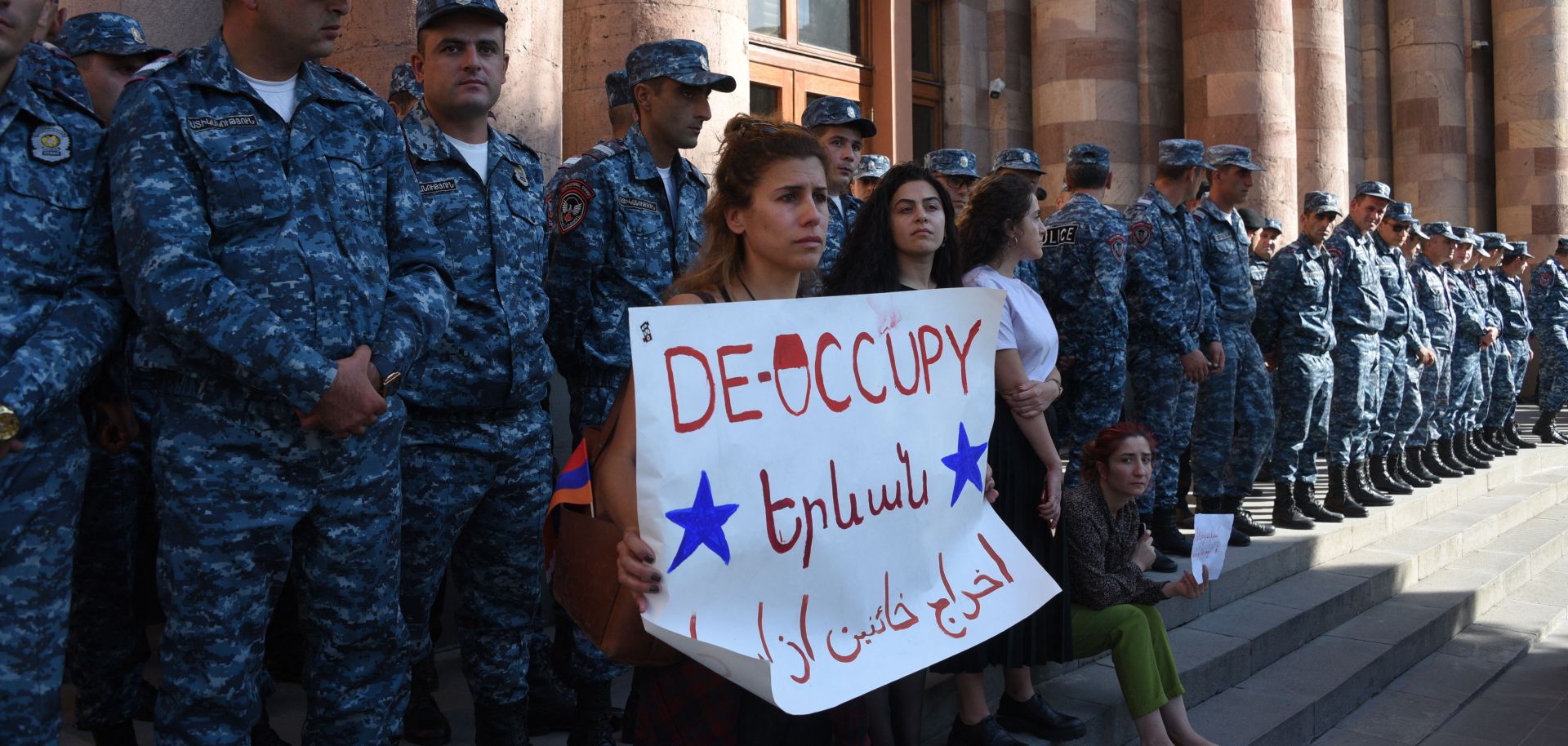
Anti-government and anti-Azerbaijan protests may continue in Armenia, but Pashinyan will likely remain in power because the opposition is too weak to unseat him or offer a viable policy platform to justify his removal. On the night of Sept. 19, crowds gathered outside Pashinyan's official residence, calling for his resignation while also chanting anti-Azerbaijan and anti-government slogans. Some also demanded an immediate declaration of war on Azerbaijan and tried to break into the building. Simultaneously, other Armenians held a large rally outside the Russian Embassy, chanting various slogans against the Russian military, the country and the Collective Security Treaty Organization (CSTO) of which both Russia and Armenia are members. Protests in Yerevan are likely to continue but are unlikely to unseat Pashinyan, as his opponents have few attractive policy alternatives to justify his removal to the Armenian public or a credible strategy to deal with Azerbaijan. For example, if opponents tried to remove him officially or via a coup by arguing that the country should move to protect Nagorno-Karabakh, this would entail a full-scale war that Armenia would likely lose. As a result, the plotters would be unpopular and unlikely to remain in office, making this option unsustainable for opposition figures. However, the Armenian opposition will likely continue to blame Pashinyan for losing Nagorno-Karabakh by claiming that his drift away from Russia is the reason Moscow failed to enforce the 2020 cease-fire.
- The Russian Embassy in Armenia said protesters blocked the diplomatic mission in Yerevan and that normal work is impossible. The embassy requested that the Armenian Foreign Ministry take measures to restore its normal functioning.
- On the night of Sept. 19, Pashinyan acknowledged in his televised address that "there are already calls, coming from different places, to stage a coup in Armenia. We must not allow certain people, certain forces to deal a blow to the Armenian state."
While the West will threaten to sanction Azerbaijan, such actions are unlikely to be impactful unless Azerbaijan expands its military operation to Armenia. With hostilities entirely confined to Azerbaijan's sovereign territory and already over, Western governments are very unlikely to respond decisively, although they will pressure Azerbaijan regarding the potential ethnic cleansing of the Armenian population from Nagorno-Karabakh. More importantly, the West is unlikely to provide Armenia with greater support, whether via large-scale military equipment deliveries or troops, that would stop Azerbaijan's threats of a future operation on Armenian territory. This reluctance to aid Armenia concretely is largely due to the slowing global economy and the West's focus on supporting Ukraine, constraints that are unlikely to disappear any time soon. Additionally, Armenia's refusal to more decisively break from Russia's sphere of influence (and NATO member Turkey's unwavering support for Azerbaijan) means NATO is unlikely to meaningfully support Armenia or isolate Azerbaijan.
Azerbaijan's victory in Nagorno-Karabakh is a decisive step in the decline of Russia's influence in the South Caucasus in favor of Turkey and the West. Secretary of the Security Council of Armenia Armen Grigoryan noted on Sept. 20 that the loss of Nagorno-Karabakh is the result of Moscow's failure to uphold its obligations under the November 2020 cease-fire. His comments are indicative of a growing reckoning across the Armenian elite and broader society about the declining value of the country's close relations with Russia. While Armenia is very unlikely to seek a rapid exit from its membership in Russian-led organizations, which would lower its leverage in ongoing peace talks with Baku, such conversations will likely gain momentum in the coming years. Russia will seek to counteract its falling influence in Armenia by building close relations with Azerbaijan and Turkey. However, Azerbaijan and Turkey both know the dangers posed by Russia, including political interference, invasion and economic coercion. Therefore, Yerevan, Baku and Ankara will all seek to steadily reduce Russian influence in the South Caucasus. To this end, Armenia will likely seek to normalize diplomatic relations with Turkey once an Armenia-Azerbaijan peace treaty is finalized. This shows that in the long run, both Armenia and Azerbaijan will deepen their ties with Turkey (and likely the European Union) at the expense of Moscow, due to the perception of better economic opportunities.
- Grigoryan previously proposed that Armenia reconsider its membership in the CSTO, the Eurasian Economic Union and the Commonwealth of Independent States.
- Russian peacekeepers, who under the November 2020 cease-fire were supposed to stay in Nagorno-Karabakh until 2025, may leave the region earlier in order to participate in the war against Ukraine.
