
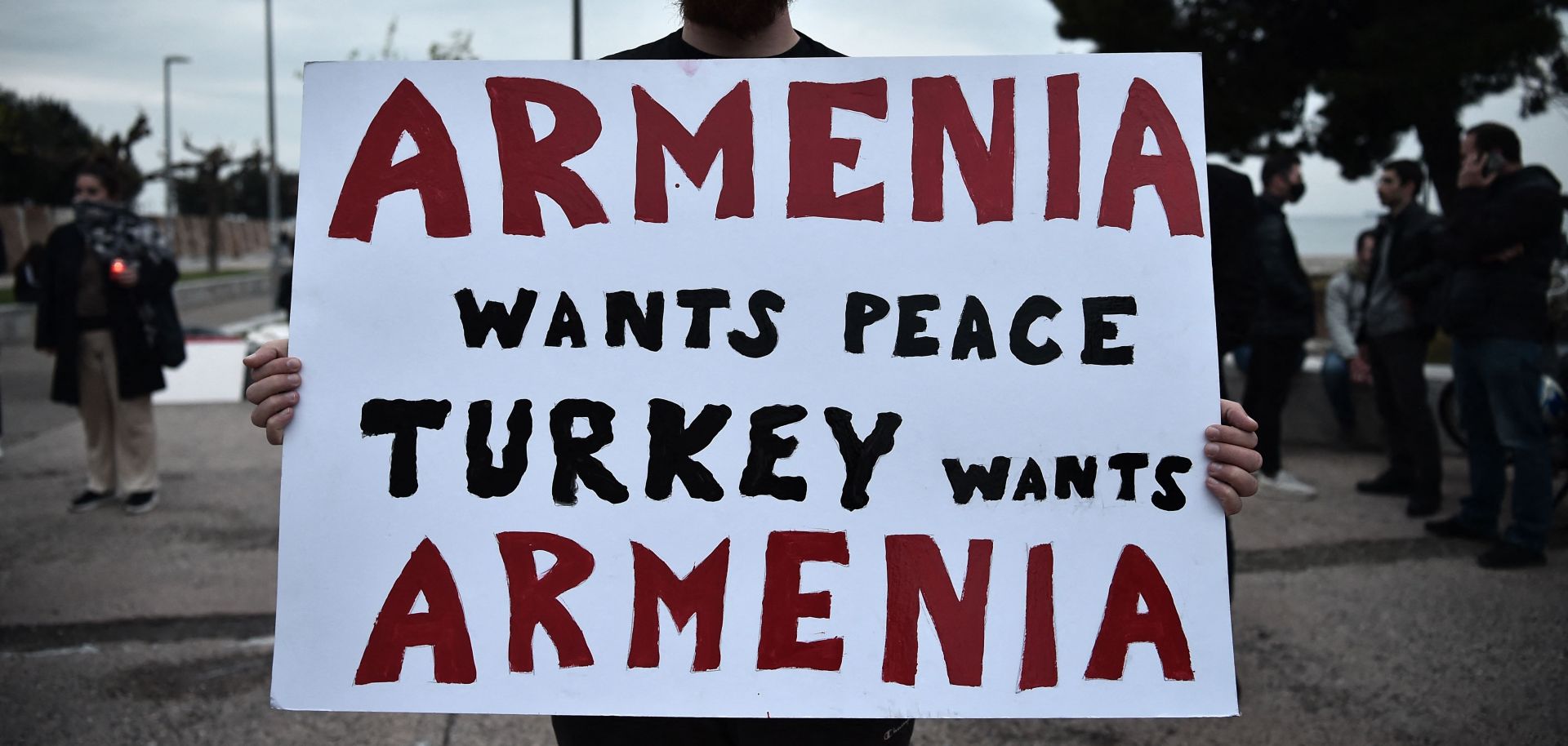
A demonstrator holds up a placard during a rally in northern Greece in April 2021 to commemorate the 106th anniversary of the Armenian genocide.
Despite recent moves, Armenia is unlikely to advance normalization with rival Turkey until there is greater progress made in Yerevan's territorial disputes with Turkey-backed Azerbaijan, risking a collapse in normalization talks that would leave Armenia isolated in the Caucasus. On Oct. 6, Armenian Prime Minister Nikol Pahsinyan and Turkish President Recep Tayyip Erdogan held the first in-person talks between the leaders of the two countries in 13 years as part of an ongoing effort to establish diplomatic relations. In July 2022, Erdogan and Pashinyan pledged in a rare phone call to continue efforts to normalize relations between the two after decades of estrangement, saying they would work to open their borders to third-country nationals and start direct cargo flights between them. The talks came after a rare summit between the two countries' representatives in Moscow on July 1, where the pledges to pursue normalization were initially struck. However, in September, Turkey's ally Azerbaijan began military operations both in disputed Nagorno-Karabakh territory and against Armenia proper to militarily pressure Armenia to adhere to the terms of the November 2020 cease-fire that ended the most recent conflict between the two sides, which Azerbaijan decisively won. Russia, which formally backs Armenia, has since been charged with enforcing the cease-fire. But Azerbaijan appears to have taken advantage of Russia's distraction in Ukraine when launching its most recent military operations.
- Last month, deadly clashes erupted on the Azerbaijani-Armenian border, marking the worst flare-up of violence between the two countries since the 2020 conflict in Nagorno-Karabakh. In a Sept. 14 speech to Armenia's parliament, Pashinyan said his country has lost over 100 soldiers in the latest episode of fighting.
- Turkey initially recognized Armenia as an independent country in 1991 after the collapse of the Soviet Union. But the two never established full diplomatic ties due to Turkey's refusal to recognize the Ottoman-era genocide of the Armenians in 1915-16, as well as Ankara's continued close ties with Armenia's rival, Azerbaijan.
- Turkey closed its border with Armenia in 1993. In July, Turkey and Armenia agreed to open their border to nationals from other countries, but the border remains closed to Turkish and Armenian citizens.
- For decades, Armenia and Azerbaijan have been locked in a tense territorial dispute over Nagorno-Karabakh, which lies inside Azerbaijan's internationally recognized borders but is largely populated by Armenians. Repeated Armenian-Turkish attempts to normalize relations in the 1990s and 2008-09 failed because of Turkey's unwavering support for Azerbaijan.
- During the 2020 Nagorno-Karabakh war, Turkey provided military aid to Azerbaijan, including Bayraktar TB2 drones, which helped Azerbaijan battle Armenian troops and ultimately gain territory in the disputed region. Russia, which is allied with Armenia through the Collective Security Treaty Organization (CSTO), stepped in to mediate a cease-fire and provided 2,000 peacekeepers to uphold the agreement.
Armenia has sought normalization with Turkey primarily as it looks for other ways to counter Azerbaijan without Russian aid, but secondarily to increase trade ties, reunite families and enable access to Armenian historical sites inside Turkey. Armenia has long complained of insufficient Russian support in fending off threats from Azerbaijan's military forces. In the 2020 Nagorno-Karabakh war, Russia did not militarily intervene to protect Armenia in part for fear of triggering a greater conflict with Turkey, which enabled Azerbaijan to seize territory in the disputed region. And now, Armenia is even less able to rely on Russian military power as Moscow deploys more troops to its ongoing war in Ukraine — a reality made clear by Russia's failure to provide fresh support to Armenia in response to Azerbaijan's latest border attacks, despite Yerevan going so far as to invoke the CSTO's mutual defense clause on Sept. 14. From Armenia's perspective, if Russia is unwilling or unable to offer more support, improved relations with Turkey could help it convince Ankara to lobby Azerbaijan to refrain from attacking Armenia. Aside from mitigating the risk of Azerbaijani attacks, Armenian outreach to Turkey is also aimed at fostering new commercial ties; the two traded only around $270 million worth of goods in 2019, but their shared border suggests they could do much more. Normalized diplomatic ties could see the full reopening of the two countries' shared border — helping reunite the roughly 60,000-70,000 Armenians who still live in Turkey with relatives inside Armenia proper after nearly 30 years of separation. Armenians would be able to visit the numerous historical sites from Armenia's past that remain inside Turkey.
- Armenia's conventional military ability to counter Azerbaijan is limited. Its armed forces are smaller than Azerbaijan's and largely rely on Soviet and Russian equipment, which proved to be severely disadvantaged against Turkish drones used by Azerbaijan during the 2020 war. These same Soviet and Russian systems are also underperforming today in Ukraine, where Russia's battlefield setbacks have likely only further raised Armenian fears over Moscow's military capacity.
Meanwhile, Turkey is trying to boost its image as an international mediator to offset NATO criticism of its foreign policies, while also improving trade ties with Armenia and maintaining its working relationship with Moscow by potentially aiding a Russian ally. Turkey continues to face Western criticism for its ongoing political and economic ties with Russia amid the war in Ukraine. Normalized ties with Armenia could help Turkey deflect some of this criticism by enabling Ankara to further posture itself as a mediator — a strategy that has also seen Turkey diplomatically intervene in the Russia-Ukraine conflict, where it helped facilitate the grain export deal Moscow and Kyiv signed in July that helped ease global food prices. Increased trade with Armenia could economically benefit cash-strapped Turkey as well, as the two countries' trade ties were dominated by Turkish exports in 2019, suggesting they could find even more market share in the future. In addition, improved relations with Armenia would help strengthen Russo-Turkish relations, as Moscow prefers Turkey's mediation in the region over that of the United States or the European Union.
- Turkey's aggressive behavior in the Mediterranean and elsewhere (including Syria and Libya) have periodically prompted Western leaders to call for sanctions against Ankara. In recent weeks, Turkey has escalated its rhetorical threats against Greece's alleged military buildup near the Turkish coast. On Sept. 29, Turkey also said it plans to reinforce the country's military presence in the self-declared Turkish Republic of Northern Cyprus in response to the recent lifting of a U.S. defense trade embargo on Cyprus.
But while these drivers may keep Armenia and Turkey engaged in normalization talks, they're unlikely to make much headway until greater progress is achieved in mediating or resolving Armenia's dispute with Azerbaijan. The drivers to normalization will continue, while ome of the constraints to normalization, such as Armenian public opposition to relations with Turkey, have also weakened amid Russia's invasion of Ukraine and its inability to meaningfully support Yerevan, particularly following Azerbaijan's most recent attacks on Armenia on Sept. 13. However, Armenia is unlikely to advance normalization so long as Turkey backs Azerbaijan's attempts to expand its territory and/or forces Armenia to participate in negotiations with Azerbaijan that would result in painful concessions from Yerevan. Armenia will also similarly remain skeptical of Turkish outreach unless Turkey is able to slow or help freeze Azerbaijani military maneuvers against it. Turkey's government, meanwhile — which faces a tough re-election in 2023 — probably has an upper limit on its willingness to normalize with Armenia as well, as Ankara's unequivocal backing of Azerbaijan is widely popular among Turkish voters.
- Azerbaijan's recent border attacks appear aimed at forcing Armenia to sign a treaty that sees Yerevan reduce or renounce control of Nagorno-Karabakh. Such a treaty might also see Armenia cede some border territory to Azerbaijan in the demarcation process, as well as create a transport corridor for Azerbaijan so it can reach its enclave of Nakhchivan (which is surrounded by Armenia, Turkey and Iran). All of these goals are deeply unpopular with the Armenian public.
Another Azerbaijani offensive could cause Armenia to walk away from normalization talks with Turkey, which would sever Yerevan's ties to the one power able to effectively pressure Baku to halt attacks. Armenian Prime Minister Pashinyan will come under intense public pressure to break off talks with Ankara if Turkey backs Azerbaijan through another offensive. Pashinyan faced both popular calls for his ousting and a military coup attempt after the defeat in 2020, and has since then faced significant public pushback against signing a greater peace accord with Azerbaijan, which many Armenians oppose. But if Armenia walks away from talks with Turkey, it will be unable to find a partner able to counter Azerbaijan. Russia will remain focused on Ukraine, while the United States and European Union are unwilling to use their comparatively less leverage over Azerbaijan to force an end to the fighting, preferring a diplomatic solution that would ultimately see Armenia renounce all claims to Nagorno-Karabakh.
- U.S.-Azerbaijani relations have been anchored by decades of cooperation on counterterrorism operations, as well as moves designed to curb Russian influence in the region; Baku is part of NATO's Partnership for Peace program, which is designed to build trust between NATO and countries seen as potential allies.
- Armenia has a strong lobby in the U.S. Congress, in part because it is a democracy in a turbulent region and in part because of sympathy over the genocide. However, Armenia's hosting of Russian forces since the fall of the Soviet Union has prevented deeper relations from developing.
If, however, Armenia is able to normalize its relations with Turkey, and especially if it can do the same with Azerbaijan, it would seriously undermine Russia's influence in the South Caucasus. The economic opportunities and reduced threat of conflict opened by normalized relations with Turkey and particularly Azerbaijan would inevitably prompt Yerevan to increasingly question whether the benefits of maintaining its close economic and security relationship with Russia still outweigh the costs — especially amid Russia's war in Ukraine. On its own, this would result in less Russian influence, and in such a scenario, Moscow would face even greater threats if Azerbaijan then seeks to secure the rapid departure of Russian peacekeepers from its territory and realize the 2021 Shusha Declaration with Turkey; this calls for even closer economic, cultural and, most notably, security ties with Ankara. Significantly, Turkish President Erdogan said in June 2021 that his government would allow the establishment of Turkish (and, by extension, NATO) military installations in Azerbaijan, much to the chagrin of Moscow. While it remains unknown whether Turkey would follow through in doing so, the mere option represents a further erosion of Russia's long-declining influence in Azerbaijan in favor of Turkey.
