
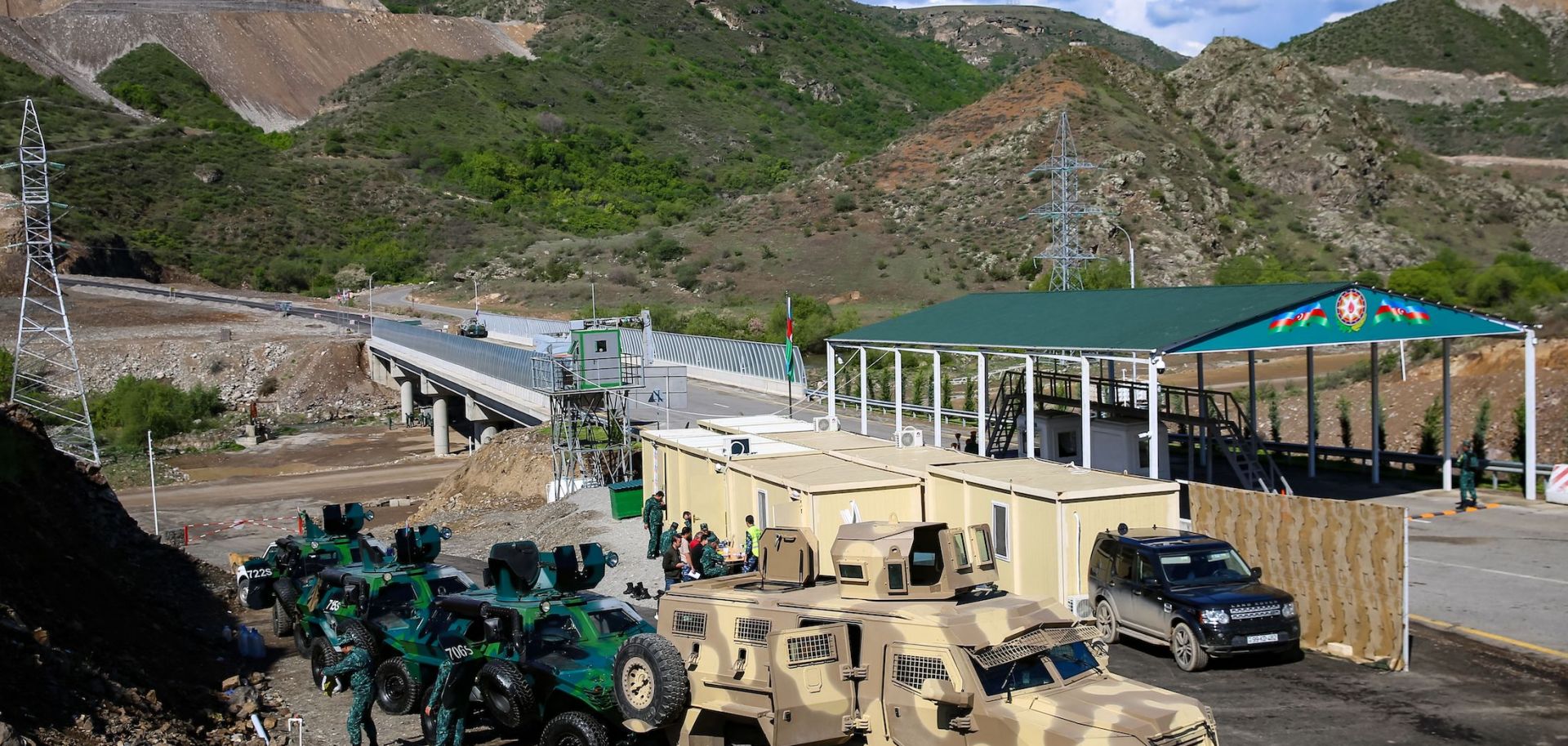
A photo taken on May 2, 2023, shows the new checkpoint set up by Azerbaijan at the entrance of the Lachin Corridor, the only land link connecting the disputed Nagorno-Karabakh region to Armenia.
As pre-election political calculations drive Turkey to slow its normalization with Armenia, Azerbaijan will be emboldened to increase pressure against Armenia in both peace talks and on the battlefield, which could raise the specter of another major conflict in Nagorno-Karabakh. On May 3, Turkish Foreign Minister Mevlut Cavusoglu announced that Turkey had closed its airspace to Armenian flights after Armenia opened a new monument in its capital commemorating a program to assassinate Ottoman and Turkish officials in retaliation for the Armenian genocide of 1915-16. The announcement came just days after an Armenian airline, Flyone Armenia, said it was denied entry to Turkish airspace without explanation. The diplomatic rift over the monument comes amid recent efforts by Turkey and Armenia to normalize their ties after decades of estrangement, which saw flights between the two countries resume in 2022 for the first time in two years.
- In early October, Armenian Prime Minister Nikol Pahsinyan and Turkish President Recep Tayyip Erdogan held the first in-person talks between the leaders of the two countries in 13 years.
- Turkey initially recognized Armenia as an independent country in 1991 after the collapse of the Soviet Union. But the two never established full diplomatic ties due to Turkey's refusal to acknowledge that the Ottoman Empire committed genocide against more than 1 million Armenians in 1915-16. The countries also remain at loggerheads over Turkey's continued close ties with Armenia's neighboring rival, Azerbaijan.
- During the 2020 Nagorno-Karabakh war, Turkey provided crucial military aid to Azerbaijan (including drones, weapons and intelligence) that enabled Azeri troops to gain territory in the disputed region and ultimately win the war against Armenia.
- Border skirmishes between Armenian and Azerbaijani troops have broken out in recent months, fueling fears of another conflict. In April, Azerbaijan installed a checkpoint on the Hakari bridge in the Lachin Corridor that isolated the Nagorno-Karabakh region from the rest of Armenia.
The Turkish government's intense response to Armenia's erection of a genocide-era monument is likely an attempt to win over nationalist voters ahead of Turkey's May 14 election. Most Turks are expected to cast their ballots based on economic concerns. But for some ultranationalist voters, the government's reaction to perceived affronts to their country's reputation — like the erection of a historical monument honoring those responsible for assassinating Turkish and Ottoman officials — could factor into their final decision as well. There are two major ultranationalist parties in Turkey: the Nationalist Movement Party (MHP), which is part of the governing coalition led by Erdogan's ruling Justice and Development Party (AKP), and the opposition Iyi Party. If the MHP fails to secure 7% of the vote in the upcoming election (which, according to polls, is a distinct possibility), the AKP would lose its parliamentary majority. The Turkish government's recent announcement that it was closing its airspace to Armenian flights is thus likely aimed at boosting support among those nationalist voters, who largely oppose normalizing with Armenia and are ardent that the Armenian genocide did not take place. With the election now just over a week away, the timing of the move further suggests it was politically motivated, especially given that Armenia already has dozens of genocide-related monuments, and that the construction of the new monument in Yerevan was well-known beforehand.
- Ultranationalist Turks often claim that the Ottoman-era genocide was a justified deportation exercise designed to defeat a pro-Allied Armenian insurgency during World War I. This claim is not supported by most historians or Turkey's key allies like the United States, but it is nonetheless a widely accepted theory among Turks.
Turkey's step away from warming ties with Armenia will embolden Azerbaijan to avoid concessions in peace talks and potentially further tighten its control of transport routes into Nagorno-Karabakh, which could upend the entire peace process and raise the risk of a fresh Caucasus war. From May 1 to May 4, Armenian and Azerbaijani negotiators met in Washington for U.S.-mediated talks over their continued disputes regarding the Nagorno-Karabakh region, which ended in little progress, failing to even produce a joint communique. The same day, U.S. Secretary of State Antony Blinken said that Armenia and Azerbaijan had made ''tangible progress'' in their peace talks, but failed to provide an example or any detail. The overall peace process has been undermined by Azerbaijan's recent construction of the Hakari bridge checkpoint, which Armenia claimed violated the cease-fire that ended the two countries' 2020 war over the enclave. With Turkey now signaling it might abandon its recent push to normalize ties with Armenia, Baku will feel more emboldened to reject any demands made by Yerevan, including that Azerbaijan set up safeguards for the Armenians living in the enclave. In the aftermath of the U.S.-mediated talks, Azerbaijan may also attempt to tighten its control of the Lachin Corridor, pressuring Nagorno-Karabakh to concede more autonomy to Baku by making it more difficult for Armenia to maintain trade and communication links with the enclave. If Azerbaijan speeds up its timetable for controlling Nagorno-Karabakh, it could spark a violent pushback from the population and prompt the Armenian government to try to defend the Armenians living there, ending the peace process and leading to a resumption of wide-scale hostilities.
- The Armenian government has traditionally served as the protector of Nagorno-Karabakh due to the region's large Armenian population. But recently, Yerevan has signaled it is prepared to concede the enclave to Baku's sovereignty in exchange for Azerbaijan recognizing Armenia's Soviet-era borders and agreeing to establish language, security and political protections for the Armenians who remain in Nagorno-Karabakh.
- Azeri nationalists deny the Armenian identity of Christian Nagorno-Karabakh. In the 1990s, the Azeri government destroyed an Armenian cemetery at Julfa near the Iranian border in an attempt to erase Armenian cultural claims to its territory.
- Azerbaijan established the controversial Lachin checkpoint on April 23, despite opposition from Russia, the United States and the European Union. On April 28, the Azerbaijanis who had been blockading the Lachin Corridor since December 2022 announced the suspension of their activities, suggesting that their blockage was redundant now that Baku had established formal control over the road via the new checkpoint. In an April 30 call with Azerbaijani President Ilham Aliyev, U.S. Secretary of State Antony Blinken expressed concern that the Lachin checkpoint would undermine confidence in the peace process.
- The Lachin Corridor is the only land route between Armenia and Nagorno-Karabakh, making its control of existential importance to the enclave of 150,000 people.
