
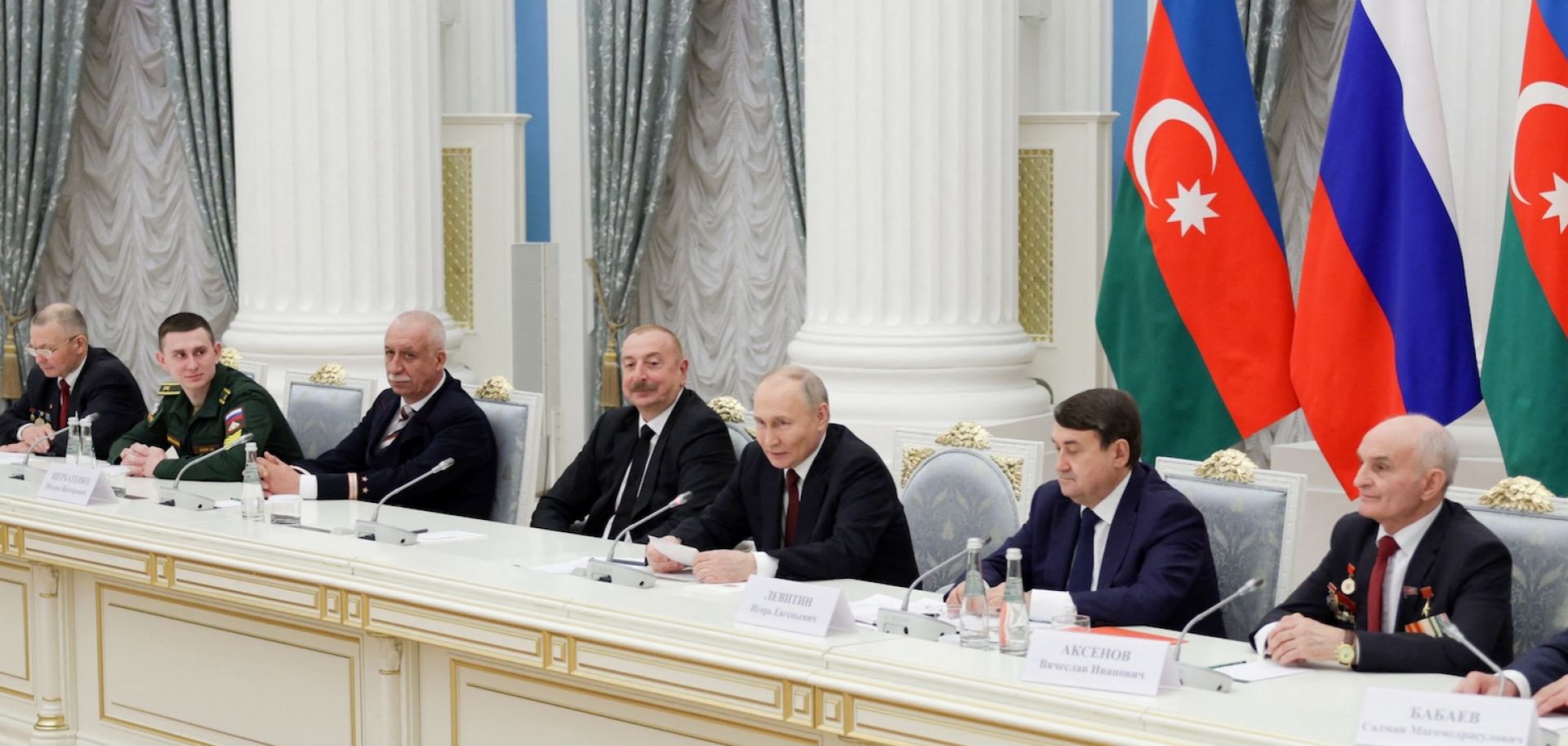
As South Caucasus states pursue policies of geopolitical balancing, Russia's position in the region is likely to remain stable in the near term. However, Moscow's influence is still on a trajectory of decline in the years ahead, creating opportunities for increased economic activity for China, Turkey and the West. Recent actions by Georgia, Armenia and Azerbaijan show how they are adjusting their foreign policies to balance global and regional powers. On Feb. 4, Armenian Prime Minister Nikol Pashinian gave a speech at the Atlantic Council in Washington, D.C., outlining his vision for closer relations with the United States and calling on Washington to facilitate its peace talks with Azerbaijan. On Feb. 7, Pashinian met with Vice President J.D. Vance to discuss Armenia-U.S. bilateral relations and the South Caucasus regional agenda. Meanwhile, on Feb. 6, Azerbaijan announced the end of the activities of Russia's civilian foreign aid and cultural organization, Rossotrudnichestvo, after the preliminary results of an investigation into the Dec. 25 crash of an Azerbaijan Airlines flight inside Russia confirmed that a Russian Pantsir-S1 anti-air system downed the aircraft. Finally, on Jan. 29, Georgia withdrew its delegation from the Parliamentary Assembly of the Council of Europe after the body passed a resolution calling for Tbilisi to hold new parliamentary elections, and on Feb. 6, Georgia's ruling Georgian Dream party announced it would fast-track repressive amendments to the country's administrative and criminal codes to curtail dissent, which immediately drew condemnation from European officials. These developments, which would have seemed unlikely a few years ago, highlight the shifting geopolitical alignment of all three countries.
- On Jan. 14, Armenia and the United States upgraded their relationship to a strategic partnership as Armenia seeks to distance itself from Moscow, which failed to support it in the 2020 war with Azerbaijan and beyond. Tensions with Russia began in 2018 when Pashinian came to power and ousted pro-Russian oligarchs and worsened after Russian peacekeepers failed to stop Azerbaijan's takeover of Nagorno-Karabakh in September 2023. As a result, Armenia has effectively frozen its role in the Russian-led CSTO and is strengthening military and political ties with the United States, Europe and other global partners.
- Azerbaijan's foreign relations have historically favored Turkey, considering Moscow's traditional support for Armenia. However, Russia's decision not to intervene decisively in support of Armenia in 2020 allowed relations to improve, culminating in a strategic partnership signed by the Russian and Azerbaijani presidents in February 2022, just before Russia's invasion of Ukraine. Ties became even more cordial after Azerbaijan's September 2023 capture of Nagorno-Karabakh, effectively resulting in Moscow abandoning its previous policy of decades shading toward Armenia in favor of closer relations with Turkey and Azerbaijan. Close Moscow-Baku relations were demonstrated through increased high-level meetings, such as Putin's first visit to Azerbaijan in six years in August 2024. Azerbaijan's termination of USAID's activities in Azerbaijan in June of 2024 suggested the country was drifting toward greater alignment with Russia, China and the anti-Western bloc.
- After years of a nominally pro-Western government pursuing Euroatlantic integration, Georgia's ties with the West soured in May 2024 when the Georgian Dream government passed a 'foreign agents' law that Western governments condemned. Georgian Dream came to power in 2013 on a mandate of reducing tensions with Moscow after the two countries' 2008 war, but over the past decade, had pursued integration with the European Union. The United States elevated relations to a strategic partnership in 2009, which the outgoing Biden administration suspended on Nov. 30, 2024. On Feb. 8, Georgian Prime Minister Irakli Kobakhidze said he was optimistic that the strategic partnership with the United States could be restored under the presidency of Donald Trump.
The South Caucasus is home to key trans-regional transit corridors for trade and energy, most critically the Trans-Caspian Corridor, which makes the region an increasingly important battleground for the influence of regional and outside powers. Russia seeks to exert influence in the South Caucasus as a buffer zone, given Russia's tenuous hold over the North Caucasus, home to some of Russia's most poorly integrated regions, such as Chechnya and Dagestan. Turkey sees the region as a potential sphere of influence and a vital trade, energy and security connection to the rest of the Turkic-speaking peoples of Central Asia. Iran views the region as a buffer against Russia, its historic rival, but even more so against Turkey, which it fears could collaborate with Azerbaijan to seal its northern border — especially if the Zangezur Corridor is established, creating a direct land link between Turkey and Azerbaijan. Arguably, the main reason for the South Caucasus' rising geopolitical significance is the Trans-Caspian Corridor, also known as the Trans-Caspian International Transport Route (TITR) or the Middle Corridor. This route represents the fastest route to Europe from China that bypasses the heavily sanctioned jurisdictions of Russia and Iran, doing so largely overland by crossing the Caspian Sea, and therefore is of great importance to numerous outside parties. For this reason, the TITR has, over the past four years, seen a sixfold increase in overall freight volumes to over 4.1 million tons in 2024, including a 25-fold increase in freight volumes from China to Europe in 2024 compared to 2023 alone. The corridor is vital to China, Europe, the United States and Turkey for similar reasons. The corridor's operation enables the states to access the global market and reduces their reliance on Russia or China for trade.
- The region is also a key energy hub, with major oil and gas pipelines, including the Baku-Tbilisi-Ceyhan (BTC) pipeline, which transports Azerbaijani crude to global markets and now also carries Kazakh oil shipped across the Caspian. Additionally, it is becoming increasingly important for green energy — in September 2024, Azerbaijan, Romania, Georgia and Hungary launched a joint venture to build the Black Sea Energy submarine electric cable, which will transmit renewable electricity from Azerbaijan's future offshore wind farms through Georgia and the Black Sea to Romania.
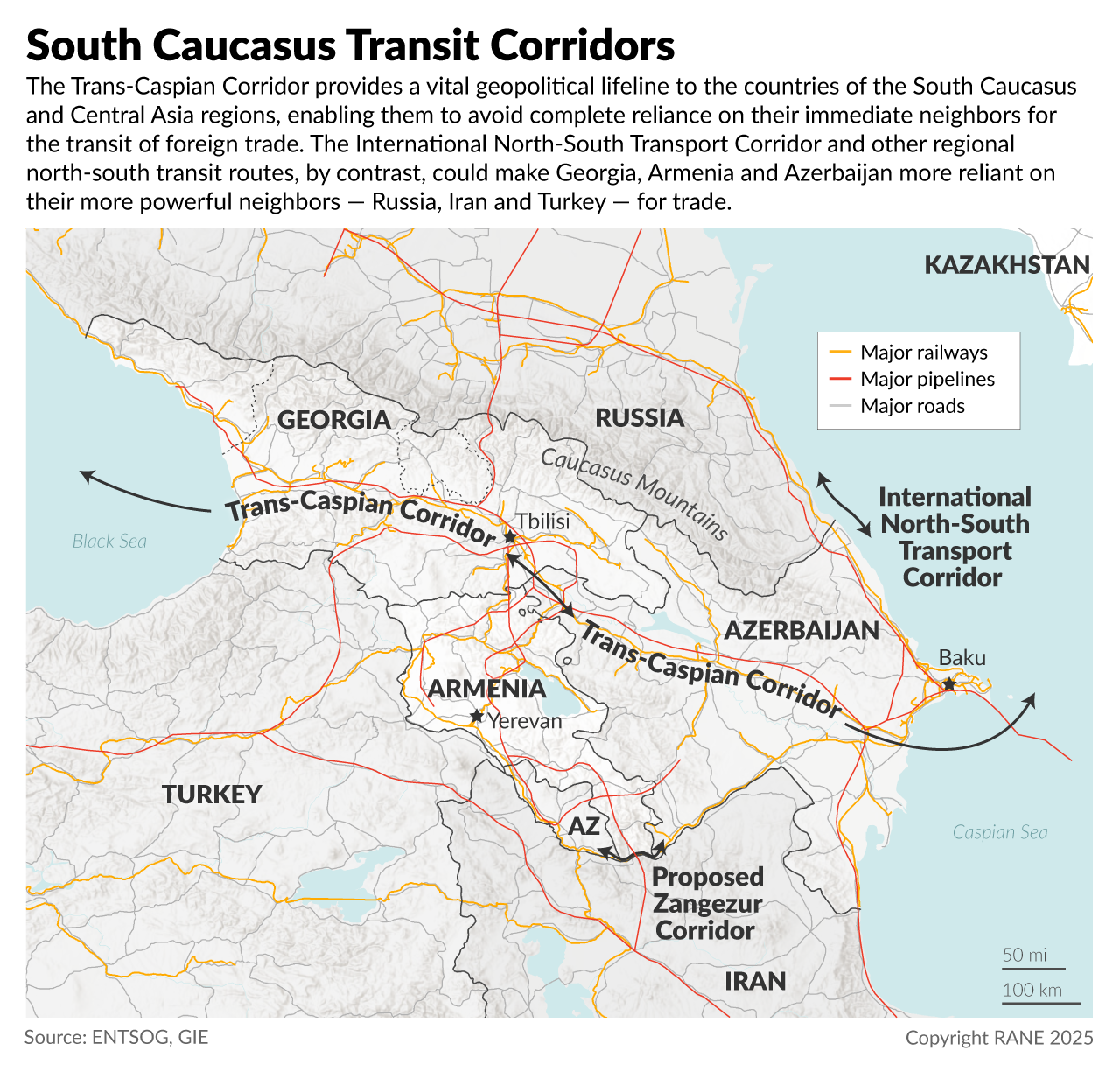
While Armenia will push to reduce its overreliance on Moscow in favor of greater Western ties, Yerevan's high economic dependence on Russia will prevent a rapid break in the coming years. Because of continued disappointment in its previous alignment with Russia and its hope for greater economic benefits from closer ties to outside powers, Armenia will continue to reduce its security ties with Moscow, maintaining the freeze of its membership in the CSTO and replacing imports of Russian arms with Western ones. It will also push its vision for the future development of regional transit corridors known as Crossroads of Peace, which seeks to improve Armenia's transportation links to Azerbaijan, Georgia, Iran and Turkey and thereby ensure the country has more economically viable routes to trade with its key partners and reach global markets, making itself a part of the Transcaspian corridor that currently runs through Georgia. However, because the Trump administration is likely to lean on close relations with Azerbaijan as a regional counterbalance to Iran, Yerevan likely will not feel that it has strong enough backing from the United States or European powers to decisively break from Moscow in the years ahead, instead retaining its policy of geopolitical balancing. The main obstacle to Yerevan decisively distancing itself from Moscow is economic, as trade with Russia accounts for over 41% of Armenia's foreign trade turnover. Rapidly reducing this reliance could jeopardize the country's strong economic growth — over 6% in 2024 — which has been key to maintaining political stability under Prime Minister Pashinian. This means that Armenia is unlikely to exit the Russia-led Eurasian Economic Union customs union until at least several years after the country's next parliamentary election in 2026, which will likely be a mandate on Pashinian's policies of steadily reducing dependencies on Moscow.
- On July 31, 2024, Russia's FSB completed the withdrawal of its border guards from Yerevan's Zvartnots International Airport, which Yerevan demanded amid mounting tensions between the two countries. Pashinian has accused Russia of supporting a protest movement and coup attempts against him.
Despite the current tensions, Russia and Azerbaijan have strong reasons to maintain stable ties in the short to medium term, but in the long run, Baku will prioritize closer relations with Turkey and other powers over Moscow. Baku's response to the downing of the airliner was in part driven by grassroots outrage over Russia's botched response to the shoot-down. However, it was also a strategic move by Baku, leveraging the incident to signal to Moscow that it has alternative geopolitical options and that Russia must make concessions to preserve strong relations. Baku calculates that its relations with Washington and the European Union will likely improve in the coming years as the United States and the European Union are less likely to let questions over Azerbaijan's human rights record and conduct in Nagorno-Karabakh obstruct geopolitical drivers for improved ties, such through energy purchases and the Trans-Caspian corridor. However, Azerbaijan-Russia relations are unlikely to significantly degrade further in the short term, as Baku believes its close ties with Moscow give it leverage over Yerevan in the ongoing peace treaty negotiations, while Moscow wants to prevent Azerbaijan from becoming a satellite of Turkey. Additionally, Azerbaijan gains immediate advantages from Russia's reliance on its key sanctions-evasion trade routes, including the International North-South Transport Corridor (INSTC), which will facilitate Russian freight transit to Iran via Azerbaijan, and potentially onward to India. This dependence strengthens Baku's leverage over Moscow while enhancing its role as both an East-West and North-South transit hub. However, in the long run, particularly in the scenario that a peace deal with Armenia be reached, Azerbaijan's foreign policy is likely to increasingly favor NATO-member Turkey and, to a lesser extent, China and the West rather than Russia. This is because Baku is unlikely to see the economic opportunities offered by closer ties with Russia, a competitor in Azerbaijan's hydrocarbon industries, as preferable to the benefits of increased economic interconnection with Turkey, China and Europe, whose economies are either larger or projected to grow faster than Russia's in the years ahead. Baku also has concerns about Moscow's willingness to use economic coercive measures, and even military force as it has in Georgia and Ukraine, to prevent Azerbaijan from decoupling from Russia and integrating with Turkey.
- Positioned between Russia and Iran, Azerbaijan plays a crucial role in their efforts to strengthen economic and security ties, which the two formalized with a strategic partnership agreement on Jan. 21, 2025. On Feb. 11, President Aliyev approved an intergovernmental agreement with Russia to develop the International North-South Transport Corridor (INSTC) project.
- China and Azerbaijan upgraded their relations to a strategic partnership in July 2024, with the two countries' presidents signing an agreement pledging cooperation on China's Belt and Road initiative to advance the construction of the Trans-Caspian International Transport Route and stable operation of China-Europe freight trains, deepening cooperation in such fields as trade, investment, oil and gas, and other spheres.
Georgia will continue its policy of geopolitical balancing and likely prevent a significant worsening of ties with the West, while Moscow could double down on exerting influence in Georgia in the years ahead to compensate for tenuous leverage over Baku and Yerevan. Despite Georgia's growing authoritarianism, the country does not seek alignment with Russia because over 80% of Georgians support Georgia's EU membership rather than integration with Russia, which nearly all Georgians view as a hostile power occupying around 20% of its territory. Instead, Tbilisi will seek to maintain productive ties with the United States, Turkey, Russia, Europe and China to conclude more commercially and politically favorable deals in the coming years. As Georgia's relations with the United States and European Union worsened as a result of the ruling Georgian Dream government's intolerance of dissent, Tbilisi will likely seek to stabilize its relations with them in the coming years. Tbilisi calculates that the Trump administration will offer a modest restoration of ties to prevent the country from sliding closer to China and Russia and that the United States could partially restore elements of the Strategic Partnership suspended under the last administration. The Trump administration will likely conclude that increased sanctions pressure would only push Georgian authorities into an even more authoritarian vector and could instead quietly offer to remove some sanctions on Georgian officials and to restore some cooperation to dissuade Tbilisi from significantly deepening commercial and political ties with China, Russia and Iran over the next four years. Meanwhile, Moscow will likely seek to increase its influence over Georgia because as long as there is no peace agreement between Armenia and Azerbaijan, the Trans-Caspian Corridor will remain reliant on Georgia, and if its government were to become more pro-Russian or the country to become destabilized, this could shut this trade route and effectively prevent the states that use it from engaging in geopolitical balancing away from Russia. This will likely mean rewarding Georgia through deepened commercial contacts. However, in the long term, particularly should the Russia-Ukraine war end and Tbilisi not reorient further toward Moscow in its economic and security affairs, Russia could resume threats of military aggression toward the country, undermining its stability. For this reason, ties with China and Turkey will likely feature heavily in Georgia's foreign policy, using their investment in the Trans-Caspian Corridor infrastructure to deter Russian coercion attempts.
- Speaking to the Georgian Parliament on Feb. 4, Georgian President Mikheil Kavelashvili said Georgia's relations with the United States would undergo a reset, arguing that the convergence of conservative and traditional values provided confidence in the reset of U.S.-Georgian relations under the Trump administration. The Trump administration has not yet made notable moves or statements regarding its policy toward Georgia.
- Tbilisi's acceptance of Chinese influence was reflected in the strategic partnership they signed in July 2023, and in the May 2024 awarding of a Chinese-led consortium (over American and European bidders) to build the Anaklia deepwater port, Georgia's first deep-sea port. When completed in 2029, it will further boost China-EU trade capacity and shorten travel time along the Middle Corridor to Europe.
If Armenia and Azerbaijan reach a peace deal and open transit routes bypassing Russia, the region's geopolitical balance will further shift away from Moscow, boosting the economic presence of Turkey, China, and, to a lesser extent, the European Union. Slow but steady progress toward a peace deal between Armenia and Azerbaijan will likely continue. Either side could use the still incomplete demarcation of the border or disagreements on issues such as regional transit corridors and constitutional changes as grounds to delay the deal, but a compromise deal is still in both sides' interest due to the potential economic benefits, and therefore, is likely in the coming years, even though the low-likelihood possibility for major military escalation will persist. Assuming a deal is reached, Russia's influence in the South Caucasus will likely wane as both Armenia and Azerbaijan strengthen ties with Turkey and the European Union, drawn by the prospect of greater economic opportunities. Increasing trade with other partners will likely motivate Armenia to consider leaving Moscow's Eurasian Economic Union. Turkey has indicated it is prepared to swiftly finalize the normalization of its diplomatic relations with Armenia as soon as Armenia and Azerbaijan reach a peace agreement, believing this would facilitate the entire South Caucasus region falling into its sphere of influence. This combination of a peace treaty and a reduction of Russia's involvement in the South Caucasus would also make European, American and Chinese investors more ready to invest, as the risk of major conflicts would be perceived as lower. Investments, including in infrastructure such as the Trans-Caspian Corridor, would trigger a cascading effect of further reduced trade ties between the region and Russia, which could have difficulty finding alternative trade partners. Increased competition for economic influence in the region would become yet another aggravating factor in the already complex triangle of Russian-Turkish-EU relations.
