
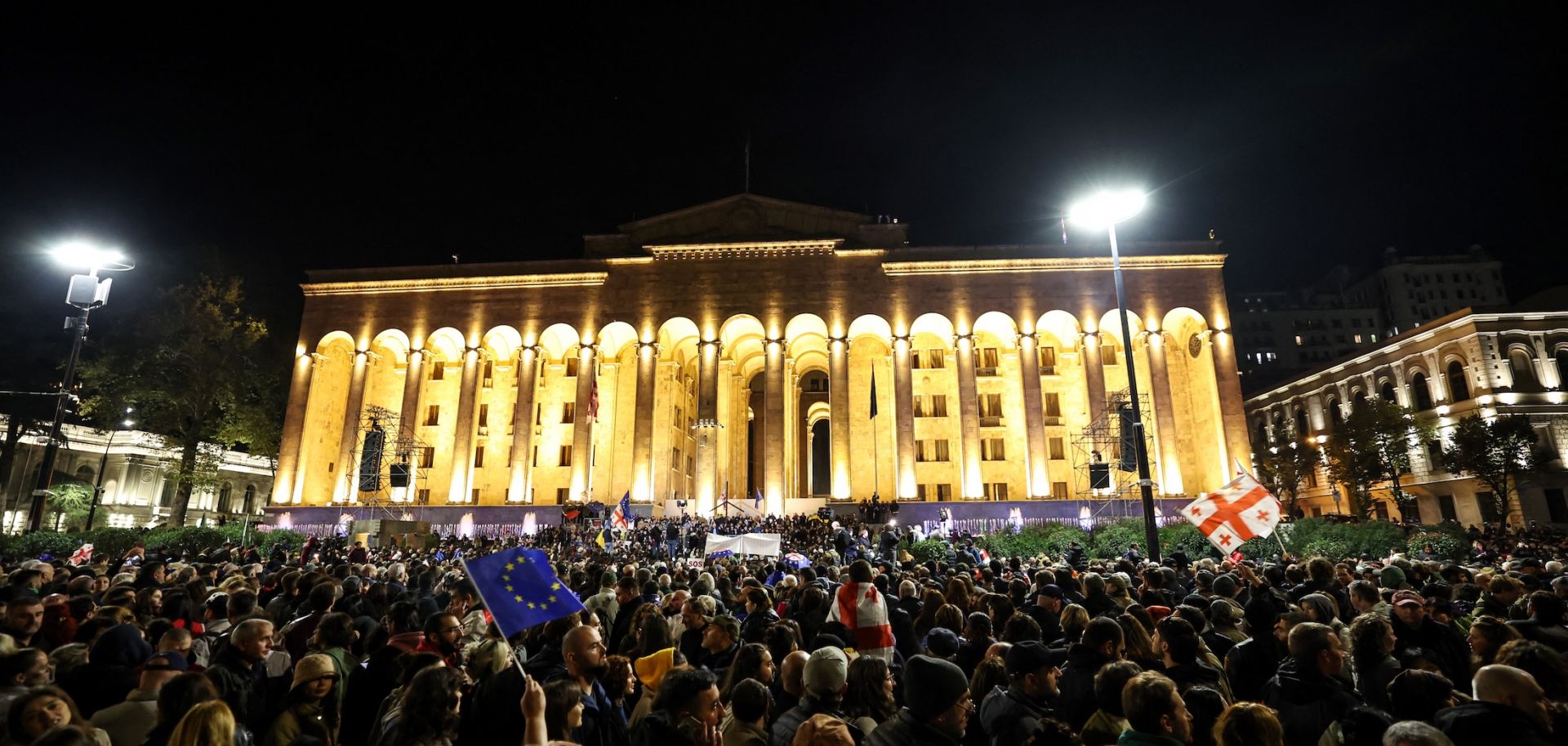
Georgian Dream's claimed victory in the parliamentary election will commence a prolonged protest movement and potential political crisis. Initial signs suggest the opposition movement is unlikely to assume power, meaning Georgian authorities will continue geopolitical balancing between the West on one side and Russia and China on the other. On Oct. 26 Georgia held its parliamentary election. According to the official results, the ruling Georgian Dream party won with 53.9% of the vote, while the combined share of four opposition forces that passed the threshold to enter parliament totaled 37.8%. Accordingly, Georgian Dream and its ally, the far-right People's Power party, will have 89 seats in the 150-seat Parliament, one less than they won in the previous election in 2020. While still a comfortable majority for governing, the number falls 10 short of the two-thirds majority needed to change the country's Constitution absent support from other parties. Georgian President Salome Zourabichvili and all the opposition parties winning parliamentary seats declined to recognize the results of the vote, with the president saying the country was the victim of a Russian "special operation" to falsify the vote in Georgian Dream's favor. Independent observers indeed documented widespread violations including mass voter fraud, physical intimidation and vote buying, which were corroborated by statistical irregularities in the official results. The protest movement against the result commenced only two nights later on the evening of Oct. 28.
- Transparency International noted more than 1,000 violations of voting procedures, including ballot stuffing that led to several voting locations' having their results canceled. The most serious accusation — later corroborated by statistical analysis of the results — was that individuals used the state ID numbers of individuals who did not vote to engage in fraudulent voting on behalf of Georgian Dream, particularly in rural areas. Statistical analysis later showed that turnout was anomalously high in rural districts and unusually supportive of Georgian Dream in ruling areas, suggesting voter fraud.
- According to the Georgian Constitution, the first meeting of the newly elected Parliament shall be held no later than the 10th day after the results of the parliamentary elections have been officially announced. The president calls the first meeting of Parliament, which is authorized to start work if a simple majority (or 76 members) of the total number of the Members of Parliament is present at the first meeting. Parliament shall acquire full powers and terminate the previous Parliament only once the mandates of two-thirds of members are recognized by a simple majority vote, despite the opposition boycotting these votes. The calling of the Parliament is a technicality, not something the president can use to obstruct Georgian Dream's new Parliament from assuming power.
Despite credible accusations of fraud, the Western response has for now been muted, which does not bode well for the opposition's protest movement. The Organization for Security and Cooperation in Europe, the most authoritative organization for forming Western government assessments of the validity of the election, denounced widespread violations in its initial postelection assessment but declined to specify the nature and scale of the irregularities. As a result, Western governments noted widespread irregularities but did not say they would reject the election's results. This means that the future of the evolving crisis will now depend on the size, regularity and risk tolerance of the protest movement, as well as the degree of Western support for it. The Georgian opposition will likely seek to occupy portions of central Tbilisi, and will understand that intermittent protests will not apply enough pressure on the government to obtain its desired effect given how this approach largely failed after the 2020 election. To successfully oust Georgian Dream, the movement would need to become a Euromaidan-style occupation protest involving strikes and to paralyze commerce in the capital. Successfully occupying central portions of the capital for an extended period would require significant financial resources to fund encampments and defensive barricades and help ensure participants are fed despite skipping and even losing their jobs. Many Georgians sympathetic to the opposition doubt that such attempts will succeed despite a powerful opposition presence in Tbilisi. This suggests the movement will need to draw stronger support from Western governments — with foreign officials regularly traveling to support the movement and highlighting the concrete reductions in cooperation that would result in a failure to accommodate the protesters — if it is to succeed.
- U.S. Secretary of State Antony Blinken said that while international observers have not declared the result to be free and fair, the election was "generally well administered" and declined to say that the United States would reject the outcome, instead only calling for investigations of alleged violations. Similarly, European Commission High Representative of the Union for Foreign Affairs and Security Josep Borrell cited the OSCE's conclusions and declined to call the results invalid. This stands in stark contrast to the bloc's reaction to a contested 2020 presidential election in Belarus, where the European Union and its members quickly called the official results illegitimate and began supporting the opposition while imposing sanctions on ruling authorities.
- Hungarian Prime Minister Viktor Orban immediately congratulated the ruling party and traveled to Georgia on Oct. 28 to bolster the election's legitimacy and suggest that he would pursue stronger cooperation between Georgia and the European Union and veto major EU efforts to isolate Georgia diplomatically. The European Union quickly clarified that Orban does not represent Brussels on the matter.
Despite the upcoming social unrest, Georgian Dream will stay in power and pursue foreign and domestic policies similar to those it has pursued in recent years, focusing on social conservatism at home and deepening productive commercial relations with Russia and China. Georgian Dream will also, however, seek to prevent further deterioration in its relations with Western governments. While major improvement is unlikely due to Georgian Dream's refusal to reverse the so-called foreign agent law that was a major factor in the worsening of relations with the West, a halt in the deterioration allowing continued cooperation would likely be possible should Georgian Dream decline to implement the most aggressive elements of its campaign rhetoric, such as banning opposition parties and activities. Georgian Dream efforts could receive a boost should former President Donald Trump win the U.S. presidential election and try to dissuade it from significantly deepening commercial and political ties with Russia and China over the next four years. Georgian Dream would likely go along with a second Trump administration, as it views Western recognition as a stronger assurance of regime security and Georgia's economic prosperity.
- The European Union is Georgia's biggest trading partner, accounting for 20.2% of the country's trade turnover by value. Turkey is the country's next largest, while the United States was the country's second-largest source of imports in 2023. Georgia's economic prosperity is largely premised on its ability to serve as conduit between its eastern neighbors, including Russia and China, and the West, which would be endangered by stronger Western sanctions on the country.
- Georgia's main export partners also include Russia and partially aligned states such as Armenia, Azerbaijan and in Central Asia, with which it engages in the reexport of Western goods to Russia, including transactions in violation of Western sanctions.
