
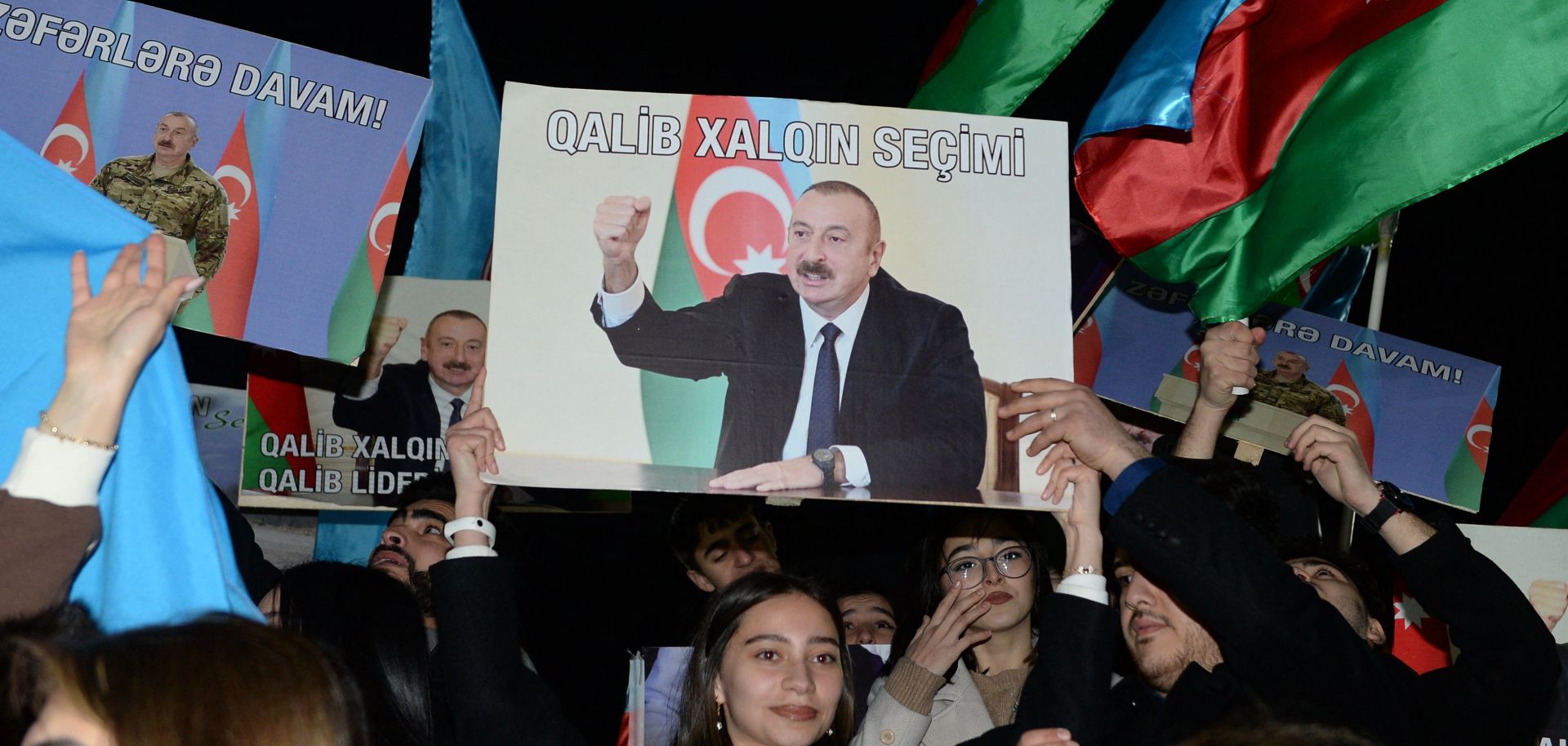
The re-election of Azerbaijan's president will clear the way for the country to continue pressuring Armenia to accept a peace deal under Baku's terms, and will keep alive the threat of further aggression. On Feb. 7, Azerbaijani President Ilham Aliyev resoundingly won a snap presidential election after receiving over 90% of the vote, an all-time high. The election was held a year earlier than scheduled, presumably to enable Aliyev to capitalize on his popularity following Azerbaijan's seizure of the disputed Nagorno-Karabakh region in September 2023, which effectively restored the country's internationally recognized border with Armenia. The election campaign was uneventful, with the main opposition groups again boycotting the vote as they have done for the past two presidential elections, while quasi-opposition candidates running alongside Aliyev praised his regime.
- Notably, some extremist candidates called for Azerbaijan to recover its ''historic territories,'' including Armenia's Syunik province (known to Azeris as Zangezur), as well as Iran's Azerbaijan province. Such statements were presumably intended to make Aliyev appear a measured and peace-minded statesman in comparison among foreign and domestic audiences.
- Representatives from the Organization for Security and Cooperation in Europe observed the vote, while representatives of other European institutions — including the European Parliament and the Parliamentary Assembly of the Council of Europe — were not invited.
The election took place at a time of rising tensions between Azerbaijan and the West amid Baku's efforts to deepen ties with Russia and China, and its continued threats of escalatory action toward Armenia. On Feb. 1, Aliyev said Azerbaijan was considering ceasing cooperation with European bodies, such as the Council of Europe (CoE) and the European Court of Human Rights, after the Parliament Assembly of the Council of Europe declined to ratify the Azerbaijani delegation's credentials this year due to Azerbaijan's failure to fulfill ''major commitments'' related to its 2001 membership in the CoE. While Azerbaijan's cooperation with these European institutions is relatively inconsequential, Aliyev's threat to leave them (and potentially downgrade cooperation in other platforms and formats) is intended to show that unless the West continues working with Azerbaijan despite its increasingly irredentist rhetoric and potentially escalatory actions toward Armenia, Baku will accept reduced European and transatlantic engagement in favor of deeper engagement with Russia and China via bodes like the Shanghai Cooperation Organization and Eurasian Economic Union. Along with steps Baku is already taking to deepen ties with Moscow and Beijing, Azerbaijan is trying to signal that the threat of Western isolation will not deter it from escalating against Armenia, and that if Europe and the United States want to continue using Azerbaijan's territory as a trade corridor and its energy exports as a way to ensure price stability, they will need to pressure Armenia to accept Baku's vision for a peace agreement.
- On Jan. 23, Russian Deputy Prime Minister Alexey Overchuk traveled to Azerbaijan to meet with Aliyev. During their meeting, the leaders emphasized that bilateral trade turnover between their countries had grown 17.5% in 2023, and also stressed the need to follow up on unspecified agreements reached between Aliyev and his Russian counterpart Vladimir Putin at an informal meeting of leaders from the Commonwealth of Independent States (CIS) in December. Specifically, Russia and Azerbaijan plan to sign a roadmap for the development of key areas of bilateral cooperation for 2024-2026, showing their deepening ties.
- Azerbaijan has also been increasing its trade with China, already a top trading partner. Rail freight volumes between China and Azerbaijan grew 47% in the first 11 months of 2023 compared with the same period last year, due largely to the growing use of the China-backed Trans-Caspian corridor. This growing trade would help Azerbaijan maintain economic connectivity should the country ever face Western sanctions or boycotts.
- On Jan. 22, EU foreign policy chief Josep Borrell expressed concerns over what he described as ''territorial claims'' to Armenia made by Aliyev, adding that ''any violation of Armenia's territorial integrity would be unacceptable and will have severe consequences for our relations with Azerbaijan.'' However, Baku likely calculates that this is a bluff because Europe has become increasingly dependent on gas and oil purchases from Azerbaijan following Russia's invasion of Ukraine. Furthermore, sanctions and efforts to isolate Baku would likely seriously threaten the Trans-Caspian corridor, an alternative transit route for freight between China and the European Union, by reducing the route's operations and attractiveness, which would, in turn, severely limit Europe's overland trade with Central Asia and China, or force it to go through Russia. This potential geopolitical and economic fallout is likely why the United States nor the European Union have avoided sanctioning Azerbaijan's seizure of an estimated 215 square kilometers (83 square miles) of internationally recognized Armenian territory since 2021.
- On Feb. 2, Armenian Prime Minister Nikol Pashinyan said his country could no longer rely on Russia as its primary defense partner due to Moscow's repeated failure to protect Armenia against threats from Azerbaijan, noting that 95-97% of Armenia's defense relations used to be with Russia. Pashinyan said Yerevan would adopt a new concept for the development of its army by the end of 2024, in which it would review interaction with other states and set out an idea with whom and how the country should cooperate in the defense sector — presumably with France and the United States playing increased roles.
With the election behind him, Aliyev could be even more willing to use force to both demonstrate and increase Azerbaijan's leverage against Armenia over the next year. Unless progress is made on border demarcation and the opening of regional transit corridors, the risk of Azerbaijan returning to escalatory action against Armenia will rise several months from now. There remain no signs of significant progress on the fundamental impediments to a peace agreement between the two countries — namely the demarcation of the border and the opening of the Zangezur transit corridor across Armenia on Baku's terms, which include no customs on goods and minimal security checks on goods transiting between Azerbaijan and its Naxcivan exclave. Without major progress on these issues, Azerbaijan could resort to escalatory shelling along the border — likely once weather conditions are favorable in the late summer and fall — to demonstrate its leverage over Armenia and threaten a return to full-scale war, potentially in the hopes of forcing Yerevan to cave to its demands. Renewed violence with Armenia ahead of the presidential election could have undermined Azeris' support for continued hostilities and deaths of Azeri soldiers, given that Azerbaijan has already restored its territorial integrity as internationally recognized. But with the election now behind him, Aliyev will be less constrained from taking such actions compared to if the vote had been held in early 2025 as originally scheduled, which will make the threat of clashes or a war in the fall of 2024 more credible.
- Armenia and Azerbaijan have made some progress on secondary issues related to a peace agreement in recent weeks. On Feb. 1, Pashinyan agreed to change Armenia's constitution and renounce the country's Declaration of Independence from the Soviet Union to remove any mention of recognition or unification with Nagorno-Karabakh — changes Aliyev has previously indicated were necessary for a peace agreement.
