
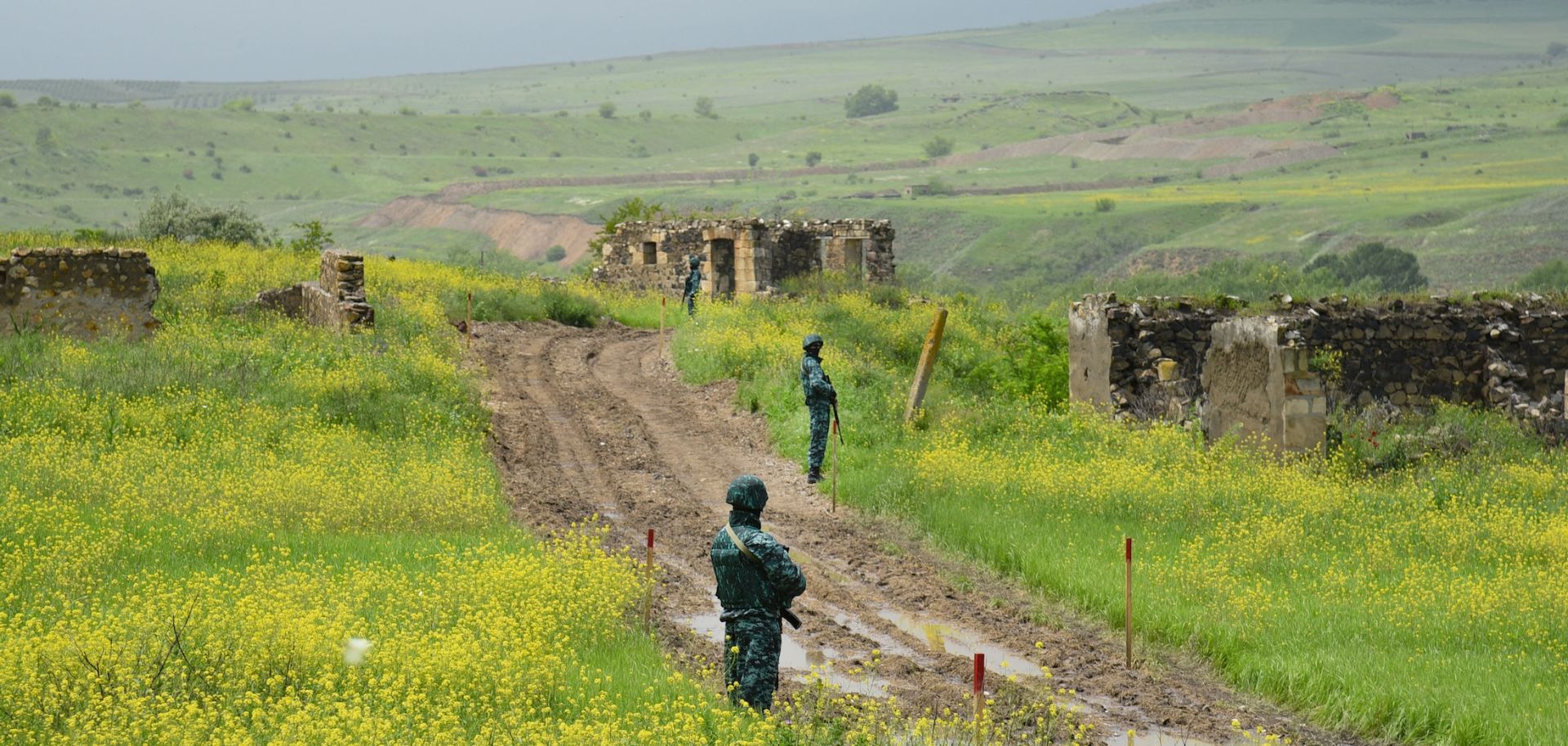
While some progress toward a peace agreement between Armenia and Azerbaijan is likely, disagreements on key areas will preclude the possibility of an agreement in the coming months, preserving the prospect of sudden military escalation. Speaking at the second Shusha Global Media Forum in Nagorno-Karabakh on July 20th, Azeri President Ilham Aliyev said that Armenian and Azerbaijani delegations have already agreed on up to 90% of the text of a peace treaty. However, Aliyev remarked that a number of Baku's conditions for a peace treaty remain unmet, including Armenia's dissolution of the OSCE Minsk Group, the largely defunct body responsible for facilitating a negotiated resolution to the conflict between Azerbaijan and Armenia over Nagorno-Karabakh since 1992 and, more notably, the necessity for amendments to the Armenian constitution removing reference to reunification with Nagorno-Karabakh. Aliyev also spoke of the need to develop regional transit corridors further to ensure lasting peace and economic development in the South Caucasus region. Aliyev's comments served as the latest reminder that significant obstacles to a peace deal between Armenia and Azerbaijan remain, meaning that sudden clashes and military escalation cannot be excluded. This is particularly the case as Baku has traditionally preferred the more favorable environmental conditions of late summer and early autumn for conducting military operations against Armenian forces.
- On July 25, Armenia's Foreign Ministry said Yerevan was preparing to respond to the 10th package of peace treaty adjustments, which it received from Azerbaijan on June 26. Armenia had last received a draft peace treaty proposal, the 9th edition of the text, on April 26th, to which it responded on June 4.
- The 2020 war between Armenia and Azerbaijan began on Sept. 27, 2020, and concluded on Nov. 10 of that year with a cease-fire. Deadly clashes between the two took place frequently from July through November 2021. On Sept. 12-13, 2022, the deadliest clashes since the end of the 2020 war occurred, resulting in nearly 300 casualties on both sides and Azerbaijan's occupation of Armenia's sovereign territory. On Sept. 19, 2023, Azerbaijan launched its military operation to seize the remainder of Nagorno-Karabakh, which local Armenian authorities at the time controlled.
Although progress on issues such as border demarcation is expected in the coming months, Baku's demands for Armenian constitutional changes and disagreements on regional transit terms will prevent a peace agreement for the foreseeable future. Armenia and Azerbaijan are likely to continue demarcating their border, a process that demonstrated significant progress when the two sides erected their first border demarcation post on April 23, 2024. The two sides have since installed over 40 border posts, and further meetings of the state commissions on border delimitation are likely to yield further progress in this area in the months ahead, including, notably, with regards to the future of each side's de jure enclaves surrounded by the other's territory. However, the lack of a breakthrough on two other issues will continue to block a peace agreement: The first is Aliyev's demand to remove any mention of Nagorno-Karabakh from Armenia's Constitution, a necessity already acknowledged by Armenian Prime Minister Pashinyan but decried by the opposition as yet another unilateral concession to Azerbaijan. In theory, his Civil Contract party could relatively quickly pass constitutional amendments without a referendum using its two-thirds majority in parliament. In practice, however, the major changes Pashinyan envisions would need to be put to a national referendum. However, Pashinyan has only instructed lawmakers and a constitutional commission to draft and approve changes by the end of 2026. The second main obstacle pertains to the operation of regional transit corridors, most specifically, the so-called Zangezur Corridor connecting Azerbaijan to the Naxcivan exclave across Armenia's territory. Here, there is little sign that the two countries have agreed to the technical details of the minimal customs and security check regime demanded by Azerbaijan. It appears increasingly likely that a solution will require the significant employment of technology, such as high-tech scanners, which may need to be financed by a third party, such as the European Union. Further complicating regional transit negotiations is Baku and Yerevan's desire to avoid upsetting the region's major powers — Turkey, Russia and Iran. These powers want any transit deal between Armenia and Azerbaijan to maintain the regional power balance and avoid establishing trade terms that favor one power over the others, such as through preferential terms and investment on specific routes.
Despite opposition to Pashinyan's pursuit of a peace agreement, a coup or major political unrest in Armenia is unlikely in the coming months. Starting this spring, a new protest movement against Pashinyan has emerged, led by Bagrat Galstanyan, a senior church official from Armenia's Tavush region. This movement began after Armenia withdrew from Azeri territory in Tavush as part of the initial border demarcation process in April. The movement is widely believed to be backed by pro-Russian political forces. However, former pro-Russian Armenian Presidents Robert Kocharyan and Serzh Sargsyan have so far declined to endorse or participate in it, likely doubting the movement's chances of success and perceiving unnecessary risks, although some of their supporters have joined. Domestic opposition to Pashinyan may grow as his detractors continue deriding his efforts to secure a peace agreement as unilateral concessions, particularly as Russia will likely increase its efforts to destabilize Pashinyan's government and bring pro-Russian political leadership to power. However, a coup attempt like the one in February 2021, or a popular uprising to remove Pashinyan, seems unlikely as most Armenians believe that his detractors lack a viable alternative policy platform. Additionally, Azerbaijan's larger and better-equipped military, along with its stronger, petrodollar-fueled economy, enables Baku to intensify provocative shelling and threaten military escalation until Armenia agrees to its terms. Among the obstacles to a peace deal, the most likely concession to provoke a coup against Pashinyan's government relates to the operation of the Zangezur Corridor. Specifically, concerns about inadequate security measures for controlling Azeri freight and passenger use of the corridor could lead military officers to believe that this might undermine Armenia's ability to defend its southern Syunik province. The domestic pressure on Pashinyan's government to find a safe solution makes a breakthrough even more unlikely this year.
