
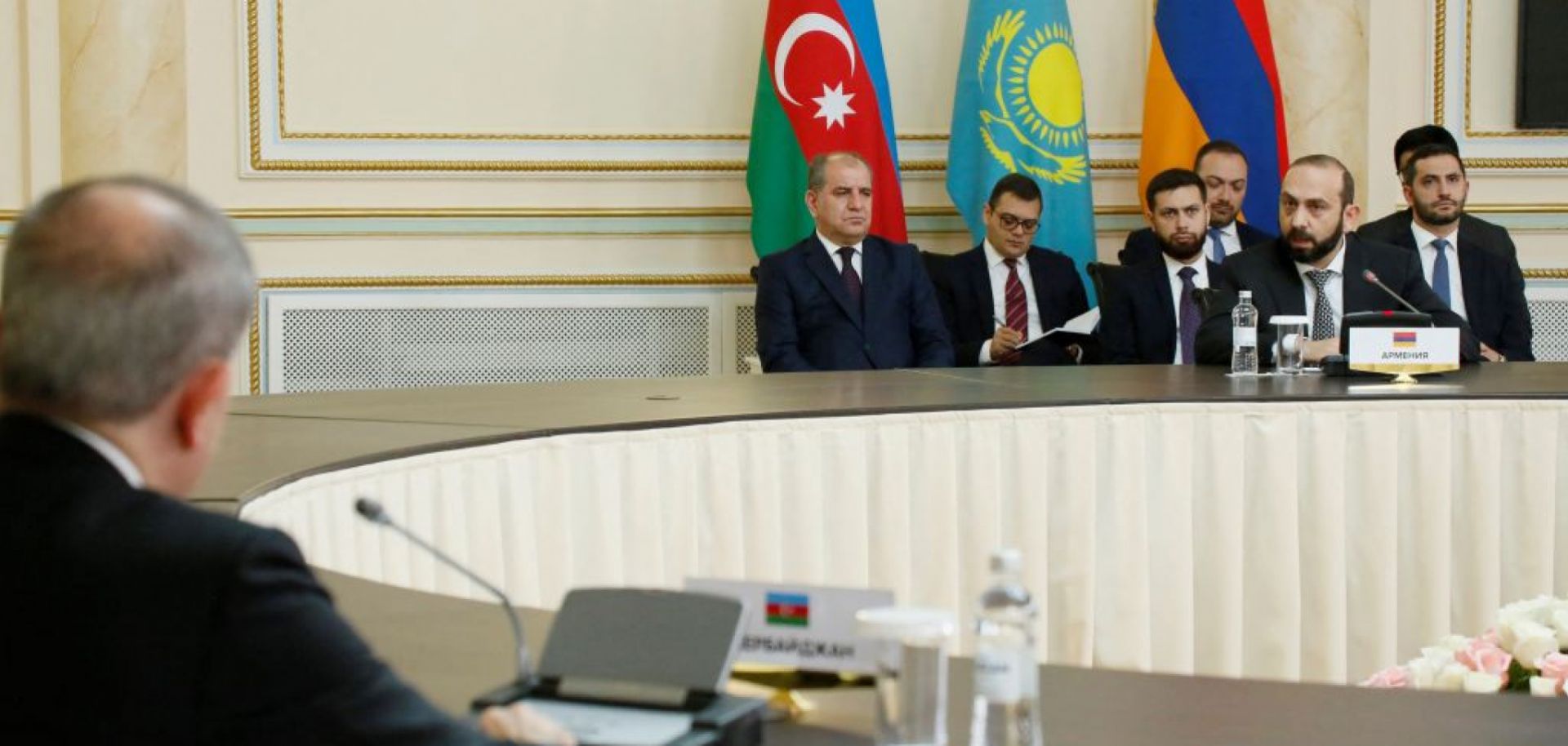
A peace agreement between Armenia and Azerbaijan is becoming increasingly likely, but internal political dynamics in Armenia may delay its implementation, opening the door to cross-border violence. In the meantime, Russia will use a combination of threats and cooperation offers to preserve its influence in the region. On April 2, Azerbaijani President Ilham Aliyev said that his country will not demand any additional changes to a peace agreement with Armenia that the two countries agreed on March 13. Still, Aliyev said that the agreement cannot enter into force unless Armenia introduces constitutional reforms to remove any references to what Baku perceives as Armenian claims on Azeri territory. On April 3, Armenia's Minister of Justice Srbuhi Galyan confirmed that her government is working on a new constitution and said that ''at some point'' the text will be made public. However, Galyan added, ''I don't think it's possible to have a new Constitution draft earlier than eight to ten months.''
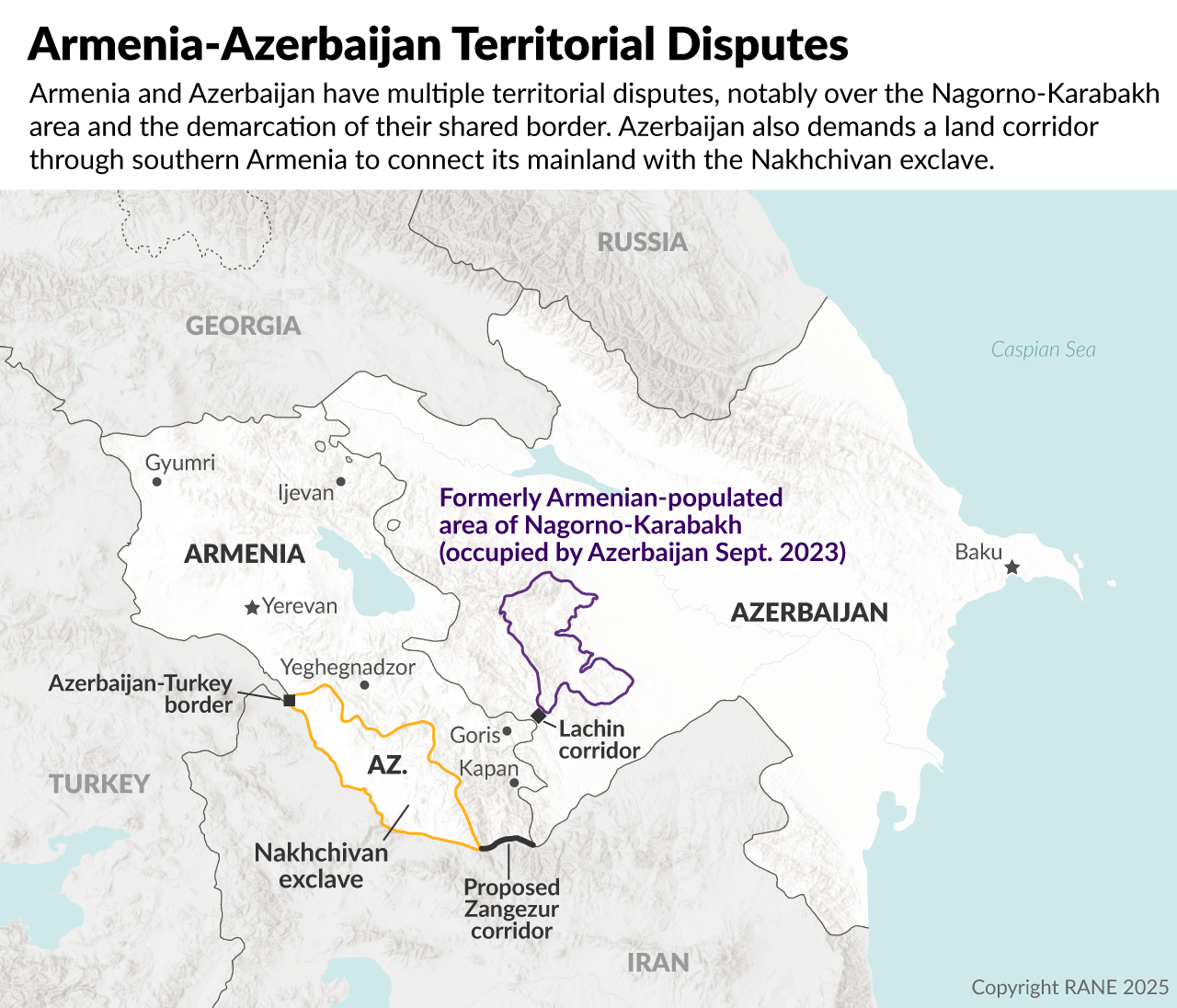
- Since the late 1980s, Armenia and Azerbaijan — two former Soviet republics — have engaged in multiple conflicts, mainly over Nagorno-Karabakh, a region within Azerbaijan that had a large ethnic Armenian population. In September 2023, Azerbaijan regained control of the territory through a military offensive, triggering the exodus of nearly all 100,000 ethnic Armenians to Armenia. The combination of territorial loss and Azerbaijan's clear military advantage prompted Armenia to pursue peace negotiations.
- On March 13, Armenia and Azerbaijan reached a peace agreement. In the document, both countries agree to recognize each other's territories as defined by Soviet-era maps, renouncing any future territorial claims. Armenia also promises to change its constitution to remove language that Azerbaijan perceives as claims over Azeri territory. Finally, the two governments agreed to dissolve the OSCE Minsk Group, which includes Russia, the United States and several European countries and was created in 1992 to reach a peaceful end to the Armenia-Azerbaijan conflict.
Armenia is likely to postpone its constitutional reforms due to ongoing domestic political challenges, a development that would sustain the risk of renewed Azerbaijani aggression. Despite Yerevan's promises, Armenia's domestic political environment will likely pose significant obstacles to advancing constitutional reform. Armenian Prime Minister Nikol Pashinian controls the necessary two-thirds of the seats in the National Assembly to make the changes, but the issue is controversial in Armenia because of the decades-long rivalry with Azerbaijan. As a result, Pashinian — whose government faced weeks of mass protests in 2024 opposing concessions to Azerbaijan — may opt to postpone such a politically sensitive decision until after the general election, which must be held by June 2026. This context also clarifies Galyan's remark that Armenia will require several months to draft a new constitution, implying that Yerevan will likely stall the process for several months in hopes of delaying the domestic political fallout until after the elections. Even if constitutional reforms are introduced, they would almost certainly necessitate a national referendum, as amendments concerning territorial integrity in Armenia require both parliamentary approval and public ratification through a nationwide vote. This could prove problematic considering both Pashinian's low popularity and the controversial nature of relations with Azerbaijan. Against this backdrop, delays in Armenia's constitutional reforms, along with the possibility of a referendum rejection, will sustain the risk of escalatory rhetoric and limited military actions by Azerbaijan. In recent years, Azerbaijan has launched multiple small-scale incursions into Armenian territory, blocking roads and harassing Armenian border villages. Baku has also issued numerous threats implying further military action if Yerevan does not agree to its demands. These tactics are likely to continue unless Armenia reforms its constitution and implements the changes.
If implemented, a peace deal would create significant economic opportunities for both Armenia and Azerbaijan. A peace deal would allow Armenia to reopen trade routes with Azerbaijan and Turkey, which would generate economic growth in Armenia and reduce reliance on costly alternative transportation routes for all the countries in the Caucasus. Opening new trade routes would also result in a marked increase in infrastructure investment in the region, as new roads and railways would be constructed and existing ones would be revamped. A durable peace would significantly improve Armenia's appeal to foreign investors by lowering geopolitical risk, while also reducing reputational concerns for Azerbaijan by curbing its persistent harassment of Armenian border villages. Nonetheless, persistent challenges such as corruption, bureaucratic inefficiencies and limited judicial independence in both countries would continue to pose obstacles to foreign investment. Peace could also lower defense spending in both countries, allowing funds to be redirected toward economic development and infrastructure. Finally, a deal would also make it easier for Armenia and Azerbaijan to increase their political and economic ties with the West, especially the European Union — which Armenia hopes to eventually join.
Meanwhile, Russia is likely to pursue a dual strategy of coercion and cooperation to maintain its regional influence. If the peace deal moves forward, Russia will likely attempt to curb Armenia's pivot toward the West in order to preserve its traditional sphere of influence over Yerevan. The Kremlin will likely threaten to restrict trade, labor migration or military support for Armenia unless Yerevan agrees to new regional security arrangements that preserve Russia's influence in the region. While Armenia is currently trying to reduce its economic, energy and military dependence on Russia, the Kremlin still has strong economic levers it can use against the country. This scenario will be particularly likely if the war in Ukraine ends under terms that are favorable to Russia, which would embolden the Kremlin to increase its efforts to remain influential in the South Caucasus. Moscow is also likely to deepen its strategic partnership with Baku — particularly in the energy and defense sectors — not only to capitalize on economic opportunities but also to counterbalance Turkish influence in the region and maintain leverage in its broader relationship with Armenia.
- In recent years, Russia and Azerbaijan have increased their energy and military cooperation. Russia is a key military supplier to Azerbaijan, as Moscow has sold advanced tanks, artillery and air defense systems to Baku. In 2022, Russia's Gazprom and Azerbaijan's SOCAR signed a deal to deliver Russian natural gas to Azerbaijan, helping the South Caucasus nation meet its domestic demand and export commitments to Europe. Azerbaijan has also increased electricity exports to Russia as part of regional grid integration efforts.
- In the meantime, Armenia has actively sought to reduce its dependence on Russia by diversifying its military suppliers and economic partnerships, partially because Moscow has failed to protect it against Azeri aggression. In 2023, Baku signed deals with France to purchase howitzers, radars and air defense systems. Armenia has also expanded military cooperation with the United States and NATO, and in 2024, Yerevan announced the freezing of its participation in the Russia-led Collective Security Treaty Organization (CSTO). In February 2025, Armenia's parliament approved a bill officially supporting Armenia's EU accession, which Armenian President Vahagn Khachaturyan signed into law on April 4.
- Still, economic ties between Russia and Armenia remain strong, as Yerevan imports more than 80% of its natural gas from Gazprom (which the company provides at discount prices), its Metsamor Nuclear Power Plant (which generates about 40% of Armenia's electricity) relies entirely on Russian nuclear fuel, Russia is Armenia's largest trading partner, and a significant portion of Armenia's GDP (about 8%-10%) comes from remittances, mainly from Armenian migrant workers in Russia. This means that despite Yerevan's ongoing diversification efforts, Moscow has significant levers to remain influential in the country.
Finally, a peace deal that does not address the problem of the Zangezur Corridor would leave the door open to a renewed conflict in the South Caucasus in the future. According to media reports, the March 13 agreement does not address Azerbaijan's demand for a direct land route to Nakhchivan — an Azeri exclave situated between Armenia, Iran and Turkey — commonly referred to as the Zangezur Corridor. For decades, Baku has demanded direct land access to its exclave, but Yerevan opposes any deals that would result in surrendering part of its sovereign territory. Iran also opposes granting Azerbaijan direct control over the corridor, as it would undermine Tehran's access to the South Caucasus and potentially enable direct land connectivity between Azerbaijan and Turkey — a development that raises concerns in Iran about the resurgence of pan-Turkic nationalism along its northern border, where a sizeable ethnic Turkic population resides. In addition, Russia is also skeptical about any deals that would increase Turkey's influence in the region. The implementation of the peace agreement between Armenia and Azerbaijan would create the conditions for negotiations over the Zangezur Corridor, and a deal on this issue would further strengthen the prospects for peace between Yerevan and Baku. However, the geopolitical issues connected to the corridor mean that both Iran and Russia will have an interest in the failure of negotiations over the corridor and could try to sabotage the process through threats, coercion and other political destabilization measures. This would leave an open door for the continuation of hostilities between Armenia and Azerbaijan even after the peace agreement is implemented.
- In recent years, there have been several proposals to allow the movement of Azerbaijani goods and citizens between mainland Azerbaijan and Nakhchivan while preserving Armenia's sovereignty. Some of these proposals involve the implementation of checkpoints and transit protocols, allowing Armenia to retain its control over who crosses its territory, combined with external oversight, such as personnel from the European Union to oversee the implementation of the deal and prevent any violations. While a potential deal may be struck within these parameters, there has been limited to no progress on this issue.
- In a low-probability but high-impact scenario, Azerbaijan could launch a full-scale invasion of Armenia to secure the Nakhchivan corridor in the short term. However, this is unlikely as this would likely trigger sanctions from the West at a time when Baku is seeking to improve its political and trade ties with Europe and the broader West. In addition, Iran and Russia would pressure Azerbaijan against such actions, as it would likely trigger a regional conflict. As a result, limited incursions, infrastructure blockades or skirmishes to intimidate Armenia are more likely than a full-on invasion.
