
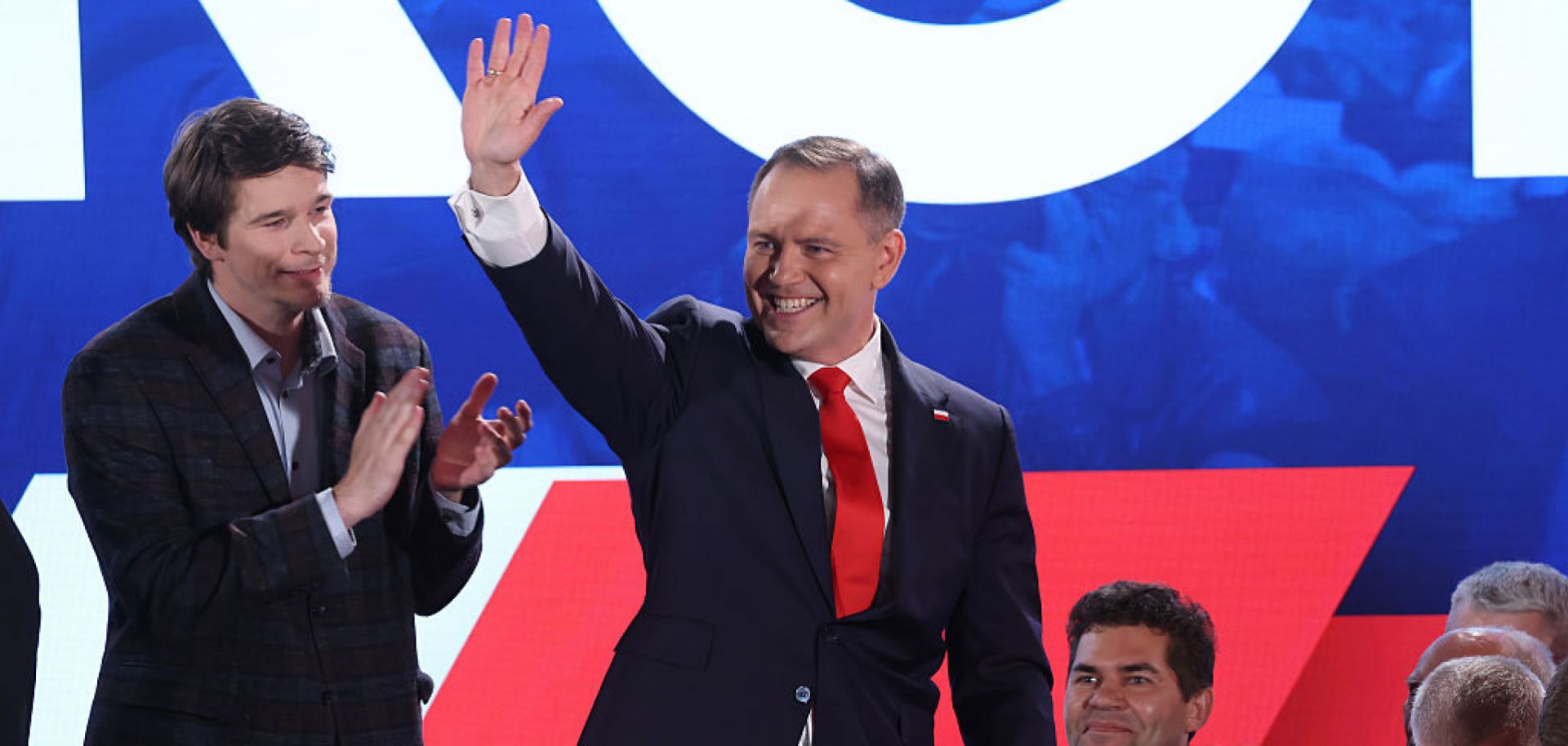
Right-wing opposition candidate Karol Nawrocki's victory in Poland's presidential election portends further institutional gridlock, political polarization and policy uncertainty in Warsaw, which will sustain foreign policy incoherence and could undermine Poland's long-term economic outlook. Nawrocki, who formally ran as an independent but was backed by the national-conservative Law and Justice (PiS) opposition party, won Poland's presidential runoff on June 1 with 50.9% of the vote, narrowly defeating liberal Warsaw Mayor Rafal Trzaskowski from Prime Minister Donald Tusk's Civic Coalition, who secured 49.1% of the vote. Trzaskowski had won the first round of the presidential election on May 18 with 31.4% of the vote, while Nawrocki came in second with 29.5%. But despite trailing behind Trzaskowski throughout the entire campaign, as well as in pre-runoff polls, Nawrocki surged ahead by capturing the bulk of support from voters who had backed far-right libertarian candidate Sławomir Mentzen of the Confederation party, who placed third in the first round with 14.8%.
- Strongly critical of the European Union and with deeply conservative views on social issues, Nawrocki has pledged to strengthen Poland's ties with the United States and was endorsed by Donald Trump's administration. Nawrocki has also vowed to oppose EU federalism, the bloc's green agenda and any attempts at expanding LGBTQ+ rights or easing strict abortion laws in Poland. Additionally, he has embraced strong anti-immigration rhetoric, calling for tighter immigration policies and reduced support for immigrants already in Poland. On defense, Nawrocki backs expanding and modernizing Poland's armed forces and maintaining military aid to Ukraine, though he has taken a tough stance on Kyiv, pledging not to ratify Ukraine's NATO accession if elected. Like Trzaskowski, he also ruled out Polish participation in any post-conflict deployment of troops in Ukraine.
- Tusk announced later on June 3 that he will soon seek a parliamentary vote of confidence to reaffirm support for his coalition in a move that aims to demonstrate his government's stability and unity following Trzaskowski's defeat.
Nawrocki will likely veto many of the Polish government's legislative efforts, which will prolong institutional conflict and policy uncertainty in the country. Outgoing President Andrzej Duda, also a member of PiS, has frequently relied on his veto power to block Tusk's reform plan. Upon taking office, Nawrocki will likely continue his predecessor's strategy by vetoing government policies he disagrees with, particularly in areas such as judicial overhaul, media regulation, public appointments, social liberalization and climate policies. This means that Tusk's government, which lacks the three-fifths parliamentary majority needed to override presidential vetoes, will face greater pressure to compromise, abandon key reforms or attempt workarounds. The resulting institutional gridlock will likely stall efforts to improve judicial independence, delay EU-mandated reforms and fuel policy uncertainty that could undermine fiscal planning, especially in light of potential presidential vetoes to the budget. Over time, this may erode investor confidence in Poland and temper economic momentum, particularly as persistent political polarization and electoral pressures (including the government's likely reluctance to pursue unpopular fiscal tightening) continue to delay politically sensitive consolidation measures and structural reforms in an environment where populist tactics remain a powerful electoral tool across the spectrum. With the presidential veto still in place, Tusk may also be tempted to bypass institutional constraints through executive or parliamentary workarounds to push ahead with efforts to replace PiS-aligned judges and purge state institutions of the conservative party's influence, which would only intensify domestic political instability and reignite rule-of-law concerns in the country. Against this backdrop, Tusk may eventually be forced to reshuffle his cabinet to manage growing frustration over unmet expectations. However, despite rising tensions within Tusk's coalition and reduced legislative cohesion following Nawrocki's presidential victory, snap elections remain unlikely to occur before the current parliamentary term ends in 2027 due to ruling parties' shared interest in preventing PiS from regaining a legislative majority.
- While Polish presidents have limited executive powers, they can veto legislation outright. Presidents can also significantly delay — and potentially block — bills by referring them to Poland's top court, the Constitutional Tribunal, which remains dominated by PiS-appointed judges and can either slow-walk politically sensitive cases or rule against them, effectively preventing the legislation from taking effect.
- Some judicial positions will naturally expire over the next two years, with the terms of PiS-appointed members of the National Council of the Judiciary ending in 2026 and over half the Constitutional Tribunal seats opening up by 2027. However, a broader rule-of-law reset now appears out of reach following Nawrocki's victory.
- While Poland's diversified economy, strategic location and skilled labor force continue to support long-term growth prospects, prolonged political deadlock and institutional friction could heighten investor caution, as persistent policy uncertainty and stalled reforms risk gradually deterring foreign investment and slowing economic momentum.
- Fiscal consolidation efforts might also stagnate, as politically sensitive reforms — such as changes to social spending, taxation or pensions — become increasingly difficult to advance amid continued polarization and rising populist tendencies. Poland's current fiscal position is not yet alarming, with public debt levels still comfortably below the European Union's 60% threshold. However, the country's elevated deficit — which stood at 6.6% of GDP in 2024, among the highest in the European Union — poses medium-term concerns, particularly if political constraints limit the government's ability to rein in spending. Continued delays in budget legislation or structural fiscal measures could also raise concerns among credit agencies and international lenders.
Despite escalating institutional tensions, Poland's relations with the European Union will remain stable, though Nawrocki's presidency may weaken Warsaw's influence within the bloc and complicate efforts to maintain unity on Ukraine. Nawrocki's euroskeptic stances will not significantly threaten recent improvements in Poland-EU cooperation under Tusk's government, which has already seen the European Commission resume funding flows for Poland that had been frozen under the previous PiS administration due to rule-of-law concerns. Still, Nawrocki's suspicion toward deeper EU integration, joint debt instruments and Brussels' green agenda may make it harder to find consensus on key EU initiatives once he takes office. On Ukraine, Nawrocki has echoed the United States' growing wariness to supporting the country in its war against Russia and leaned into domestic anti-Ukrainian sentiment during his campaign, further complicating European efforts to maintain a united front in support of Kyiv. Nawrocki will maintain a hawkish stance on Russia, back aggressive military rearmament, and support strong ties with NATO and the United States (not least due to his positive relations with Trump). However, his presidency will likely introduce a degree of incoherence into Polish foreign policy due to conflicting messages with the Tusk government on EU cooperation, NATO priorities and support for Ukraine. Moreover, with Washington likely to engage directly with Nawrocki while EU officials coordinate primarily with Tusk, competing diplomatic channels may emerge. Core foreign and defense policy objectives will remain largely intact, as Tusk's government retains ultimate authority in these areas and there is broad cross-party political consensus over key goals, such as increasing defense spending and militarily supporting Ukraine. But this fragmentation could nonetheless complicate defense coordination, delay key decisions (such as arms transfers, defense procurement and joint military exercises), and ultimately weaken Poland's credibility as a coherent and fully functional partner and regional leader.
