
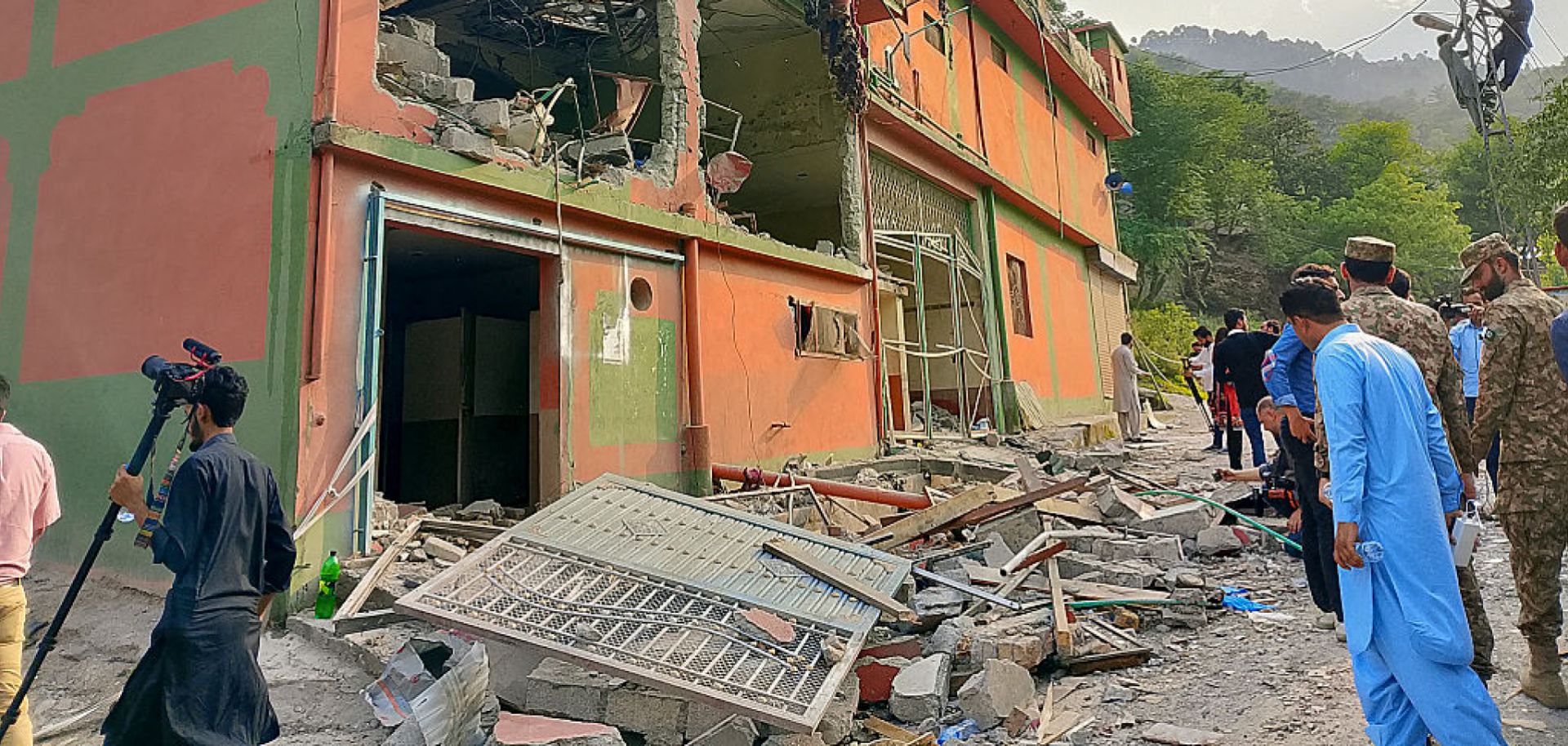
Though both sides likely want to avoid full-blown conflict, India's strikes in Pakistan and Pakistan-administered Kashmir will very likely prompt Islamabad to undertake its own kinetic response, threatening at least a limited period of more cross-border attacks that will heighten a range of security risks in both countries. Early May 7, the Indian military announced it had launched "Operation Sindoor," claiming it struck nine sites of "terrorist infrastructure" linked to militant attacks in Kashmir. Four of the sites were reportedly located in Pakistan's eastern province of Punjab, with the remaining five located in Pakistan-administered Kashmir. Local media reports claim India's military used air assets to deploy standoff weapons, including SCALP/Storm Shadow cruise missiles and AASM HAMMER smart missiles, as well as loitering munitions to target alleged militant infrastructure. Indian Foreign Secretary Vikram Misri characterized the strikes as "pre-emptive and precautionary," saying New Delhi acted in response to intelligence it had collected that indicated further militant attacks against India were imminent. Islamabad has countered New Delhi's claims, saying India only targeted six sites total, none of which were militant camps, and adding that the strikes had killed at least 26 civilians and injured some 46 others. Pakistani Prime Minister Shehbaz Sharif characterized India's strikes as an "act of war" that has prompted Pakistan to undertake an ongoing "strong response," and Islamabad claims its retaliation has included downing five Indian fighter jets that had participated in the May 7 operation. India has not confirmed Pakistan's alleged shootdown of the jets, but local government sources in India-administered Kashmir reported that three Indian fighter jets have crashed in different parts of the region.
- Alongside sites in Pakistan-administered Kashmir, Indian media reports claim the Indian military targeted several terrorist camps in Pakistan's Punjab province, including Markaz Subhan Allah in the city of Bahawalpur, the alleged headquarters of the Pakistan-based militant group Jaish-e-Muhammad; Markaz Taiba in the city of Muridke, the alleged headquarters of the Pakistani militant group Lashkar-e-Taiba; and Mehmoona Joya in the city of Sialkot, an alleged key training facility for the Pakistan-linked Kashmiri separatist group Hizbul Mujahideen.
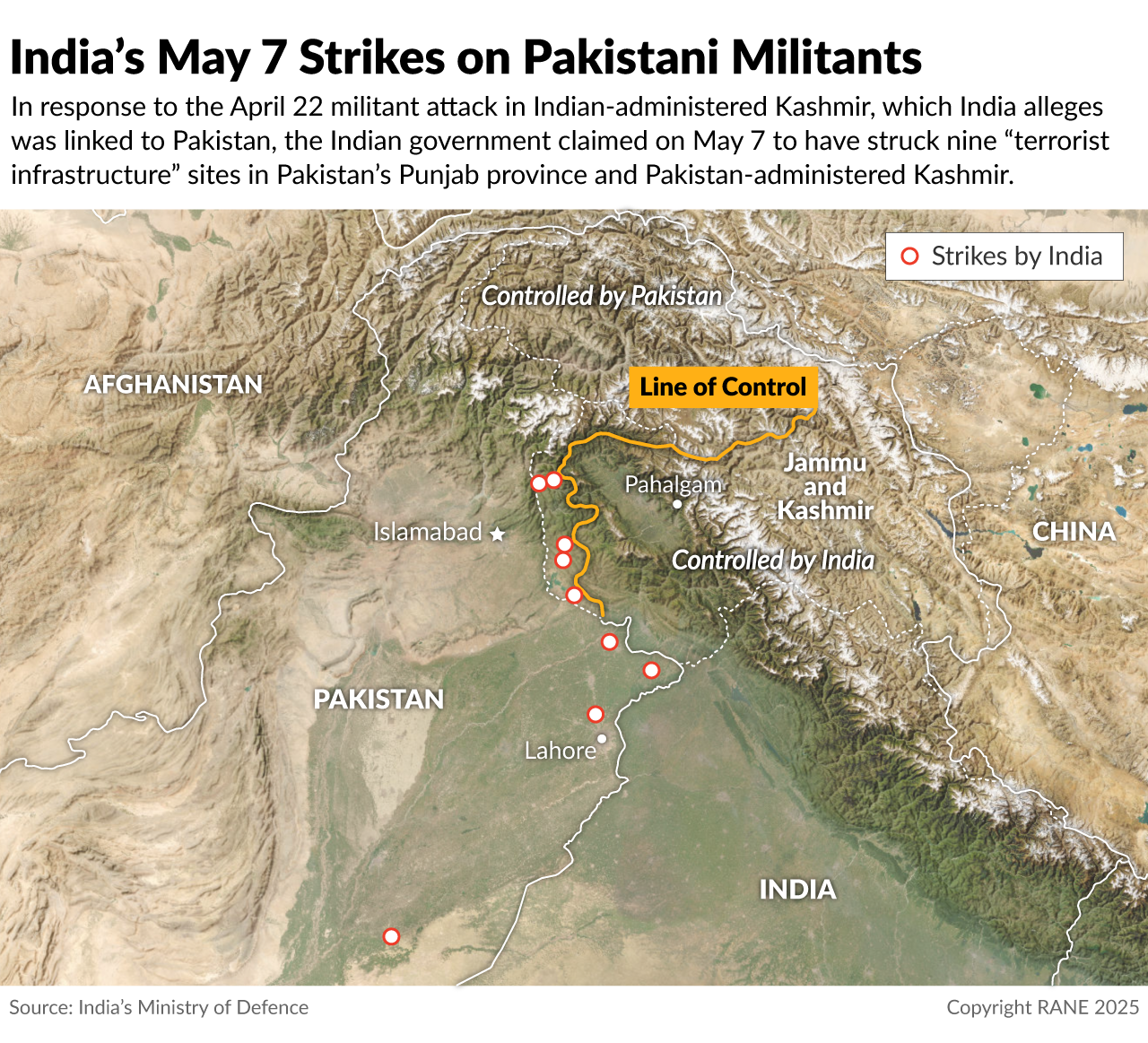
India's strikes in retaliation for the April 22 militant attack in India-administered Kashmir were some of the deepest its military has carried out in Pakistan in years, but were also seemingly intended to be measured. Pakistani security officials have warned for days that India would imminently undertake kinetic retaliation. Notably, the reported sites India targeted in Punjab were some of the deepest Indian forces have struck in Pakistan in years. In particular, the alleged Jaish-e-Muhammad camp in Bahawalpur is located around 60 miles (approximately 100 kilometers) from the India-Pakistan border, and some 280 miles (around 450 kilometers) from Pakistan-administered Kashmir. India's military previously carried out strikes against Pakistan in 2019 and 2016 following major militant attacks in Kashmir. However, India's more geographically expansive and severe response to the April 22 attack underscores the greater severity with which it perceives the latest attack, which killed over two dozen civilians, marking one of the deadliest militant attacks to target civilians in India in years. Although India has accused Islamabad of complicity in the April 22 attack, this accusation is seemingly based more on Pakistan's general support for Kashmiri militants rather than evidence of Islamabad's direct involvement, which New Delhi has yet to publicize. While also motivated by New Delhi's broader expressed desire to limit further escalation, India's choice to specifically target alleged militant camps in its retaliation, along with its emphasis that it avoided targeting Pakistan's military, may further support the idea that New Delhi believes Islamabad has only tenuous links to the April 22 attack.
- India previously carried out kinetic retaliations for major militant attacks in India-administered Kashmir in 2019 and 2016 that killed 40 and 19 Indian security personnel, respectively. However, these prior retaliations were more limited in geographic scope and severity, with India's 2019 response primarily involving airstrikes on an alleged militant training camp in northern Pakistan about 5 miles (around 8 kilometers) from Pakistan-administered Kashmir, and India's 2016 response involving Indian special operations force raids targeting alleged "militant launch pads" in Pakistan-administered Kashmir.
- On April 26, Pakistan called for a neutral investigation into the April 22 attack, rejecting Indian accusations of involvement and expressing its willingness to cooperate in the interest of peace.
Pakistan will very likely retaliate against India's strikes and may undertake action beyond Kashmir that leads to further cross-border attacks in the coming days; however, both countries probably will keep the duration and intensity of further kinetic exchanges below the threshold of sparking a larger and prolonged confrontation. The greater severity and geographic scope of India's strikes, along with strong domestic pressure on Islamabad to demonstrate its own power and resolve, mean Pakistan will very likely carry out its own kinetic retaliation in response to the strikes. Though Pakistan has said its retaliation was already ongoing and included the alleged downing of five Indian jets, there remains a high possibility that Islamabad will pursue a more distinct, separate kinetic response in the coming days and potentially weeks, especially if Pakistan believes its retaliation has so far proven insufficient. Such a response would likely involve Pakistan's military targeting Indian military positions along the two countries' border in the Kashmir region with artillery, small arms fire, and potentially air strikes. That said, the wider geographic scope of India's strikes may compel Pakistan to similarly target Indian military sites beyond the Kashmir region, such as those in western Indian states near the Pakistani border. These sites would likely be lower-level military assets that are less strategically important to India, such as ammunition depots, airfields and forward operating bases, whose targeting would enable Pakistan to disrupt Indian military operations without significantly heightening the risk of a sharper and more severe escalation. While such attacks would still carry the possibility of triggering a more intense and/or sustained conflict, both sides have conveyed a desire to avoid a full-blown war, which would prove costly for both countries but especially Pakistan, which is grappling with greater economic challenges, alongside a security crisis fueled by unconstrained militancy in its western provinces. Indeed, New Delhi emphasized its May 7 strikes as "focused, measured and non-escalatory," while Pakistani defense officials have said Pakistan is "trying to avoid" all-out war and would only strike military and not civilian targets. These statements, alongside the costs a full-scale conflict would entail, suggest there will remain pressure on both sides to curb the duration and narrow the intensity and scope of any further kinetic exchanges — especially given that other countries, including powers like the United States and China, will continue to press Islamabad and New Delhi to exercise restraint as well.
- India and Pakistan's prior flare-ups in 2019 and 2016 ultimately de-escalated weeks after they erupted, despite initial cross-border attacks by both sides. Most notably, the 2019 clashes included a dogfight between Indian and Pakistani warplanes that resulted in Pakistan shooting down an Indian jet fighter and taking its pilot hostage. Pakistan released the captured Indian pilot days later, characterizing the move as a peace gesture. These eventual de-escalations underscore both sides' historical avoidance of full-blown conflict, likely in large part due to a mutual desire to avoid uncontrolled escalation between the two nuclear-armed countries.
- Beyond the location and importance of the sites India and Pakistan may target in any further kinetic exchange, the kinds of munitions the two countries use will also determine the risks of triggering a full-blown war. The use of ballistic missiles, for example, would be particularly escalatory, given their ability to be equipped with either conventional or nuclear warheads, fueling a higher possibility of miscalculation and outright conflict.
Further kinetic exchanges will threaten personal safety and disruptions to travel and business operations in the Kashmir region and potentially beyond, along with elevated threats of nationalist unrest, militant attacks and cyber activity in both India and Pakistan. Such exchanges will sustain high personal safety risks in the Kashmir region, especially along the Line of Control (LoC). India's strikes in Pakistan's Punjab province also underscore the possibility of further military action beyond Kashmir, though these would likely target lower-level military sites, probably in areas along the India-Pakistan border, and generally seek to avoid civilian casualties. Beyond personal safety risks, the threat of further kinetic exchanges will sustain disruptions to travel and business operations in parts of India and Pakistan, as well as their administered regions in Kashmir; such disruptions will include closures or partial suspensions of operations at airports, businesses, schools and religious seminaries. Escalating India-Pakistan tensions will also significantly raise the risk of nationalist protests in both countries, especially in major cities, which may become violent and pose further localized disruptions to travel and business continuity. Against this backdrop, violence targeting Muslims in India and/or Hindus in Pakistan is possible as well, which would heighten the likelihood of militant attacks, with Islamist extremists potentially seeking to carry out unsophisticated attacks in India, and various militants in Pakistan possibly exploiting security forces' focus on India to conduct attacks in Pakistan's restive western provinces. Additionally, ongoing tensions between India and Pakistan, along with the resulting surge in nationalist sentiment, will likely drive more frequent and potentially severe cyber threat activity from state-linked threat actors and hacktivists. While much of this activity will remain less sophisticated distributed-denial-of-service and website defacement attacks targeting government entities, the outbreak of more severe kinetic action will likely compel threat actors to attempt more disruptive cyberattacks, potentially against critical infrastructure, to support either side.
- In prior crises, most Indian- and Pakistani-linked cyber threat activity has centered around cyberespionage and typically consisted of less sophisticated tactics like social engineering. Nevertheless, in recent years, both New Delhi and Islamabad have also likely invested in more disruptive capabilities that could emerge if tensions worsen in the coming days or weeks. For example, state-backed and potentially even independent hacktivist groups in both countries could target critical infrastructure via the deployment of data wiper or industrial control system malware. In such a scenario, the successful breach and encryption or destruction of data, alongside potential disruptions to automated operational technology processes, could cause localized interruptions to critical services, including water, electricity, or oil and gas. For businesses operating in both countries, even localized or short-lived disruptions to these services could have secondary implications for multinationals, which may be forced to shutter brick-and-mortar businesses or shorten hours depending on the severity of the disruptions.
