
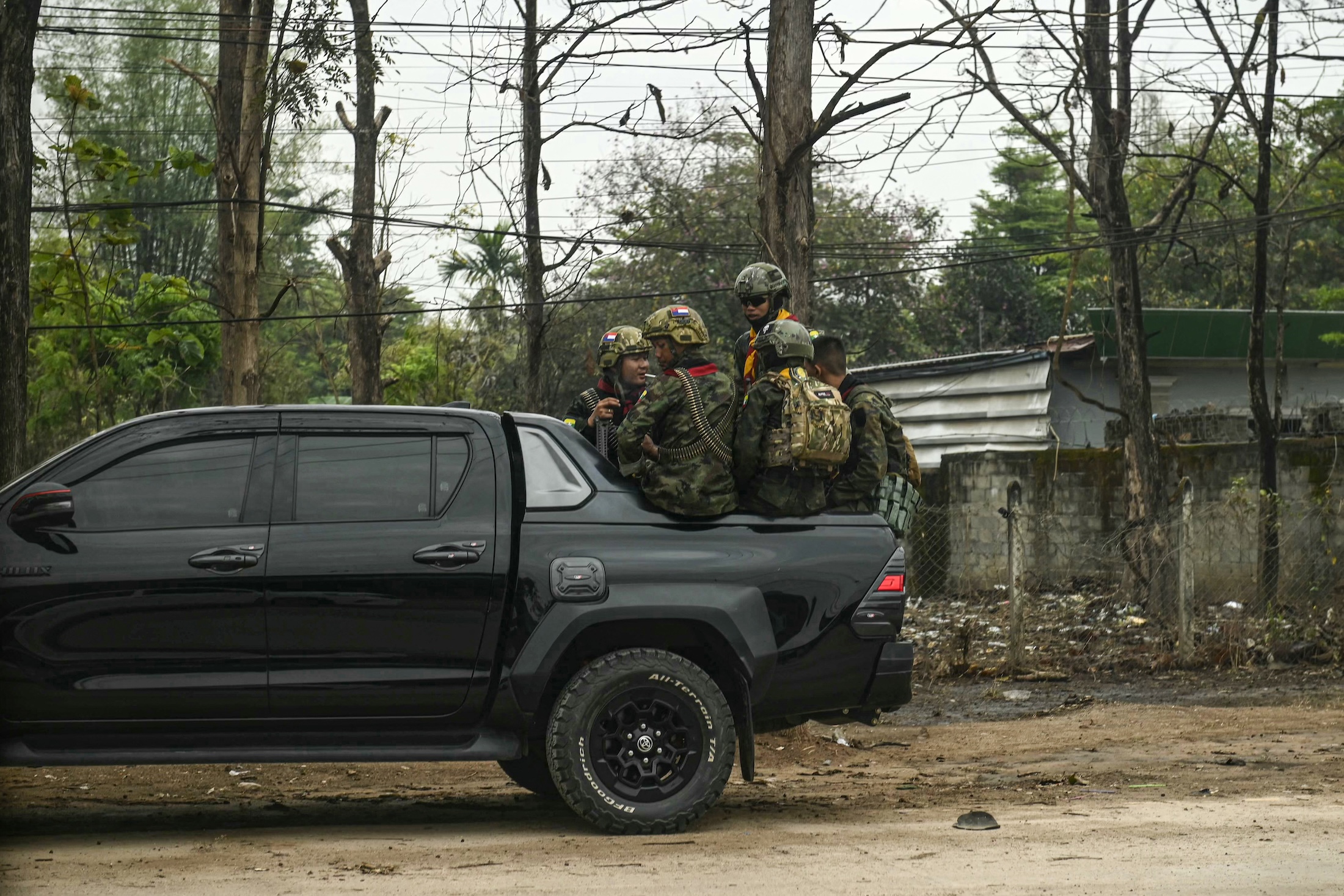
Myanmar's new security law allowing foreign private security companies to operate domestically is likely to help China protect its business interests and citizens in the country while also demonstrating to Pakistan that Beijing can play a leading role in managing security risks despite facing greater challenges in improving security conditions in Pakistan. On Feb. 18, Myanmar's State Administration Council adopted the Private Security Services Law (PSSL), which allows foreign companies to apply for licenses to operate armed security companies in the country. The new law, which was designed to facilitate Chinese security deployments, requires that at least 75% of the security company's employees are Burmese nationals, and the foreign security personnel must not be active members of a foreign military. The approved security companies will be allowed to protect foreign-owned investment projects, employees and companies, in addition to public events where foreign-owned equipment is used. The law stipulates that if a criminal act occurs in an area where the security company is providing services, security personnel are authorized to intervene, apprehend the perpetrators, and hand them over to Burmese security officials at the nearest police station. Additionally, the PSSL requires licensed security companies to collaborate with the regime's security forces and to immediately report any information about threats to the military government's stability. The announcement followed a government decision in October to organize a working committee to prepare the groundwork for a Memorandum of Understanding for the possible creation of a Myanmar-China joint security company. The 13-member committee was tasked with creating a regulatory framework for the importation of weapons, communication equipment and other specialized devices imported from China.
- According to The Irrawaddy, in November 2024, China's state-owned CITIC conglomerate and Myanmar's Special Economic Zone management subcommittee agreed to establish a private military corporation in Kyaukphyu, a coastal area in western Rakhine state, where the Chinese government is funding a strategic deep-water port that provides access to the Indian Ocean.
- In response to the joint security company proposal, Myanmar's government-in-exile National Unity Government (NUG) spokesperson, U Kyaw Zaw, wrote on the NUG Facebook page that the junta could not protect Chinese interests and its citizens, further stating, "We understand China's concerns about the security of its investment and citizens amid the instability caused by junta actions in Myanmar."
Although there is uncertainty over the implementation of the PSSL, both Myanmar and China are trying to navigate sensitivities about sovereignty. Thus far, no foreign company has been approved under the PSSL, meaning it remains unclear precisely how foreign private security forces — namely, those from China — would operate in Myanmar. In particular, critics of the PSSL have argued that the stipulation against active members of foreign militaries may allow private security companies to circumvent the constitutional ban on foreign military activity on sovereign territory by employing security personnel with previous military training. Myanmar's 2008 Constitution states, "No foreign troops shall be permitted to be deployed in the territory of the Union." Thus, the new law theoretically makes an exception for former or retired military members. Beijing also prefers to distinguish between private security companies (PSCs) and private military contractors (PMCs), both of which often employ former military members. While PMCs are usually heavily armed and provide military-related services, such as combat, intelligence gathering and training, PSCs are usually lightly armed or unarmed and provide security services like protection of individuals and property. The Chinese Communist Party (CCP) has effectively banned PMCs from operating on behalf of the Chinese government for fear that an armed military-trained organization could operate outside the direct oversight of the Chinese Communist Party. While the PSSL permits security companies to seek approval to carry firearms, the level of sophistication of the weapons and associated operational equipment remains unclear.
- Many of the owners and employees of China's security companies are former military and intelligence members operating in China's largely domestic PSC sector, where established firms like Dewey Security Frontier Service Group and Kunlun Lion Security have developed experience working in tandem with domestic security services in Egypt, Kenya and Uganda.
- An estimated 7,000 PSCs are thought to be officially registered with the Chinese government, with the vast majority of the companies operating domestically.
Chinese-funded projects have been caught in the crossfire in Myanmar since the military instigated a coup in February 2021 that has led to an expanded civil war in which several rebel groups are on the offensive, resulting in large-scale territorial and troop losses for the junta government. Even before the start of the rebel offensive in October 2023, Chinese infrastructure projects had been damaged by fighting. In January 2022, the People's Defense Force (PDF) — an armed wing of the government in exile — attacked and seized control of the Chinese state-owned Tagaung Taung nickel processing plant in Sagaine Province, reportedly valued at $800 million with an annual output of 85,000 metric tons of nickel and iron. After almost three years of armed conflict between the military and several rebel groups, on Oct. 27, 2023, the Three Brotherhood Alliance — an alliance of Ethnic Armed Organizations (EAOs) between the Arakan Army, the Myanmar National Democratic Alliance Army, and the Ta'ang National Liberation Army — launched a military offensive dubbed Operation 1027 in northeastern Shan State. According to the Myanmar Peace Monitor, rebel groups have seized approximately 95 towns and more than 200 military bases across the country since the start of Operation 1027. As the conflict intensified between the military and the EAOs, Chinese-funded projects increasingly came under attack, endangering Chinese nationals, delaying construction timelines and disrupting supply chains. On Oct. 18, 2024, rebel forces were suspected of carrying out an attack on the Chinese Consulate-General in Mandalay when an improvised explosive device was detonated on the street near an office building of the consulate; there were no reports of injuries despite damage to the building. The Chinese Embassy in Yangon and the Consulate-General in Mandalay activated their emergency response procedures following the attack, while the Consulate-General in Mandalay issued a security alert for all Chinese businesses and nationals in Myanmar.
- In October 2024, the Kachin Independent Army (KIA) in northern Kachin state gained near total control of Chipwa township, a rare-earth mining hub primarily operated by Chinese businessmen.
- In July 2024, the Mandalay People's Defense Force (MPDF) attacked a rebel camp near the Chinese-owned Alpha Cement plant near Aungthapye village in Madaya township — located 10 miles (16 kilometers) north of Mandalay. The junta troops allegedly set fire to several buildings at the plant while attempting to flee the MPDF's advances.
China is likely to pursue the long-term deployment of its PSCs in Myanmar to strengthen the protection of its nationals and investments, although such a presence will not fully shield Chinese interests from violence. With the passage of the PSSL and the junta's previous failures to protect Chinese investments since the coup began, China is likely to send private security contractors to Myanmar in the coming months with greater operational leeway and more sophisticated weaponry. In this case, they would likely be responsible for preventing theft and destruction of property, protecting the perimeter of Chinese infrastructure projects in volatile regions, particularly along the China-Myanmar Economic Corridor (CMEC) — which crosses several of the most contested regions in the country from eastern Shan state to southwestern Rakhine state —, and safeguarding the living quarters and transportation convoys of select Chinese nationals working in dangerous areas of the country. With additional security personnel on the ground in Myanmar, Chinese PSCs, with support from the Chinese government, will increase their ability to monitor, track and forecast EAO's movements near Chinese-funded projects. With the establishment of an in-country intelligence gathering presence specifically dedicated to decreasing rebel attacks on Chinese interests, Beijing will be more likely to dissuade and thwart future attacks on Chinese infrastructure investments. However, several challenges are likely to arise for Chinese PSCs in Myanmar. Oil pipelines, railroad infrastructure and other Chinese-funded projects along the CMEC in rebel-held territory may present logistical and operational challenges that Chinese PSCs may find difficult to overcome. Moreover, projects like the Tagaung Taung nickel mine or the rare-earth mining hub near Chipwa township are often located in isolated rural areas with jungle terrain and long distances from urban areas. Such obstacles make supply chain logistics and personnel support difficult to overcome, meaning Chinese interests will still be vulnerable to attacks.
- The CMEC is designed to increase connectivity, trade and infrastructure between China's Yunnan province and Myanmar's Rakhine State. The CMEC is a key segment of China's larger Belt and Road Initiative.
If Chinese PSCs are able to successfully decrease attacks on Chinese investments in Myanmar, Beijing will likely attempt to increase pressure on Pakistan to allow Chinese PSCs to operate independently and armed within Pakistani borders, but it will encounter greater challenges there than in Myanmar. Similar to the CMEC, the China-Pakistan Economic Corridor (CPEC) is a large-scale infrastructure and investment initiative that stretches from China's western Xinjiang region to Pakistan's Balochistan province where the Balochistan Liberation Army (BLA) and the Pakistani Taliban have been fighting an ongoing insurgency against the Pakistani government for several decades. Despite the presence of a small number of unarmed Chinese PSCs operating in Pakistan, particularly in Balochistan province, Chinese-funded projects and nationals continue to be a consistent target of BLA separatists. As a result, Beijing has an interest in trying to replicate any successes of its PSC deployment to Myanmar in Pakistan. While Islamabad has been hesitant to give Chinese security contractors significant capabilities, including less oversight and high caliber weaponry, pressure from Beijing in conjunction with several attacks targeting Chinese nationals and the example offered by Chinese PSCs in Myanmar would be more likely to change the Pakistani government's stance. By arming and increasing the operational freedom for Chinese PSCs, private companies would be more likely to deploy larger numbers of well-trained former military personnel to Pakistan. Additional personnel would be able to extend security perimeters around key projects, employ larger and more secure convoys to transport workers and expand intelligence-gathering capabilities that the Chinese government would likely support. However, Chinese PSCs operating in Pakistan would be unlikely to significantly degrade the ability of the BLA or Pakistani Taliban to carry out attacks against Chinese interests. The Inter-Services Intelligence, Pakistan's premier intelligence agency, would likely be reluctant to share sensitive intelligence information with Chinese PSCs, and foreign PSCs would likely lack the human intelligence networks that are key to preventing militant attacks in Pakistan's tribal regions. This means that Chinese PSCs would likely be less successful in Pakistan in impeding attacks against Chinese interests due to Beijing's comparatively deeper relationships with both the military junta and several EAOs in Myanmar.
- In November 2024, the Chinese government signed security agreements with three PSCs — Dewey Security Frontier Service Group, China Overseas Security Group and Huaxin Zhongan Security Service — to provide enhanced protection for Chinese-funded infrastructure projects in Pakistan after the BLA killed two Chinese nationals in a suicide bombing at the Karachi Airport on Oct. 6, 2024.
- In Gwadar city in southwestern Balochistan, the Pakistani military has increased checkpoints and blocked road access for locals in order to monitor extremism in the region. Yet, the BLA has remained unfettered in planning and carrying out attacks in the city. In March 2024, several armed militants opened fire on local security personnel in an attempt to target Pakistani intelligence offices inside the Gwadar Port Authority complex — one of China's largest investments in the country. Eight militants were killed, and two security personnel were injured in the shootout. The BLA claimed responsibility for the attack.
- In Myanmar, Chinese diplomats have previously brokered several ceasefires between the military and EAOs, demonstrating established lines of communication and their ability to mediate with the government and different rebel groups.
