
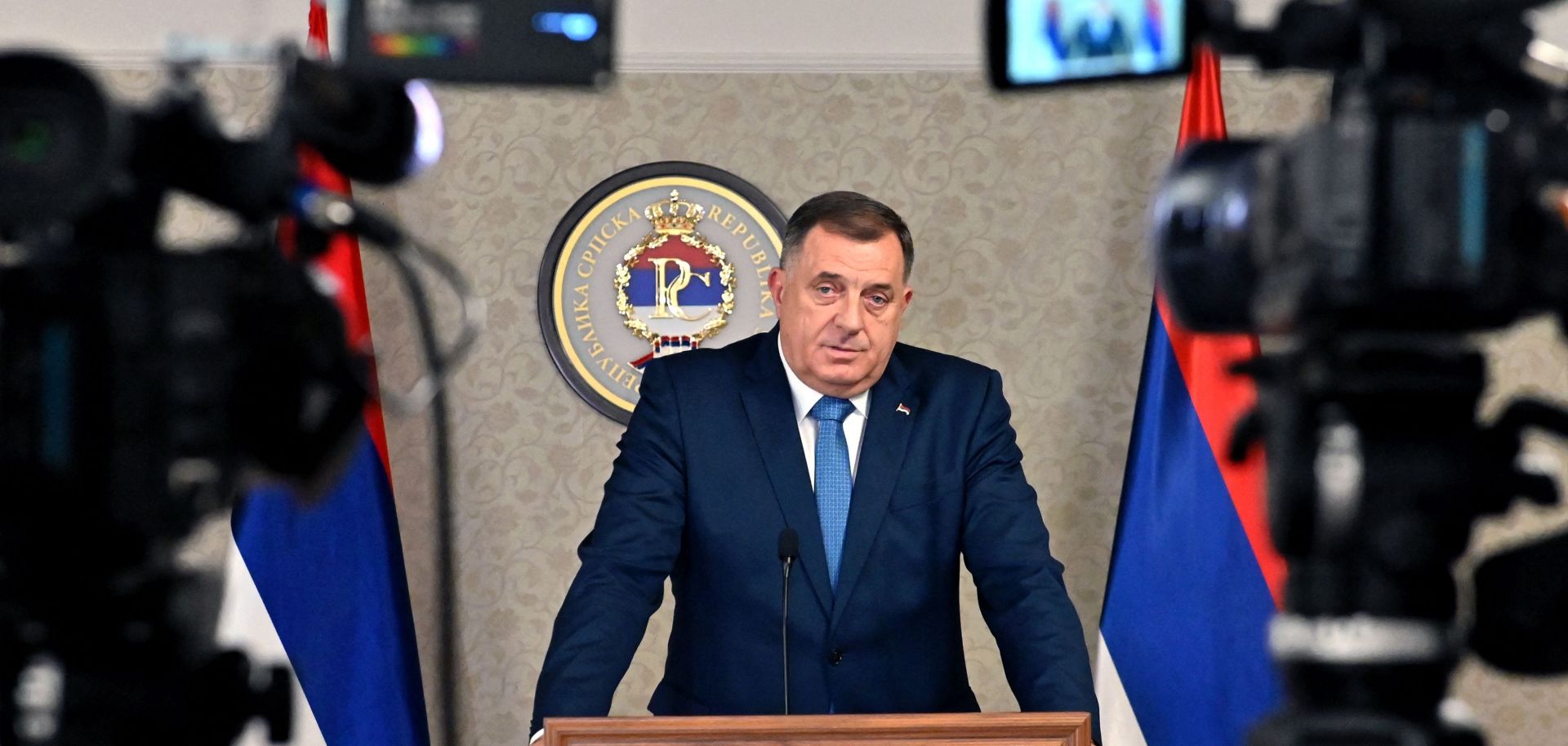
An arrest order for Bosnian Serb leader Milorad Dodik will intensify Bosnia's political and constitutional crisis, testing the country's fragile institutional order amid rising regional and global instability and fueling concerns of a potential spillover of unrest across the Western Balkans. Bosnian state prosecutors issued arrest orders March 13 for Bosnian Serb separatist leader Milorad Dodik and some of his aides — including Prime Minister Radovan Viskovic and regional parliament Speaker Nenad Stevandic — for defying a court summons. Dodik, the president of Bosnia's autonomous Republika Srpska, is under investigation for allegedly undermining Bosnia's federal constitutional order after initiating laws purporting to eject central government judicial and police authority from the autonomous region. It remains unclear whether authorities intend to detain him or simply escort him to testify. On Feb. 26, Bosnia's state court sentenced Dodik to one year in prison and banned him from politics for six years for systematically passing laws in violation of Bosnia's Constitution and for defying rulings by High Representative Christian Schmidt of the Office of the High Representative in Bosnia and Herzegovina, the body that oversees the implementation of the Dayton Agreement and Bosnia's Constitution. In response, Republika Srpska's parliament adopted new laws Feb. 27 nullifying reforms enacted since the Dayton Agreement and rejecting the country's central investigative and judicial institutions effective March 7.
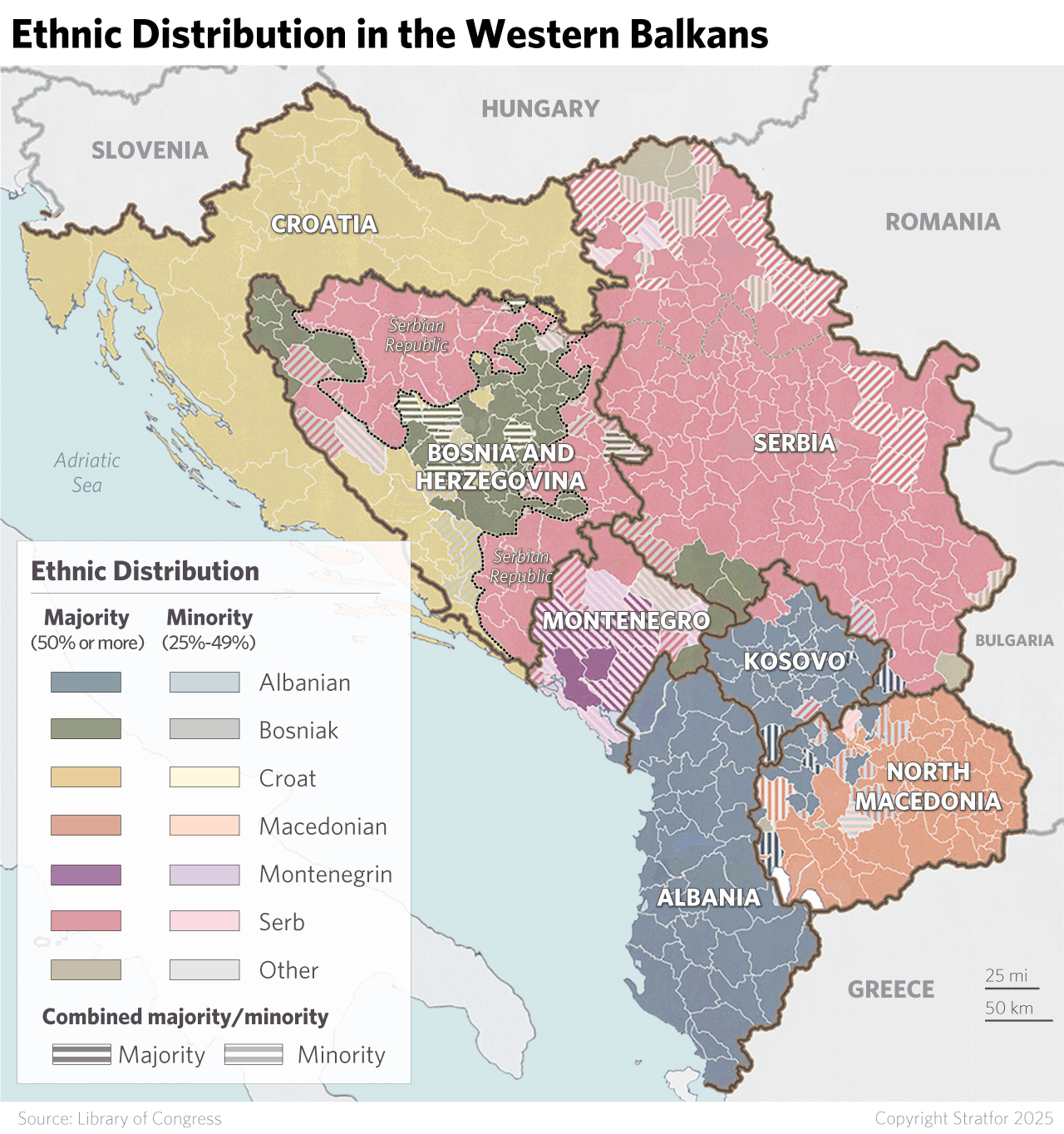
- Since 1995, Bosnia and Herzegovina has operated under the U.S.-brokered Dayton Accords, which ended the Bosnian War and established a state divided into two entities — the Republika Srpska for ethnic Serbs and the Federation of Bosnia and Herzegovina for Bosniaks and Croats. The country has a rotating three-member presidency, with one representative from each of the three main ethnic groups, and is overseen by a high representative responsible for implementing the accords, a role traditionally held by EU officials. While the agreement ended the war, it created a fragile and deeply fragmented governance structure that has effectively paralyzed decision-making and reinforced ethnic divisions.
- During the Republika Srpska assembly debate Feb. 27, Dodik insisted that the new laws did not constitute secession but were instead aimed at strengthening Republika Srpska's autonomy by rolling back some of the reforms taken under the Dayton framework rather than pursuing full independence. Serbia, Hungary and Russia have approved of his actions. Serbian President Aleksandar Vucic convened an urgent session of the National Security Council on Feb. 26, condemning the Bosnian state court's ruling as "undemocratic, uncivilized and unlawful" and warning that Bosnia and Herzegovina was facing its most severe crisis since the war ended in 1995.
Dodik may see an opportunity to advance his secessionist ambitions for Republika Srpska as the EU attention focuses on Ukraine, NATO's future grows uncertain and speculation increases over a potential U.S. strategic pullback from Europe. Dodik has long threatened to split Republika Srpska from Bosnia and Herzegovina and has repeatedly defied both Sarajevo's central institutions and the international community by challenging the high representative's authority and systematically eroding the constitutional framework established by the Dayton Accords. He may now sense a window of opportunity to advance his secessionist agenda. Doubts over Europe's ability to fill the security vacuum left by potential U.S. disengagement in the region while Brussels must simultaneously increase military and financial support for Ukraine to compensate for any U.S. aid reduction may be leading Dodik to believe that the status quo established in the aftermath of the Yugoslav wars of the 1990s could be challenged with minimal or manageable consequences. Moreover, he may be betting on the prospect that a new settlement could be renegotiated with the United States as the Trump administration may seek to bypass Europe to unilaterally broker a resolution to ethnic disputes in the region as part of its broader rapprochement with Russia — a long-standing patron of Republika Srpska — while securing a quick diplomatic win for Trump. No signs have yet emerged from Washington, however, that such a shift may actually be in the cards. Strong condemnation from U.S. State Department Secretary Marco Rubio — who on March 10 accused Dodik of undermining Bosnia's institutions and called on Western allies to push back against his secessionist ambitions — suggests that the Trump administration stance may not be as accommodating as Dodik anticipates.
- Anticipation of a potential U.S. shift in policy in the Western Balkans is in part based on the first Trump administration's approach to the region, which prioritized rapid, optics-driven agreements over sustainable, long-term solutions. Some fear Washington could also once again endorse territorial swap proposals in Kosovo as a short-term fix to the region's entrenched disputes. In 2020, former national security adviser John Bolton signaled that the United States would not oppose land swaps as long as each side consented.
Dodik's arrest raises the stakes in a standoff that threatens Bosnia's stability, escalating the political and constitutional crisis and significantly increasing the risk of renewed ethnic violence in the region. Dodik's defiance of Bosnia's judiciary and push for Republika Srpska's constitutional overhaul directly challenge the internationally backed high representative and the fragile post-Dayton order. His arrest could spark mass protests among Serb nationalists, deepen Bosnia's already polarized political landscape and fuel separatist ambitions in Republika Srpska. If tensions escalate, Bosnia's central government may struggle to enforce its authority, raising concerns over a return to violence and broader regional destabilization. The European Union Force Bosnia and Herzegovina — or EUFOR, the EU's peacekeeping mission in Bosnia — has already deployed reinforcements in anticipation of unrest, underscoring fears of renewed interethnic clashes. Though Republika Srpska secession remains unlikely due to the presence of international peacekeepers and the autonomous region's heavy reliance on foreign aid — which stands to gain independence only at the cost of international isolation and an interruption of Western funding — any eruption of violence could quickly escalate given profound ethnic divisions and social tension in Bosnia and the region. A failure to contain the crisis would severely test European and U.S. influence in the Balkans and embolden revisionist forces across the region, potentially reopening long-settled ethnic disputes elsewhere. Tensions could spill over into nearby Kosovo, where disputes between Serb-majority northern provinces and Pristina's Western-backed government have led to frequent flare-ups in tensions, including on the border between Kosovo and Serbia in recent years.
- Belgrade, which is currently facing growing domestic political turmoil, might find it convenient to exploit rising tensions in Bosnia and Kosovo (though probably not to the point of actively fueling ethnic tensions via local proxies) to deflect attention from ongoing anti-government protests in Serbia, increasing the risk of escalation. Vucic has so far maintained a cooperative approach with the European Union on initiatives aimed at resolving issues in both Bosnia and Kosovo and, at least officially, he does not back Republika Srpska's independence. That said, he has also consistently maintained support for Serbian minorities in the region.
