
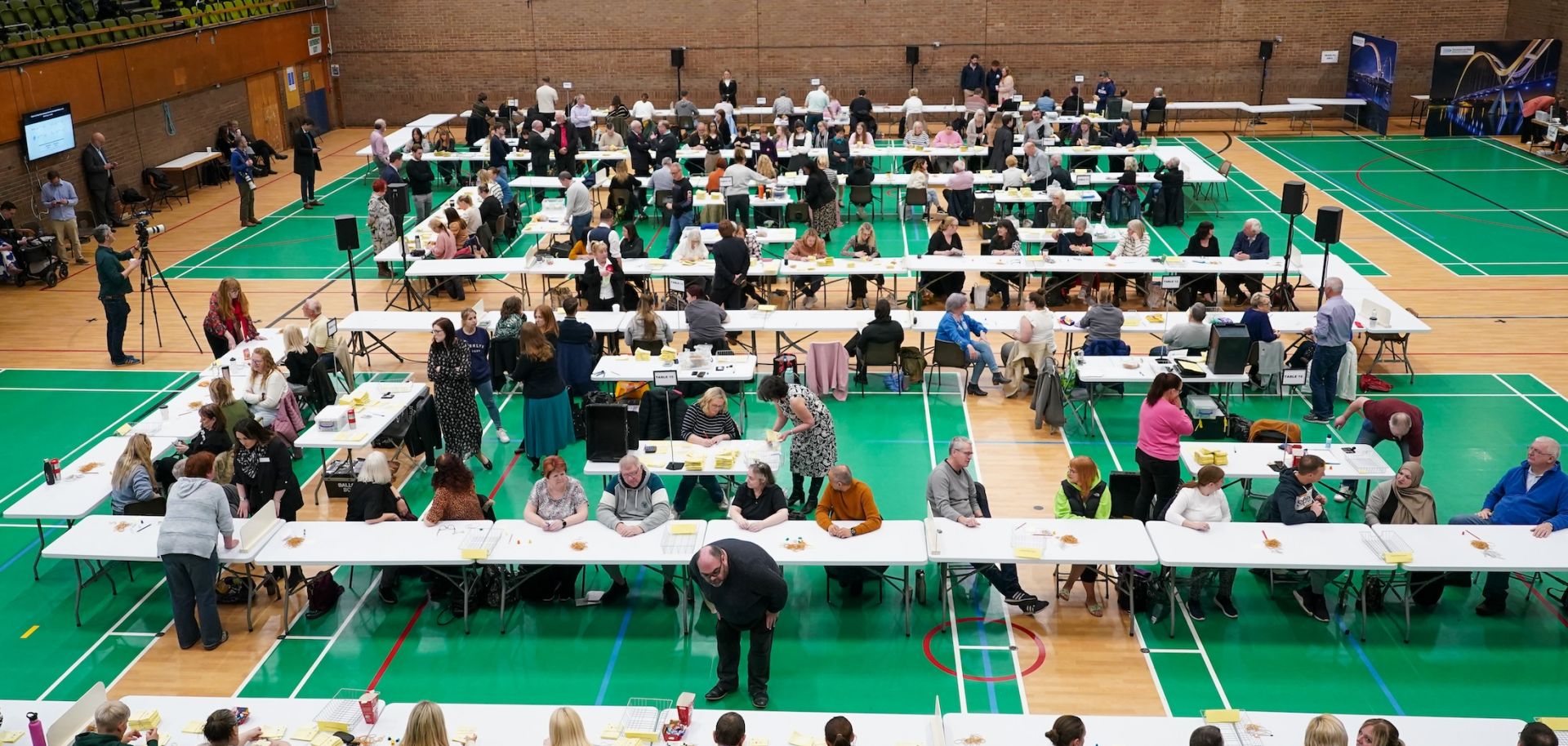
The outcome of local elections in the United Kingdom confirmed the ruling Conservative Party will most likely perform poorly in the country's general election, but also that the opposition Labour Party will face competition from smaller parties. U.K. Prime Minister Rishi Sunak's Conservative Party suffered painful defeats in local elections held across England and Wales on May 2, according to the final results announced on May 3-4. The vote was the last electoral test for the Conservatives ahead of the United Kingdom's next general election, which is widely expected to be held in the fall. The opposition Labour Party gained over 180 seats and took control of eight councils, while the Conservatives lost almost half of the seats they were defending (more than 470), losing control of 12 councils. While Labour's victory was expected in the Northeast, the party also secured victories in closely watched mayoral elections in the Midlands and other contested constituencies widely seen as key battlegrounds for the general elections. Separately, Labour also won a parliamentary by-election in the Blackpool South constituency, previously held by the Conservative Party. Meanwhile, smaller parties such as the Liberal Democrats and the Greens also performed well in the local elections, gaining 104 and 70 council seats across the country, respectively. Nigel Farage's pro-Brexit Reform UK party won only two council seats in the local elections but won 16.9% of the vote in the Blackpool South by-election, coming in third, less than 150 votes behind the Conservatives.
- Labour's incumbent mayors in the major English cities of London (Sadiq Khan), Manchester (Andy Burnham) and Liverpool (Steve Rotheram) were also all re-elected for a third term.
- Labour's victory in Blackpool South came with a 26.3% swing from the Conservatives, marking the ruling party's 11th by-election loss since the Conservatives' landslide victory in the 2019 general election.
While local elections are never a perfect indicator of voters' intentions at the national level, the results of the recent England and Wales ballots largely confirm Labour's large lead over the ruling Conservatives in opinion polls ahead of the national election — pointing to a potential landslide victory for the opposition party after 14 years out of power. Most notably, Labour comfortably won local votes across much of the party's former stronghold regions in the Midlands and northern England that Conservatives won in the 2019 general election (known commonly as the ''red wall''), while also making gains in traditionally Conservative areas in the south, further highlighting a shift in voting intentions in key electoral battlegrounds. This confirms that Labour is highly likely to win the United Kingdom's upcoming general election, as the party continues to successfully capitalize on the political volatility of the past few years under successive Conservative governments, as well as on the country's generally dire economic situation amid stubborn inflation and stagnant economic growth. However, despite its overall strong performance in the local ballots, Labour suffered significant losses in areas with a large number of Muslim voters. But while Labour's failure to take a stronger stance against Israel's actions in Gaza appears to be affecting its popularity among the Muslim electorate, this is unlikely to significantly impact the party's prospects in the general election, as the largest drops in support were primarily concentrated in areas where Labour already has strong backing. In addition, Liberal Democrats made convincing gains across the south and south-west of England, further increasing pressure on the Conservatives in their home ground. Meanwhile, Reform UK's strong performance in Blackpool South's by-election suggests the party will also pose a threat to the Conservatives in the general election.
- Based on local elections' results, Labour's lead over the Conservative Party would be only seven points, in contrast with most national opinion polls giving the main opposition party a 20-point lead. These results, however, are skewed by local dynamics (which play a much bigger role than in parliamentary elections) and by the fact that elections were only held in England and Wales (thus excluding Scotland and Northern Ireland from the overall picture); turnout is also typically lower in local elections than in national votes. Labour's gap over the Conservatives is thus likely to be much closer to the 20-point lead across most opinion polls than what the outcome of local elections may suggest.
- Labour's leadership has faced significant internal criticism for its stance on the Gaza war, which many in the party view as excessively cautious and similar to that of the Conservative government. In February, Labour leader Keir Starmer finally called for a humanitarian cease-fire between Israel and Hamas after facing months of pressure to do so from both activists, as well as members of his own party, some of whom resigned from local councils and the party's frontbench in 2023. Against this backdrop, in the areas where over one in five residents identify as Muslim, the Labor Party secured 21% fewer votes than they did in the 2021 local elections, according to an analysis by the BBC. Meanwhile, the Greens increased their vote share in areas with a high population of Muslims and/or students, indicating the party may be benefitting from Labour's struggle to strike the right tone on the Gaza issue.
Following the Conservatives' poor performance in the local votes, Sunak will face increased internal pressure to announce more policy changes aimed at re-gaining voters' support (like tougher immigration rules and more tax cuts), but such efforts are unlikely to notably boost his party's popularity ahead of the general election. The local elections took place amid low support for the ruling Conservatives following years of political turbulence and economic dissatisfaction. In recent months, Prime Minister Sunak has announced limited tax cuts, walked back some of the country's environmental commitments and introduced stricter migration policies in the hopes of rallying his party's more conservative voter base. These efforts, however, appear to have had little impact in swaying voters' intentions, as now evidenced by the Conservatives' poor performance in the local elections. But while the ruling party's defeat in the England and Wales elections is more bad news for Sunak, his party leadership (and therefore his position as prime minister) does not look under threat, as the Conservatives will likely seek to avoid an internal rebellion and consequent government crisis so close to the nationwide vote. Internal pressure may instead translate into more policy shifts from the government aimed at re-gaining popularity among conservative voters, which could include a toughening of immigration policies (such as introducing an immigration cap or withdrawing the United Kingdom from the European Court of Human Rights), as well as further tax cuts. But such policy changes are again unlikely to significantly increase the Conservatives' re-election prospects, given that the party is still trailing 20 points behind Labour in most general election polls. Indeed, while Labour's margin may shrink in the coming months as the U.K. economy stabilizes and inflation falls, the party is still set to maintain a relatively comfortable lead over the Conservatives ahead of the national ballot.
- According to YouGov projections published in April, the Labour Party is set to win over 400 of the 650 seats in the House of Commons (the lower house of the U.K. Parliament), while the Conservative Party is set to only win 155 seats.
- The Conservative Party has been in power in the United Kingdom since 2010, which means a Labour victory in the general election would likely mark significant policy changes after nearly 14 years. Compared with the current government, a Labour-led government would likely result in a greater state presence in the economy, higher taxes, more ambitious climate and energy transition policies, as well as improved U.K.-EU ties (though major deals to reverse the effects of Brexit would remain unlikely). In continuity with the current government, Labour would likely also maintain strong support for Ukraine and NATO. U.K.-China relations would remain strained over Beijing's human rights abuses, espionage activities in the United Kingdom and tensions over Taiwan, though this would not result in a decoupling from China as both countries will remain interested in maintaining overall positive economic and trade relations. Transatlantic relations would also remain positive, though former U.S. President Donald Trump's potential re-election in November could lead to some tensions.
