

In the coming years, the United Kingdom's economy will continue to underperform relative to its pre-Brexit trajectory, as well as to its peers, but this is unlikely to compel any future U.K. governments to consider re-joining the European Union. For the first three decades in the aftermath of World War II, the U.K. economy was characterized by low economic growth, high government debt, stop-and-go macroeconomic policies and general underperformance compared to its Western European peers. The United Kingdom's reliance on the Commonwealth, along with its late joining of the European Community — which, had it happened earlier, would have exposed U.K. industry to greater competition from other advanced economies and helped increase productivity — were among the main factors contributing to the country's disappointing economic performance. While France and Germany were experiencing decades of rapid growth and economic development in the post-WWII period, the U.K. economy (and especially U.K. industry) was undergoing relative decline. The combination of joining the European Community in 1973 and the economic liberalization overseen by former Prime Minister Margaret Thatcher (1979-1990), which increased the competitiveness of Britain's labor and product markets, helped revive the United Kingdom's economic fortunes and put it on a more favorable economic trajectory. A combination of improved trade access, increasing foreign investment and domestic economic liberalization then helped further grow the U.K. economy during the following four decades in which the United Kingdom was a member of the European Community, and then the European Union (which replaced the European Community in 1993).
- The United Kingdom's stop-and-go macroeconomic policies in recent decades specifically refer to the Keynesian methods of managing demand that the country deployed throughout the post-war era in a cycle of economic growth and contraction. The stimulation of aggregate demand would result in higher import levels, followed by a subsequent deficit in the balance of payments. Governments would then typically counteract this by suppressing demand instead of devaluing the currency.
- Between 1961 and 1980, French real GDP growth averaged 4.7%, compared with the United Kingdom's 2.7%. Between 1981 and 2016, the U.K. economy averaged real GDP growth of 2.3%, compared with 1.8% in France and 1.7% in Germany.
- The three decades of economic growth seen in France and Germany between the second half of the 1940s and the 1970s were known as Les Trente Glorieuses (''The Glorious Thirty'') and Wirtschaftswunder (the ''German economic miracle''), respectively. Meanwhile, the United Kingdom's economic decline during those decades earned it the moniker of the ''sick man of Europe.''
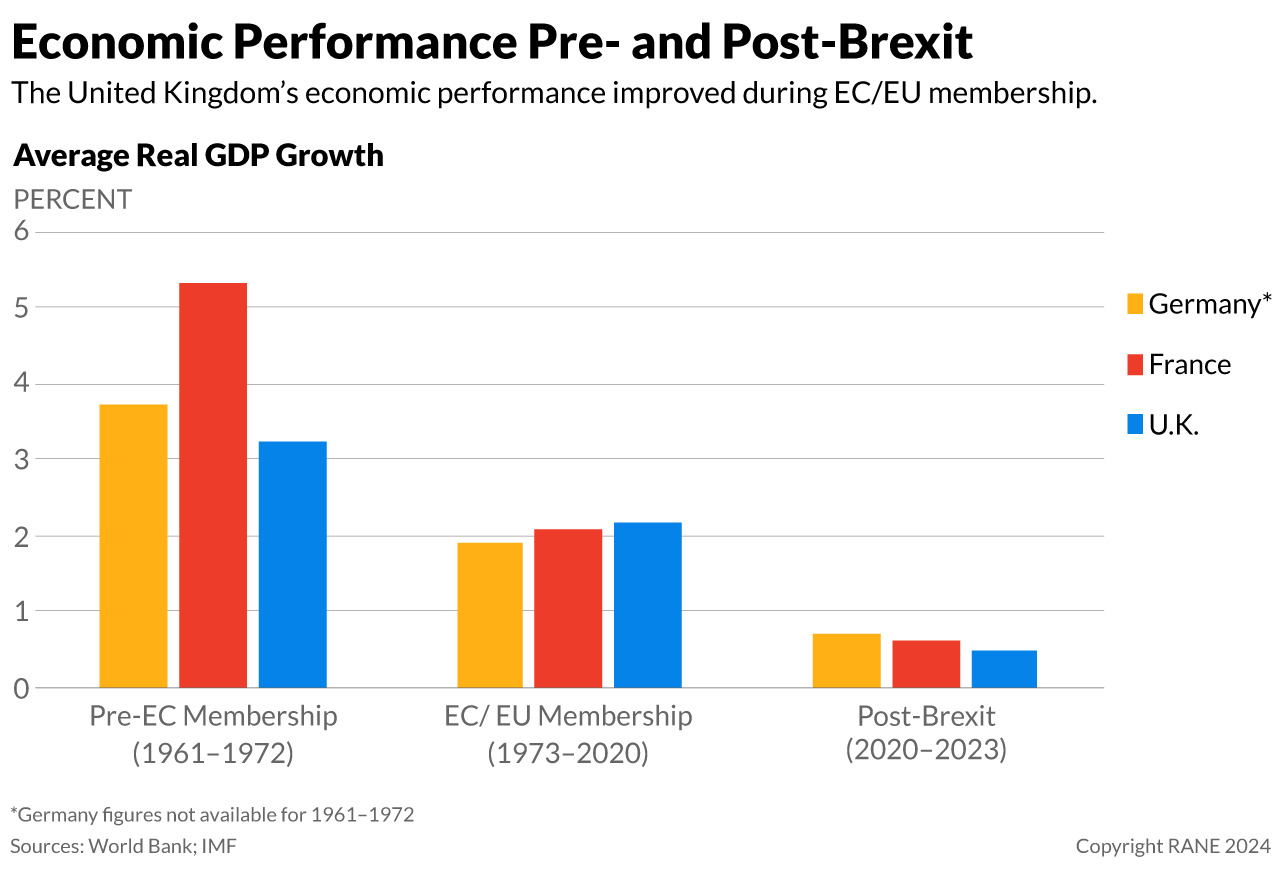
The United Kingdom's decision to leave the European Union in 2016 has since had a material impact on its economy in terms of lost output, with only limited benefits. Long-term economic growth is a function of many factors, including demographics, savings and investment levels, technological innovation, macroeconomic and regulatory policies, and international trade integration. And there are different ways of measuring economic performance by, for example, accounting for differences in demographic changes or levels of per capita income. However, the U.K. economy has lost ground in recent years, both relative to its performance pre-Brexit and its relative economic performance vis-a-vis its European peers (including France, Germany and Italy). Most economists believe that the United Kingdom is significantly worse off than it would have been had Brexit never happened, as the country's 2016 withdrawal from the European Union has since deterred investment, lowered confidence in the U.K. economy, and increased costs of doing trade with its most important trading partner, the European Union. Despite the promises of a post-Brexit ''Global Britain'' that could more effectively expand global trade relations without the constraints of EU bureaucracy, major U.K. trade deals remain out of reach, and the trade agreements the United Kingdom has reached since Brexit have had a negligible impact on its economy.
- In 2024, Goldman Sachs estimated that the U.K. economy has underperformed its peers by 5% since Brexit in 2016, though the actual impact may have been 4-8% of real GDP, relative to a non-Brexit scenario. The United Kingdom has also experienced higher inflation; U.K. prices today are 31% higher than they were in 2016.
- The five-year real GDP growth in the United Kingdom in 2016 was 2.4%, significantly higher than in France, Germany, Italy and the United States. That growth rate has since fallen to just 0.8%.
- The United Kingdom's relative economic decline in recent years cannot be solely ascribed to Brexit given the substantial global economic fallout from the COVID-19 pandemic and the Ukraine-related energy and inflation shocks. However, other European economies were also subject to the same exogenous shocks and have still outperformed the United Kingdom in the post-Brexit era.
- While Britain has historically lagged behind its peers in terms of business investment, it has underperformed very dramatically in recent years. In 2023, business investment in the United Kingdom — a major driver of economic and productivity growth — was only 6% higher than it was in 2016. By comparison, business investment in the United States was up 25% last year.
The United Kingdom's continued economic underperformance is unlikely to lead to calls to reverse Brexit, though it could make future U.K. governments more inclined to seek greater cooperation with the European Union. The United Kingdom remains highly unlikely to reach a free trade agreement with the United States, which was one of Brexit's main promises, due to a lack of executive and legislative support in Washington for new free trade agreements. A free trade agreement with China, the world's third-largest economy, is not even on London's agenda. Meanwhile, the United Kingdom's negotiations with protectionist-leaning India are proving difficult. When it comes to Europe, there are limits to how much the United Kingdom can deviate from the European Union in terms of economic, trade and industrial regulations under the post-Brexit U.K.-EU Trade and Cooperation Agreement (TCA). However, the regulatory divergence between the two will create new barriers to trade between Britain and its largest trading partner. This will lead to reduced market access and higher trade costs, as well as more red tape for U.K. businesses trying to export to the European Union while complying with EU rules (including customs regulations), which will further harm those businesses' competitiveness vis-a-vis their EU-based peers. Economic reasons, as well as shifting public attitudes in the United Kingdom toward the European Union, will gradually lead the United Kingdom to seek greater economic cooperation with the bloc. But this will be a slow process and it will not compensate for the losses caused by Brexit for the foreseeable future.
- The European Union will remain the United Kingdom's dominant trade partner, followed by the United States. The United Kingdom's much lower levels of trade with other countries mean that gains from trade liberalization will be very limited, even if those gains have the potential to grow fast. As of 2022, 43% of U.K. merchandise exports went to the European Union, while 12% went to the United States. In terms of services trade, the European Union is less important, accounting for 37% of U.K. service exports, compared with 28% for the United States.
- U.K. public opinion has become more pro-EU membership in recent years. A YouGov poll conducted in November 2023 showed that 57% of Brits would support re-entering the EU single market if it allowed for a resumption of the free movement of people between the United Kingdom and EU countries. The poll also showed that nearly three-fourths of Brits want their country to have closer ties with the European Union. Support for rejoining the bloc is greater among supporters of the opposition Labour Party compared with supporters of the ruling Conservative Party. Yet reversing Brexit will remain a highly problematic political proposition for any party in power, and Brits' growing support for rejoining the European Union is more likely to translate into greater, yet still limited, economic cooperation and regulatory alignment with the bloc rather than a new U.K. EU membership bid.
- The center-left Labour Party is currently polling roughly 20 points ahead of the ruling Conservative Party in the lead-up to the United Kingdom's next general election, which is largely expected to take place in the fall of 2024. Labour leader Keir Starmer said his party won't seek to reverse Brexit if it takes power, but will pursue greater trade and regulatory cooperation with the European Union and push for a major rewrite of the post-Brexit deal when it comes up for review in 2025.
The United Kingdom will not be able to sufficiently liberalize trade with third countries to offset the economic losses associated with Brexit, which will continue to weigh on the country's economic outlook. The ruling Conservative Party's vision of turning the United Kingdom into a hub for high-end international services trade by relying on light-touch competitive regulation has remained elusive. The United Kingdom has a competitive advantage in high-value services such as banking, legal services and consulting thanks to its location between North America and continental Europe (which is important, because countries do more trade with countries geographically closer to them, in part because of lower transportation costs), its strong rule of law (which lowers transaction costs and makes for an attractive place to do business) and agglomeration effects (which lock in a competitive advantage in terms of specialized knowledge, infrastructure or labor markets). Given these structural advantages, the U.K. government has been trying to liberalize trade services with third countries. But high-level trade agreements on services can be particularly difficult to reach due to the need to reach an agreement on reducing non-tariff barriers, which need to be removed to allow for services trade such as banking, legal services and consulting. The United Kingdom has also made little progress on domestic regulatory reform, in part because retaining access to the EU market makes it difficult to significantly liberalize parts of the United Kingdom's regulatory regimes. Against this backdrop, the United Kingdom will not be able to offset Brexit-related economic losses through growth-boosting trade agreements with other countries — especially since, on its own, it has far less bargaining power to extract concessions in negotiations than the European Union, as well as vis-a-vis third countries.
- Apart from those with the United States and China, no potential trade deals that would significantly impact the United Kingdom's economic growth in the medium-to-long term. While the Indian economy is growing quickly, its economic size in nominal GDP terms is relatively small compared with the United States and China, and its trade with the United Kingdom is small and would only increase from a very low base. Moreover, India remains reluctant to open some of its services substantially to U.K. exports, which has been one of the main hangups in U.K.-India free trade negotiations.
- The United Kingdom is set to join the Comprehensive and Progress Trans-Pacific Partnership (CPTPP) this year, a grouping of a dozen economies on either side of the Pacific. But the economic benefits of joining the CPTPP will still be modest since the United Kingdom already has free trade agreements with virtually all CPTPP members (except Malaysia). The United Kingdom's Office for Budget Responsibility estimates the United Kingdom's entry into the CPTPP would add just 0.04% to the country's GDP over the next 15 years.
