
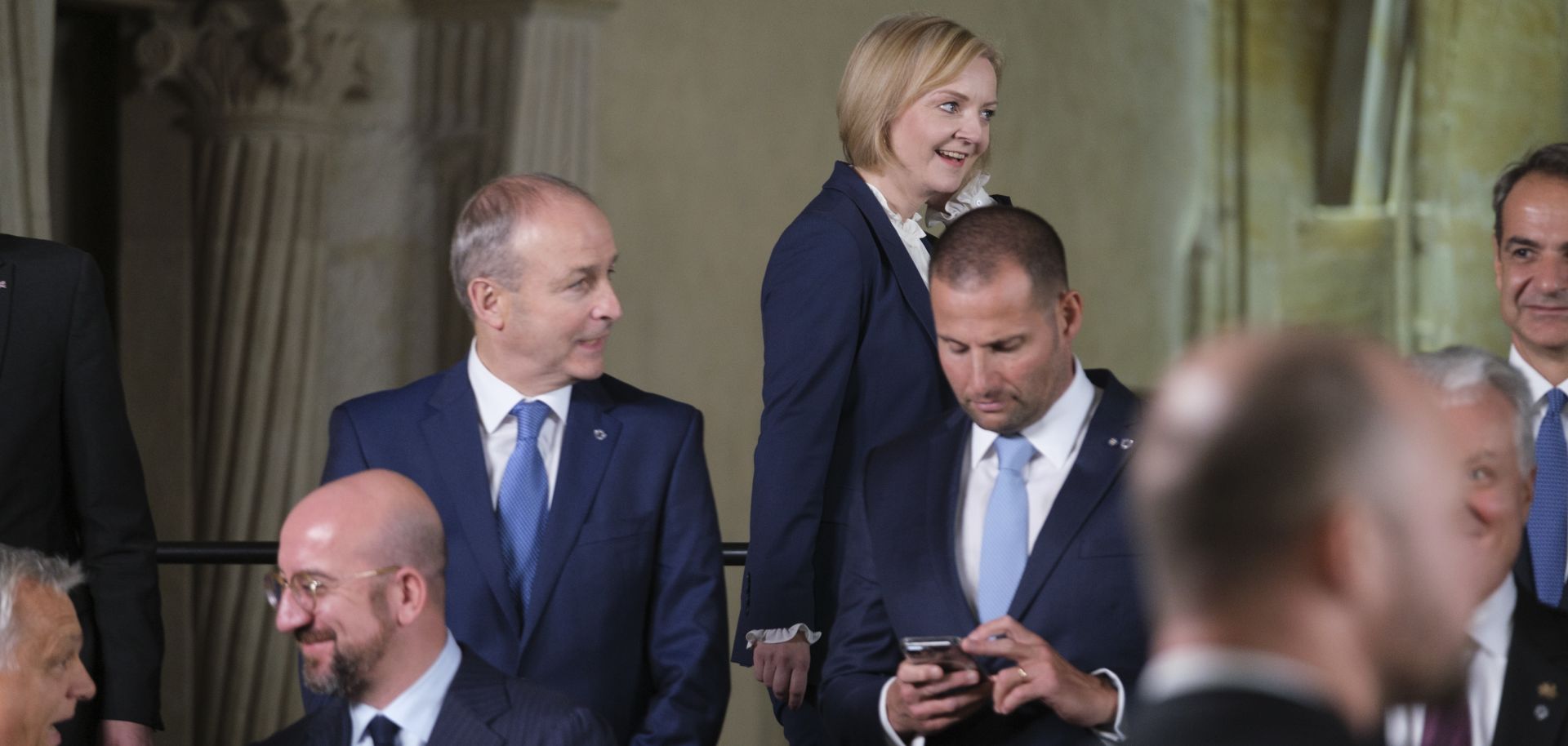
Economic and political motivations are accelerating a U.K. rapprochement with the European Union that could lead to an agreement on outstanding Brexit issues on Northern Ireland, though significant obstacles remain and the risk of a trade war persists. Relations between the United Kingdom and the European Union have warmed over the past few weeks following months of soaring tensions. U.K. Prime Minister Liz Truss has softened some of her eurosceptic positions since her appointment in September, and so have senior members of her cabinet. This shift was evident in her decision to accept French President Emmanuel Macron's invitation to attend the first meeting of the European Political Community (EPC) on Oct. 6, an entity that includes 44 European countries and offers a new framework for post-Brexit U.K.-EU cooperation. Contributing to this improved bilateral climate, negotiations between the United Kingdom and the European Union over the Northern Ireland protocol (which establishes customs controls at the Irish Sea) formally resumed in late September after several months of stagnation, and recent statements from both sides suggest that the talks are making progress.
- During the EPC summit, the United Kingdom secured a deal with the European Commission to rejoin the North Seas Energy Cooperation (NSEC), a regional EU energy cooperation framework. This will mitigate the risks of energy shortages in the United Kingdom.
- Following high-level talks on Oct. 7 at the British-Irish Intergovernmental Conference in London, the United Kingdom's Secretary of State for Northern Ireland Chris Heaton-Harris said he was optimistic about the resumption of talks with the European Union following a months-long standoff.
- U.K. Foreign Secretary James Cleverly said at a Conservative Party conference in Birmingham on Oct. 4 that talks between the United Kingdom and the European Union around post-Brexit trade relations were finally improving, hinting a solution to the Northern Ireland protocol dispute may be found soon. At the same event, Heaton-Harris said the government thinks a negotiated settlement on the protocol could be reached ''in the next few weeks.''
The United Kingdom's energy and cost-of-living crises, combined with the recent turmoil in U.K. financial markets, are pushing London to avoid a deepening of its confrontation with the European Union. A combination of domestic and international factors is creating the material circumstances for a quicker rapprochement between London and Brussels. Both are scrambling to protect their citizens and businesses from the energy and cost-of-living crises, which explains the NSEC deal. The United Kingdom is also grappling with financial turbulence after the government's new fiscal strategy spooked markets — causing the sterling pound to crash to record lows against the U.S. dollar, government borrowing costs to soar to record highs, and the Bank of England (BoE) to delay its planned quantitative tightening. Against this backdrop, any signs of renewed EU-U.K. tensions that could lead to a trade war over the Northern Ireland protocol would further rattle United Kingdom's financial markets, which partly explains why U.K. officials are now publicly expressing optimism about a deal with the European Union. More broadly, the United Kingdom also cannot afford a trade war with the European Union at a time when its economy is heading toward a recession.
- Under their 2020 Brexit agreement, the United Kingdom and the European Union agreed to elaborate a framework for future electricity trading that would come into effect in 2022. However, negotiations stalled amid a broader distancing between London and Brussels over the Northern Ireland protocol. The lack of an electricity trading framework led the United Kingdom to adopt a more inefficient system for buying and selling electricity through subsea interconnectors linking the country with France, the Netherlands and Belgium. This has contributed to higher energy bills for British households.
- Former Chancellor of the Exchequer Kwasi Kwarteng's ''mini-budget'' announced on 23 Sept. introduced 45 billion pounds worth of debt-financed tax cuts, causing investors to question the sustainability of the country's public finances. The announcement led to a sell-off in U.K. assets, sending the pound to a record low of $1.035 against the U.S. dollar on Sept. 26 and pushing government bond yields to their highest in over a decade, which forced the BoE to intervene in the U.K. government bonds market on Sept. 28, pledging to buy up to 65 billion pounds worth of bonds. As a result of this financial turmoil, Truss sacked Kwarteng on Oct. 14.
Political considerations are also urging the United Kingdom government to repair relations with the European Union and negotiate a way out of the impasse. Under Truss, the ruling Conservative Party is trying to focus on severe tax cuts to boost economic activity. But the financial turmoil that followed the announcement of unfunded tax cuts is significantly reducing the government's room for maneuvering. Truss will probably not be able to pursue her libertarian agenda if the United Kingdom is in a trade war with the European Union over unfinished Brexit disputes. Investors are closely watching Truss' moves, and a worsening of the crisis would likely lead to a government collapse. This explains why finding a solution to the contentious Northern Ireland protocol is acquiring an increasing sense of urgency. Moreover, an Oct. 28 deadline for appointing a government in Northern Ireland to avoid an early regional election is adding yet another reason for London to accelerate negotiations, as new elections could increase the threat of instability between republicans and unionists in the region.
- Sinn Frein, Northern Ireland's largest republican party, won the legislative election that took place in the region in May. According to Northern Ireland's rules, Sinn Fein must share the government with the Democratic Unionist Party (DUP), the largest unionist party. However, the DUP has so far refused to enter a government with Sinn Fein and if there is not a deal by the end of October, there will be an early regional election. The DUP is demanding a reform of the Northern Ireland protocol (to eliminate all customs controls at the Irish Sea) before entering into a coalition government with Sinn Fein.
While London will seek to reach a political agreement with Brussels over the coming weeks to break the stalemate, the risk of a trade war will remain. Despite the improving EU-U.K. relations, achieving a comprehensive deal on the Northern Ireland protocol will prove challenging. While London is calling for fundamental changes to the treaty to ensure that goods move freely between Great Britain and Northern Ireland, Brussels insists that some customs controls are necessary to prevent U.K. goods from illegally entering the EU single market through Northern Ireland. The European Union and the United Kingdom also disagree on whether Northern Ireland should follow EU or U.K. regulations on issues like state aid and value-added tax (VAT). Finally, the role of the European Court of Justice is also controversial, as London wants to remove the court's position as the arbiter of the protocol. Nevertheless, a high-level political solution — followed by lengthy, detailed negotiations to define the details — is possible, and the two sides will likely push for a preliminary political agreement at least covering the main points of controversy. Failure to make progress on any of these outstanding issues will increase the probability of an escalation in tit-for-tat tariff hikes between the European Union and the United Kingdom, which would negatively impact bilateral trade at a time of slowing economic growth.
- The Northern Ireland protocol bill, a piece of legislation that would give the United Kingdom government powers to unilaterally scrap parts of the Northern Ireland protocol, is a significant point of contention. The European Union has told the United Kingdom the bill must be scrapped before a deal on the Northern Ireland protocol can be reached. The bill is making progress in the United Kingdom Parliament, but its approval will likely be delayed at the House of Lords.
- In recent months, the European Union has agreed to remove customs controls at the Irish Sea for some specific U.K. products, but Brussels still believes most controls should be kept in place. The United Kingdom has proposed to create a ''red lane'' for U.K. products whose final destination is the EU single market (which would be subject to customs controls) and a ''green lane'' for U.K. goods whose final destination is Northern Ireland (which would not be subject to customs controls). While this could be the basis for a compromise between London and Brussels, there is still significant mistrust between them about London's ability or willingness to correctly enforce such a mechanism and share trade data with Brussels.
