
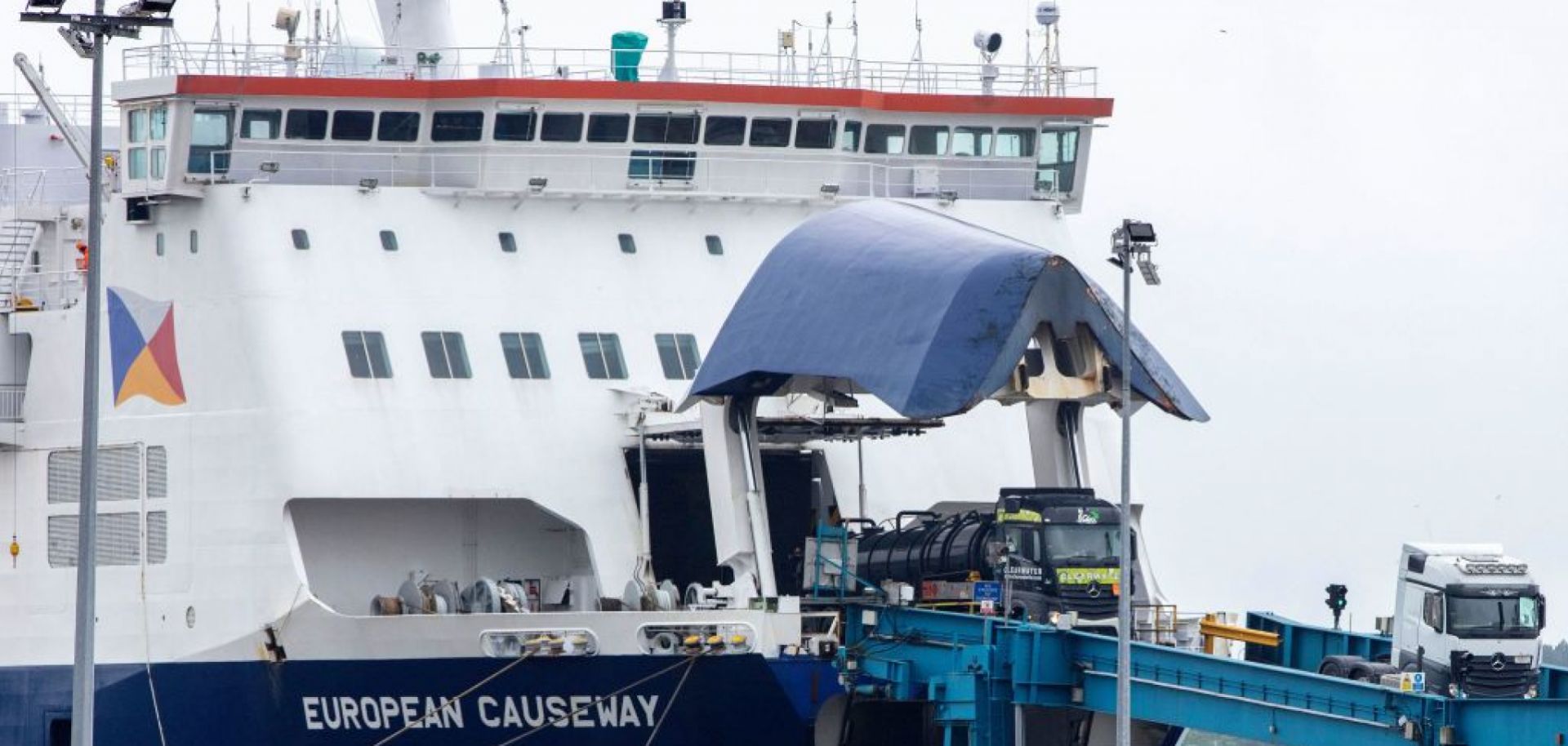
Trucks on May 17, 2022, disembark a ferry at Larne port, north of Belfast, Northern Ireland.
While a British government proposal to unilaterally abandon some parts of the Northern Ireland protocol is probably a negotiation tactic, it will make talks with the European Union tougher and eventually could spark a trade war. British Foreign Secretary Liz Truss told Parliament on May 17 that London would soon unveil a bill that would unilaterally change the implementation of the Northern Ireland protocol. Part of the EU-U.K. Brexit agreement, the protocol establishes customs controls at the Irish Sea. According to Truss, the bill would create a "green lane" with no customs controls for British products destined to Northern Ireland and a "red lane" with full customs controls for British products for export to the Republic of Ireland or the broader EU single market. Truss said the British government would announce more details of the proposals in the coming days.
- By establishing customs controls at the Irish Sea, the protocol avoids the imposition of a "hard" border between Northern Ireland and the Republic of Ireland, which would go against the 1998 Good Friday Agreement that greatly reduced sectarian conflict in Northern Ireland. Unionist forces in Northern Ireland argue, however, that granting Northern Ireland a separate legal status from the rest of the United Kingdom makes the protocol a prelude to reunification with the Republic of Ireland.
- Though it agreed to the protocol in 2020 to smooth the Brexit process, London now argues that the imposition of customs controls at the Irish Sea undermines the unity of the British internal market and causes disruptions in trade between Great Britain and Northern Ireland. The British government has also criticized a protocol clause requiring London to notify Brussels of subsidy policies involving goods entering Northern Ireland, and a clause requiring Northern Ireland to apply the EU value-added tax. Finally, the United Kingdom wants to eliminate the European Court of Justice as the final arbiter of the protocol.
- Though the European Commission recently has proposed reducing bureaucratic hurdles to moving goods between Great Britain and Northern Ireland, it insists that customs controls are necessary to prevent Northern Ireland from becoming an illegal entry point for British products into the EU single market. The European Union also argues that because the United Kingdom has agreed to keep Northern Ireland in the EU single market, the region must comply with EU tax and subsidy rules. Should the United Kingdom violate the protocol, the European Union has threatened to respond with trade sanctions.
London has not announced a timetable for the bill's approval or implementation, indicating that broaching the bill represented an attempt to gain leverage in negotiations with Brussels. By announcing a bill is on the way but not specifying its exact content or a ratification process, London is probably seeking to pressure Brussels into compromising over the protocol. The bill is likely also meant to satisfy Unionist forces in Northern Ireland, which have demanded protocol reforms in exchange for entering a coalition government with Republican forces and so ending the political stalemate in the region.
- During a May 16 visit to Northern Ireland, British Prime Minister Boris Johnson said that he did not want to scrap the protocol but rather to "fix" it. He also described the new piece of legislation as an "insurance policy" in case negotiations with the European Union fail to progress. According to reports in the British media, the British Cabinet is internally divided between factions willing to escalate tensions with the European Union to obtain concessions in the negotiations and factions that want to avoid a trade war with Brussels at a time of rising economic uncertainty in the United Kingdom.
- On May 17, Irish Prime Minister Micheal Martin urged the British government to engage in "substantive talks" with the European Union over the protocol's future. He also warned London not to try to modify it unilaterally.
A compromise between the United Kingdom and the European Union remains possible, though rising political tensions could still derail the negotiation and result in an escalation of trade sanctions that would damage both economies at a time of global economic volatility. The British government is probably interested in avoiding a trade war with the European Union, which would make EU products more expensive amid rising inflation. Since exiting the European Union, the United Kingdom has chosen not to implement customs controls on EU products so as to avoid delays at ports that could disrupt supply chains. While the United Kingdom is a relatively small market for the European Union, the bloc is also interested in avoiding a trade war amid its current economic problems. The war in Ukraine will probably convince London and Brussels to avoid fragmenting the Western alliance at a time of high geopolitical tensions with Russia. Still, the Conservative government in the United Kingdom could seek an escalation of tensions with Brussels to secure support from nationalist voters and members of parliament to distract from recent scandals. At the same time, long-term concerns about undermining British territorial integrity could also result in London refusing to compromise with Brussels. In the European Union, the need to preserve the integrity of the single market and the political decision to send EU voters the message that exiting the bloc is an economically painful process could also harden Brussels' position. Should the United Kingdom exit or ignore the protocol, the European Union probably would impose trade sanctions on the United Kingdom, causing London to retaliate with countersanctions. This scenario remains a distant possibility; further negotiations are more likely even if the United Kingdom unilaterally violates the protocol.
- Discontent with the Northern Ireland protocol was one of the drivers of riots in Derry, Belfast and other Northern Irish cities in March 2021. Discontent with the protocol and a surge in the cost of living could produce isolated episodes of unrest in the region in the coming months, but widespread sectarian violence in Northern Ireland is unlikely.
