
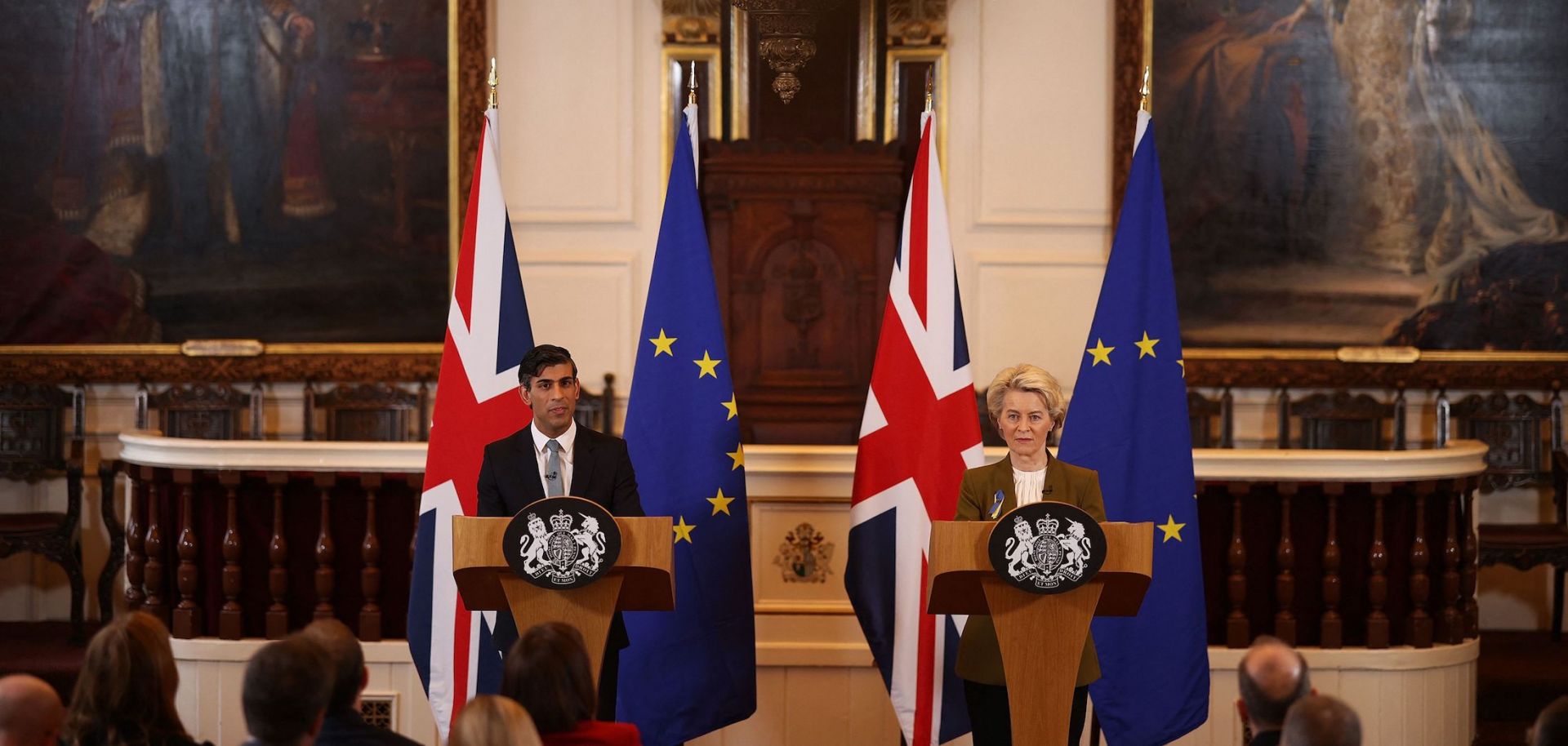
U.K. Prime Minister Rishi Sunak and European Commission Chief Ursula von der Leyen hold a joint press conference at the Fairmont Hotel in London on Feb. 27, 2023, following their meeting.
The EU-U.K. deal on Northern Ireland protocol marks a key step in London's effort to improve its post-Brexit relationship with Brussels and avoid a trade dispute with the bloc. But domestic political risks could still lead to a government and economic crisis in the United Kingdom. Following months of negotiations, the United Kingdom and the European Union have finally struck a deal to end their long-standing dispute over post-Brexit trade rules for Northern Ireland. During a Feb. 27 press conference in the London suburb of Windsor, U.K. Prime Minister Rishi Sunak and European Commission President Ursula von der Leyen confirmed the two sides had finalized an agreement, dubbed the ''Windsor Framework,'' that amends to the so-called Northern Ireland protocol of the EU-U.K. Brexit deal. The adjustments include a new ''green-red lane system'' that will reduce custom checks on goods moving from Great Britain whose final destination is Northern Ireland (but apply full controls for goods whose destination is the Republic of Ireland or the rest of the EU single market). The deal also grants the U.K. government jurisdiction over VAT and excise changes in the province, and establishes an emergency mechanism that ''safeguards sovereignty for Northern Ireland'' by allowing the Northern Ireland Assembly in Stormont to veto changes to EU rules applying in the province. Later in the day, Sunak gave more details on the specific terms of the deal in a statement to U.K. lawmakers in the House of Commons, during which he also announced he was scrapping the controversial Northern Ireland protocol bill that would have given U.K. ministers powers to unilaterally override parts of the protocol.
- On the movement of goods between Northern Ireland and Great Britain, Sunak claims the Windsor Framework effectively removes any sense of a border in the Irish Sea within the United Kingdom, thanks to the green-red lane system.
- The deal will allow medicines, pets and plants to circulate freely across the Irish Sea while London will be able to extend eventual country-wide tax breaks and subsidies to Northern Ireland as well – which the U.K. government has characterized as protecting Northern Ireland's place in the Union.
- London also says that concerns over Northern Irish sovereignty are addressed with the new so-called ''Stormont Brake,'' which will allow the Northern Ireland Assembly to oppose new EU goods rules on the same basis as the ''petition of concern'' mechanism in the 1998 Good Friday Agreement that largely restored peace in Northern Ireland after decades of violence. This is meant to address one of the most important sources of concern for critics of the protocol, the so-called ''democratic deficit'' for Northern Ireland if it was subject to EU rules it does not have a say on.
The deal is the culmination of a months-long gradual process of EU-U.K. rapprochement driven by economic and geopolitical concerns, despite persisting political constraints in the United Kingdom. For months, the United Kingdom and the European Union have been locked in delicate negotiations to try to address the former's concerns with the Northern Ireland protocol within the framework of the original Brexit agreement signed in December 2020. Between late 2022 and early 2023, a succession of trust-building gestures between Brussels and London resulted in a breakthrough in negotiations, which eventually entered their final phase at a meeting between Sunak and von der Leyen on the sidelines of the Munich Security Conference on Feb. 17. Throughout this time (and despite pushback from euroskeptic voices within the United Kingdom's ruling Conservative Party), negotiations have been driven by London and Brussels' mutual desire to not only avoid a trade war that would exacerbate both territories' economic crises, but preserve some degree of European unity in the face of heightened geopolitical tensions with Russia over the ongoing Ukraine war.
- U.K.-EU tensions first showed signs of thawing under the short-lived government of former U.K. Prime Minister Liz Truss, which took office on Sept. 6. Negotiations on the protocol formally resumed in late September after several months of stagnation and then significantly accelerated once Truss resigned and Sunak took over in October.
- In late 2022, the United Kingdom agreed to give the European Union access to real-time data on goods going from Great Britain to Northern Ireland. In January, the U.K. government then published legislation allowing it to order the construction of border posts at Northern Irish ports, signaling London's desire to facilitate a green-red lane system.
- Von der Leyen and Sunak's meetings in Munich and Windsor followed weeks of talks between their teams' two main Brexit negotiators: European Commission Vice President Maros Sefcovic and U.K. Foreign Secretary James Cleverly, respectively.
The agreement should enable the United Kingdom to continue improving relations with not only the European Union but also the United States and France, thus strengthening its ability to respond to both immediate and future social and economic challenges. The Northern Ireland deal is the first step in the United Kingdom's broader push to repair relations with the European Union (its biggest trading partner) after years of post-Brexit tensions. In fact, the deal could lead to future agreements in other areas as well, including on research cooperation (with the Northern Ireland deal unlocking U.K. participation in the Horizon Europe research program) and on post-Brexit cooperation on professional and financial services. A rapprochement with the European Union could help bolster the U.K. government's position in the face of upcoming challenges, including supply chain diversification and rising global protectionism. Moreover, a deal on the Northern Ireland protocol could improve bilateral relations with both France and the United States to some extent, as both Washington and Paris have criticized any alternative to a deal with the European Union on Northern Ireland — particularly London's controversial Northern Ireland protocol bill, which Sunak has now shelved.
- The United Kingdom is particularly compelled in improving bilateral relations with the European Union and maintaining its outreach to Brussels as the bloc formulates its new green industrial policy strategy in response to the U.S. Inflation Reduction Act to make sure any likely increase in state subsidies does not excessively harm British companies.
- The administration of U.S. President Joe made it clear that the Northern Ireland protocol bill and related trade disputes with the European Union would not be ''conducive'' to a U.K.-U.S. trade deal, which remains an important (though unlikely) objective for London, especially after Brexit.
- French President Emmanuel Macron, who has also taken a hard line on the protocol, will host Sunak at a Franco-British summit in Paris on March 10. The summit is meant to relaunch a positive agenda for bilateral cooperation after years of strained relations. Positive relations with France are particularly important for Sunak as he aims to deliver on his promise to tackle illegal migration across the English Channel and secure energy supplies from the country amid the ongoing energy crisis.
Domestic political opposition to a deal on the Northern Ireland protocol could still trigger a political and economic crisis in the United Kingdom, though such a crisis is unlikely to derail the agreement. A deal with the European Union on the Northern Ireland protocol also comes with significant political risks for Sunak, as it could open up to backlash from pro-Brexit hard-liners in his Conservative Party and unionists in Northern Ireland, with both groups expected to formulate an official position on the deal over the coming days. The U.K. Parliament is slated to vote on the changes to the protocol, but it remains unclear whether Sunak will manage to win enough backing from his party without needing the support of the opposition Labour Party, which would allow Sunak to pass his deal but would also politically undermine his premiership. An internal Conservative Party rebellion — which could either take the shape of high-profile resignations from Sunak's cabinet or a vote of no-confidence to unseat him as prime minister — could lead to yet another government crisis in the United Kingdom and possibly to an early election. This scenario would most likely create turmoil in financial markets and worsen the country's economic crisis. But members of the Conservative Party will likely want to avoid holding an early vote, which polls currently indicate the Labour Party would win by a landslide.
- The latest YouGov voting intention survey in the United Kingdom shows the Labour Party leading by 28 points ahead of the Conservative Party, with the latter polling at just 22%, down two points from the survey the U.K.-based pollster conducted earlier this month.
- The Democratic Unionist Party (DUP) has boycotted power-sharing institutions in Northern Ireland since May 2022 — essentially paralyzing the devolved government — and has demanded fundamental changes to the protocol. In order to end its boycott, any plan needs to pass ''seven tests'' laid out by DUP leader Sir Jeffrey Donaldson in July 2021. Conservative lawmakers in the influential pro-Brexit European Research Group will then largely base their support for the deal on the DUP's final verdict.
