
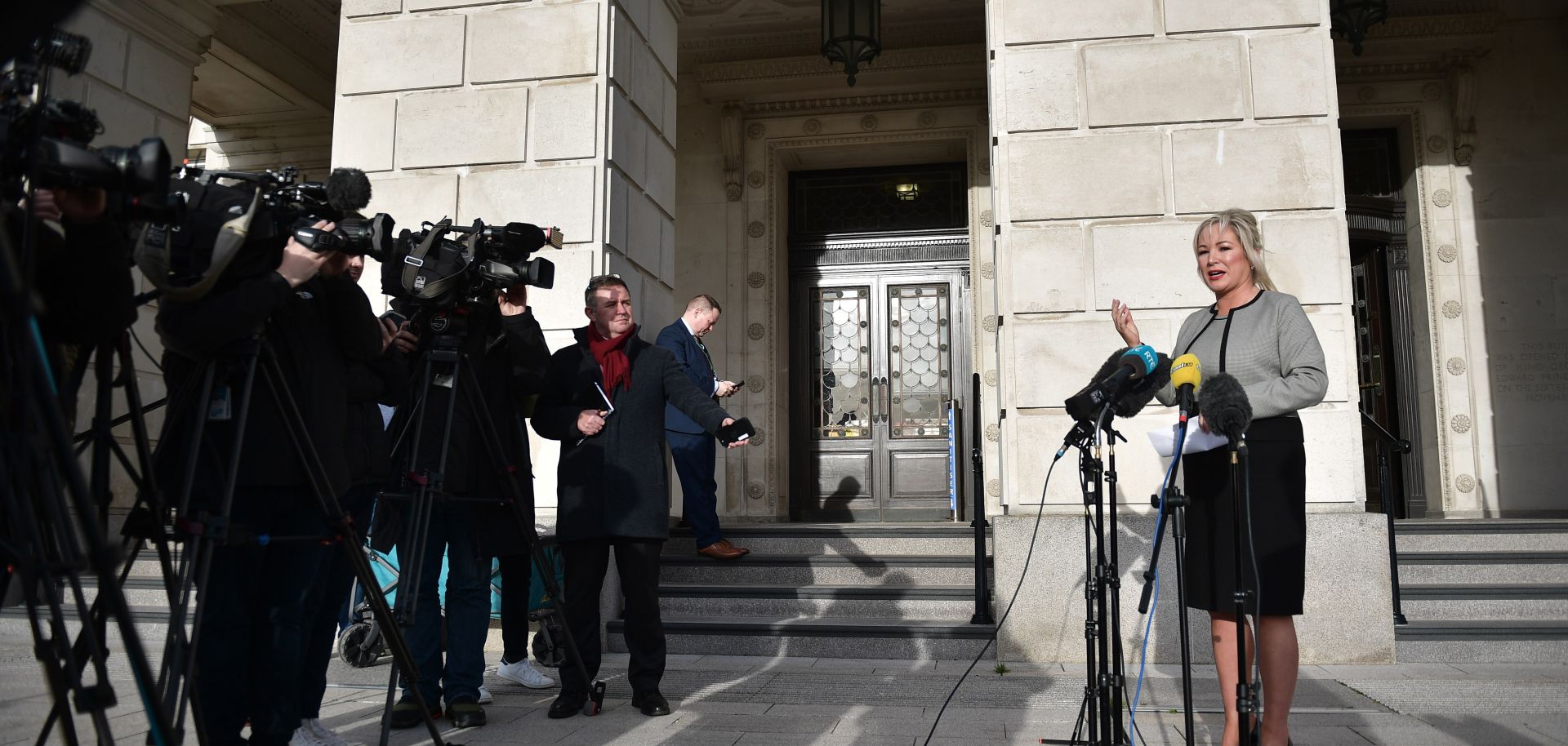
Sinn Fein vice president Michelle O'Neill holds a press conference outside the Northern Ireland Assembly in Belfast on Nov. 9, 2022, after the United Kingdom announced an extended deadline for Northern Ireland's main parties to form a government before a new election is triggered.
The U.K. government's decision to delay a regional election in Northern Ireland to March or April gives London more time to reach a compromise with Brussels on reforming the Northern Ireland protocol, but significant obstacles remain and a trade war is still possible. On Nov. 9, Northern Ireland Secretary Chris Heaton-Harris announced an extension of the deadline for political parties in Northern Ireland to form a government to Dec. 8, with the possibility of a further extension by another six weeks. Northern Ireland's main republican party, Sinn Fein, and the Democratic Unionist Party (DUP) failed to form a government by the original Oct. 28 deadline to avoid an early election, which would have triggered a vote by mid-January. Heaton-Harris' decision to change the deadline means that the earliest date for an early election is now March or, if there is a second extension, April. Northern Ireland held a legislative election in May, where Sinn Fein ended in the first position and the DUP ended second. According to the 1998 Good Friday Agreement, which ended decades of sectarian violence in Northern Ireland, Sinn Fein and the DUP must govern together. But the DUP has refused to enter a government unless the British government scraps or significantly amends the Northern Ireland Protocol of the EU-U.K. Brexit agreement, which establishes customs controls at the Irish Sea.
- According to the DUP, the Northern Ireland Protocol undermines the United Kingdom's territorial integrity by keeping Northern Ireland in the EU single market and by establishing customs controls for goods moving from Great Britain to Northern Ireland — a view that is shared among many members of the United Kingdom's governing Conservative Party. From the DUP's perspective, the Northern Ireland Protocol sets a dangerous path toward Ireland's eventual reunification. Sinn Fein, for its part, defends the protocol, arguing that it is necessary to prevent the establishment of a land border between Northern Ireland and the Republic of Ireland, which would violate the Good Friday Agreement.
- While the protocol is a divisive issue in Northern Ireland, the region has so far avoided a significant escalation of sectarian violence because there is not enough social or political support for it. However, the monthslong political stalemate in Belfast, combined with the ongoing cost of living crisis in the United Kingdom, raises the potential for isolated episodes of unrest and violence (like the riots seen in unionist neighborhoods in March and April 2021).
The U.K. government's decision suggests it believes that a deal with the European Union over the Northern Ireland Protocol is possible. Negotiations between Brussels and London to amend the protocol have moved slowly in recent months, in part because of fundamental differences in how to reform it, and in part because of the rapid succession of financial and political crises in the United Kingdom (which has had three prime ministers since September). Heaton-Harris' decision to delay an election in Northern Ireland confirms that a deal with the European Union over the protocol — which would, in turn, allow for a deal between the DUP and Sinn Fein — is improbable by the end of the year. Now that the election will take place in March or April, London and Brussels have additional time to reach a compromise. Ideally, the United Kingdom would like to settle the issue by April 10, which will mark the 25th anniversary of the Good Friday Agreement. To commemorate the anniversary, the United Kingdom is planning a ceremony that U.S. President Joe Biden would potentially attend, given that the United States is a guarantor of the treaty. In recent years, several U.S. officials and lawmakers have warned the U.K. government not to do anything that would jeopardize peace in Northern Ireland and to respect the protocol.
- In an interview with the Financial Times published on Nov. 9, Heaton-Harris said he was ''genuinely very positive'' about London and Brussels reaching a deal on the Northern Ireland protocol in early 2023.
- On Nov. 7, the European Union's chief Brexit negotiator, Maros Sefcovic, said the two sides could reach such a deal ''within weeks'' if they both showed enough political will, noting that Brussels was not ''seek[ing] any political victory'' and ''just want[ed] to solve the problem.''
While London and Brussels are interested in a deal, outstanding disagreements could still result in an escalation of punitive measures that would undermine bilateral trade. The European Union has repeatedly warned the United Kingdom that failure to enforce the Northern Ireland Protocol would result in punitive measures, including financial penalties and tariff hikes on selected U.K. goods. Should Brussels impose any of these measures, London would likely retaliate with similar policies. Neither side, however, wants to engage in such a tit-for-tat escalation of tariff hikes, which would further disrupt their economies at a time when both are battling severe inflation and energy crises. An eventual compromise on the Northern Ireland Protocol thus remains more likely, though this will still require overcoming significant obstacles. The first is what kind of customs controls (if any) to impose at the Irish Sea, and for which products. The United Kingdom wants no controls at all, especially for goods shipped from Great Britain to Northern Ireland. But the European Union is concerned that this would make Northern Ireland a backdoor for U.K. goods to enter the EU single market illegally. In addition, London wants to remove the European Court of Justice's role as the arbiter of the protocol, but Brussels argues that issues involving the bloc's single market are within its court's jurisdiction. Finally, there are disputes over whether U.K. policies and rules on areas such as taxes and state aid apply to Northern Ireland. While resolving these sticking points will remain a tall order, Heaton-Harris' decision to delay elections in Northern Ireland has provided EU and U.K. negotiators with a bit more time and breathing room to hash out a deal.
- After months of disputes, the U.K. government recently gave the European Union access to live data from His Majesty's Revenue and Customs (HMRC) about cargo destinations entering Northern Ireland from Great Britain. Since Brexit, the European Union had accused the United Kingdom of providing data with a 40-minute lag, which was long enough for U.K. goods to first enter Northern Ireland and then enter the Republic of Ireland illegally. This change in the United Kingdom's position increases the probability of a deal to lift customs controls on goods whose final destination is Northern Ireland, while keeping controls on goods whose final destination is the Republic of Ireland and the EU single market — a compromise that Brussels and London can accept.
