
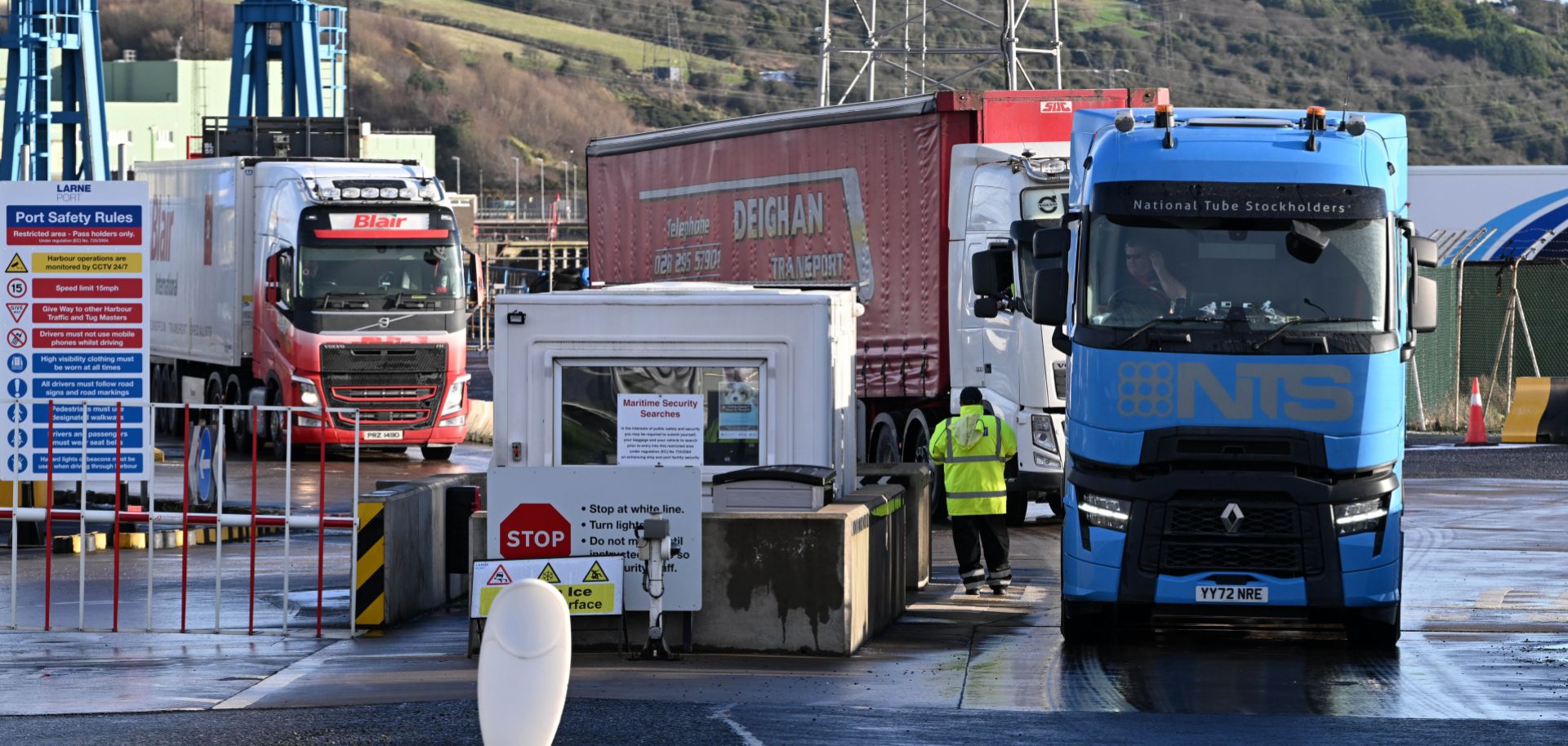
Trucks carrying goods are checked upon arriving at the port in Larne, Northern Ireland, on Jan. 17, 2023.
A compromise between the United Kingdom and the European Union to amend the controversial Northern Ireland protocol is approaching, which reduces the probability of a trade war that would negatively impact both economies, though technical and political obstacles remain. After years of negotiations, the European Union and the United Kingdom are nearing a deal to amend the Northern Ireland protocol, the part of the Brexit agreement that calls for customs controls at the Irish Sea to prevent a hard land border between Northern Ireland and the Republic of Ireland. On Feb. 6, an unnamed senior EU official told Irish broadcaster RTE that Brussels has agreed to remove most customs controls and phytosanitary checks for goods originating in Great Britain whose final destination is Northern Ireland, and to only apply full controls and checks for goods whose final destination is the Republic of Ireland and the broader EU single market. If implemented, this would meet a longstanding British demand to treat goods differently depending on their final destination.
- While the United Kingdom agreed to the protocol in late 2019, London has since refused to fully enforce it, claiming the protocol disrupts trade between Great Britain and Northern Ireland, and also contributes to political and sectarian instability in Northern Ireland. For years, the U.K. government has proposed creating a ''green lane'' with reduced controls for goods originating from Great Britain whose final destination is Northern Ireland, along with a ''red lane'' with full controls for goods whose final destination is the Republic of Ireland or the rest of the EU single market. In June 2022, the U.K. government published the Northern Ireland Protocol Bill, which if approved and enforced would give U.K. officials the power to unilaterally implement the ''green lane'' in Northern Ireland.
- The European Union is worried that lifting customs and phytosanitary controls at the Irish Sea would turn Northern Ireland into a backdoor for U.K. goods entering the EU single market illegally. Brussels has threatened to impose financial and trade sanctions on the United Kingdom if the Northern Ireland Protocol Bill is approved.
The recent EU-U.K. rapprochement on their Northern Ireland dispute is likely being driven by a mutual desire to avoid a disruptive trade war at a time of mounting economic and geopolitical uncertainty. A succession of trust-building gestures between Brussels and London has made the recent process in negotiations possible. In late 2022, the United Kingdom agreed to give the European Union access to a real-time database on goods going from Great Britain to Northern Ireland. Then in January 2023, the U.K. government published legislation that allows U.K. ministers to order the construction of border posts at Northern Irish ports. According to London, the existing facilities at Northern Ireland's ports need to be ''enhanced'' in order to make a ''red lane'' for goods possible. Both the data-sharing and enhancement of port infrastructure are meant to reassure Brussels that London plans to be transparent about the situation at Northern Irish ports and make a ''red lane'' possible. These gestures are probably the result of Brussels and London seeking to avoid a trade war that would increase inflation in both territories by disrupting their free trade agreement. Economic activity has decreased significantly in the United Kingdom and the European Union in recent months, and a trade war would only make things worse. Brussels and London are likely also looking to preserve some degree of European unity in the face of a more volatile geopolitical environment and heightened tensions with Russia amid the ongoing war in Ukraine.
- The U.K. government is also under political pressure from the United States to reach a compromise with the European Union. In recent years, multiple U.S. officials and lawmakers have warned the United Kingdom not to make any unilateral moves that would undermine the 1998 Good Friday Agreement that ended decades of sectarian conflict in Northern Ireland, of which the U.S. is a guarantor. The U.K. government wants U.S. President Joe Biden to visit Belfast to mark the agreement's 25th anniversary in April, but the White House has suggested Biden would only do this if there is a deal with the European Union on the Northern Ireland protocol.
While an agreement on customs controls significantly increases the probability of a deal, technical and political obstacles could still derail a compromise and result in a trade war. The ongoing negotiations between London and Brussels will likely result in a deal to amend the Northern Ireland protocol, and a trade war will likely be avoided. However, there are still technical and political obstacles to overcome, including the role of the European Court of Justice (ECJ) as the Northern Ireland protocol's arbiter. While London agreed to this in 2019, it now claims that it does not want Northern Ireland to be subject to a foreign court of justice and has demanded that a separate arbitration panel be created to oversee any potential bilateral disputes. According to unconfirmed media leaks, London and Brussels are negotiating the establishment of such a panel to coexist with the ECJ; other leaks suggest that Brussels is willing to accept limiting the ECJ's arbitration role to only cases deferred by Northern Irish courts. In addition, the protocol establishes that Northern Ireland must comply with EU single market rules on issues such as VAT and state aid, which is very controversial in the United Kingdom and could still derail a deal with the European Union. Finally, the British government is dealing with domestic opposition to a compromise with the European Union, as both hard-line members of the governing Conservative Party and unionist forces in Northern Ireland will oppose any deal that is perceived as too lenient with the European Union. This explains why London is being extremely discreet about the negotiations with Brussels, and why U.K. government spokespeople constantly belittle rumors of an imminent deal. From London's perspective, a deal that is seen as too quick increases the probability of domestic resistance.
- According to the Good Friday Agreement, unionist and republican forces must share power in Northern Ireland. However, the Democratic Unionist Party (DUP) refuses to enter a coalition with the republican Sinn Fein party until the Northern Ireland protocol is scrapped or substantially reformed. As a result, no government has been formed in Northern Ireland since the region's legislative election in May 2022. While the DUP and Sinn Fein have missed two deadlines to form a government, the U.K. government has yet to make a decision on whether or not to authorize a snap election in Northern Ireland.
- Conservative hard-liners in the European Research Group (ERG), a euroskeptic party caucus in the U.K. Parliament, are pressuring Prime Minister Rishi Sunak's government to put any deals with the European Union on the Northern Ireland protocol to a vote in Parliament. Such a vote would not necessarily block a deal with the European Union, especially because the main opposition party, Labour, has suggested that it would support a compromise deal with Brussels. It would, however, weaken Prime Minister Sunak and expose divisions within his ruling Conservative Party, which will deter London from holding a vote in Parliament on any prospective deal on the Northern Ireland protocol. Ultimately, the need for a vote will probably depend on whether the actual protocol is amended (which means that a vote in the U.K. Parliament is probably needed) or whether London and Brussels agree to a separate document that outlines their interpretation of the protocol (which probably wouldn't require legislative approval).
