
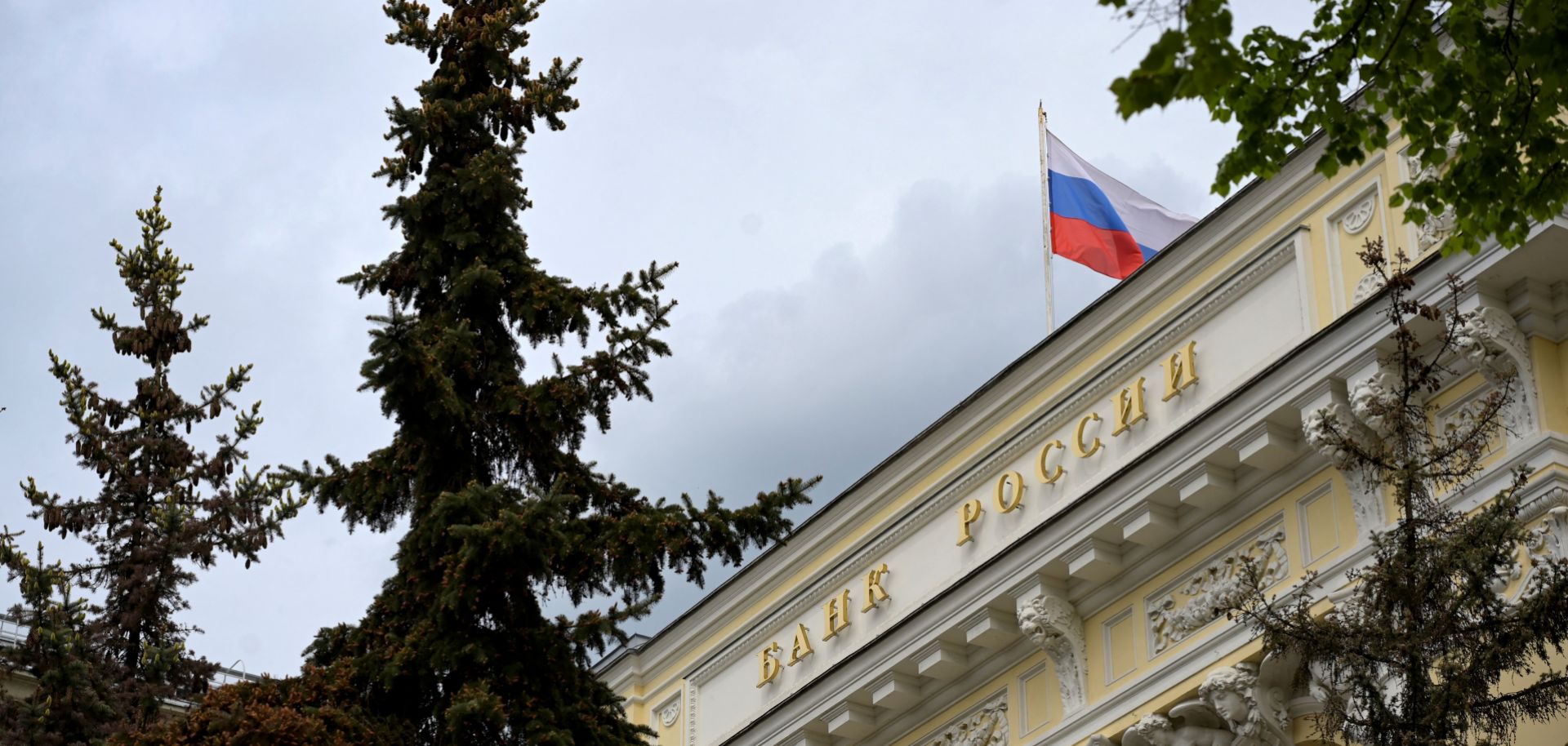
Faced with increasing domestic opposition to providing Ukraine with more financial aid, the United States and its allies are considering seizing frozen Russian assets to help fund Kyiv's war effort. Such a move, however, would lead Moscow to retaliate by confiscating Western companies' assets in Russia, which would in turn help the Russian government fund its invasion of Ukraine, while escalating the greater economic tit-for-tat between Russia and the West. In recent weeks, the G-7 countries (Canada, France, Germany, Italy, Japan, the United Kingdom and the United States) have intensified discussions about the possibility of seizing Russian government-owned financial assets stashed in Western nations, and then using those funds to support Ukraine's war effort or fund its reconstruction. Since Russia launched its Ukraine invasion in February 2022, the United States has generally taken a more assertive stance on seizing, not just freezing, Russian government assets compared with the European Union, and especially individual EU members like France, Germany and Italy. However, faced with waning domestic political support for extending aid to Ukraine, Washington's European allies have started warming up to the idea. In December, the G-7 countries agreed to study the legal and economic implications of seizing Russian assets, with Washington pushing for the group to prepare options from which to agree on a common policy approach by Feb. 24, the two-year anniversary of Russia's invasion.
- In the wake of Russia's Ukraine invasion, Western governments have frozen about $300-350 billion worth of assets owned by the Russian government, mainly the Russian central bank. Sanctioned Russian individuals and companies have also seen their assets frozen. But Western governments have so far refrained from confiscating Russian government-owned assets.
- EU countries have been more reluctant to seize the Russian government's overseas assets because the bulk of those assets are held in the European Union. EU countries also generally have greater holdings of assets in Russia — especially foreign direct investment, consisting of equity and loans to Western-owned companies — that Moscow would likely seize in retaliation.
- In the European Union, Hungary's opposition to a new Ukraine aid package may be forcing Brussels, as well as individual member countries, to find new ways to provide Kyiv financial support by circumventing unanimity. Meanwhile, U.S. financial support for Ukraine is being held up by a stand-off on Capitol Hill over border security between U.S. President Joe Biden and Republican lawmakers in Congress.
Seizing Russian assets will require agreement among the G-7 countries and, likely, among the largest EU members. No single G-7 member will be keen to ''go it alone'' for both diplomatic and economic reasons. The bulk of Russian assets are held in Belgium and the Belgian government will be keen to obtain EU legal backing before taking such a bold move. Based on various announcements over the past few months, the United States and the United Kingdom appear more willing to seize assets than France, Germany or Italy. This is in part due to the fact that the latter countries' companies have greater investments in Russia, which would become the target of Russian retaliation. Even if an agreement in principle is reached at the diplomatic level, individual countries may face considerable domestic legal obstacles, not least because the seizure of sovereign assets possibly violates international law. Moreover, in several cases, including the United States, non-commercial, sovereign-owned assets are protected from seizure by domestic law. Meanwhile, European countries are also more concerned about how asset seizure might impact the euro and financial stability. Expropriating sovereign assets, including foreign central banks' foreign currency reserves, might lead foreign governments to shift their assets out of the euro, thus creating financial market and volatility risks. It is debatable whether this would happen, but central banks prefer to err on the side of caution. Germany, in particular, is also worried about the precedent that seizing government-owned assets might set, fearing that it might pave the way for World War II-related expropriation of German-owned assets by other countries. Last but not least, German and Italian companies own significant assets in Russia, which would become subject to retaliation and seizure by the Russian government.
- Russia is estimated to hold roughly $200 billion worth of European assets, but less than $5 billion in U.S. assets. Unsurprisingly, European countries, as well as the European Central Bank, are more concerned about the reputational damage the euro would sustain and the possible implications for financial stability if the G-7 moved to seize Russian government assets.
- Under international law and frequently under domestic law, government-owned foreign non-commercial financial assets, such as government debt securities, are generally considered to be protected from seizure. If the G-7 reaches an agreement on asset seizure, governments in many instances will need to change their domestic legislation and may face legal challenges, including opposition from constitutional courts. Even in the United States, foreign central banks' assets have been traditionally and largely, if not completely, protected by the Foreign Sovereign Immunities Act.
- In December, a German prosecutor filed a motion to seize more than $700 million worth of assets held by a Russian financial institution, the National Settlement Depository, a subsidiary of the Moscow Stock Exchange, which has been under sanctions since mid-2022, on account of sanctions violation. Even if the G-7 fails to agree on seizing Russian government assets, the financial tit-for-tat will likely intensify.
Should the G-7 overcome its internal differences and decide to seize Russian assets, Moscow will likely retaliate by expropriating the foreign assets of Western companies in Russia without compensation. Russia's retaliation would force financial losses on Western companies operating in the country. Admittedly, a number of Western businesses still operating in Russia have already written down the value of their assets. Moreover, various restrictions imposed on the disposal of assets by Western companies have reduced the value of Western-owned companies in Russia. But outright expropriation would nevertheless force them to write down the residual value of their assets. For the Russian government, the seizure of Western assets and the subsequent sales of those assets would go some way toward financing Moscow's war effort in Ukraine, while also helping plug Russia's fiscal deficit. Russian authorities would be less likely to sell seized companies to foreigners, even if offered at a discount, as such assets would be subject to litigation and the foreign companies acquiring these companies may be faced with Western sanctions. As such, selling seized Western company assets would help Moscow raise domestic financing to fund its ongoing invasion of Ukraine.
- At the end of 2022, inward foreign direct investment (FDI) in Russia by all countries amounted to $360-380 billion, or roughly 15% of GDP. Not all FDI is owned by Western companies and the value of these assets has likely declined over the past year given Russia's uncertain economic outlook.
- Moscow has introduced a variety of measures that make it very unattractive for Western companies to sell their local assets. The Russian government has also seized the assets of the French food manufacturer Danone, as well as the assets of the Danish beer maker Carlsberg, after the two companies announced their decision to leave the Russian market. In July 2023, Moscow established an ''unfriendly countries list'' requiring foreign companies leaving Russia to sell their assets to Russian buyers at a 50% discount, as as make a 10% ''donation'' of the total asset value to the Russian government. To alleviate undue balance-of-payments pressure, Moscow also curtailed the ability to convert ruble-denominated sales proceeds into dollars and transfer them abroad.
- In November, the Russian government issued a decree that allows foreign companies with frozen assets in Russia to use them to buy blocked assets owned by Russian companies abroad, effectively establishing a mechanism for swapping frozen assets. The mechanism has yet to be used, and it is far from clear whether Moscow and Western governments would be able to agree to swap assets if the G-7 seized Russian assets. However, the decree suggests Moscow is aware of the leverage Western-owned Russian assets may provide to sabotage agreement on assets seizure at the G-7-level.
- On Dec. 20, Russia passed a decree that allows the government to seize and sell off the Russian assets held by foreign energy companies deemed ''unfriendly.'' On Dec. 29, the Russian government also announced that it had drawn up a list of American and European company assets that it would seize in case the G-7 decided to expropriate Russian government assets.
