
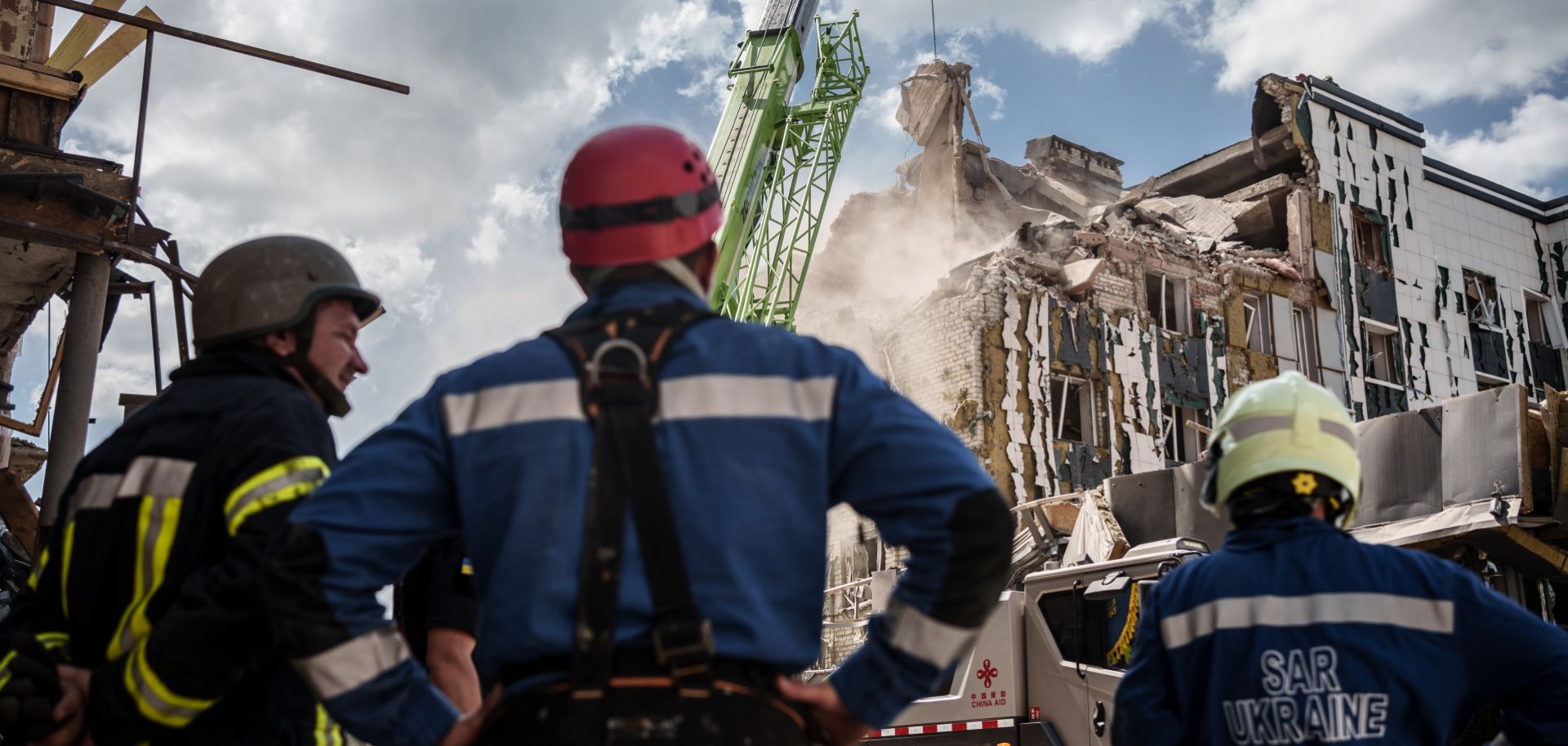
Western governments are facing mounting pressure to use the roughly $300 billion in Russian central bank assets they froze back in February 2022 to fund Ukraine's reconstruction. In late June, European Commission President Ursula von der Leyen said the European Union would soon outline how it intends to use proceeds from seized Russian assets for Ukraine's post-conflict recovery efforts. In the United States, lawmakers in Congress have also recently introduced bills that would grant the U.S. president the authority to confiscate Russian assets frozen within the country and allocate them to Ukraine.
Such propositions are intuitively appealing for several reasons, with the most obvious being that they'd reduce the financial burden on Kyiv's partners in rebuilding the war-torn country. From an economic and legal standpoint, expropriating Russian government assets would also help hold Moscow accountable for the destruction it has wrought on Ukraine, as well as for violating international and moral norms by invading the country. And from a strategic standpoint, it might help deter other countries from engaging in military aggression.
However, expropriating assets owned by a sovereign state is a complex issue with myriad legal, economic and strategic implications that are worth exploring as Western policymakers mull such a major decision.
Legal Challenges: International
As it stands, there are significant obstacles to expropriating state-owned foreign assets without breaching customary international law, which is wedded to the doctrine of sovereign immunity. This doctrine establishes that a state is immune from criminal prosecution and civil suit in another state's domestic courts, meaning that assets held by a foreign state cannot be expropriated based on decisions made by domestic courts.
In mulling the potential implications of Western countries paying for Ukraine's reconstruction with frozen Russian funds, some legal scholars have debated whether, in the event of a violation of international norms (in this case, Russia's invasion of Ukraine), customary international law may allow to implement extra-judicial (outside the remit of domestic courts) ''confiscatory action'' qua (in the capacity of) legal countermeasures. At the heart of this debate is the question of whether expropriating Russian government assets to help finance Ukraine's reconstruction would constitute such a countermeasure by forcing Russia to meet its legal obligation to compensate for the damages caused by its ongoing war. But while scholarly opinion differs, there appears to be a consensus that countermeasures have to be revisable and temporary. And since expropriation constitutes a permanent transfer of ownership, using Russian funds to pay for Ukraine's reconstruction would not seem to meet that definition. Moreover, by sidestepping the domestic-legal process, executive action would deprive a foreign state of due process, which may raise additional legal-procedural issues, including the violation of the rule of law.
International law does provide for exceptions to the doctrine of sovereign immunity, including expropriating state assets, in the case of a violation of international norms. But there are only two ways to procedurally establish that Russia's invasion of Ukraine constitutes such a violation. The first is the adoption of a U.N. Security Council (UNSC) resolution, which is a non-starter since Russia's permanent member status would enable it to block such a vote. The second is a favorable ruling by the International Court of Justice (ICJ), which also represents a high hurdle because the court would need to find Russia guilty of having committed genocide in order to waive the country's sovereign immunity (and so far, the ICJ has only called for Russia to cease its attack on Ukraine).
State-owned assets can also be seized in the context of a peace treaty. A country may, for example, agree to see its assets transferred into another country's ownership as part of an agreement on war reparations. This, however, requires the consent of the state whose assets are being seized — something Russia is highly unlikely to provide unless it suffers a major defeat in Ukraine, which most military analysts believe is not in the cards. But most importantly, as non-belligerents in the war, the United States and the European Union are not a party to peace negotiations and would therefore have no right to confiscate another state's assets as part of any treaty reached between Ukraine and Russia to end the conflict..
Legal Challenges: Domestic
Many states have also incorporated the doctrine of sovereign immunity into domestic law, creating further procedural-legal obstacles to seizing Russian assets. In the United States, for example, the Foreign Sovereign Immunities Act (1976) grants significant protections to states, though it also allows for some exceptions. Under the so-called doctrine of restricted sovereign immunity, the commercial (as opposed to strictly public) activities of a foreign state may be exempted from sovereign immunity. This means that state-owned commercial assets can in principle become the subject of domestic litigation and expropriation, while a presidential aircraft, for example, may not. The legal hurdles are high even when it comes to attaching commercial assets, but they are not necessarily impossible to surmount. Nevertheless, U.S. courts have consistently shielded foreign states' holdings of foreign-exchange reserves from domestic commercial litigation, most recently in the case of creditor litigation against the government of Argentina. This would seem to put the expropriation of $200-300 billion worth of Russian central bank foreign-exchange holdings beyond the reach of commercial litigation.
Per U.S. domestic law, property taken in violation of international law may also be exempt from sovereign immunity. And a foreign state can waive its immunity. In the United States, a foreign state that has been designated as a sponsor of terrorism may also not benefit from sovereign immunity, possibly making foreign-exchange holdings subject to attachment. The U.S. Terrorism Risk Insurance Act (2002), for example, allows plaintiffs seeking to enforce terrorism-related judgments compensatory damages, including from a foreign state. But the U.S. government has not designated Russia a state sponsor of terrorism, legally sharply circumscribing this avenue when it comes to using frozen Russian funds to pay for Ukraine's reconstruction.
In the United States, state-owned assets can also be seized in the event of a state engaging in armed conflict with another state. Under the U.S. International Emergency Economic Powers Act (1977), the federal government is authorized to block and immobilize foreign assets, but the United States can only expropriate assets if it's engaged in armed conflict with another country. Under this law, the United States would have to declare war on Russia before it could seize Russian assets.
Current U.S. domestic law could, of course, be reformed to allow for the use of frozen Russian funds in Ukraine's reconstruction. Congress would probably have to pass a new law, authorizing the expropriation (as opposed to the mere blocking of) Russian assets. This would violate international law, but it could certainly be done, unless the Supreme Court takes a different view.
But the European Union will find it difficult to agree on a common position, in part due to these various legal obstacles. The European Commission appears to be keen on expropriating Russian assets, but the European Central Bank (ECB) and various member states are not. The ECB is worried about the potential real-world consequences of weakening the rule of law, such as damaging the euro's attractiveness and increasing the risk of financial instability.
Some EU member states like Germany are concerned that if the weakening of sovereign immunity were to become a general trend, it might be exposed to World War II-related lawsuits. To the extent that these legal issues make the various relevant actors reluctant to weaken sovereign immunity in order to facilitate the expropriation of state assets, agreeing on a joint EU position towards expropriating Russian state assets will be difficult. While adherents of realpolitik argue that legal norms do not constrain state behavior, the existence of such norms does create procedural-institutional and political obstacles to expropriation.
Economic Implications
Seizing another state's assets also has economic-financial consequences. For the United States and its European allies, seizing Russian state assets would limit the call on their own resources in funding Ukraine's reconstruction. But it might also expose Western countries to financial retaliation and concomitant financial losses — especially those with greater foreign private investment in Russia.
Admittedly, Russia has already imposed a policy of ''indirect expropriation'' by requiring foreign companies to pay an exit tax to finance the war efforts or lock up the proceeds for an extended period of time before they can be transferred. More recently, Russia has expropriated foreign companies outright without paying compensation. But if the West decides to use frozen Russian assets to pay for Ukraine's reconstruction, Russia may decide to expropriate assets held by foreigners, which would primarily affect private investors. Even if the U.S. government holds no assets in Russia, U.S. companies could still become subject to retaliation, possibly causing a domestic political backlash.
In the short-to-medium term, the economic costs would likely be manageable — especially if the United States, the euro area, Japan, the United Kingdom, Canada, and Australia act jointly. But expropriating Russian government assets may diminish demand for U.S. and European financial assets, including by third parties concerned about the potential erosion of the rule of law and sovereign immunity. But admittedly, even if this happens, the economic costs may be quite manageable.
Strategic Implications
The outright or even indirect expropriation of government-owned foreign assets would have consequences at the strategic level as well. For a start, it would make the Russian government even more reluctant to reach a compromise to end its war in Ukraine, which would then require greater resources for Kyiv to decisively prevail on the battlefield to impose a punitive peace, including the forfeiture of Russia's foreign asset holdings. Leaving aside the question of how desirable a punitive peace might be, outright expropriation would remove the option of holding foreign assets ''at risk'' and of using them as a bargaining chip in getting Russian to sign a peace agreement. Admittedly, the geopolitical interests that initially provoked the conflict in Ukraine will much more strongly influence whether a peace deal is reached compared with a few hundred billion dollars worth of foreign assets. But freezing rather than seizing those Russian assets might make it easier to reach a peace agreement.
In this context, an important distinction needs to be drawn between the legal protections afforded to assets owned by a state, and those afforded to assets owned by another state's companies or individuals. Under international law, private foreign ownership of domestic financial and real assets does not benefit from immunity, making them subject to domestic law and hence expropriation. However, the state is obligated to compensate the owners of the expropriated assets. The World Bank's Investor-State Dispute Settlement, for example, provides for arbitration in case of dispute and can award plaintiffs damages, even though it has no power to enforce these claims. (International investment treaties weaken state sovereignty by providing for a dispute settlement mechanism that allows private foreign investors to pursue legal claims against a host state, including expropriation and discriminatory treatment.) But in case of criminal activity (like sanctions violations), assets owned by foreign legal or private persons can become subject to expropriation without compensation, though this can generally be challenged by the party subject to expropriation in the domestic courts.
Expropriating private-sector assets would also mean reducing the Western countries' ability to influence the attitudes of Russian private economic actors as the prospect of regaining assets may make the private sector more inclined to favor a resolution of the conflict. Finally, from a tactical point of view, expropriating Russian assets would also do little to weaken Russia's ability to prosecute the war, relative to a scenario where the assets are merely frozen.
A Complex Calculus
Seizing (or expropriating) assets is fundamentally different from blocking (or freezing) assets. Mindful of the legal obstacles and reputational consequences of outright expropriation, some observers have proposed imposing a windfall tax on profits linked to Russian assets, as well as schemes to invest Russian assets to generate higher yields and then channel the excess returns into Ukrainian reconstruction efforts. The former would undoubtedly qualify as ''indirect expropriation'' by treating Russian holdings differently from the holdings of other states. The latter would be risky, as higher-risk investments might go bad, forcing governments and taxpayers to compensate the Russian government for any losses. Both proposals would create reputational costs for limited financial gains. For Western policymakers, it will thus be a question of whether the potential political-economic costs of expropriation outweigh the potential benefits.
From Washington and Brussels' viewpoint, there is no doubt that territorial integrity is an international norm worth defending by penalizing those who violate it, at least in the hopes of deterring potential future violators. Economically, it is also no doubt desirable to limit the financial resources Western countries will need to mobilize to rebuild Ukraine. For Western decision-makers, the question is whether expropriating Russian assets is the best and most cost-effective way to achieve these goals, all risks and benefits considered.
