
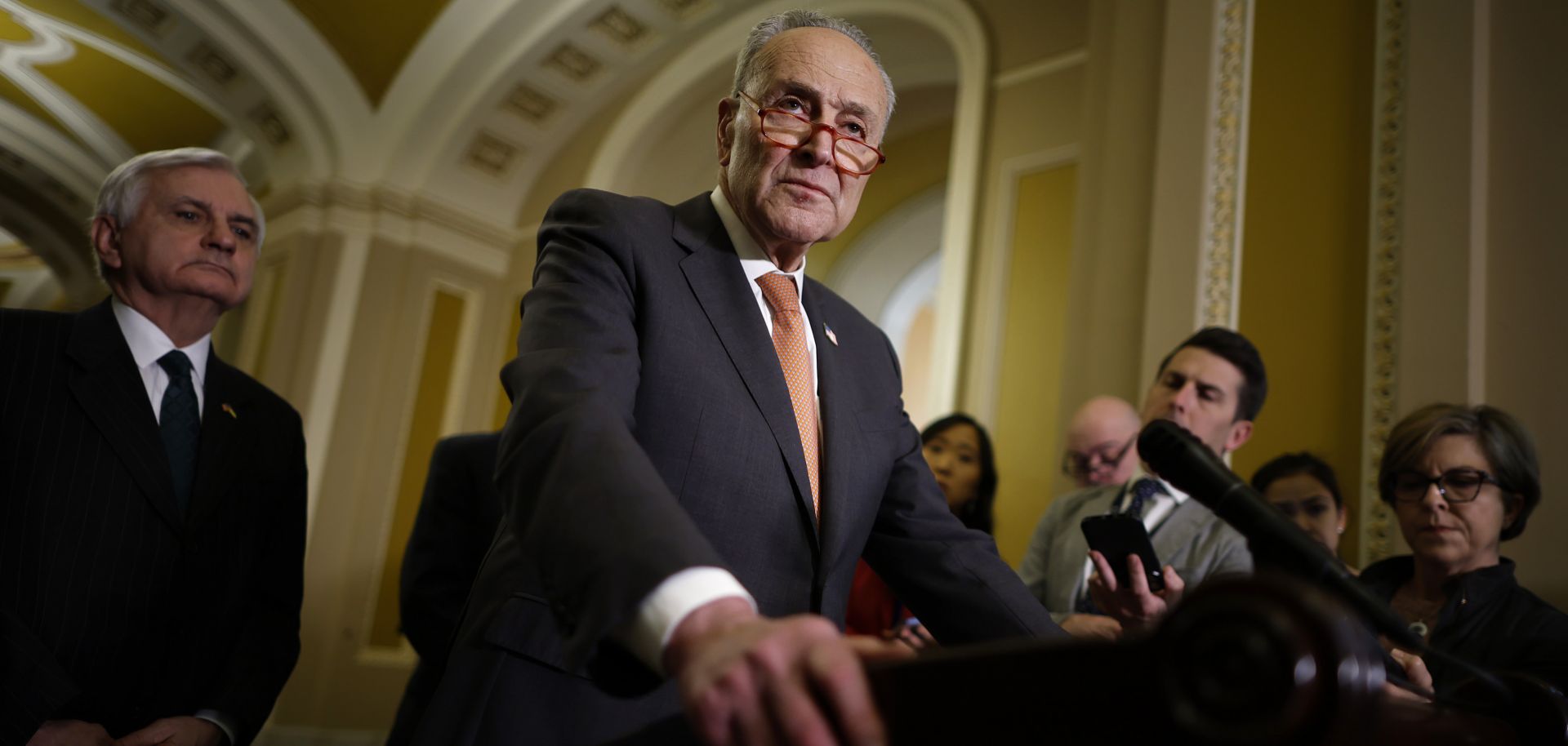
An upcoming U.S. congressional visit to China is unlikely to generate tangible gains other than potentially opening the door to further visits, as many constraints remain on even limited U.S.-China cooperation. Confirming media reports first aired in September, Senate Majority Leader Chuck Schumer (D-NY) and the ranking Republican on the Senate Finance Committee, Mike Crapo (R-ID), plan to lead a delegation to China next week that will include four other U.S. senators from both parties. The delegation aims to meet with President Xi Jinping, according to a spokesperson for Crapo. Schumer's office claimed the trip would also involve discussions on China's treatment of U.S. companies, human rights issues and the illicit fentanyl trade. Numerous news outlets have further highlighted that Schumer and Crapo plan to specifically discuss Beijing's treatment of U.S. memory chipmaker Micron, on which China placed purchasing restrictions in May in what appeared to be retaliation for U.S. export restrictions on semiconductor technology to China. After visiting China, the same group of U.S. senators will then travel to South Korea and Japan, other key players in global chip markets.
- Crapo and Schumer both have economic interests in assisting Micron, in particular, given the company is headquartered in Idaho (the former's constituency) and is building a plant in New York (the latter's constituency).
The visit will resume an avenue for U.S.-China dialogue that has largely been closed since the onset of the COVID-19 pandemic and comes amid persisting bipartisan hawkishness on China in the U.S. Congress. No U.S. lawmaker has visited China since 2019, in large part due to Beijing's strict zero-COVID restrictions. But even prior to the pandemic, congressional visits had been on the decline amid deteriorating U.S.-China relations. Visits by White House officials, however, have proliferated in recent months as part of U.S. President Joe Biden's efforts to establish a working dialogue with Beijing amid the two countries' growing strategic rivalry, which has been fueled most recently by the Biden administration's push to place economic restrictions on China in response to various national security concerns. Since mid-2023, lawmakers in Congress have also issued new bills on nearly a weekly basis that take aim at China on all manner of issues, including human rights, cyber threats and industrial policy.
- Despite the paucity of U.S. congressional visits to China in recent years, such visits to Taiwan have increased in tandem with concerns about a Chinese invasion threat, with nearly 40 congresspersons visiting the island nation in 2022.
- The congressional visit comes ahead of a potential meeting between Biden and Xi on the sidelines of the Asia-Pacific Economic Cooperation (APEC) summit in November, which will be held in San Francisco. It also follows a number of high-level diplomatic meetings, including most recently a Sept. 28 meeting in Washington between U.S. Assistant Secretary of State for East Asian and Pacific Affairs Daniel Kritenbrink and Chinese Vice Minister of Foreign Affairs Sun Weidong.
Strategic constraints on deeper U.S.-China cooperation — including upcoming U.S. elections, anti-China sentiment among Americans, and Washington's growing national security concerns — mean this particular trip is unlikely to yield any tangible gains beyond potentially setting a precedent for further congressional trips to China. It is unlikely that this trip will lead to any major progress on the long (and growing) list of divisions between Washington and Beijing. The senators' hoped-for meeting with Xi is unlikely to come to fruition, given that U.S. congressional visits to China have historically involved meetings with lower-ranking officials, like Chinese ministers. Moreover, U.S. updates to its chip restrictions on China, expected later this year, will likely further reduce China's willingness to make any concessions. And Washington's myriad national security concerns about Beijing's domestic and foreign policies also show no signs of abating — especially ahead of the November 2024 election, which is already shaping up to be another ballot where candidates (including the many senators who will be up or reelection) will compete for the most hawkish on China. As a result, the only potential tangible outcome of the visit will likely be paving the way for others in Congress to pursue dialogue with China with more visits and other people-to-people exchanges, even as they continue pushing legislation to mitigate China-related national security risks. There's a chance that China may also offer a minor concession on Micron as an incentive for better relations between Beijing and Congress in the hopes of slowing the pace of U.S. economic restrictions. But any such concession would be small (e.g. exemptions to sales restrictions on the U.S. chipmaker), as Beijing's primary contention with Washington on this issue — namely, U.S. export restrictions — remains unresolved, with restrictions only likely to further grow.
- In a Gallup poll published in March, only 15% of U.S. voters said they viewed China favorably — a record low since at least 1979.
