
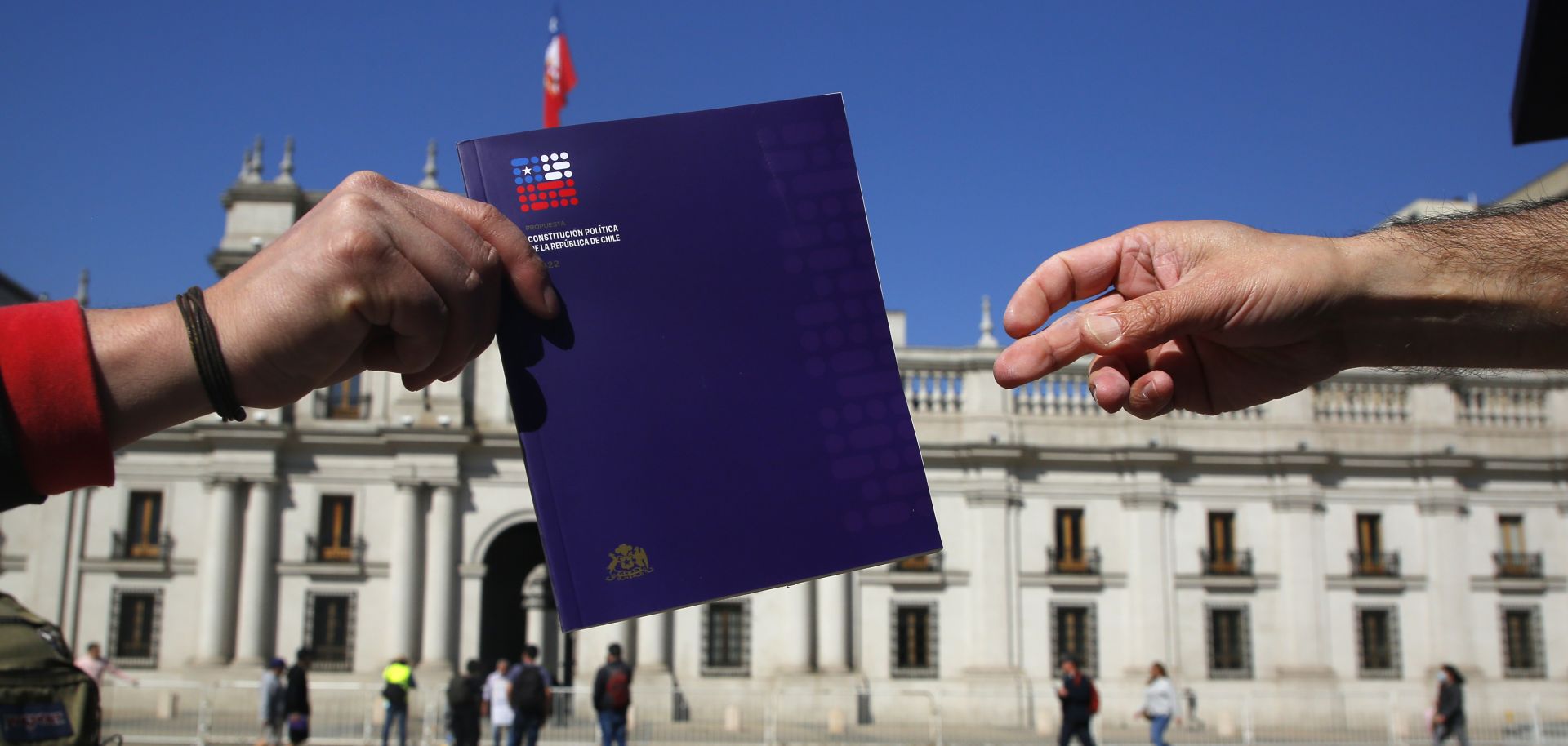
Citizens in Santiago, Chile, receive a copy of the country's proposed new constitution on Aug. 29, 2022, ahead of the upcoming referendum.
Regardless of the result of the upcoming constitutional referendum, Chile's left-wing and right-wing political forces will push for their own constitutional amendments, which will keep legal uncertainty high and threaten decades of regulatory stability. On Sept. 4, Chileans will vote on whether to adopt a new constitution that would significantly alter their country's political structure and business climate.
- The proposed document, which was drafted by a constitutional assembly over the past year, includes 388 articles. If approved, it would be the longest constitution in the world.
- Central aspects of the new constitution include eliminating the upper chamber of Chile's federal legislature and giving regional governments increased powers by deeming the country ''plurinational." It also establishes new public sector institutions for healthcare and education, as well as stipulations for increased Indigenous and environmental rights.
Popular support for a constitutional rewrite emerged from the 2019-2020 protests, which saw thousands of middle- and lower-class Chileans demonstrate against the political and economic systems they believe are no longer benefiting them. Chile's current constitution entered into force in 1980 under the dictatorship of Augusto Pinochet. The business-friendly articles enshrined in the constitution have helped fuel the country's high economic growth in the past four decades. However, critics have long questioned the business-friendly nature of the document, claiming that it failed to guarantee adequate social services for Chile's middle and lower classes. Frustration with the country's growing inequality prompted an unprecedented 10% of the population to participate in nationwide protests between late 2019 and early 2020. In response to the demonstrations, former President Sebastian Pinera agreed to hold a referendum to decide if the country should rewrite its constitution. The referendum passed in October 2020 with overwhelming public support for a constitutional rewrite process. However, as the Constitutional Convention undertook this task, public support for the new constitution decreased, likely due to the sweeping changes that some members of the convention proposed. According to a recent survey conducted by local polling firm Cadem, 46% of Chilean voters intend to reject the new draft constitution on Sept. 4, 38% plan to approve it and 16% remain undecided.
- Chile's GDP grew an average of 5% per year between 1990-2020 and the poverty rate fell from 40% to 10%. But the country's growing middle class increasingly felt the burden of exorbitant out-of-pocket health and education bills, which fueled fears that they may end up living in poverty.
- Protests began in 2019 after a small price hike in subway fares led to student demonstrations. However, grievances quickly expanded beyond the fare increase to include the rising cost of living, low wages and pensions, shortfalls in the education system, poor public health systems, and economic inequality.
What to Expect if the Constitution is Rejected
Widespread demonstrations would likely disrupt businesses and supply chains dependent on Chile. If the new constitution is rejected, the current constitution would remain in effect, which means that leftist activists, labor unions and Indigenous groups would almost certainly stage widespread demonstrations and strikes in the weeks following the vote to voice their discontent. While most protests would be peaceful, a small number of extremists could clash with security forces, damage public infrastructure or implement roadblocks. Protests could also cause transportation disruptions that limit employees' ability to travel to work and delay shipments to stores. Some employees themselves may participate in demonstrations as well, peaceful or otherwise. Separate from protest risks, the rejection of the proposed constitution — which includes protections for Chile's Indigenous population — would likely inflame anti-government sentiment among Indigenous groups, including the militant Mapuche Coordinadora Arauco-Malleco (CAM) and Weichan Auka Mapu. This could lead to more frequent attacks against companies operating in the forestry sector and aggregate industries that operate on Indigenous ancestral lands, such as the Bio Bio and Araucania provinces.
Future pushes for constitutional change from the right and the left would also contribute to an uncertain legal environment in Chile that could last years. If the new constitution is rejected, President Gabriel Boric has already stated he would launch a new constituent process, which would include yet another vote for new members of a constituent convention to begin the process of drafting a second new constitution over the course of 2023. In a similar effort, members of center-right and right-wing parties have launched an effort to reject the proposed new constitution and instead appease public demand for structural change by reforming the country's current constitution. In this scenario, conservative lawmakers would seek to implement such changes by passing constitutional reforms, likely giving Indigenous peoples increased recognition and making the pension system public but stopping short of making broad changes to private sector rights. This scenario could lead to competing processes to enact constitutional changes, one through a legislative process and the other through a new constituent convention, creating a high degree of political uncertainty. However, the center-right parties do not have the two-thirds majority currently needed to unilaterally implement constitutional changes, meaning that the Boric-sponsored process to draft a new constitution would be the most likely outcome. Nonetheless, the dispute could lead the country's leaders to focus their efforts on long-term constitutional changes instead of addressing more timely needs such as measures to combat inflationary pressures and addressing the country's worsening security climate.
What to Expect if the Constitution is Approved
The new constitution's vague language would almost certainly require accompanying legislation, leaving room for interpretation that could result in a confusing regulatory environment. Should the new constitution be approved, leftist President Boric will have five days to conduct a ceremony pledging to abide by it and 10 days to publish it in the country's official gazette, at which point it would enter into force. While the constitution lays out a general direction for issues such as land and water rights, it requires supporting legislation to enforce those rights. This means that Congress would need to implement supporting legislation and accompanying financing. As many of the articles have vague wording, this would give the legislative branch significant leeway over their interpretation. Such legislation may also face judicial challenges based on inaccurately interpreting the constitution, which would see the Supreme Court have the final decision. This process of legislative changes and litigation would, in turn, create uncertainty for investors and businesses operating in the country.
The Chilean government's pledge to amend the new constitution would likely exacerbate this regulatory uncertainty. Boric and other center-leftist lawmakers have responded to criticism of the new constitution by promising to reform some of its more controversial aspects if the document is approved in the Sept. 4 referendum. Fulfilling this promise, however, would likely prove difficult in practice. This is because reforming Chile's new constitution would require securing a four-sevenths majority in both chambers of Congress, as well as a formal consultation of autonomous Indigenous groups. While Boric's coalition has enough seats in parliament to pass a constitutional reform, the coalition is fragile and ideologically divided between the center- and far-leftists, meaning that the government would likely experience significant constraints to meaningfully reforming the new constitution if it is ratified, resulting in political gridlock.
- According to a Cadem poll conducted on Aug. 7, 33% of Chileans support approving the new constitution and reforming the text after the fact; only 10% support approving the new constitution and implementing it in its current form.
- Boric has said the new constitution could be perfected but has not specified what aspects his leftist coalition would seek to change if the document is approved.
Such uncertainty would be particularly problematic in Chile's extractive sector. The constitutional convention rejected a proposal to change the country's mining concession model (which gives a significant role to the private sector). However, the convention left the language around private sector involvement vague, which leaves open the possibility of significant regulatory changes if the new constitution is approved. As such, investors in Chile's extractive industries would likely pause new ventures until the legal and regulatory landscape becomes clearer. If that landscape remains unclear, decreased investment in Chile's mining sector — which generates roughly 10% of the country's GDP and makes up over 50% of its total exports — would risk contributing to a greater economic slowdown.
- Mining companies such as Antofagasta and Anglo American indicated in August that they would review any future projects in Chile if the country were to raise royalties and taxes, as currently proposed by the Boric administration. The constitutional changes would likely add additional uncertainty to the sector, further leading privately-owned mining companies to reconsider their presence in Chile.
- In Chile's current constitution, nearly every metal and mineral are deemed to be available to the private sector via concessions. However, the new constitution does not specify the concessions scheme, meaning that Congress could enact legislation to allow the extraction of natural resources under a revocable permit, making it easier for the state to carry out expropriations and increasing risks to potential investors.
- The new constitution also protects the rights of nature, ensuring that ''the State and society have the duty to protect and respect'' those rights, potentially exposing companies to the threat of legal action carried out on behalf of the environment.
The new constitution would also change the way the legislative process works and increase regional autonomy, both of which will make policymaking more volatile. If the new constitution is approved, the country's Senate would be dissolved in 2026 in favor of a ''Chamber of Regions'' whose responsibilities would be greatly reduced, leading Congress to a system of asymmetric bicameralism. The new chamber wouldn't have a say on legislation but would be able to vote on constitutional amendments, along with the annual budget and tax reforms. This system would give any party that wins the presidency and a simple majority in the House of Representatives the ability to quickly implement policy. In the long term, this would likely mean that the country's laws could shift drastically between differing administrations, creating increased regulatory uncertainty. Additionally, the new constitution would afford greater power to Chile's 13 regions, particularly Indigenous territories. While the details of this stipulation will need supporting legislation, it could potentially allow regional governments the autonomy to create their own judicial systems, control of taxation and the ability to issue debt. This could lead individual regions to take on large sums of debt, hurting the country's overall fiscal discipline, and decreasing judicial coordination between regions on litigation — potentially leading to a muddied regulatory environment.
