
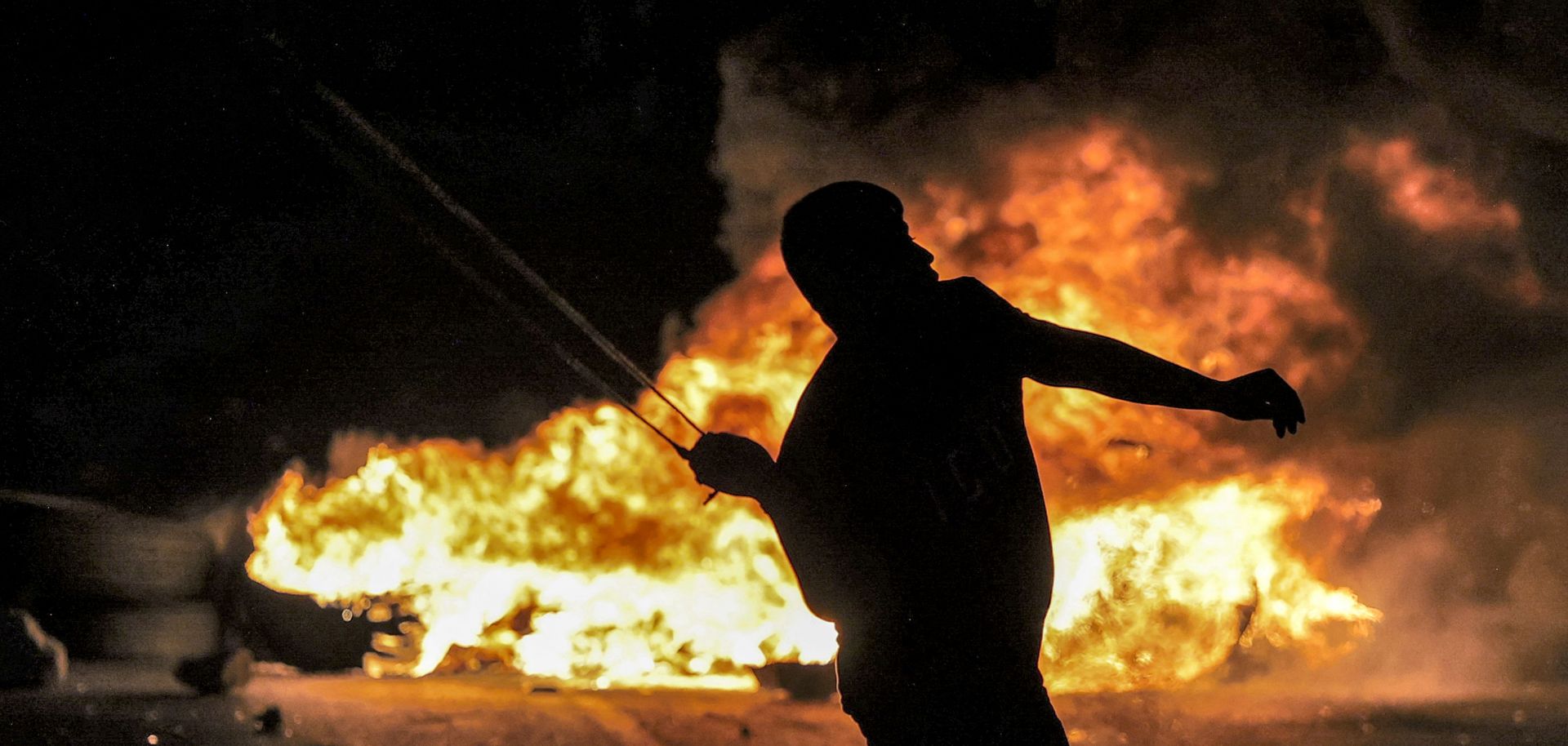
A Palestinian youth throws a rock with a slingshot at Israeli security forces during Oct. 3, 2022, clashes at the northern entrance of the city of Ramallah in the West Bank.
Editor's Note: We continue to monitor simmering unrest in Israel and the Palestinian territories from multiple angles. As part of our coverage, we first examined the growing influence and impact of right-wing Israeli political forces. Now, we examine Palestinian militant groups in the West Bank. Neither of these (nor any other assessment) is meant to attribute responsibility for ongoing violence, but rather to provide a window into the different actors involved in the complex and multifaceted conflict.
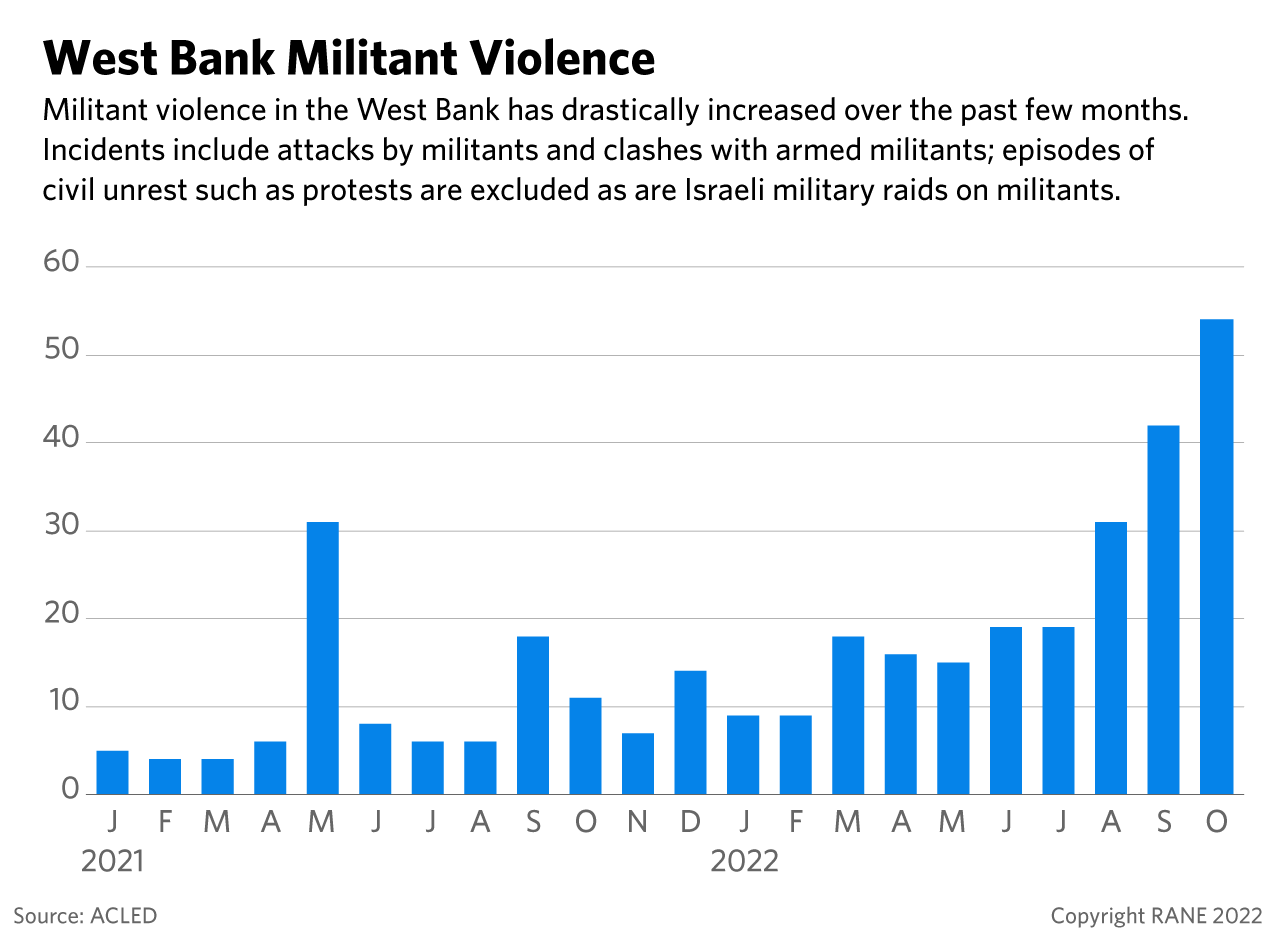
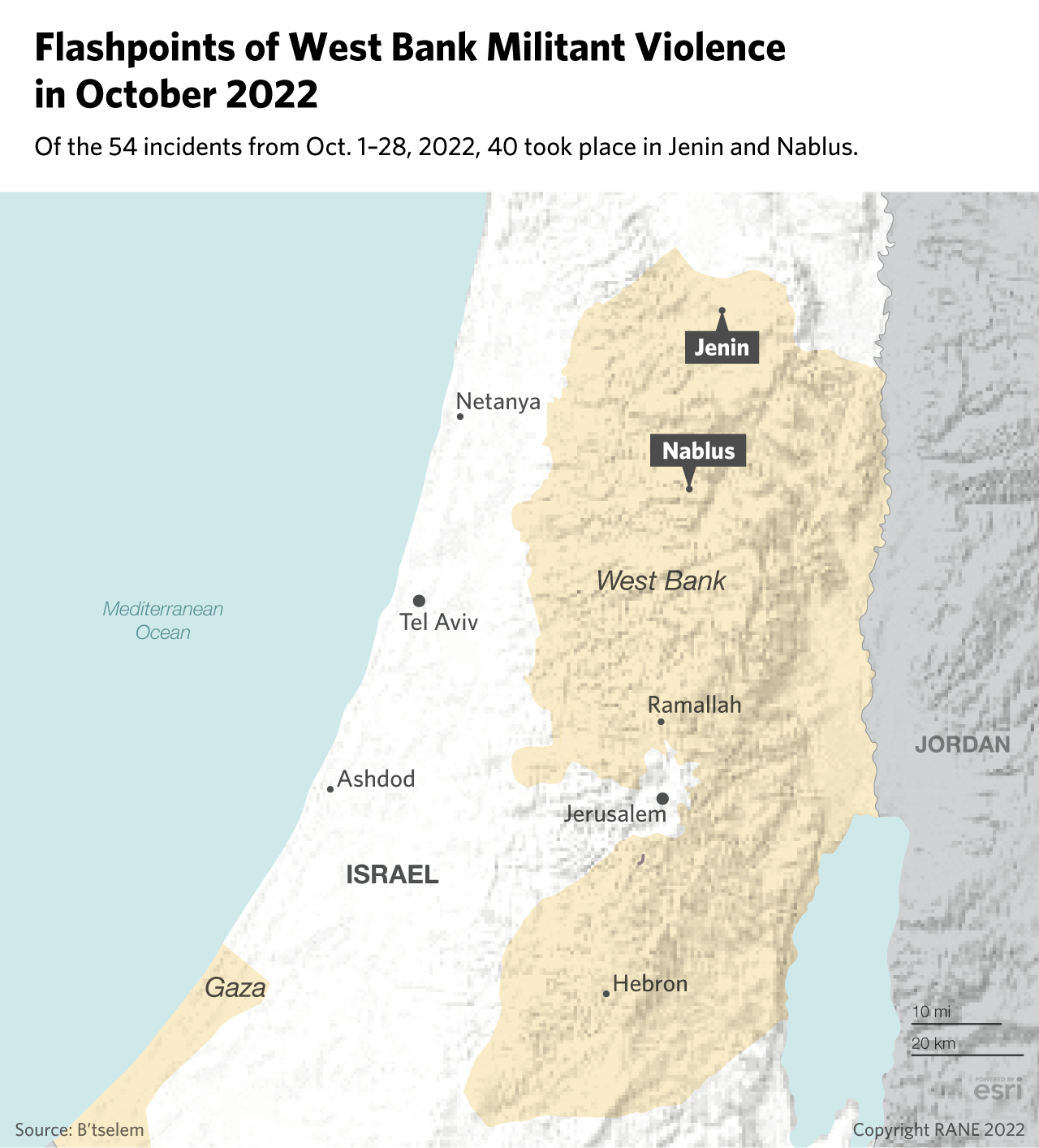
Militant and grassroots violence in the West Bank has intensified in recent months alongside Israeli counterterrorism operations and a recent spike in Israeli far-right violence. This increases the near-term risk of militant attacks within Israel, and the potential for a larger flare-up in the long term given the recent ascendancy of the Israeli far right and uncertainty regarding the future of the Palestinian government. According to ACLED data, Palestinian militant groups have been involved in at least 54 violent incidents (including militant attacks and armed clashes) in October alone, part of a steady escalation since July. The number of incidents in October dwarfs the 31 incidents during the May 2021 Gaza War, which is notable not only because it shows the comparative scale but also because the recent increase is part of a monthslong trend rather than a one-month uptick. The cities of Jenin and Nablus, located in the northern West Bank, accounted for 40 of the 54 incidents. Notably, Nablus is home to Joseph's Tomb, a sacred site for Jews and Muslims that has seen multiple recent violent incidents. Israelis wishing to worship at the tomb require a military escort, but the worshippers and their escorts provide a target for militant ambushes. Such an ambush occurred June 30, when Palestinian Islamic Jihad militants ambushed a group of Israeli soldiers and Jewish worshippers near Joseph's Tomb, wounding an Israeli military officer and two civilian worshippers.
- Border closures from the COVID-19 pandemic hit both cities hard economically. Jenin, which directly borders Israel, in particular faced a significant economic downturn in 2020 and 2021 due to border closures that prevented Palestinian workers from going to work in Israel. Militant groups like Hamas and PIJ stepped in to fill the void, providing job opportunities smuggling arms and offering increasingly resentful residents the opportunity to attack Israeli soldiers.
The increase in attacks in the West Bank comes amid worsening security conditions in the territory stemming from long-term factors like poor economic conditions and the decreasing legitimacy of the Palestinian Authority, along with short-term factors like Israeli counterterrorism operations and increased settler violence. During the height of the COVID-19 pandemic in 2020, U.N. data indicates that the gross domestic product of the Palestinian territories contracted by 11.3%; despite recovering to grow by 7.1% in 2021, it remained 5.1% below its pre-pandemic level, with a large deficit and mass unemployment hindering economic growth. The worsening economic situation has stoked popular anger toward the authority. The Palestinian Authority's legitimacy has decreased in recent years, driven by election delays and widespread public perception that it is a tool of Israeli occupation. Meanwhile, Israeli counterterrorism operations — often involving gunbattles, mass arrests and other disruptions to daily life — have increased Palestinian resentment and grassroots anger. Increased Israeli settlement activity, and in particular acts of harassment and violence, also have contributed to Palestinian anger in the West Bank.
- The Palestinian Authority is facing increased fiscal pressure due to decreasing tax revenues from the sluggish economy to cut the number of public sector employees. This represents a difficult task given that unemployment stands at approximately 17% across the West Bank and that 23% of West Bank residents face food insecurity, according to August 2022 U.N. figures.
- Contributing to the decreasing legitimacy of the authority, Palestinian President Mahmoud Abbas postponed legislative elections in April 2021 and has not set a new date for them, meaning that national elections have not been held in the Palestinian territories since 2006. According to an October 2022 poll conducted by the Palestinian Center for Policy and Survey Research, approximately 57% of respondents viewed the Palestinian Authority as a burden rather than as an asset.
- Meanwhile, Israeli military forces have increased the tempo of counterterrorism operations since April 2022, with the Israeli military conducting almost daily raids in densely populated areas of the West Bank — killing at least 100 Palestinians so far this year and arresting 2,000 others, according to Nov. 17 reporting by The Times of Israel
- Additionally, Israeli settler attacks on Palestinian individuals and property in October also spiked, according to an Oct. 21 report by Israeli news outlet Haaretz. It reported 100 incidents, including assaults against Palestinian residents and vandalism of homes and property, further driving Palestinian resentment and potentially motivating individuals either to conduct grassroots attacks or join militant groups.
Decreasing Palestinian Authority legitimacy and increasing grassroots anger have fueled the rise of previously unseen militant groups like the Lions' Den, which is unaffiliated with larger militant groups like PIJ and Hamas. Founded in August 2022 in Nablus, the Lions' Den — which likely numbers in the dozens to low hundreds of militants — is an outgrowth of the Nablus Battalions, a local umbrella organization that coordinated between various armed factions including Hamas and PIJ. An Aug. 9 killing of a Nablus Battalions' leader, Ibrahim al-Nablusi, was a key trigger for the founding of the Lions' Den, as he was popularly known as the "lion of Nablus." Notably, however, the Lions' Den does not appear to be part of the larger groups, but rather coordinates with them. Unlike Hamas and PIJ, which generally use religious and nationalist rhetoric to appeal to recruits, the Lions' Den appears to focus more on local grievances, using newer social media channels like TikTok and the encrypted communications platform Telegram to appeal to younger recruits.
- Since its emergence, the Lions' Den has played a relatively small role in West Bank violence, conducting only 10 of a combined 96 attacks between September and October 2022, according to ACLED data, suggesting that the more established groups and grassroots-driven attacks still remain the primary militant threat.
- Despite conducting relatively few attacks, Lions' Den appears to enjoy a notable level of grassroots support. Thousands of Palestinians turned out for an Oct. 25 funeral procession in Nablus held for three Lions' Den members killed in an Israeli raid that day.
Despite the drivers for increased militancy, effective Israeli counterterrorism operations, the Palestinian Authority's economic dependence on Israel and a lack of popular Palestinian support for another uprising continue to make a new intifada unlikely. Israeli counterterrorism operations are continuing at a very high tempo, having arrested approximately 2,000 suspected militants since operations began in late August 2022. Moreover, the Israeli government has several tools available to compel Palestinian counterterrorism cooperation, such as threatening to reduce or cancel the work permits of Palestinians that allow them to work in Israel. Israel may also withhold tax revenue from the Palestinian Authority, which it collects on the authority's behalf, further depriving it of revenue. The Palestinian Authority's dependency on Israel for funding thus provides authority security forces with an incentive to keep militancy in check to ensure the government remains solvent and public sector salaries are paid.
- In addition to Israeli coercive measures, the same Palestinian Center for Policy and Survey Research polling that found increased dissatisfaction with the Palestinian Authority also found popular support for a mass Palestinian uprising, or intifada, dropped from 55% to 48% from August to October 2022. While the precise cause for the drop is unclear, it should be noted that it coincides with the brief (Aug. 5-8) conflict between the Israeli military and PIJ in Gaza. While the PIJ demonstrated increasing capabilities in the brief conflict, firing a large number of rockets, the polling shows that only 12% of Palestinians perceive the PIJ as having won the war, potentially indicating a lack of appetite for a return to organized armed struggle.
Recent Israeli election results showing growth in Israel's far-right, potential leadership changes in the Palestinian Authority and future Israeli-Palestinian cycles of violence could limit the effectiveness of those constraints on violence in the future, especially if other highly localized militant groups emerge in other West Bank cities. Israel's far right, which generally supports both a stronger crackdown on Palestinian militancy and increased West Bank settlement activity, performed better than expected in Israel's November 2022 elections, and consequently far-right politicians will play an important role in Israel's new government. Notably, extremist members of parliament like Itamar Ben Gvir (who is vying for a position as minister of public security) call for a harsher stance on Palestinian militancy and more settlement activity, both of which may drive increased Palestinian grassroots anger and ultimately militancy. Separately, Palestinian President Abbas is reportedly in poor health; his death could further weaken the Palestinian Authority, providing a permissive political environment for Palestinian militancy.
- The incoming Israeli far-right government has already signaled that it will make settlement expansion a priority. On Nov. 17, Itamar Ben Gvir reached an agreement with incoming Prime Minister Benjamin Netanyahu to legalize several Israeli settlements in the northern West Bank (near Jenin). The increased settlement activity will only further increase the need for Israeli military operations to secure the new settlements, ultimately fueling Palestinian resentment and the long-term threat of militancy.
- The grassroots anger that Israeli far-right policies drive is an important motivating factor for the Lions' Den. Its example also provides a potential template for other local groups in Nablus and Jenin, or elsewhere in the West Bank, even if Israeli counterterrorism operations decimate the group itself.
- Abbas has only recently started making overt signals about his succession. In May 2022, he appointed a close confidant to be secretary-general of the Palestine Liberation Organization, a post that has historically been a stepping stone to the Palestinian Authority presidency. Despite the appointment, it is still likely that Abbas' death will trigger uncertainty within the authority because the precise succession plan for Abbas is still unclear, and personal rivalries within the government may delay or impede succession. That uncertainty combined with the preexisting legitimacy crisis would create a favorable environment for grassroots anger and potentially new militant groups to flourish.
