
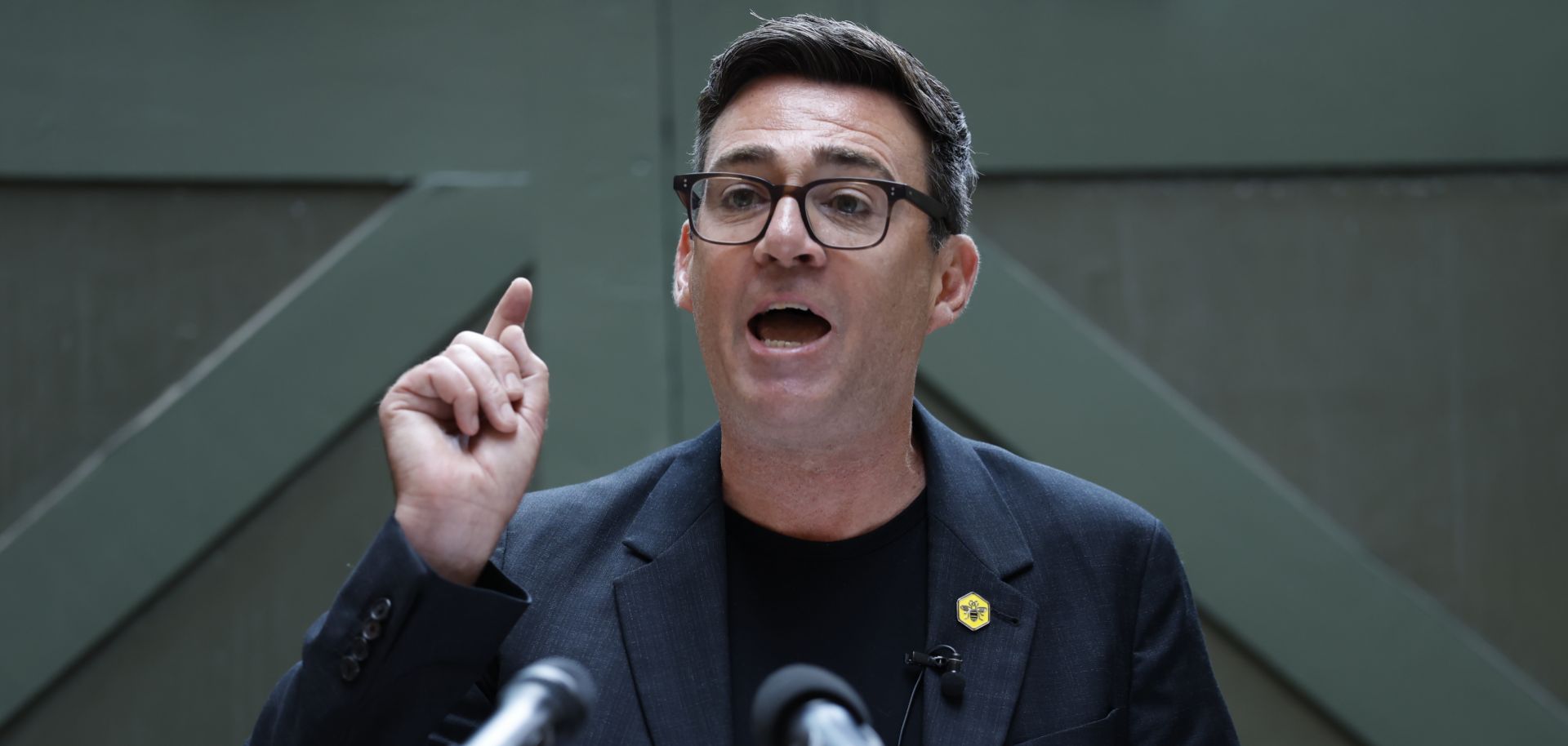
Andy Burnham delivers a speech on June 29, 2026, in Manchester, England.
(Jeff J Mitchell/Getty Images)
Andy Burnham delivers a speech on June 29, 2026, in Manchester, England.

Andy Burnham is set to become the United Kingdom's next prime minister in the coming days, likely maintaining broad continuity on fiscal, foreign and defense policy within tight market and budget constraints; however, a left-leaning chancellor pick or ambiguity on tax and spending plans could result in temporary market volatility, while EU relations will advance only incrementally and could turn more ambitious toward the 2029 election. Within hours of nominations opening on July 9 to replace Keir Starmer as party leader and U.K. prime minister, Burnham secured backing from 322 of Labour's 403 lawmakers in Parliament, four times the 81 nominations required to stand. The scale of his support makes a rival bid all but mathematically impossible, since each lawmaker can back only one candidate and a single further nomination would leave too few uncommitted for any challenger to reach the required threshold. Former Health Secretary Wes Streeting, who the press had identified as a potential challenger, also already endorsed Burnham after ruling himself out on June 22. Meanwhile, former Armed Forces Minister Al Carns, the last potential challenger weighing a run, confirmed July 8 that he would not stand. Nominations close on July 16, and if Burnham remains the sole candidate, the party will declare him leader on July 17 without a vote among party members. Starmer, still in office as caretaker, would then tender his resignation, and Burnham would formally become prime minister around July 20, giving him the impending summer recess to form a government and prepare an agenda before Parliament returns in September.

  • Pressure on Starmer had built for months amid falling approval ratings, a stagnant economy and repeated policy reversals and scandals, culminating in Labour's May 7 local election defeat, the worst result for a governing party in over 30 years. National polling for Labour had fallen from 34% at the July 2024 general election to around 17%, with the right-wing Reform U.K. party leading at 28%. In response, over 100 Labour lawmakers called for Starmer's departure and then-Health Secretary Wes Streeting resigned on May 14, citing a loss of confidence. Burnham could not stand while outside Parliament, but Makerfield lawmaker Josh Simons resigned his seat to let him run in a June 18 by-election, which Burnham won with a large majority. Starmer announced his resignation on June 22, the day Burnham took his seat.
  • Under Labour Party rules, a leadership contest requires candidates to secure nominations from 20% of the party's members of parliament, currently 81 of 403, with contested races decided by members of parliament, affiliated organizations and party members voting under a one-member-one-vote preferential system administered by the National Executive Committee. However, if only one candidate reaches the threshold when nominations close, the party declares that candidate the leader without a membership ballot.

A Burnham premiership will likely see broad fiscal and economic policy continuity, with his commitments to existing fiscal rules and Labour's manifesto pledges set to contain market volatility around the transition, though his openness to higher asset taxes and greater regional and social investment will keep investors cautious, focusing attention on his choice of chancellor and his first budget. Burnham has vowed to keep current Chancellor Rachel Reeves' fiscal rules and pledged not to increase income tax, national insurance or VAT. He has also signaled openness to higher taxes on capital gains, land and property, including proposals to replace the stamp duty with a land value tax, alongside spending tilted toward housing, transport and devolved regional investment. The unresolved question remains how Burnham will manage to reconcile these ambitions with the limited fiscal headroom he will inherit from the current government, which the Iran war has further eroded, with projections of the 2029-30 budget surplus falling from 24 billion to around 19 billion pounds since March (or about 0.5% of GDP). Burnham might be tempted to top up spending now while penciling savings into years beyond the next election, once the current budget balance target rolls over to 2030-31 in April 2027. Bond investors, however, would likely punish that tactic with higher yields, given gilt markets already price a political risk premium, with 10-year yields near 4.9% and having surpassed 5% earlier this year, and 30-year borrowing costs near their highest since 1998. Bond markets' behavior in recent years strongly suggests investors will reward discipline signals and punish ambiguity quickly, leaving limited room for the uncosted commitments his party's left wing demands. Utilities may also face scrutiny given his support for greater public control of water and energy.

  • Reeves' self-imposed fiscal rules require the current budget to reach balance in the third year of the forecast, a rolling target that currently applies to 2029-30 but will roll over to 2030-31 in April 2027, putting the target year beyond the next general election. Compliance is judged against OBR forecasts of stated plans, potentially letting a government formally comply while raising spending immediately and booking unspecified savings in later years, a restraint that a future government could simply drop after the vote.
  • Markets reacted positively to Burnham's June 29 speech setting out his economic agenda, with bond yields falling and the pound rising after he explicitly pledged to maintain existing fiscal rules and signaled ambitions to reduce the welfare bill, though the speech was light on details.
  • Economists, including Burnham advisers Jim O'Neill and Andy Haldane, published a letter on July 6 urging the upcoming government to adopt a radical tax simplification plan, including scrapping stamp duty and council tax and merging income tax with national insurance. The economists claimed these proposals would raise government revenues, creating around 38 billion pounds of additional fiscal headroom, without requiring any additional borrowing. The full report is due July 16, days before Burnham takes office. While Burnham has not officially endorsed the plan, several factors suggest he might draw on it, including its timing, its authorization by close associates, and his own comments on July 3 noting that there was "some room within that manifesto for movement on tax."
  • Reeves is widely expected to be demoted to a junior role or dropped from the cabinet altogether, given she is seen as too closely tied to Starmer, and her replacement will be the clearest early signal of Burnham's fiscal policy direction. The names floated in recent days include Foreign Secretary Yvette Cooper, Energy Secretary Ed Miliband, former Health Secretary Wes Streeting and former Defense Secretary John Healey. Miliband, who is reportedly the frontrunner, would signal a more leftward tilt toward clean energy and welfare spending with likely tax increases, an appointment investors would treat more cautiously. In contrast, Cooper, a moderate with Treasury experience, would likely reassure markets on fiscal discipline, whereas Streeting and Healey are considered less likely choices.

Burnham will also preserve broad continuity on foreign and defense policy while advancing EU relations along the existing incremental approach, though Labour's EU policy could turn more ambitious toward the end of the parliamentary term as electoral and economic pressures mount. Burnham's government will sustain support for Ukraine, NATO commitments and rising defense spending, though tight public finances may push it to delay actual spending timelines, even while formally sticking to headline targets. By contrast, he will likely take a tougher stance toward Israel over Gaza, yet any pressure on Israel will remain limited by the need to stay aligned with the United States and manage Labour's own divisions, stopping short of measures such as a full arms or trade embargo. On EU relations, Burnham will focus on completing the agreements under negotiation — covering agrifood, youth mobility and emissions-trading linkage — at the EU-U.K. summit postponed from July 22 and now expected in the fall to let the new government settle in. Revisiting single market or customs union membership remains off the table, as any substantial deepening of ties would face resistance from certain Labour factions and could alienate parts of the broader electorate, while Brussels would likely demand budget contributions and freer movement of people in return. However, that calculus could shift closer to the 2029 general election, as deeper EU alignment would offer Labour a way to draw a sharper contrast with the eurosceptic Reform U.K. and help recover voters lost to the Liberal Democrats and Greens — particularly if the economy keeps stagnating and polling keeps sliding, in which case closer alignment may look worth the political cost of meeting Brussels' conditions and could emerge as a defining campaign issue. Finally, relations with the administration of U.S. President Donald Trump will likely remain tense yet stable, as Burnham's foreign policy continuity should preserve the working relationship that Starmer has managed to build despite fundamental ideological differences. However, any slow-walking on defense spending targets would give Washington grounds for criticism at a time when burden-sharing remains one of its central demands of European allies.

  • Burnham's priorities of greater investment in the National Health Service, housing and regional development all compete for the same limited fiscal headroom, and if the new government wants to maintain fiscal discipline without substantial additional borrowing, cuts will have to come from somewhere. Defense lends itself better than other big budget areas to delaying spending while keeping headline targets, since long procurement timelines mean slippage is harder to detect, capability targets fall years beyond the current parliamentary term and cutting there carries lower political costs with voters than cuts to healthcare or benefits.
  • Former Defense Secretary John Healey and Armed Forces Minister Al Carns resigned in early June over the lack of a funded pathway under Starmer to the pledges of spending 2.5% of GDP on defense by 2027 and 3.5% by 2035. The Defence Investment Plan — which was finally published on June 30 and that Burnham had reportedly sought to delay until the fall — commits an additional 15 billion pounds through 2029-30 but identifies funding sources for only two-thirds of it, leaving 4.7 billion pounds that Burnham's first budget will have to cover through tax rises, cuts elsewhere or borrowing. Though he is unlikely to reopen the plan itself, the document contains no timeline or specific plans for reaching the longer-term 3.5% target, and reaches only around 2.7% of GDP by the end of the decade, leaving him room to keep the headline pledge while scheduling the bulk of actual outlays into later years, beyond the current Parliament.
  • Burnham maintains a generally pro-EU stance, having said in 2025 that he hoped the United Kingdom would rejoin the European Union in his lifetime. But during his by-election campaign for a strongly Leave-voting seat, he stressed that he does not support rejoining the bloc now. In a July 3 ask-me-anything (AMA) session on Reddit, Burnham also committed to pursuing a more ambitious U.K.-EU trade deal, without going further toward structural reintegration.
RANE
SUBSCRIBERS ONLY

Expert analysis when it matters most.

Get access to RANE's decision-grade geopolitical intelligence.