
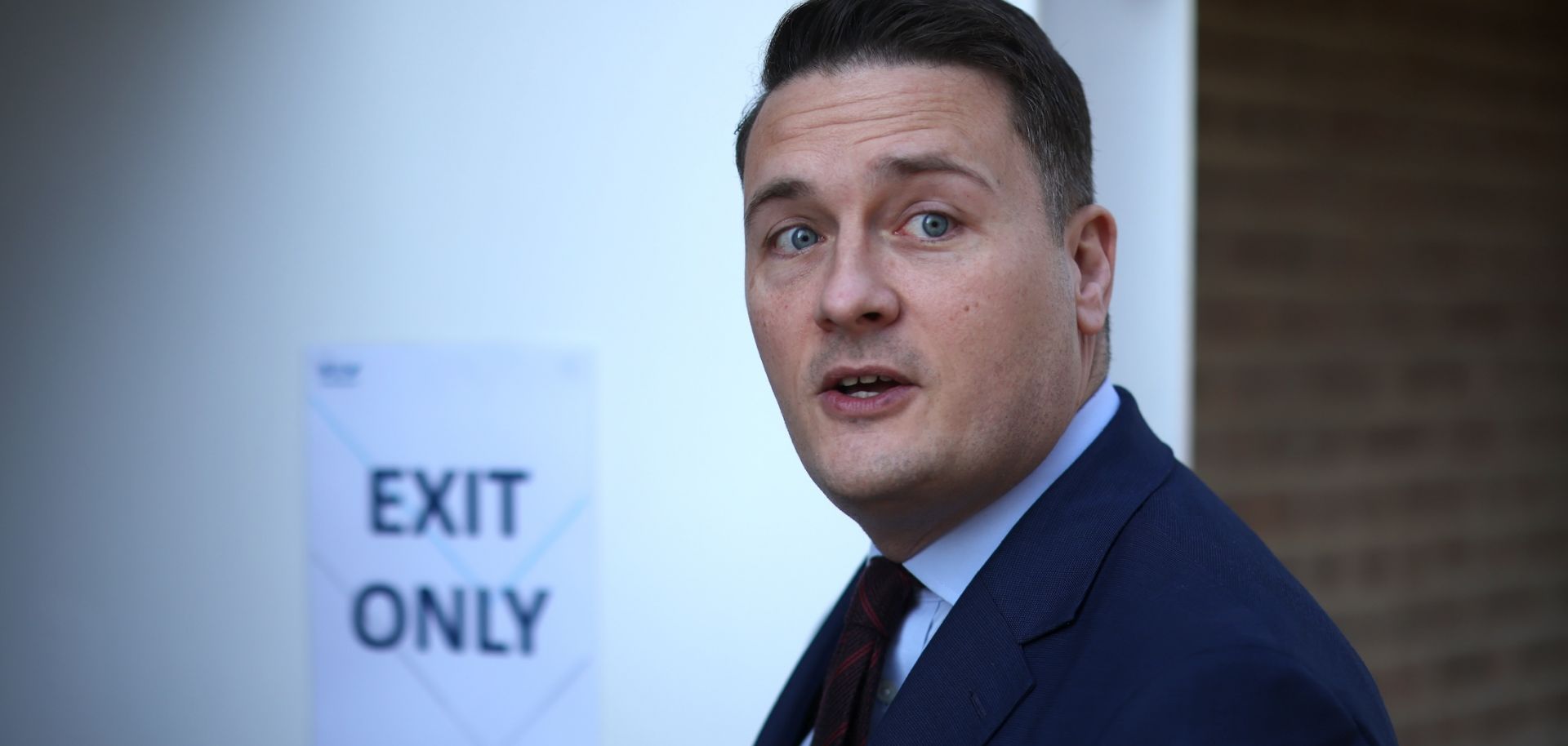
U.K. Health Secretary Wes Streeting arrives at the University of Kent in Canterbury, England, on March 19, 2026, as students receive the Meningitis B vaccine.
(Dan Kitwood/Getty Images)
U.K. Health Secretary Wes Streeting arrives at the University of Kent in Canterbury, England, on March 19, 2026, as students receive the Meningitis B vaccine.

The United Kingdom's deepening political crisis is increasing the likelihood of a leadership transition in the coming weeks that would prolong political uncertainty and market volatility, yet any new prime minister would preserve broad policy continuity and budget discipline, with differences largely bound to the pace and composition of fiscal restraint and the ambition of any EU rapprochement. U.K. Health Secretary Wes Streeting resigned on May 14, citing a loss of confidence in Prime Minister Keir Starmer's leadership, though he stopped short of launching a formal leadership challenge. Streeting's resignation letter described a government drifting without vision or direction, and pointed to Starmer's May 11 speech in response to the Labour Party's heavy losses in May 7 local elections as illustrative of those shortcomings. Doubts remain over whether Streeting has secured the 81 nominations from members of parliament needed under Labour rules to trigger a leadership contest. Pressure on Starmer has been building for months amid falling approval ratings, a stagnant economy, tight fiscal room, repeated policy U-turns and a string of recent scandals. In the week that followed the May 7 election, more than 80 Labor lawmakers publicly called for his resignation, three junior ministers quit and senior ministers privately pressed Starmer to set a timeline for his departure. Starmer vowed to stay on and rejected the calls as "destabilizing," arguing he would run in any eventual leadership challenge.

  • Labour's performance in the May 7 elections — contested across roughly 5,000 English council seats, six mayoralties and all seats in the Scottish and Welsh parliaments — was the worst local result for a U.K. governing party in over 30 years. The party finished third in Wales, made no headway in Scotland and lost over 1,500 English councilors, ceding long-held seats in Sunderland and Barnsley to the Reform UK party and previously safe London councils like Lambeth and Hackney to the Greens.
  • Nationwide polling for Labour has fallen from 34% at the July 2024 general election to around 17% today, with the right-wing Reform UK party overtaking at 28%. 
  • In the days since the municipal election, three junior ministers resigned and called on Starmer to set a departure timetable, while Home Secretary Shabana Mahmood and Energy Secretary Ed Miliband reportedly urged the same privately. 
  • Under Labour rules, a leadership contest can be triggered if 20% of the party's members of parliament (currently 81 of 405) back an alternative candidate. Once this threshold is reached, the contest is formally administered by the National Executive Committee (NEC), with members of parliament, affiliated trade unions and party members voting under a one-member-one-vote preferential system. The NEC sets the timetable after nominations close, with membership ballots typically running for several weeks before results are declared. Labour rules allow repeated challenges against the party's leader, meaning a leader remains vulnerable to renewed contests even after surviving an initial vote.

Streeting's resignation increases pressure on Starmer to either step down or face a leadership challenge in the coming weeks, likely sustaining market volatility until a credible successor with a clear fiscal direction emerges. Several broad scenarios are possible in the coming days and weeks. A challenger could secure the necessary nominations to trigger a formal contest, opening a leadership election that lasts several weeks. Alternatively, Starmer could pre-empt a formal challenge if he concludes his position has become untenable, announcing a departure timetable and managing an orderly handover. Another possibility is that no challenger reaches the nomination threshold in the near term and Starmer remains in office, though likely under sustained pressure to set a departure timetable, effectively prolonging political uncertainty. An early general election remains highly unlikely, given Labour's large parliamentary majority and weak national polling, which would leave many of its lawmakers at risk of losing their seats. Across all scenarios, market volatility is likely to persist, though to varying degrees and for differing durations. British assets would come under particular strain if a candidate from Labour's more left-leaning faction emerges as the front-runner, given fears that any potential departure from Chancellor Rachel Reeves' fiscal framework would lead to increased borrowing. Volatility would intensify further if a contest fails to decisively resolve Labour's factionalism, whether with a weak new leader or if Starmer survives but his authority remains under question, leaving the government's political authority and policy direction in question. By contrast, a short-lived contest with a clear outcome followed by credible early signals of fiscal continuity would contain volatility.

  • Figures cited in British media as potential frontrunners include Streeting himself, former Deputy Prime Minister Angela Rayner and Energy Secretary Ed Miliband. Greater Manchester Mayor Andy Burnham's name has also been floated, though he is currently ineligible as he is not a member of parliament; however, this could change if Starmer remains in power long enough for Burnham to win an eventual by-election and enter Parliament. Other potential candidates include Home Secretary Shabana Mahmood, Defense Secretary John Healey and Armed Forces Minister Al Carns. 
  • A Survation poll of Labour members published on May 14 indicates Burnham is the party's favored potential successor to Starmer, followed by Rayner, Miliband and Streeting. The poll suggests the first three would defeat Starmer in a leadership contest, though Starmer is favored to prevail in a direct matchup against Streeting.
  • U.K. markets responded nervously to Streeting's resignation on May 14, with sterling weakening by around 0.2% against the euro and the dollar, and 10-year government bond yields holding onto gains made earlier in the week. Market pressure has been building since May 12, when 30-year gilt yields hit 5.81% (their highest since 1998) and 10-year yields rose to 5.13% (their highest since 2008), as the pound briefly fell 0.7% against the dollar. The Iran war has compounded the strain in recent weeks, with rising oil prices leading traders to price in three quarter-point Bank of England rate hikes this year. 

The appointment of a new prime minister would likely lead to limited policy shifts, as structural constraints mean any successor would be forced to preserve budget discipline, with divergence between centrist and more left-leaning candidates largely confined to economic policy and the extent of realignment with the European Union. A centrist or center-right prime minister like Streeting — or, less likely, Mahmood, Carns or Healey — would prioritize fiscal discipline and policy predictability, broadly preserving Starmer's supply-side approach, modest social reforms, defense spending trajectories and pragmatic relations with the European Union; however, Streeting has signaled openness to going further than the current government's current red lines on EU trade. A more left-leaning government under Rayner, Miliband or Burnham would place greater emphasis on redistribution (through higher taxes on health and income to fund public services), green investment, workers' rights, expanded state ownership of key services, and further devolution to regional and local government, alongside a more proactive industrial policy and closer engagement with Brussels. Miliband and Burnham have signaled willingness to loosen Reeves' fiscal rules to accommodate higher borrowing for green and capital investment, a stance markets would see as risky for the United Kingdom's fiscal outlook. That said, spending increases would remain limited by fiscal constraints under any successor and are likely to be largely offset by targeted tax adjustments or slower growth in other expenditure areas. Across both camps, broad continuity would prevail on defense, NATO alignment and the core architecture of EU relations, with differences centered on the pace and composition of fiscal restraint and the ambitiousness of any EU rapprochement. Any proposal to substantially deepen ties with the European Union (such as entering the bloc's customs union or single market) would face significant resistance from some segments of Labour and the broader electorate. But a more ambitious stance could nonetheless emerge closer to the 2029 general election as part of a strategy to draw a sharper contrast with Reform UK and win back voters lost to the Liberal Democrats and the Greens. This is particularly likely if Labour's polling numbers continue to slide and the U.K. economy continues to stagnate, in which case closer EU alignment may be seen as worth the political cost of meeting Brussels' conditions. 

  • In the less likely scenario in which Starmer remains in power, his ability to steer the ship will still be restricted. Starmer is unlikely to fulfill his pledge of a more ambitious EU reset at the upcoming June summit due to his refusal to revisit single market or customs union membership, as well as Brussels' likely demands for budget contributions and freer movement of people. Tight fiscal headroom will also continue to constrain any tax or spending pivot aimed at reviving Labour's popularity or Starmer's own standing in the party.
  • For the United Kingdom, joining the European Union's customs union would require accepting stringent EU conditions on regulatory alignment, EU dispute resolution mechanisms and the loss of independent U.K. trade policy. Such a deal would also not cover the United Kingdom's crucial services sector, since the customs union covers only goods. However, full membership in the EU single market, which would extend access to services, remains even more politically controversial due to its requirement for freedom of movement, full EU rule-taking and budget contributions.
RANE
SUBSCRIBERS ONLY

Expert analysis when it matters most.

Get access to RANE's decision-grade geopolitical intelligence.