
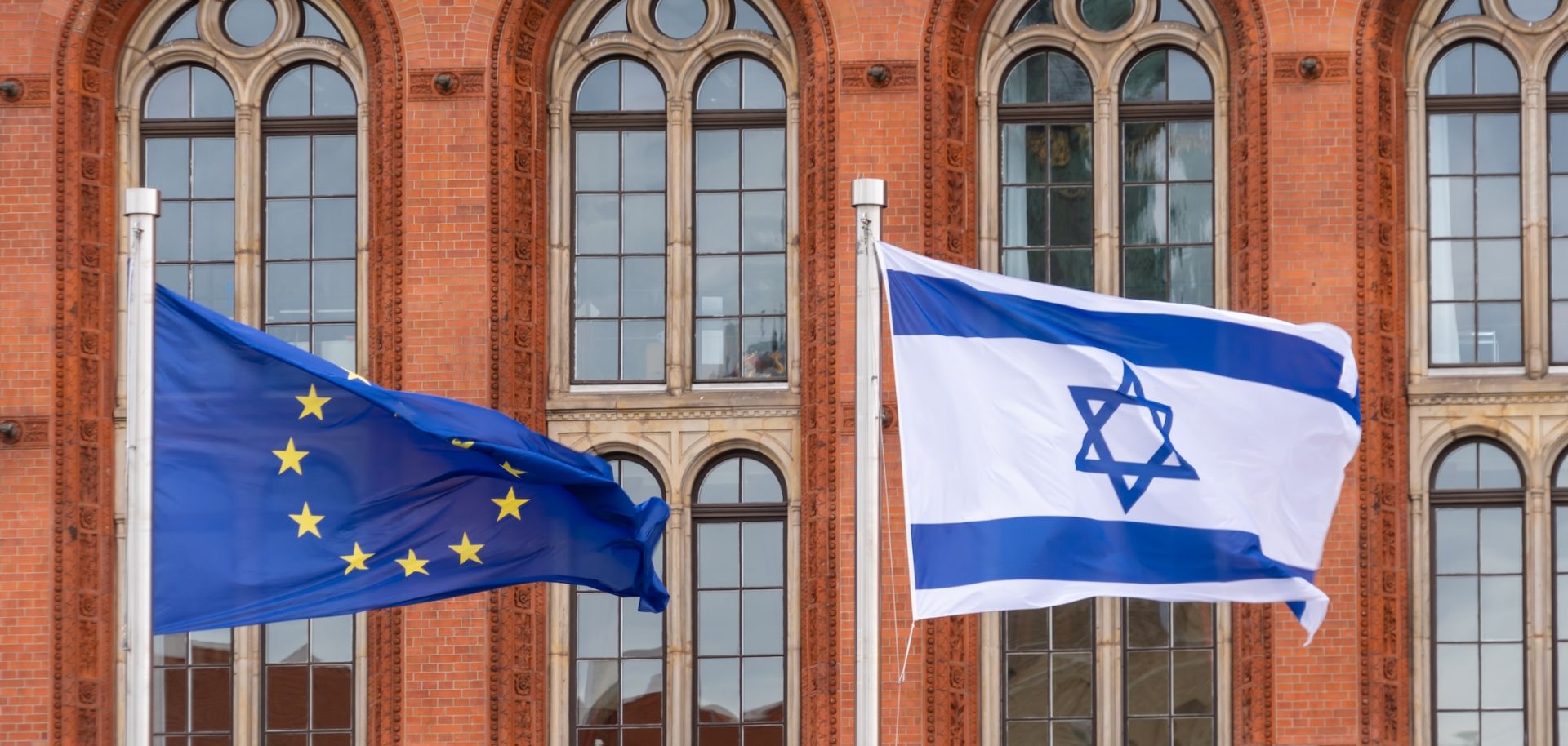
The EU and Israeli flags in March 2024 in central Berlin's Rotes Rathaus.
(Reinhard Krull/Getty)
The EU and Israeli flags in March 2024 in central Berlin's Rotes Rathaus.

Despite recent EU sanctions on violent Israeli settlers, internal EU divisions and European demand for Israeli defense systems make broader coordinated measures against Israel unlikely, though more assertive Israeli policies in the Palestinian territories could trigger unilateral restrictions and public backlash against linked companies. On May 11, the European Union agreed to sanction three violent Israeli settlers who have attacked Palestinians in the West Bank and four settler organizations, after Hungary — under a new pro-EU government — dropped its veto. The sanctions include travel bans, the freezing of assets held in the European Union and a prohibition on the sanctioned entities conducting business in the bloc. EU foreign policy chief Kaja Kallas said in a May 11 X post that "Extremism and violence carry consequences," sentiments echoed by other senior European officials. The identities of the sanctioned entities have not been disclosed, but they did not include far-right Israeli National Security Minister Itamar Ben Gvir or Finance Minister Bezalel Smotrich. Furthermore, the European Union did not approve tariffs on goods imported from Israeli settlements or a suspension of the EU-Israel Association Agreement. Additionally, the European Union sanctioned Hamas leaders. 

  • On June 10, 2025, the United Kingdom sanctioned Ben Gvir and Smotrich for repeatedly inciting violence against Palestinian civilians in the West Bank. At the time, the British government also called on the government of Israeli Prime Minister Benjamin Netanyahu to halt the expansion of Israeli settlements in the West Bank — considered illegal under international law — prevent settler violence and condemn the ministers' incendiary and extremist rhetoric. 
  • In a May 11 post on X, Ben Gvir denounced the sanctions, calling the European Union "antisemitic," and wrote, "The settlement enterprise will not be deterred. We will continue to build, to plant, to defend, and to settle throughout the entire land of Israel."
  • The European Union requires products produced in Israeli settlements to be labeled as such. Slovenia and Spain have banned goods from Israeli settlements. 

Although European countries have been critical of Israeli operations in the Palestinian territories, bilateral ties between European countries and Israel as well as European demand for Israeli air defense systems have hindered efforts for a coordinated response. Since the outbreak of the Israel-Hamas war in late 2023, Israeli military operations in Gaza, the rising Palestinian death toll and increasing Israeli settler violence against Palestinians in the West Bank have fueled momentum for the European Union to take a stronger stance against Israel. Although the European Union previously sanctioned some violent settlers in 2024, further efforts were blocked by Hungary under former Prime Minister Viktor Orban. Some countries, such as Spain and Slovenia, have imposed arms embargoes on Israel, although these moves were largely symbolic gestures since neither is a key arms supplier. Other member states have merely expressed rhetorical concern over increasing settler violence against Palestinians in the West Bank but have not taken practical action despite a push by some more hardline countries, including Spain, Slovenia and Ireland, to suspend the European Union's trade and research ties with Israel. A further constraint on coordinated EU action is that Israel has long been a key strategic partner on security matters for at least some EU members. This has taken on greater significance in recent years as many European countries have inked contracts with Israeli defense companies to acquire air defense systems as they continue efforts to boost capabilities to counter Russian capabilities. 

  • The number of Palestinian fatalities from Israeli settler violence has increased over the past decade, reaching a record high in 2025. The total number of Palestinians killed by settlers between January and April this year was higher than the 2025 total. 
  • According to the Stockholm International Peace Research Institute, between 2020 and 2024, the United States was the largest arms exporter to Israel, comprising around 66% of Israeli arms imports. Germany was the second largest, at around 30%. 
  • In December 2025, Germany's parliament approved a $3.5 billion expansion of the Arrow 3 defense system, including interceptors, just weeks after Berlin received its first Arrow 3 battery from Israel. Finland has also sought Israeli-made defense systems to boost its defense capabilities, having inked a deal for David's Sling, a medium-to-long-range air and missile defense system, in 2023. 

The European Union will likely sanction additional settlers and organizations and take largely symbolic steps against Israel, but the bloc is unlikely to make more assertive moves, such as suspending portions of its trade agreement. Even though the coming to power of a new Hungarian government has enabled the European Union to impose additional sanctions on Israeli settlers, EU governments' stances on and defense ties with Israel will likely hinder additional efforts to take more extensive coordinated steps. Although Germany has some coercive leverage over Israel due to its significant arms exports, it is unlikely to fully suspend arms exports due to sensitivities over relations with Israel stemming from the legacy of the Holocaust. It could, however, place conditions on exports that could be used against Palestinians in Gaza due to concerns that the weapons’ end usage would violate international law. Most European leverage over Israel is through economic means, since the European Union accounts for around a third of Israel's total trade. However, in the absence of an EU-wide response, Israel is unlikely to face any sustained economic pressure to curb its policies. Furthermore, even though Israel has gradually taken control over more territory in the Gaza Strip since the October 2025 ceasefire, the lower intensity of military operations, combined with broader regional uncertainty surrounding the Iran war, means that media attention on Gaza has reduced. Consequently, domestic pressure on many European governments to take a more assertive stance against Israel has eased, though some grassroots efforts persist. While additional targeted sanctions against violent Israeli settlers and settler organizations are highly likely, especially after upticks in violence in the West Bank, the European Union will likely only take symbolic steps. This is because countries like Italy, Germany and the Czech Republic are likely to obstruct more impactful efforts, including those affecting bilateral trade relations. All oppose the suspension of the EU-Israel Association Agreement, which requires a qualified majority to suspend trade-related provisions. Therefore, trade dynamics between Israel and the European Union — especially for key Israeli exports including semiconductors and circuits, defense equipment and medical supplies — are unlikely to significantly change. The European Union is also highly unlikely to be able to pressure Israel to curtail any more assertive policies in the Palestinian territories. 

  • The European Union could also take steps to minimally curb research cooperation. In July 2025, the European Commission proposed partially suspending Israeli participation in the European Innovation Council (EIC) accelerator program, which would suspend Israeli startups and businesses — particularly those with potential dual-use applications — from accessing accelerator funding in future rounds. But EIC accelerator funding comprises a minuscule portion of Israeli startup funds, since many rely on private capital and government grants. Even if the partial suspension were approved — which would require an unlikely qualified majority — the suspension would have a negligible impact on Israeli startups.
  • On May 15, Prime Minister Netanyahu said that Israel controlled around 60% of the Gaza Strip. As part of the October ceasefire agreement between Israel and Hamas, the so-called Yellow Line divided the Gaza Strip into Hamas-controlled and Israeli-controlled territory. Since then, the territory under Israeli control has slowly expanded through limited ground operations and airstrikes. 

Increasingly assertive Israeli policy in the Palestinian territories will likely result in increased European popular backlash. Some countries could take unilateral measures to ban trade in goods from Israeli settlements, while companies with links to Israel risk increased reputational risk. If Israel expands military operations against Hamas in the Gaza Strip (which could become more likely as the October elections approach) or pursues de facto annexation of portions of the West Bank, pro-Palestinian sentiment in Europe is likely to swell. In this scenario, there would likely be increased calls for divestment and stronger government measures. In the absence of a cohesive European-wide strategy, some countries may take unilateral, albeit largely symbolic, steps. Countries more critical of Israel, such as Ireland, may advance unilateral efforts to ban imports from Israeli settlements in the West Bank. These bans will likely be restricted to the import of goods — such as agricultural products — and not services, as those could have more extensive business implications, including for European tech companies. Even so, given that such measures would only affect a small percentage of Israel's total exports, they would likely have only a limited and mostly symbolic impact. Even without formal trade bans, a resurgence of pro-Palestinian movements will likely incite stronger backlash against European companies conducting business with Israeli settlements and multinational corporations operating in the Palestinian territories, expressing perceived support for Israel or with alleged ties to the Israeli government. Such companies face reputational risk and could be exposed to targeted protests and additional calls to boycott, divest and sanction. 

  • The United Kingdom, Ireland and Slovenia are among the European countries to have recognized Palestinian statehood since the outbreak of the Israel-Hamas war in 2023. Others may choose to join them to symbolically increase pressure on Israel.
  • Ireland has considered banning imports from Israeli settlements — which are less than 1% of total Irish imports from Israel — on multiple occasions. However, the United States has pushed back against these efforts, with some U.S. officials, at times, suggesting that U.S.-Ireland trade could be hurt if Ireland passed the bill.
RANE
SUBSCRIBERS ONLY

Expert analysis when it matters most.

Get access to RANE's decision-grade geopolitical intelligence.