
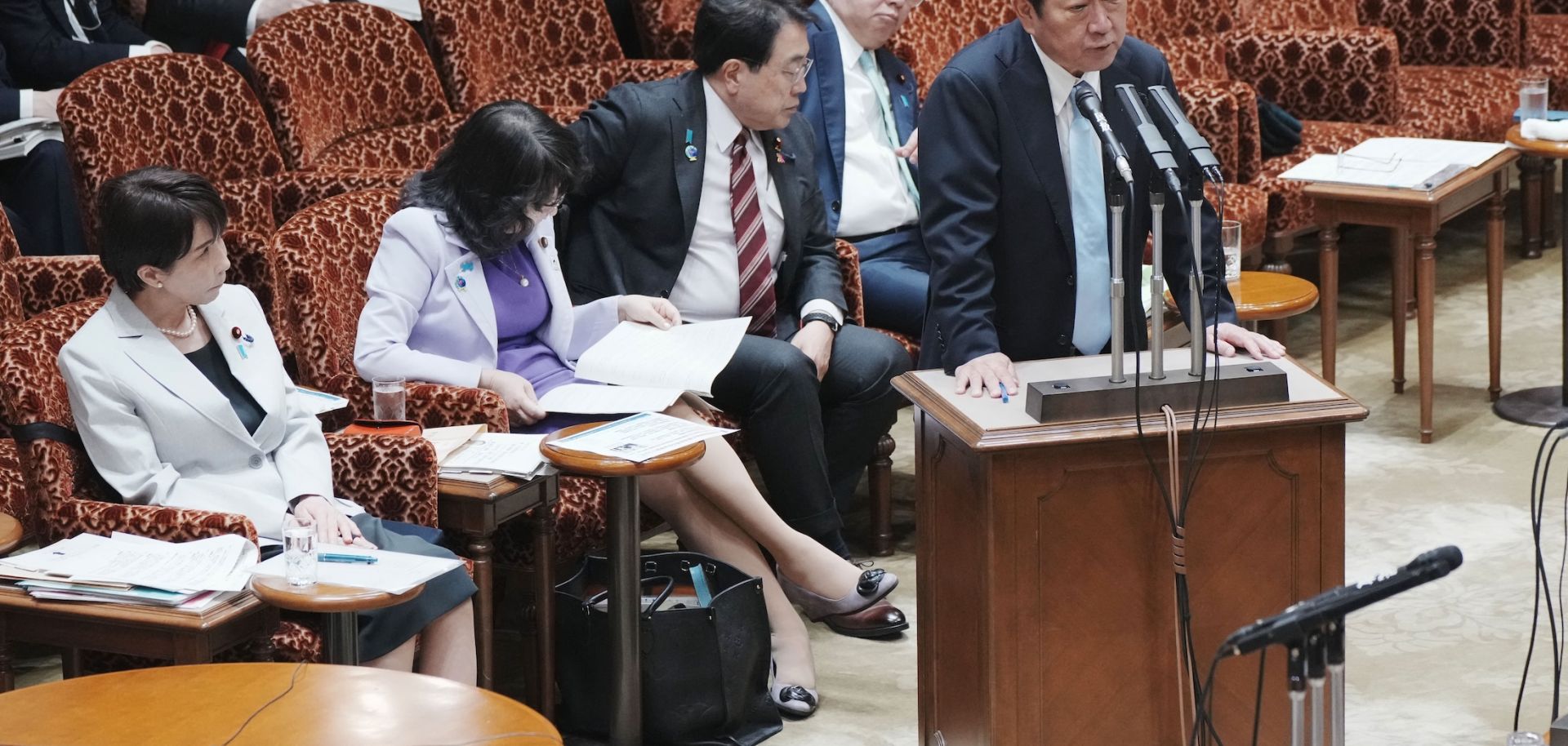
Japan's new budget will enable increases in strategic investments and defense expenditure, but future spending increases will remain constrained by relatively low economic growth and a large, if manageable, government debt burden. On April 7, Japan's upper legislative chamber approved the fiscal year 2026 budget proposed by Prime Minister Sanae Takaichi, weeks after the lower house gave its ascent. Following her decisive victory in the February lower-house elections, Takaichi is partly trying to emulate former Prime Minister Abe Shinzo's economic policies by increasing fiscal deficit spending and raising investment in critical economic sectors. Furthermore, the budget aims to accelerate strategic, state-led investments across seventeen priority sectors, including artificial intelligence, semiconductor manufacturing and shipbuilding. These investments are designed to bolster economic resilience and foster long-term productivity growth amid demographic challenges and sluggish economic growth. Following a supplemental budget passed last December, which aimed to raise defense expenditure to 2% of GDP, the 2026 budget will further increase military spending by almost 10% in nominal terms compared to the regular 2025 budget.
- In 2013, then-Prime Minister Abe launched an aggressive economic revitalization program to pull Japan out of two decades of deflation and stimulate growth. This so-called "Abenomics" strategy hinged on "three arrows" of policy action, including monetary easing, increased government spending and structural reform to increase inflation, economic growth and productivity.
Increased government investment and defense spending will add to Japan's fiscal deficit, but this is unlikely to trigger major market volatility given Tokyo's stable finances. While the resulting increase in the fiscal deficit will boost short-term growth by adding demand to the economy, it also carries the potential to elevate inflation and increase expectations for further interest rate hikes. This is particularly relevant in the context of the Iran conflict and the resultant higher energy prices. Typically, higher fiscal spending and the prospect of higher interest rates would strengthen the Japanese yen. This is because it reduces the appeal of the "carry trade" (where investors borrow cheaply in yen to purchase higher-yielding foreign assets and incentivizes Japanese investors to repatriate foreign assets due to higher domestic rates. However, the volatile geopolitical and energy price landscape — and its impact on Japan's balance of payments — introduces a degree of uncertainty regarding the overall effect of the increased fiscal spending. Still, a large fiscal deficit is unlikely to cause major market volatility, such as a sustained selloff in Japanese assets, given the country's stable financial position. For one, Japan's international investment position is very strong, meaning there will almost always be a marginal buyer for Japanese debt. Only a little more than 10% of government debt is held by non-residents, limiting Japan's dependence on foreign investors. Government debt is also denominated in Japanese yen, meaning a weaker yen will not push up the debt ratio. Additionally, some of the deficit-increasing measures in the budget, such as the sales tax, will be temporary. Finally, Japan's net government debt is comparable to that of most other Group of Seven (G7) economies, suggesting it has greater fiscal leeway than its gross government debt ratio of 230% of GDP would suggest.
- Japan's gross government debt soared from around 60% of GDP in 1990 (the start of its so-called "lost decade") to 250% in 2020. However, Japan's consolidated public sector balance sheet, accounting for both assets and liabilities, was closer to 120% of GDP in 2022, according to the Federal Reserve Bank of St. Louis. This is partly due to the Bank of Japan's accumulated assets, which include unrealized gains of around 10% of GDP, per the Financial Times. Japan's public pension fund and other assets also help reduce net government debt.
- The Federal Reserve Bank of St. Louis estimates that Japan's net government debt burden is roughly equal to that of the United States and most other advanced economies, where debt ratios range from 100% to 150% of GDP.
- On April 1, the International Monetary Fund projected that Japan's fiscal deficit would increase from 1% of GDP to 4% by the end of the decade, largely due to higher interest payments. The Fund also projected that Japan's gross public debt would slightly decrease over the same period, from just over 200% of GDP to 190-195% of GDP.
Despite the short-term spending boost, Japan's medium-term economic growth will remain slow, constraining the government's ability to significantly increase defense expenditure, especially compared to China, over the coming years. The increase in deficit-financed government spending outlined in the new budget will help stimulate the economy, thereby generating higher government revenues. However, Japan's real GDP growth remains highly unlikely to average more than 1% over the medium term due to adverse demographics, namely a declining labor force, which will constrain its efforts to boost defense spending. In recent years, Japan has sought to shed its pacifist past to slowly prepare for military action abroad. As part of this effort, Tokyo passed a supplemental budget in late 2025 that increased defense spending to 2% of GDP. But despite Takaichi's clear focus on rebuilding the country's armed forces, future major expenditure increases will be constrained by a high government debt burden, as well as the political challenge of balancing defense needs with rising social spending due to an aging population — especially in the context of sluggish, even if slightly improved, economic growth. While Japan's net debt position is better than its gross debt suggests, rising debt-service costs due to higher nominal interest rates will also limit deficit-financed defense spending. Meanwhile, the growth differential with Japan's top geopolitical rival, China, will remain substantial. The IMF projects that China's economy will expand by 4% annually over the coming years, compared with Japan's mere 0.6% annual growth. This will, in turn, enable Beijing to significantly outpace Tokyo in defense spending in the coming years, even if Japan were to attempt much larger expenditure increases.
- Japan's real GDP growth has averaged a mere 0.5% annually over the past decade, compared with China's 5.7%. Although Chinese defense spending is generally considered opaque, it is estimated to be around 2% of GDP.
- According to the IMF, China's GDP — measured in current international dollars based on purchasing power parity — will reach $43.5 trillion in 2026, compared with Japan's projected $7 trillion. This means that even if both countries allocate the same percentage of their GDP to defense, Chinese expenditure would still exceed Japan's by a factor of six to seven.
- According to the Australian Lowy Institute think tank, Japan's defense expenditure totaled $62 billion in 2025, compared to the United States' $1 trillion and China's $374 billion.
While Prime Minister Takaichi will prioritize policies aimed at strengthening Japan's economic resilience and national security in the years ahead, her progress will also be limited by a challenging geopolitical landscape. Takaichi is better positioned than her recent predecessors to pursue strategic, forward-looking economic and defense policies, including greater defense expenditure at the expense of social spending. This is despite domestic political constraints, such as her party's lack of an upper house majority, and existing financial constraints, notably high government debt. However, the extent of Takaichi's progress will be limited by an increasingly complex geopolitical landscape, which will compound the challenges posed by Japan's low economic growth and demographic pressures. Japan's primary rival, China, is experiencing strong economic expansion, making great technological strides and bolstering its military power. Meanwhile, the United States has become a less predictable and reliable partner under President Donald Trump. This is evident both geopolitically — through Trump's shifting stance on China and North Korea, and his sometimes more ambiguous support for Taiwan — and economically, through Trump's aggressive tariff strategy and the trade and investment concessions his administration has forced on Tokyo. At the same time, the ongoing Iran war risks worsening inflation and straining Japan's energy supplies, given the country's deep reliance on oil and gas imports — particularly from the Middle East. This challenging geopolitical environment will limit the financial resources at Takaichi's disposal to strengthen Japan's economy and national security in the years ahead, potentially forcing difficult political trade-offs that limit social spending. However, structural economic reform and enhanced cooperation with allies, including through initiatives like the Critical Minerals Production Alliance, offer potential avenues for Japan to advance these interests without requiring significantly greater fiscal resources.
- The United States purchased 20% of Japan's total exports in 2025, while China purchased 18%, making these countries Japan's top two trading partners. This leaves Japan highly exposed to U.S. and Chinese trade restrictions.
- Japan is highly dependent on energy imports, which account for 85-90% of its total consumption. This dependence, particularly on crude oil from the Middle East (which accounts for 95% of its supply) and Japan's status as the world's top LNG importer, makes the country highly susceptible to energy supply disruptions and rising prices, including those caused by the ongoing Iran war.
