
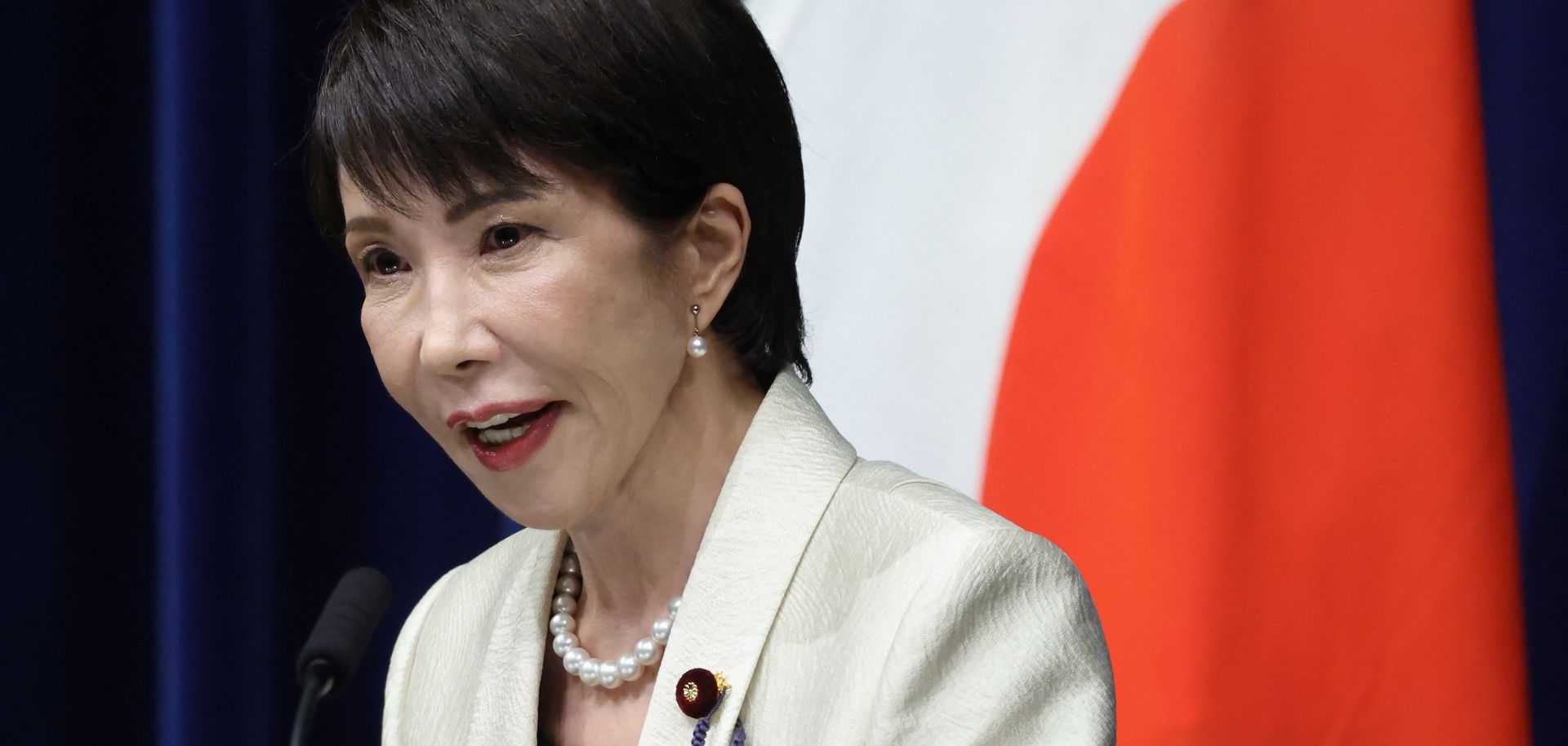
Japanese Prime Minister Sanae Takaichi will likely be able to make sufficient concessions to U.S. President Donald Trump during their summit to avoid U.S. retaliation and/or a slowdown in her own military modernization policies, but a protracted Iran war could nonetheless undermine her economic growth plans. Takaichi will visit Washington on March 19 to meet with Trump for the first time since she was reappointed as premier on Feb. 18, aiming to firm up relations with Japan's top defense ally and second-largest trade partner. Until recently, the meeting was expected to focus on implementing their July trade deal, cooperating on energy and technology supply chains and coordinating military modernization efforts to jointly deter Chinese aggression against Taiwan. On March 14 and 15, however, a more fraught issue was added to the list when Trump demanded that U.S. allies and partners like Japan, South Korea and the United Kingdom assist the U.S. Navy in escorting oil and gas tankers through the Strait of Hormuz to protect them from Iranian missile and mine attacks. After days of complaining about their lack of support, on March 17, Trump claimed that "we no longer 'need' or desire" assistance due to what he described as overwhelming U.S. military success. Amid this back and forth, Takaichi said that she was considering Japan's legal options for engagement in the Strait of Hormuz, including potential maritime security operations to protect Japanese-flagged vessels. However, her Cabinet members have indicated that legal obstacles to such Japanese engagement are "very high." Although Trump has asked allies and partners to provide minesweepers — and Japan has strong naval mine-countermeasure capabilities — Tokyo has remained relatively quiet about offering this type of support.
- Trump has strong ideological overlap with Takaichi as a conservative firebrand. He also voiced support for Takaichi ahead of the Diet's vote for prime minister in late 2025 and ahead of Japan's Feb. 8 lower house elections. After her party's victory, Trump cited his own support as pivotal to her win and was among the first world leaders to congratulate her and hailed their "great relationship."
- Japan's snap elections for the powerful lower house of the Diet on Feb. 8 handed Takaichi's ruling conservative Liberal Democratic Party (LDP) a supermajority and its largest share of seats since the party's founding, shortly after World War II. This victory has afforded Takaichi political bandwidth to pursue expansive social spending and defense modernization, and fulfill the U.S. trade deal.
Takaichi will likely be able to navigate the Trump meeting without spurring U.S. trade retaliation or damaging her strong personal relationship with the U.S. president, partly by offering concessions that keep Japan from getting embroiled in the Iran war, but the less likely scenario of a major bilateral dustup remains on the table. For now, it seems Trump's ire is directed at U.S. allies and partners in aggregate, not at Japan specifically and his March 17 post suggests his pressure on Takaichi to assist militarily may somewhat abate. Still, Trump is all but sure to raise the issue during their meeting. Because the U.S. relationship is far too important for Takaichi to assume U.S. grievances on the matter are gone, she will likely want to offer concessions and faster progress on joint security initiatives to keep relations on a solid foundation. To that end, Japan's NHK News reported on March 17 that the Japanese government would pitch the United States on a plan to boost production and purchases of Alaska crude oil. She may also seek progress on long-term plans to jointly produce missile systems that are in high demand due to conflicts like the Iran war sapping U.S. stockpiles of offensive and defensive missiles. Similarly, she could offer an accelerated timeline on U.S.-Japan plans for Japanese shipyards to service and repair U.S. naval vessels and aircraft, which would also accelerate the development of Japan's defense-industrial base. Takaichi could also offer vague commitments to assist the U.S. military effort in Iran, such as by offering intelligence assistance or postwar minesweeping support. Still, there is a low possibility of a less-than-amicable meeting given Trump's sometimes mercurial nature in leadership summits. This would raise the risk of greater U.S. trade demands, tariffs and pressure for Japanese support in some capacity with the Iran war effort.
- Japan is a highly import-reliant nation in general and energy is no exception. Prior to the war, 93% of Japan's oil imports and 18% of its liquefied natural gas imports came through the Strait of Hormuz. However, Japan also has vast strategic petroleum reserves that it has already tapped in an independent capacity and in coordination with other countries since the beginning of the Iran war.
A protracted Iran war would threaten Takaichi's plans to spend Japan's way to economic growth, while persistent pressure from Trump for Takaichi to join a naval escort mission would risk scuttling her defense modernization plans. Domestically, this high-stakes meeting comes at a sensitive time for Takaichi. The Iran war's inflationary impact on fuel prices and Japan's greater spending to maintain the price-insulating effect of government fuel subsidies are blunting her post-election plans to bolster Japanese consumption and economic growth with expanded social spending. If the U.S. war effort wraps up in the next month or so and global oil and gas supplies return relatively quickly to prewar levels, the blunting impact on Takaichi's economic growth plans will likely be limited, even with lingering energy price impacts. If not, she may be left with an expanded wartime social support budget that nonetheless fails to boost consumption and comes alongside falling public support, as so often occurs during wartime economic downturns. Meanwhile, Takaichi and her LDP are also seeking to capitalize on their parliamentary supermajority to rapidly expand the capabilities and role of the Japanese military, including eventually via a high-stakes constitutional amendment process, in order to realize a "free and open Indo-Pacific" that deters and/or contains rising Chinese military threats to Taiwan, Japan and the East and South China Seas. If U.S. pressure on Japan to assist with a Strait of Hormuz escort mission continues and Tokyo begrudgingly acquiesces to putting the Japanese military in harm's way for a war that only has single-digit domestic approval ratings, she could severely diminish public support for her broader military strengthening effort. This would risk slowing or altogether pausing Japan's efforts to bolster munitions production and arms sales and redefine the country as a linchpin in regional security efforts with U.S. allies and partners, not just a domestic military power. For now, strong Trump-Takaichi relations, the importance of the U.S.-Japan alliance to deter China and Takaichi's high willingness to meet U.S. trade demands suggest she will likely be able to avoid major military commitments and maintain her defense strengthening plans. However, given the uncertain trajectory of the Iran war, it is unclear whether Takaichi's fiscal expansion-driven growth plans will have to wait for 2027, be watered down or even scrapped altogether.
