
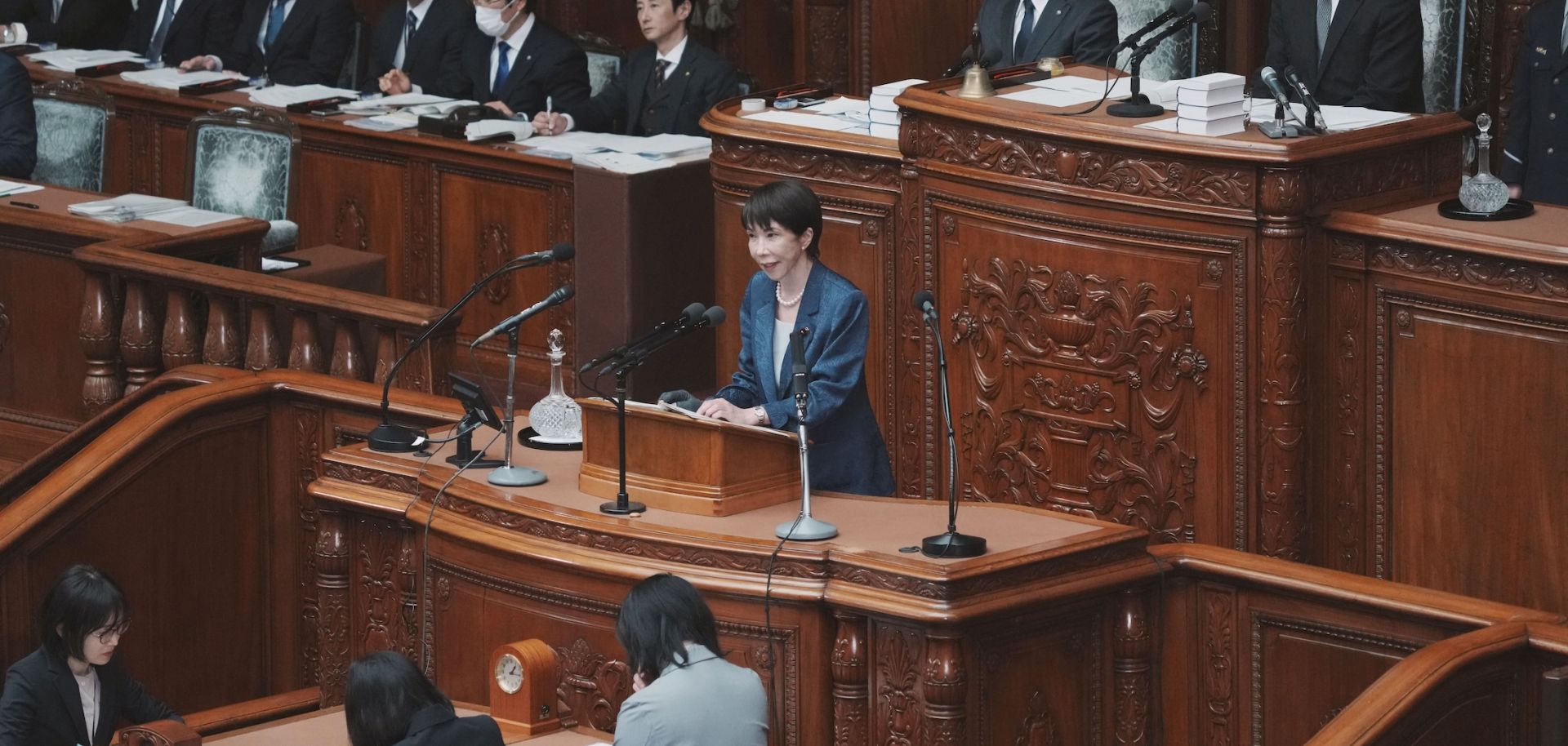
The current rift in Japan-China relations has deep roots and will likely last for the duration of the Takaichi administration, portending industrial disruptions in Japan, and Tokyo leaning into supply chain and defense cooperation with regional partners like South Korea and the United States. Since Japanese Prime Minister Sanae Takaichi's controversial comments to the Diet about Taiwan on Nov. 7, Japan-China relations have rapidly deteriorated. In the weeks after Takaichi's comments, Beijing levied trade restrictions, including reimposing import restrictions on Japanese seafood products in late November that it had lifted just weeks before. China also curbed outbound tourism to Japan via informal guidance to tourism operators in November and visa limits in December, restricting one of Japan's top sources of tourists. In the months since, the Chinese Foreign Ministry has repeatedly demanded that Takaichi retract her statement and steadily imposed new restrictions, including in January, when it restricted the export of dual-use goods, like heavy rare earths, to potential military users in Japan. Expanding upon this, in February, China banned exports of dual-use goods to 20 Japanese companies, including Mitsubishi Shipbuilding Corp. It also added 20 Japanese companies, including Subaru Corp., to a watch list that requires more rigorous export licensing for them to acquire dual-use goods like rare-earth magnets. Despite these curbs, Takaichi has repeatedly clarified that, though she aims to facilitate productive China-Japan relations, her comments did not deviate from official Japanese policy and that she will not recant.
- In a Nov. 7 meeting of the Diet's Budget Committee, Takaichi stated that a Chinese naval blockade could threaten Japan's survival. Japanese law provides that a survival-threatening situation could justify Japan intervening with military force, despite its pacifist constitution. Though this conditional intervention logic has long been Japan's de facto stance, Takaichi's comments marked rare explicit discussion of the matter.
- Stemming partly from a deep-seated historical rivalry, the severity of Beijing's retaliation against Takaichi's Nov. 7 remarks also reflects China's strategic focus on isolating Taiwan, both diplomatically and militarily. If Beijing is unable to prevent Western nations and allies, like Japan, from supporting Taiwan, China could face the difficult task of fighting a regional war if it chose to invade Taiwan.
There are numerous drivers for this diplomatic spat and Takaichi's rhetorical shift on Taiwan, and they all suggest that China-Japan relations will continue to deteriorate. Takaichi's decision to make explicit in the Nov. 7 Diet session what had long been Japan's de facto policy on Taiwan has many drivers. Takaichi is a self-professed acolyte of the Shinzo Abe school of Japanese politics, including the former prime minister's strong focus on national security and the cornerstone idea of a "free and open Indo-Pacific," or FOIP. Moreover, Takaichi came into office partly thanks to the strong backing of one of the ruling Liberal Democratic Party's (LDP) most powerful elder statesmen, Taro Aso, a long-time China hawk and a proponent of closer relations with Taiwan. Even before the LDP won a supermajority in the powerful lower house of the Diet in Feb. 8 snap elections, Takaichi's strongly conservative faction of the LDP has been heavily focused on strengthening Japan's military, long inhibited by Japan's pacifist constitution, in the face of a rising China. Now, with a rare parliamentary supermajority, the LDP is all the more dedicated to realizing this military strengthening, including by raising defense spending, expanding arms exports and regional security cooperation with Western partners, revising national security doctrine to focus on threats beyond Japan's shores, and revising the constitution to give the Self-Defense Forces (Japan's defense-oriented military) a broader mandate, including a clearer role in contingencies beyond homeland defense. Thus, Takaichi's rhetoric on Taiwan is representative of this shifting view in Tokyo about the necessity of a Japanese defense doctrine that focuses not only on explicit homeland security threats but also on threats farther afield that could eventually endanger Japan. To that end, Tokyo is wary of the growing size and frequency of China's daily military air and sea incursions around Taiwan as well as the once- or twice-yearly large-scale exercises that encircle Taiwan. More concerning still for Tokyo is that Chinese state media has, in recent years, revived old narratives questioning Japan's sovereignty over the Ryukyu Islands, including Okinawa, highlighting China's closer historical ties to the once-independent island chain. In recognition of this shift and in response to Beijing's retaliation, Takaichi's administration appears to be in the early stages of downgrading diplomatic ties with China. As for Beijing, Takaichi's defense-strengthening policies will deepen China's long-standing concerns about a resurgent "Japanese militarism."
- The FOIP concept includes deterring or stopping Chinese military aggression in the South China Sea or Taiwan, both of which would threaten supply chain security and the physical security of Japan's Okinawa Prefecture, an archipelago hundreds of miles from Japan's main islands that terminates less than 70 miles from Taiwan.
- The first draft of Japan's 2026 Diplomatic Bluebook, publicized March 24, shows Tokyo downgrading its description of the Japan-China relationship from "one of the most important bilateral relations" in the 2025 edition to an "important neighbor" in the 2026 edition. The 2026 edition also criticized China for "intensifying unilateral criticism and coercive measures against Japan."
Japan's focus on deterring Chinese aggression in the region — particularly against Taiwan and the Okinawan Islands — will likely prompt new Chinese export curbs and the cancellation of diplomatic meetings. Tokyo's focus on deterrence is more likely to manifest through engagements with regional pro-U.S. partners rather than through direct engagement with Taiwan, although indirect ties will slowly expand. This will involve expanding Japanese participation in regional military drills, such as the annual U.S.-Philippines Balikatan exercises in the Philippines, scheduled for July 2026. Japan will also steadily expand joint production of munitions, especially defensive and standoff missiles, with the United States and increasingly deploy existing missile systems farther south, closer to Okinawa and Taiwan. In addition, the government will revise various defense doctrines and, eventually, the constitution to expand the operational capacity of the SDF, which Beijing will continue to view as preparations for war with China and military "interference in the Taiwan issue." And Japan will seek to expand indirect ties with Taiwan, mainly through visits by small groups of LDP parliamentarians, unofficial trips by high-level officials and rhetorical support for Taiwan's inclusion in international institutions like the World Health Organization, the Comprehensive Progressive Agreement for Trans-Pacific Partnership trade agreement and the International Civil Aviation Organization. All of these developments, especially personnel exchanges and Taiwan's engagement in international groupings, are likely to spur further Chinese economic retaliation, including curbs on Japanese agricultural products and export restrictions on industrial inputs such as synthetic diamonds, lithium-ion battery ingredients and elements, and chemical compounds containing magnesium. China could also add more major Japanese companies to its export control and watch lists. Beyond these, diplomatic retaliation is also likely, as seen in China's suspension of the seventh annual High-Level Economic Dialogue with Japan, previously scheduled for early 2026, after Takaichi's Nov. 7 comments.
- Japan's involvement in the Balikatan military drills is steadily growing. In 2025, Japan transitioned from being an "observer" to a "full participant" in the drills, engaging in joint maritime maneuvers. Now that Japan has signed a reciprocal access agreement with the Philippines, which entered into force in September 2025, the Japanese SDF will contribute ground troops to Balikatan drill land exercises this year. Those drills are increasingly focused on archipelagic defense to deter Chinese aggression against Taiwan and the Philippines. Japan's involvement has focused on the elements of these drills in the northern Philippines, closest to Taiwan.
- On March 7, Taiwanese Premier Cho Jung-tai visited Tokyo in a private, unofficial capacity to attend one of Taiwan's national team's games in this year's World Baseball Classic, marking the first visit to Japan by a Taiwanese premier since Japan switched diplomatic recognition from Taiwan to China in 1972. Japan's immigration authorities had to approve this visit, showing the Takaichi government's tacit support for a slight change in Japan's policy of diplomatic nonengagement with Taiwan.
Chinese retaliation will accelerate Japanese supply chain diversification, especially for rare earths, but in the near term, China's actions will weigh on Japan's high-tech industrial production and tourism industries. Chinese actions will drive the Japanese government and Japanese private industry to deepen efforts to diversify supply chains away from China and to develop or expand stockpiles of key goods, such as rare earths. This has already happened following previous bilateral disputes, such as China's 2010 brief cutoff of rare earth exports to Japan in retaliation for Tokyo's handling of a territorial dispute that led to the arrest of a Chinese fishing boat captain. This incident drove the Japanese government to expand light rare earth stockpiles and many of Japan's largest consumers of heavy rare earth magnets, particularly automobile producers, to create their own private, monthslong stockpiles of those magnets. Moreover, the Japanese government has recently signed new supply deals for heavy rare earths, a type for which Japan is most reliant on Chinese suppliers. This included a deal with Australia's largest rare earths producer. Still, the supplies from this Australian deal will take months to come online, and other deals could take years. In the meantime, China's persisting curbs on rare earth exports could disrupt Japanese industrial production, particularly for producers without extensive private stockpiles, like manufacturers of electronics, renewable energy products like windmills and chemicals used in semiconductor production. Likewise, China's tourism curbs will weigh on the expansion of this otherwise booming Japanese industry, hurting revenue across Japan's restaurant, hotel and other tourism-related sectors.
- In early March, Japan Australia Rare Earths — jointly owned by a Japanese government agency and a private Japanese trading firm — secured an agreement to purchase at least 50% of the annual heavy rare earth oxide production of Australia's Lynas Rare Earths and for Lynas to give JARE preferential buying access to 75% of said production. JARE also agreed to purchase at least 5,000 tons per year of neodymium-praseodymium, or NdPr, a light rare earth material used to produce magnets for vehicles. Lynas agreed to maintain a total annual production capacity of NdPr of at least 7,200 tons through 2038. These volumes, once fully realized, would cover half of Japan's annual consumption of NdPr magnets.
- In January and February — a period commonly analyzed in aggregate given the shifting annual dates of the Lunar New Year holiday, a common travel date for Asian tourists — inbound tourism to Japan grew by just 0.3% to over 7 million visitors, including roughly 782,000 Chinese tourists, a 54% drop. This 0.3% figure represents a notable slowdown from the January-February period of 2025, when tourism grew almost 29% year on year.
As industrial disruptions mount, Takaichi will continue seeking de-escalation, but these efforts are unlikely to yield relief from Chinese rare earth curbs, while their long-term relationship is also bound for steady deterioration, pushing Takaichi to lean more into economic and security ties with the United States and regional partners like South Korea. In the coming months, as the impacts of China's rare earth curbs begin to deplete Japan's stockpiles and disruptions to industrial sectors mount, Takaichi will continue to pursue a diplomatic climbdown with less incendiary rhetoric, but she will not ease up on defense modernization policies. Meanwhile, due to significant public concern about overtourism, she is unlikely to go to great lengths to seek a reversal of China's tourism curbs. To date, Beijing has rejected her conciliatory rhetoric and instead demanded she fully and explicitly recant her Nov. 7 statement. This is something Takaichi cannot do, first because her statement represents long-standing LDP policy and the Japanese Constitution's framing of acceptable military action. Second, an explicit recantation would be politically infeasible, given Takaichi's new tenure as prime minister and her strong parliamentary mandate to advance defense modernization with an eye toward deterring China. Takaichi's conservative backers would view a recantation as unacceptable and would likely pressure her to resign if she made one. There is a low chance that Beijing will at some point ease implementation of these rare earth curbs to take advantage of a sudden rift in the U.S.-Japan relationship. But for now, Takaichi is doing her utmost to ensure such a rift never occurs, namely by acquiescing to hefty U.S. demands during their trade talks. Regardless of whether the rare earth dispute resolves, it is likely Japan-China relations will steadily deteriorate for years under Takaichi, with Beijing more likely to seek rapprochement only after Takaichi leaves office, a common Chinese tactic. Thus, Tokyo will prioritize strengthening economic and security ties with its defense benefactor, the United States, as well as with regional powers concerned by China's aggression, like Australia, with Japan acting as a catalyst for the expansion of regional military capabilities via joint defense production agreements and collaboration in drills and contingency planning. This trajectory could also sustain the ongoing, rare rapprochement in South Korea-Japan ties — assuming those too do not deteriorate over historical baggage — facilitating supply chain and economic security agreements between these two industrial powerhouses.
- In the weeks following her Nov. 7 remarks, Takaichi sought to reduce tensions with China by noting that her comments on Japanese military intervention were based only on hypothetical future contingencies, not an absolute military opposition to China. She also stated that she would seek to avoid discussing this matter in public forums, such as the Diet floor. Nonetheless, the Chinese Foreign Ministry has repeatedly rejected her efforts and called for her to explicitly recant her Nov. 7 remarks.
- Following her Feb. 8 election victory, and barring any political scandal, Takaichi faces no significant threats to her premiership until at least the September 2027 LDP leadership elections, but is more likely to face significant threats during the July 2028 upper house elections or lower house elections not due until February 2030.
- China's previous yearslong foreign disputes have included its 2018-2025 diplomatic tensions with Canada, which dropped significantly less than a year after Mark Carney came to office in March 2025. In addition, China's 2020-2022 trade dispute with Australia began to wind down within a year of the progressive Anthony Albanese replacing conservative Scott Morrison as premier in May 2022.
