
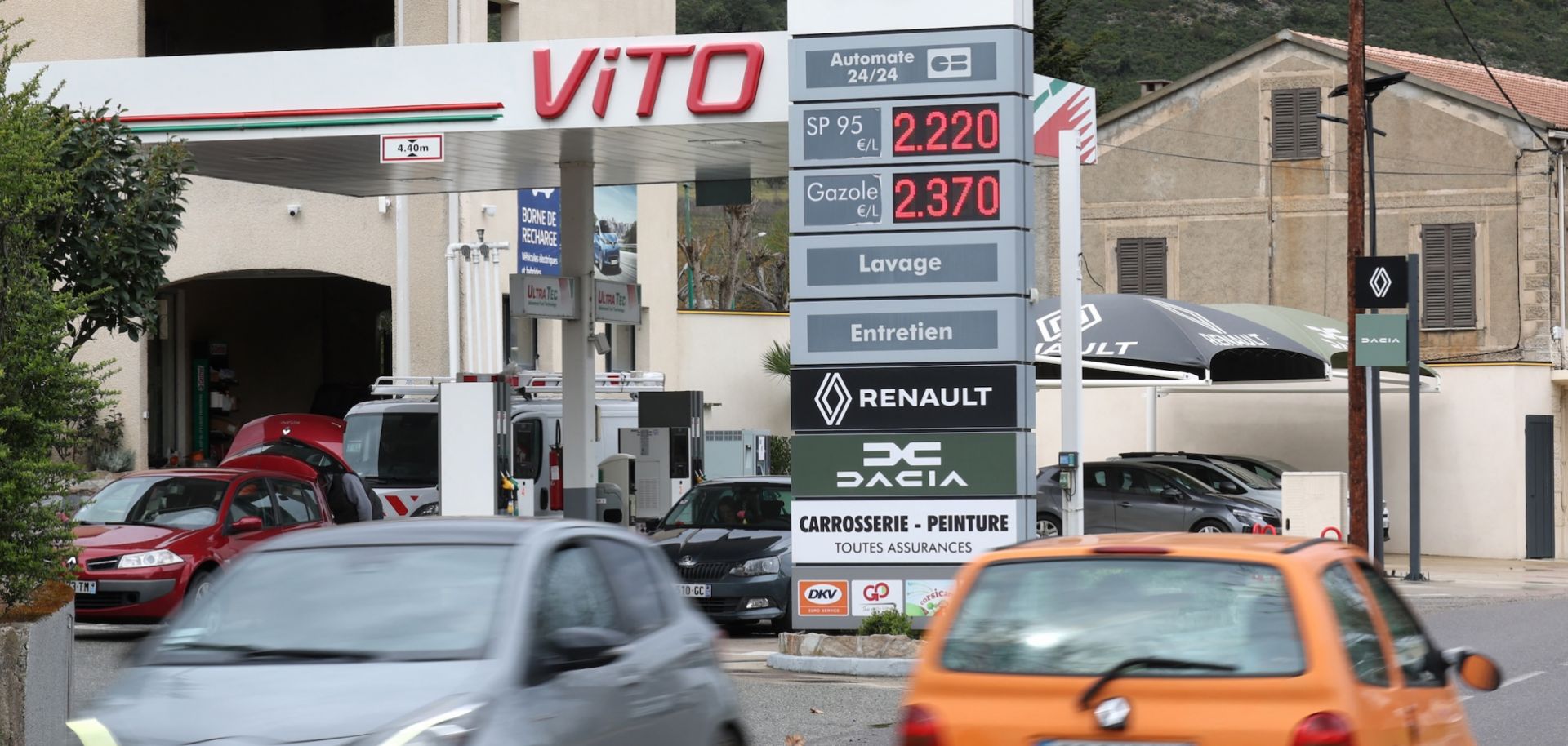
While Gulf oil and gas supply disruptions are driving higher and more volatile energy prices in Europe, EU-wide market interventions remain unlikely, leaving a fragmented patchwork of national relief measures that will only partially shield households and industry, and although Europe will avoid physical shortages, high prices will continue to weigh on industrial competitiveness and economic growth. Four weeks since the start of the U.S.-Israeli conflict with Iran on Feb. 28, the effective closure of the Strait of Hormuz — through which passes roughly 20% of global oil and liquefied natural gas (LNG) trade — has reignited fears of a protracted energy crisis in Europe. Ongoing drone and missile threats and naval mines have curtailed oil and gas output in key Gulf countries and brought tanker and LNG carrier traffic to a near-standstill. These events have pushed Brent crude from around $70 to over $100 per barrel and have nearly doubled European natural gas prices since the start of the crisis, resulting in a sharp rise in fuel costs and electricity bills across the Continent. European governments have announced a series of measures to shield households and businesses from rising energy prices. For example, Spain introduced a 5 billion euro ($5.77 billion) relief package featuring value-added tax cuts and fuel subsidies, Italy and Portugal adopted tax-based offsets utilizing excess VAT revenue, and more aggressive measures include Hungary's domestic fuel price caps and German and Austrian price-regulation mechanisms. Additionally, several governments are considering reintroducing windfall taxes on energy companies to fund consumer relief. Meanwhile, EU leaders have requested that the European Commission prepare temporary measures to curb prices, and Brussels has already advised member states to lower mandatory gas storage targets from 90% to 80% of capacity while urging an early start to the filling season to avoid summer supply competition.
- Dutch front-month TTF gas futures, Europe's benchmark, rose from around 30 euros per megawatt-hour (about $10 per million British thermal units) before the start of U.S.-Israeli strikes on Iran to around 55 euros per MWh (about $19 per mmBtu) as of March 26. Prices briefly exceeded 70 euros per MWh (about $24 per mmBtu) on March 19 following attacks on Qatar's Ras Laffan LNG complex, which prompted QatarEnergy to declare force majeure on long‑term LNG supply contracts affecting deliveries to buyers in Italy, Belgium, South Korea and China.
- Saudi Arabia has rerouted some crude shipments from the Persian Gulf to the Red Sea port of Yanbu via the East-West pipeline, providing partial relief for oil exports. LNG shipments, however, cannot be rerouted this way, leaving gas markets fully exposed.
While transit through the Strait of Hormuz could resume once hostilities ease, lengthy restart processes and damage to oil and LNG infrastructure will prolong supply disruptions beyond any ceasefire, sustaining tight market conditions and elevated prices into the 2026-27 winter season, though the shock will likely remain less severe than Europe's 2022 energy crisis. Even if negotiators reach a ceasefire in Iran in the coming days that reopens the Strait of Hormuz, the full restoration of energy production would likely take weeks or even months due to the technical constraints of restarting LNG operations, persistently high insurance costs and the ongoing risk of renewed attacks. Moreover, Iranian drone attacks on Qatar's Ras Laffan complex on March 19, in retaliation for Israeli strikes on Iran's South Pars field, damaged facilities responsible for roughly 17% of Qatari LNG exports, with repairs to the damaged liquefaction trains estimated to take three to five years, sidelining around 12.8 million tons of annual production in the interim. This outage effectively offsets a significant share of Qatar's planned capacity expansion from 77 million to 126 million tons per year by 2027, reducing the buffer that was expected to ease global supply tightness in the coming months and years. Any further Iranian strikes on regional LNG infrastructure would exacerbate these constraints. While Europe relies less on Gulf LNG than Asian markets do — accounting for only roughly 8% of imports — it remains highly sensitive to price movements. This sensitivity is particularly high as the Continent enters the April-to-November storage refill season with inventories at a five-year low of around 30% and unfavorable seasonal spreads, and as it prepares to phase out Russian gas, with bans on short-term LNG and pipeline contracts set for April and June, respectively. Still, while high energy prices and volatility are set to linger in the coming weeks and months, the shock will remain more contained than the 2022 crisis, when the bloc lost nearly 45% of its total gas imports in a matter of months following Russia's abrupt curtailment of pipeline supplies and prices reached peaks of over 300 euros per MWh (about $96 per mmBtu).
- Restarting LNG production requires phased shutdown reversals, gradual cooldowns to prevent thermal stress on equipment and sequential recommissioning of liquefaction trains, all constrained by limited storage capacity, meaning full output restoration can take several weeks to months even under optimal conditions. Similarly, restoring disrupted oil production involves stabilizing wells, coordinating pipelines and terminals, and restarting export flows, with full resumption likely taking several weeks due to technical, operational and logistical constraints.
- Following U.S. President Donald Trump's March 20 ultimatum for Iran to reopen the Strait of Hormuz or face strikes on its power plants, Iranian officials responded that any attacks on Iranian energy infrastructure would trigger retaliatory strikes on regional power plants, LNG and desalination facilities. This highlights Tehran's red lines and the risk that further escalation could worsen Gulf energy disruptions and intensify global LNG market pressures.
- Since early March, multiple LNG tankers originally bound for Europe have diverted toward Asia amid tightening supplies following disruptions in Gulf exports, reflecting rising Asian demand and arbitrage opportunities that are drawing flexible‑destination cargoes away from European buyers and intensifying competition for scarce LNG volumes. Unlike in 2022, when weaker Asian demand freed up cargoes, global spare supply is now extremely limited, thus intensifying competition.
- In 2025, EU countries imported roughly 17 billion cubic meters of Russian LNG, accounting for about 13% of total gas imports. This remaining Russian supply represents a meaningful portion of Europe's refill needs, meaning the phaseout will directly reduce the volume available to replenish storage ahead of the next winter heating season.
Major EU-wide measures, such as a gas price cap or reforms to carbon pricing and electricity market rules, remain unlikely amid deep-seated member state divisions over market interventions, but a slowdown of Russian gas phaseout plans is possible if energy market disruptions are prolonged. An EU-wide gas price cap remains an especially controversial proposal, as many governments fear it could distort markets by artificially boosting demand for already scarce supply while placing heavy burdens on public finances and enabling Asian competitors to outbid Europe for flexible LNG cargoes, echoing concerns that made the measure contentious in 2022 before it was eventually adopted. Just like four years ago, however, if political pressure on Brussels intensifies from member states traditionally more favorable to market intervention and most exposed to rising energy and electricity prices, potentially including France, Italy, Spain, Belgium and Greece, a compromise could again see the cap set at a sufficiently high level to make its activation highly unlikely. Meanwhile, a broad coalition of member states continues to view accelerated decarbonization and domestic clean energy as the structural solution to high import costs and volatility, making sweeping reforms to the Emissions Trading System or electricity market design unlikely. Should the crisis deepen, however, the most significant policy shift at the EU level could involve delays to the Russian energy phaseout strategy. While Brussels continues to rule out reengagement with Moscow, a prolonged energy crisis could force a temporary slowdown of restrictions on short-term LNG and pipeline contracts scheduled for the coming months to keep Russian gas in the system for longer and stabilize prices. A full reversal of the strategy remains unlikely, however, as it would require reopening complex legal and political negotiations between the European Commission, the European Parliament and member states and would run counter to the European Union's broader geopolitical strategy by continuing to finance Russia's war in Ukraine.
- During the 2022 crisis, after months of intense negotiations, the European Union adopted a "market correction mechanism" that would have capped gas prices if TTF exceeded 180 euros per MWh (about $58 per mmBtu) under strict conditions, though it was never triggered as prices remained well below that threshold.
- A full reversal of the RePowerEU Russian energy phaseout would only be conceivable following a sustainable resolution of the war in Ukraine and a gradual normalization of relations with Moscow, aimed at securing greater strategic flexibility amid persistently high energy costs and tight supply-demand balances. While legally binding phaseout targets are difficult to unwind, existing pipeline infrastructure could make historically cheaper Russian gas attractive again if prices remain elevated and/or concerns about overreliance on U.S. LNG intensify. However, any future imports would be limited, tightly regulated and occur within a fundamentally more diversified and resilient European energy framework, sharply curbing Russia's historical geopolitical leverage.
EU governments will therefore continue relying primarily on national tools such as temporary tax cuts, consumer subsidies or windfall taxes to shield households and industry, but these interventions will remain less aggressive than those seen in 2022 and only partially contain price volatility, sustaining pressure on inflation and industrial competitiveness. While government interventions such as fuel tax cuts and subsidies will partially shield households and industrial consumers and cap headline inflation, they will likely remain temporary and largely targeted toward vulnerable households and energy‑intensive industries. Fiscal space across most European countries is already constrained by the deterioration in public finances stemming from the COVID-19 pandemic, the previous energy crisis and high borrowing costs, limiting the scope for sustained support at a time of low growth and rising defense and industrial spending needs. As a result, elevated and volatile energy prices will likely persist until the Iran crisis eases and may remain structurally higher thereafter. Europe retains the financial capacity to compete with Asian buyers on the global LNG market, ensuring the crisis remains primarily a price shock rather than a physical shortage, but at the cost of higher energy bills for households and industrial sectors. Gas-intensive industries such as chemicals, steel and fertilizers therefore face renewed demand destruction as temporary support will only partially offset rising cost pressures. Although prices will remain well below the August 2022 peak, persistent volatility will likely delay investment decisions, raise financing costs and force the European Central Bank to pause expected rate cuts, adding to the economic drag. Over the longer term, the gas glut that markets had anticipated from new liquefaction capacity in 2026 will likely be delayed at best or significantly downsized at worst, meaning energy costs may remain structurally elevated and continue to weigh on competitiveness and growth across the EU economy for an extended period.
- A European Commission study published in November 2025 found that oil and gas price shocks of 2022 added around 2% to euro‑area inflation and reduced gross domestic product growth by about 1%. Additionally, the International Monetary Fund's estimates from a March 2026 report suggest energy price shocks since 2021 could shave nearly 1% off euro‑area potential output by 2027, illustrating how sustained energy price increases can directly weigh on output and competitiveness. Meanwhile, a 2025 European Investment Bank survey shows that 41% of EU companies still view energy costs as a major obstacle to investment.
