
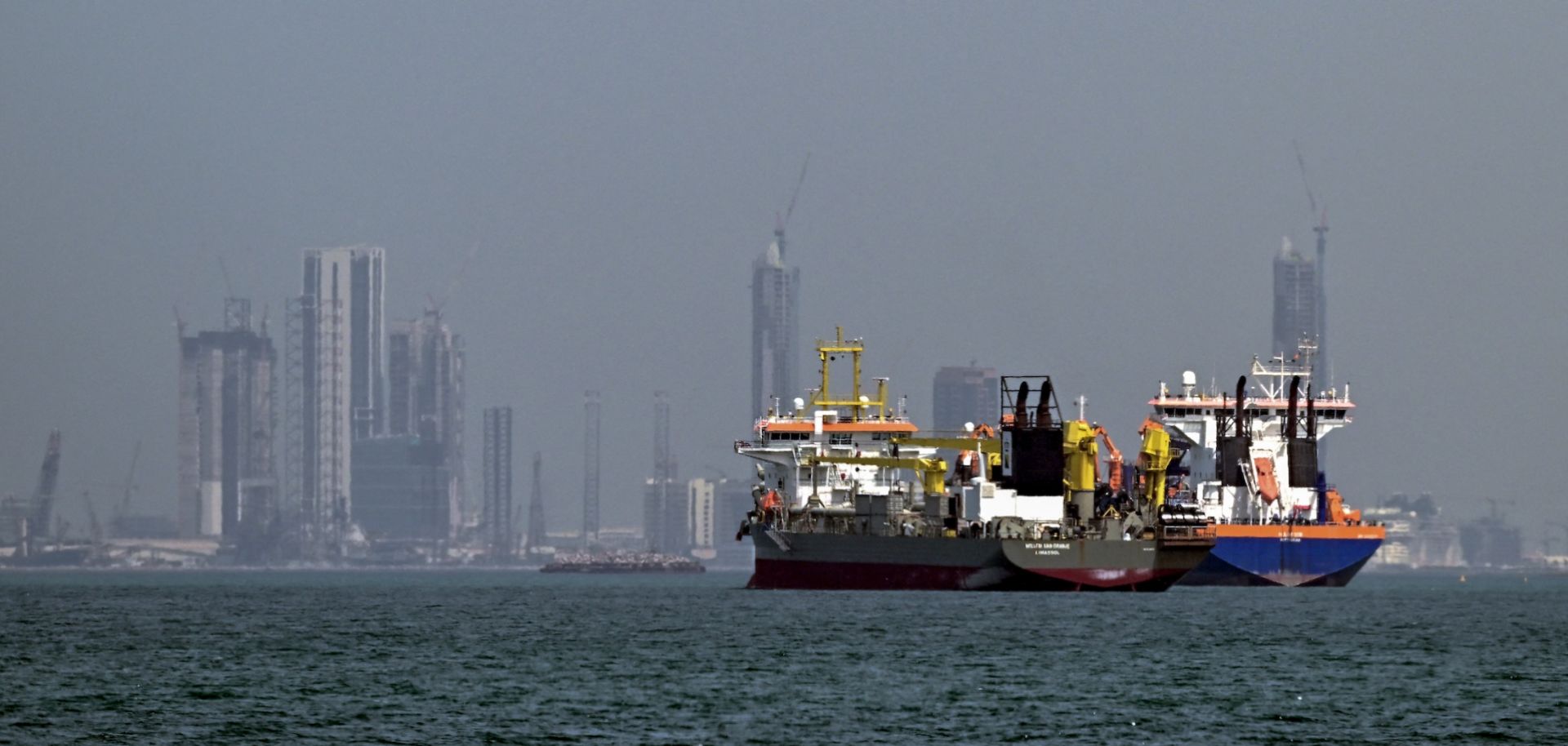
A U.S.-led naval mission to protect ships through the Strait of Hormuz would likely only commence once the intensity of the Iran conflict dies down, and even then, such a mission would take weeks to organize and yield only a limited resumption of shipping, unless a comprehensive de-escalation agreement is also reached. In recent days, U.S. President Donald Trump has been increasing pressure on countries to help secure the Strait of Hormuz, where shipping has dropped over 90% since the U.S.-Israel war on Iran began on Feb. 28. In a March 16 post on Truth Social, Trump called on China, France, Japan, South Korea, the United Kingdom and "others" to send naval vessels to the Middle East. The following day, he said it would be "very bad for the future of NATO" if the alliance's members did not help protect commercial ships transiting the strait from Iranian attacks. But despite Trump recently telling reporters that "numerous countries" were deploying ships to the region, his proposal for an international naval coalition has so far been met with skepticism. While U.S. allies and partners (particularly European ones) have expressed some willingness to send naval assets, their officials have largely been vague regarding the size, scope and timing of any mission directly related to the Strait of Hormuz. China has also been reluctant to participate in any coalition.
- Since the war began in late February, Iran has only allowed a few commercial ships to safely transit the Strait of Hormuz without being attacked. Most of these ships were either carrying Iranian goods or destined for China, Pakistan or India, with their transits likely negotiated with Iran on a case-by-case basis. Iranian officials have floated allowing ships to transit the strait if they register with Iran, ensure their goods will not go to the United States or Israel, and pay for energy products in yuan instead of U.S. dollars. However, few ships would meet these terms.
- For China, deploying ships to the Strait of Hormuz would be a major doctrinal shift, given that its military has sought to avoid entanglement in conflicts abroad.
- On March 16, EU foreign affairs commissioner Kaja Kallas said that while there was a "clear wish" among EU foreign ministers to expand the bloc's Aspides operation (which launched in 2024 to protect Red Sea shipping from attacks by Yemen's Iran-backed Houthi militants), there was "no appetite" to change the mission's mandate (i.e., to expand its focus to the Strait of Hormuz) — something German and Italian officials have expressed doubts about.
Pressure on the United States and other countries to secure the Strait of Hormuz will only intensify in the coming weeks, regardless of whether the warring parties reach a ceasefire or de-escalation agreement. Prior to the Iran war, nearly 20% of the world's oil supply and 20% of the world's LNG supply transited the Strait of Hormuz each year, alongside substantial volumes of petrochemicals, fertilizers, helium, refined oil products and liquefied petroleum gas. If this critical shipping route is disrupted for an extended period, it would thus trigger severe global economic and political repercussions. Already, the prices of many of these goods have increased sharply since the start of the conflict; Brent crude oil, in particular, has risen by more than 40%. However, there is still room for far greater price spikes, as traders appear to be pricing in a quick resolution to the conflict and a resumption of shipping through the Strait of Hormuz within weeks, not months. If it becomes clear that disruptions will persist, prices are thus likely to climb much higher. The United States and Israel may halt their attacks on Iran in the coming weeks, in an effort to reduce tensions. But Iranian officials have indicated this would not lead them to cease retaliatory strikes, potentially including those targeting ships in the Strait of Hormuz, as Iran would aim to ensure any reduction in hostilities is not simply a temporary lull before potential renewed U.S. and Israeli attacks. This means that even if there is a brief de-escalation, the risk of renewed hostilities between the United States, Israel and Iran will remain high. Consequently, the momentum to establish a naval escort mission to safeguard shipping through the Strait of Hormuz will likely continue to grow, even if only a few countries participate.
European governments are unlikely to send naval vessels to the Strait of Hormuz until there is a clear decline in tensions with Iran, or until the Iranian threat has been entirely neutralized. While U.S. allies and partners (particularly European ones) have expressed some willingness to send naval assets, their officials have largely been vague regarding the size, scope and timing of any mission directly related to the Strait of Hormuz. The Iran war is deeply unpopular in Europe, with many viewing the crisis as of the United States' making and thus its responsibility to resolve. Consequently, most European ships sent to the region since the war broke out in February are not focused on securing the Strait of Hormuz, but rather protecting EU member state Cyprus from further Iranian strikes, after the U.K. military presence there was attacked by Iranian drones in early March. Even French President Emmanuel Macron, who appears to be the most hawkish European leader on the need to protect shipping through the Strait of Hormuz, has said the mission should only begin after "the most intense phase of the conflict has ended." This caution stems from the high risk involved, as Iran would likely view any Western U.S. defense partner — even one not supporting U.S. military action against Iran — as a belligerent if they deployed ships to protect commercial traffic, potentially exposing those vessels to Iranian attacks. Countries thus appear highly unlikely to participate in Trump's naval coalition until a broader de-escalation reduces the threat of their ships being directly fired upon. But even if this occurs, it would still take at least a week or two for European navies to redeploy ships from the Mediterranean or Red Sea to the Strait of Hormuz, and longer still for vessels closer to home. U.S. officials have also noted that Iran's Anti-Access/Area Denial (A2/AD) capabilities have not been sufficiently degraded, making naval convoys extremely dangerous until potentially the end of March.
- On March 9, French President Emmanuel Macron announced the French navy would send eight frigates and two amphibious assault ships to the eastern Mediterranean and Red Sea, where they would join France's Charles De Gaulle aircraft carrier strike group. Italy, Spain, Greece and the United Kingdom have also said they were deploying ships to the eastern Mediterranean to protect Cyprus from further Iranian attacks.
- The United Kingdom is reportedly considering aiding countermine measures in the Strait of Hormuz with its drone capabilities, though Prime Minister Keir Starmer has stressed that his country would not be "drawn into a wider Iran war."
Given Iran's extensive drone, mine and missile capabilities, the organization of a naval mission to enable greater transit through the Strait of Hormuz would present several tactical challenges. The first step in carrying out any such mission would be the continuation of U.S. military action designed to significantly degrade or disable Iran's A2/AD capabilities in the areas immediately surrounding the Strait of Hormuz, such as Iranian naval and other military assets in Bandar Abbas and the island of Qeshm north of the strait. However, this mission is proving difficult. While Iran's fixed naval assets, radar stations, port infrastructure and other military targets are relatively easy to identify and destroy, Iran's unmanned aerial vehicles and even some of its short-range anti-ship missile capabilities are mobile, making them far more difficult for the United States to identify and strike. The rugged, mountainous terrain along Iran's southern coastline makes these operations even more difficult, particularly as Iran's drones and missiles have ranges that enable them to be launched from deep inside Iran into the strait. Even in a best-case scenario for the United States, Iran will likely retain significant unmanned aerial vehicle and even unmanned surface vehicle capabilities to use against ships transiting the Persian Gulf.
Once Iran's A2/AD capabilities are deemed sufficiently suppressed, the United States and its allies may need to dispose of any naval mines that Iran has deployed in the Strait of Hormuz and surrounding waters before even considering escort convoys. Iran is believed to have between 6,000 and 8,000 naval mines. U.S. officials have boasted about destroying more than a dozen Iranian minelaying vessels, but it is unclear how many mines Iran has already deployed and how many more it will be able to deploy in the coming weeks, particularly if the conflict persists and Iran becomes concerned that the United States may send warships into the Persian Gulf for a possible amphibious assault on Iranian territory, such as to seize Iran's Kharg Island, which exports virtually all of Iran's oil. Countermine ships are generally small and often lack robust defenses, meaning they would need to be protected either by degrading Iran's attack capabilities or, more likely, by destroyers and frigates, as Iran would have an incentive to try to disable its rivals' ability to demine the strait.
Once a sanitized mine-free corridor is established, destroyers, frigates and cruisers — and potentially even fixed-wing and rotary aircraft at first — would help protect ships as they transit the strait. If convoys do not occur under the auspices of a broader de-escalation of the war, Iran would have an incentive to strike U.S. naval vessels (and the ships they protect) to create an incident that deters shipping companies, insurers and even militaries involved in the convoys from continuing. As a result, the U.S. Navy and any allied militaries would need to offer ships protection. It is likely that only a handful of ships could be protected per cruiser, destroyer or frigate used in such an operation. This low commercial ship-to-military ship ratio means shipping volumes would still remain well below the preconflict level. Even if convoys are organized, high insurance costs and war risk premiums would remain a significant impediment to resuming high-volume shipping. Furthermore, ships protected by these convoys — especially those protected by American naval vessels — could be directly targeted by Iran for their cooperation with U.S. forces.
The United States would struggle to protect ships from Iranian attacks in the Strait of Hormuz alone, absent a massive surge in its own naval presence in the region or a broader de-escalation of the conflict with Iran. While the United States has built up naval assets in the Middle East over the last two months, its overall capacity in theater for a mission to guarantee shipping through the Strait of Hormuz is somewhat limited. Currently, the U.S. Navy has two carrier strike groups (the USS Gerald R. Ford and USS Abraham Lincoln, plus their two Arleigh Burke-class guided-missile destroyers), six independently deployed destroyers, an unknown number of attack and ballistic missile submarines, and a handful of other support vessels in the region. The week of March 9, the United States also ordered the USS Tripoli, an air conflict-focused America-class amphibious assault ship with a complement of STOVL F-35B Lightning II fighter jets, to head to the Middle East, likely with two escort ships. Although the United States may soon have around a dozen destroyers in the region to protect ships, destroyers that are accompanying the Ford, Lincoln and Tripoli are all likely to remain focused on providing layered defense to those ships, even if convoys are organized, given the still likely threat of Iranian attacks on carriers. This means the United States may only have 10 or so ships available for escort duties unless it deploys more ships to the region, so the United States alone could likely only protect one to two dozen ships transiting the strait on a given day, as long as the area remains a combat zone. Meanwhile, the United States also has three Independence-class littoral combat ships equipped with mine countermeasure (MCM) packages based in Bahrain, but two of the ships were reportedly spotted in Malaysia in mid-March, suggesting that the three may have been moved out of the Persian Gulf before the conflict in an effort to protect them from Iranian attacks. While these ships remain nearby and could be made ready to conduct minesweeping operations in the strait, U.S. MCM capabilities could fall short if Iran deploys a large number of mines. By pressing U.S. allies and partners to join, the United States could add more MCM capabilities (through European navies) to sanitize the strait, add more naval vessels to help protect convoys and potentially free up more destroyer capacity to help with sustained counter-A2/AD operations.
- The U.S. Navy has shifted away from traditional MCM minesweepers toward its littoral combat ships, which act as motherships to deploy anti-mine drone technology from a distance. However, this tactical shift is largely unproven in a conflict environment, and the U.S. Navy only began installing the packages on its littoral combat ships in Bahrain in June 2025. Trial operations have encountered many issues with single points of failure, casting doubt on the effectiveness of any countermine operations. For instance, in 2025 one of the ships was unable to retrieve its unmanned surface vehicle after a tow bracket broke.
- The USS George H. W. Bush carrier strike group completed its predeployment training earlier in March and could be deployed to the Middle East, though once ordered to deploy, it would take two to three weeks to arrive. The United States also has more naval assets in Japan that could move to the Middle East if necessary.
Tensions between the United States and its European and Asian allies will grow as Washington demands help in protecting shipping, and even if convoys materialize, shipping volumes will remain very limited, keeping the global economic impact of the conflict high in the absence of a broader deal that allows more shipping to resume. With Israeli and U.S. officials saying that combat operations against Iran could last several more weeks, if not longer, European and Asian nations will likely remain reluctant to quickly agree to a concrete convoy mission with the United States over fears of drawing Iranian drone and missile attacks. The White House will likely grow impatient in the face of this reluctance, potentially leading the United States to threaten retaliation over other issues. Already, Trump announced on March 16 that he would delay his upcoming visit to China by "a month or so," hours after threatening to delay the summit if China did not assist U.S. efforts to organize a convoy. U.S. retaliation against other countries could cover a variety of issues, such as Greenland, trade or support for Ukraine. However, even if the United States successfully cajoles some partners into participating in its convoy project, this participation would likely only augment the U.S. military presence, not multiply it significantly, as the United States maintains the world's most capable blue water navy in terms of both size and capability. As a result, constraints on organizing convoys in large volumes will likely persist, forcing participants to prioritize some ships – most likely LNG carriers, LPG tankers and crude oil tankers – over others less crucial to the global economy, including container shipping and potentially some types of chemicals and fertilizers. A resumption of crude oil shipments through the strait could help stabilize oil prices if volumes are sufficient, but a persistent threat of Iranian attacks on tankers would likely keep the price risk premium above $10 per barrel, and any successful Iranian attack on a tanker or a naval vessel protecting a convoy could lead to a sudden halt in shipments.
