
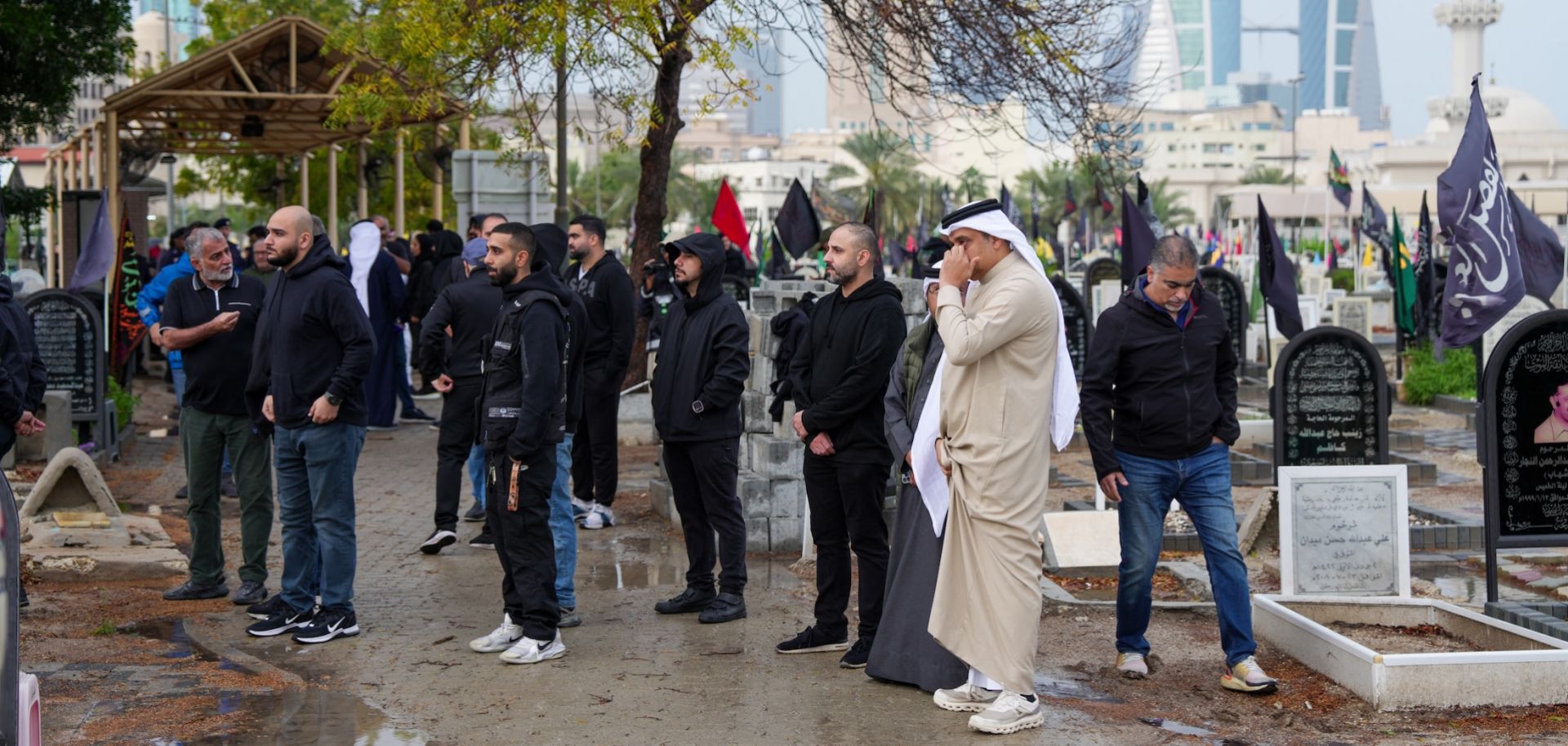
People attend the funeral of a person killed during an Iranian drone attack on a high-rise apartment building in Bahrain's capital, Manama, on March 10, 2026.
(AFP via Getty Images)
People attend the funeral of a person killed during an Iranian drone attack on a high-rise apartment building in Bahrain's capital, Manama, on March 10, 2026.

The Iran war risks fueling sectarian tensions in Bahrain and further straining its economy due to disruptions to energy and aluminum exports. Other Gulf countries may choose security and economic intervention to stabilize the country, with a financial package potentially conditioned on further fiscal consolidation efforts. Bahraini authorities have been cracking down on protesters and government critics following domestic protests after the Feb. 28 assassination of Iranian Supreme Leader Ayatollah Ali Khamenei during U.S. and Israeli strikes against Iran. The protests, a rare instance of civil unrest in the kingdom, have involved at least hundreds of participants from the majority Shiite Bahrain population and extended to cities and villages throughout the country. While the majority of protests were peaceful, some protesters threw Molotov cocktails and clashed with Bahraini security forces, resulting in several dozen arrests. Although Bahraini authorities have limited publicity of the demonstrations, security forces' arrests and government measures obstructing organization efforts appear to have hampered the protest movement. Meanwhile, Iran has attacked Bahrain numerous times in the past 12 days as part of its regional retaliation campaign. Bahrain is a priority target, in part, because it hosts the headquarters of the U.S. Naval Fifth Fleet and due to its ties with both Israel and the United States. Iranian drone and missile attacks have targeted military, civilian, energy and critical infrastructure and caused numerous casualties, including a March 1 attack on the Crowne Plaza hotel in Manama, a March 5 attack on a major oil refinery and a March 8 attack on a desalination plant that caused "material damage."

  • Although Bahrain is ruled by a Sunni royal family, the majority of the population is Shiite. There are longstanding tensions between Bahrain's ruling elites and broad swaths of the population. In addition to being an Iranian political leader, Khamenei was also a spiritual leader for Shiites globally, making his "martyrdom" a flashpoint for Shiites around the world, including in Bahrain.
  • Bahrain's Sunni government has long repressed the majority Shiite population with discriminatory practices, including removing Shiites from office, banning Shiite opposition groups and imprisoning Shiite activists, including on charges related to trying to overthrow the government, thereby fueling popular discontent among Shiites. 

The Iran war has further exposed Bahrain's economic vulnerabilities stemming from its reliance on the Strait of Hormuz to export oil and aluminum products, two of the country's key exports. In addition to Bahrain's demographics, which make it vulnerable to sectarian tensions, Bahrain's high debt-to-GDP ratio and low foreign exchange reserves make its economy more vulnerable to external shocks and regional uncertainty than other Gulf Cooperation Council (GCC) countries. Even though Bahrain has a relatively diversified economy, oil-related activity still accounts for around 15% of GDP. Bahrain relies on the Strait of Hormuz to export oil and aluminum, which makes up a further 12% of GDP. Shipping traffic through the strait has significantly declined following Islamic Revolutionary Guard Corps (IRGC) threats to maritime shipping through the strait. As a result of the attacks and shipping disruptions, several Bahraini companies, including state-owned oil company Bahrain Petroleum Company and Aluminium Bahrain, have declared force majeure. 

  • According to Bahrain's third-quarter 2025 Economic Quarterly Report — the most current update — non-oil activities accounted for around 85% of real GDP, driven by finance, insurance and manufacturing, which combined accounted for around 34% of Bahrain's GDP. 
  • On Feb. 23, Fitch Ratings downgraded Bahrain's credit rating from B+ to B with a stable outlook, citing the increasing government debt-to-GDP ratio — which was already nearing 150% at the end of 2025 — and low foreign exchange reserves, which were estimated to be around 1.3 months of external debt payments. Within the past year, S&P also downgraded Bahrain's rating for similar reasons. Moody's, the other main financial credit rating service, has not rated Bahrain since 2022.
  • On March 2, the IRGC announced that it would fire on any vessels trying to traverse the Strait of Hormuz. Since then, multiple ships have been attacked in the waterway and surrounding waters, though details about the source of most attacks and their damage are limited. As a result of the ongoing conflict and threats, insurance companies have canceled war insurance. Tanker traffic through the strait has decreased by over 90% compared with pre-war levels. 
  • According to the U.K.-based financial services firm Marex, if the Strait of Hormuz were closed for three months, Bahrain's fiscal deficit could grow from 9.9% to 12.6% of GDP.

Bahrain will crack down against sectarian protests stoked by Khamenei's killing and rising anti-U.S. sentiment, though if protests continue to grow, security forces will likely call for expanded Gulf support, though underlying sectarian tensions will remain. Anti-U.S. sentiment stoked by Khamenei's assassination and the continued U.S. and Israeli campaign against Iran will elevate the risk of further unrest while the conflict lasts. Bahrain's Civil Defense Council will likely prolong the government's March 6 ban on public gatherings in streets and open squares — a measure imposed in part to obstruct efforts to coordinate protests — to further mitigate the protest risk and forcibly crack down on violators. However, if protests persist and there are more extensive violent clashes between protesters and security forces, the Bahraini royal family will likely request additional support from the Peninsula Shield Force — the GCC's collective security mechanism — to support security forces in repressing any unrest. Social media rumors suggest that some Peninsula Shield Force had already deployed to Bahrain shortly after protests began, but this remains unconfirmed. Even if so, additional forces would likely be deployed were protests to grow. While a harsh repression of unrest would likely quash protests, underlying sectarian divisions and discontent with U.S. military actions will remain, given the United States' long-term military presence in the country.

  • In March 2011, the Bahraini ruling family requested the assistance of GCC forces to suppress the pro-democracy movement, marking the first time that the Peninsula Shield Force was deployed to quell internal threats. 
  • The internal unrest will likely embolden the hardliner Khawalids, a faction of the Bahraini ruling family that was largely sidelined during Prime Minister Salman bin Hamad al-Khalifa's major Cabinet reshuffle in 2022. The Khawalids have a stronger security-focused governance approach and are influential in the security services.

Shipping disruptions and material damage will disrupt Bahrain's economic activity and likely worsen its debt burden. Although GCC countries will likely provide Bahrain with a financial lifeline to avoid a financial crisis if necessary, they may condition support on Bahrain taking additional fiscal consolidation steps. In addition to the material and infrastructure damage caused by Iranian attacks, disruptions to the Strait of Hormuz effectively close off one of Bahrain's main trade routes, resulting in significant production disruptions for the country's main exports, including energy and metals, which combined accounted for around 75% of Bahrain's exports in 2024, the last fully recorded year of data from the Observatory of Economic Complexity. Some companies, such as Aluminium Bahrain, have tried to find alternative routes for exports. However, Bahrain's geography provides limited alternatives since overland export routes exclusively use the King Fahd Causeway connecting Bahrain to Saudi Arabia, which is subject to congestion and bottlenecks. As such, long-term business disruptions will almost certainly curb Bahraini state revenue and further widen the already concerning government debt-to-GDP ratio and fiscal deficit, in turn elevating concerns over Bahrain's medium-term fiscal sustainability. In the near term, Gulf states — especially Saudi Arabia and the United Arab Emirates — would likely intervene, if necessary, to provide financial relief to Bahrain. Although Gulf countries have recently become more cautious about providing bailouts — prioritizing investments and their own economic diversification — maintaining stability among GCC members remains important. This is largely due to concerns that political unrest, particularly a Shiite uprising, could spread to other Gulf states. As a result, Gulf countries would likely still be willing to offer financial support to Bahrain, as they have previously. Such assistance would likely increase Saudi Arabia's influence over Bahrain in particular. Furthermore, any financial package may include conditions aimed at strengthening Bahrain's fiscal position, such as expanding the tax base and reducing the government's debt-to-GDP ratio.

  • Aluminium Bahrain's statement clarified that force majeure was declared due to shipping disruptions via the Strait of Hormuz, not due to damage to the facilities or an inability to produce, indicating that if shipping routes via the Strait of Hormuz were to reopen, exports would likely quickly resume.
  • In 2018, Saudi Arabia, Kuwait and the United Arab Emirates provided Bahrain with a $10 billion bailout package to prevent Bahrain from facing a credit crunch that could cause a broader financial crisis. 
  • The Iran War will also likely derail Bahraini Prime Minister al-Khalifa's Vision 2030 reform efforts due to increased investor hesitancy as well as damage from the attacks. 
  • The war has exposed Bahrain's vulnerabilities to Iranian drone attacks and will incentivize Bahrain to upgrade its air-defense systems. Bahrain is in discussions with Ukraine to acquire some low-cost drone interceptors that have proven effective against Shahed drones in the Russia-Ukraine War. However, Ukraine has in turn requested access to advanced U.S. defense systems to counter Russia and increased U.S. pressure on Russia to make concessions, which the United States is unlikely to do. Furthermore, major upgrades to Bahrain's air defense systems could add to the government's fiscal deficit and compound its economic troubles. 
RANE
SUBSCRIBERS ONLY

Expert analysis when it matters most.

Get access to RANE's decision-grade geopolitical intelligence.