
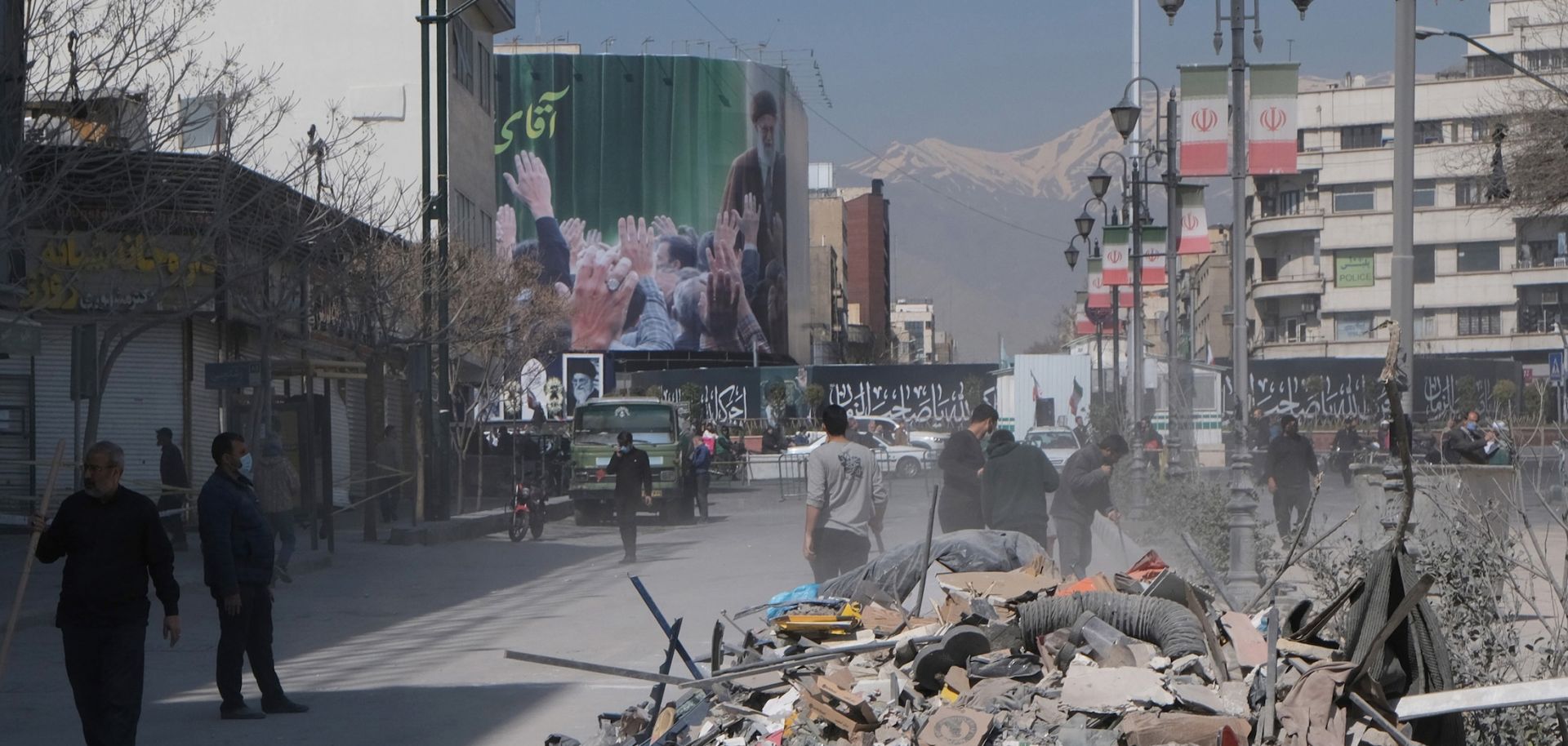
The current trajectory of the Middle East crisis suggests the most likely outcome is a tenuous ceasefire in a few weeks, but a more immediate ceasefire or one that takes longer to achieve is also possible, depending on the level of U.S. political resolve to maintain its campaign against Iran. The joint Israeli-U.S. attacks on Iran that began on Feb. 28 mark the fourth major overt assault on Iranian territory in the past two years, following 12 days of Israeli attacks (which the United States eventually joined) in June 2025 and two rounds of Israeli missile barrages in 2024. Each of these cycles of escalation has resulted in a wider target set and greater regional impact, but each has also ended in an informal ceasefire, either declared overtly or implicitly. Diplomats from across the region and the world are already working on finding a path to try to de-escalate the current crisis, but are encountering strong resistance from the three main participants — with the United States, Israel and Iran all claiming, at least publicly, that they are prepared for a prolonged conflict.
- Media reports from outlets like Bloomberg have suggested that Emirati and Qatari diplomats are seeking de-escalation due to their diminishing stocks of defensive munitions. Their U.S.- and Israeli-supplied air defenses have seen significant usage since the start of the conflict, and resupply is uncertain, given that the United States has been unable to replenish air defenses at scale since the June 2025 conflict with Iran.
- In June 2025, U.S. President Donald Trump unilaterally imposed a ceasefire on Israel and Iran to end the so-called 12-Day War. Despite last-minute violations, both Israel and Iran had, until now, abided by the tenuous truce, as each claimed their campaigns made significant gains. Israel claimed to have heavily damaged Iran's nuclear program, while Iran claimed to have successfully defended the Iranian homeland from direct attack by its archrivals.
As of now, neither side appears capable of accomplishing a conventional military victory, suggesting the conflict will eventually end in another U.S.-led ceasefire. But how quickly that truce is reached will likely depend on Washington's political will. Despite some outward mixed messaging, Israeli and American war goals are primarily focused on destroying Iran's missile stockpiles, damaging its nuclear aspirations and coercing Iran to reduce support for regional proxies. While the United States has not explicitly labelled regime change as a strategic goal, by killing so many Iranian political and security leaders, airstrikes leave open the door for a significant leadership change that aligns with Israeli and U.S. interests or a full-scale regime collapse through a popular revolt. Meanwhile, Iran, though still currently in survival mode, aims to rebuild some deterrence and take revenge for the assassination of its leaders, including Supreme Leader Ayatollah Ali Khamenei. But with neither side sharing a border and there being no imminent sign of a ground invasion, achieving these war goals can only be brought about by imposing enough physical damage and economic harm to break the political will of the adversary, rather than to fully destroy one another's military capabilities or take and hold their territory. For Israel and the United States, their war goals can only be achieved if their air power inflicts enough military and economic damage on Iran to convince its government to offer significant concessions. So far, Iran's remaining leaders have ruled out such concessions, instead hardening their position and taking steps to ensure the Islamic Republic regime's continuity. But the United States has shown some flexibility, defining its war goals broadly rather than with specific missions, which suggests that Washington may declare victory when it suits the United States. However, the timing is highly uncertain, as the United States could declare victory in a matter of days, weeks or potentially even longer, should U.S. political will hold out.
- Iran's attacks on Gulf Arab states are designed to impose economic harm not only on those countries but also on the United States by rattling global energy markets and trade. Iran is also seeking to push the Gulf states to lobby Washington to end the conflict, especially as these countries have emerged as a significant source of foreign investment in the United States.
- The United States and Israel continue to conduct strikes on Iranian leadership in hopes that enough successful assassinations will weaken the government's resolve to continue the fight. But due to Iran's dispersed political structure, these strikes have mostly been disruptive rather than paradigm-shifting.
The most likely scenario is that the United States will impose a ceasefire after it has run through its target set, but before the domestic economic and political repercussions become significant enough to create a crisis for the White House, suggesting the campaign will go on for several more weeks until the war's domestic impact is more intensely felt. In the 12-Day War in 2025, the United States declared a ceasefire after it struck Iran's nuclear facilities, having assessed that its attacks had sufficiently degraded the program to halt hostilities. As the United States aims to weaken Iran's missile and nuclear programs, military capabilities and proxies, it also has a target set it is working through that will eventually be exhausted. This means Washington may again declare a ceasefire once it has assessed that strikes have sufficiently progressed towards those goals. But given the extensive nature of Iran's missile program and the infrastructure supporting its proxies, it will likely be weeks before the United States assesses that enough physical damage has been done to Iran to justify a halt in hostilities. Despite continued energy disruptions and economic damage to Gulf countries, and the depletion of regional air defense munitions, the White House will likely also calculate that it can continue to absorb the domestic fallout and fend off an energy crisis, a stock market collapse and/or a congressional revolt for at least a few more weeks.
- President Trump himself has suggested that the war will only last a few weeks. The Israeli military has assessed it might last until Passover, which begins April 1, and has called up reservists in preparation for a conflict of that length.
- While the conflict is disrupting Gulf energy exports, the U.S. Strategic Petroleum Reserve provides Washington with a buffer to stave off an oil shock. Compared with other countries, the United States is also less exposed to a cutoff of Qatari liquefied natural gas (LNG). Additionally, national gas price averages in the United States were relatively mild, at below $3 a gallon, before the war began, giving the White House more time before the perception of rising prices and their association with the war spur greater political backlash and fears of a coming economic crisis.
- The U.S. stock market has also not experienced a sharp, extended decline, with the S&P 500 remaining largely flat since the attacks began on Feb. 28, as traders bet that the conflict and its economic impacts will be limited.
- On March 4, the Senate is expected to begin voting on a War Powers Act resolution. However, whether the resolution secures the two-thirds majority in Congress needed to override a presidential veto and legally compel the Trump administration to end the war is uncertain, since Republicans control both chambers of the legislature and remain largely united behind Trump's war goals. Some Democratic leaders, like Senate Majority Leader Chuck Schumer, have also not outright called for an end to the war, instead criticizing it on procedural grounds rather than on substance.
While less likely, there is a chance a ceasefire could be reached much sooner if a sudden economic, military or political shock weakens the White House's resolve. A shorter timeline in which a ceasefire occurs in only a few days is unlikely, but could happen in response to several developments. Although U.S. stock market losses and energy impacts have been relatively mild so far, a sudden shock might emerge if Iran destroys a major Gulf Arab energy facility, like Saudi Arabia's crucial Abqaiq oil processing facility, or if Gulf states enter the war against Iran and begin to strike Iran's energy facilities in an escalating series of strikes. A larger, sustained stock market selloff and a surge in bond prices might emerge from such a scenario as well, deepening the sense of crisis and incentivizing a sudden end to the conflict. If Iran successfully launches a major military strike on either Israeli or American forces, it could also hasten a ceasefire by spurring a sense that the costs of the conflict have become too high. The depletion of air defense munitions could do the same by fueling fears that Iran will soon be able to cause significant civilian and military harm. Additionally, it remains possible that Iran's leadership change results in a government that wants an immediate ceasefire, even if only to buy time to consolidate power and restock its depleted arsenal, something Trump would likely seize on. Finally, though still unlikely, the U.S. Congress could pass a War Powers Act resolution with a veto-proof majority that forces Trump to end the conflict, especially in reaction to an economic or military shock.
- President Trump has come under significant criticism for allegedly under-selling the conflict to the American people. He only briefly mentioned the conflict in his recent State of the Union address and has not yet delivered a wartime speech to the nation, breaking precedent with both his first term and that of many other presidents. A Reuters/Ipsos poll conducted shortly after the start of the war found only 27% of Americans backed the strikes.
- Former U.S. President Ronald Reagan withdrew troops from Beirut after the 1983 Hezbollah attacks killed 241 troops. Even Trump has previously backed down from conflict in response to U.S. losses or stalemates, like ending the anti-Houthi campaign in spring 2025 and working to withdraw troops from Afghanistan in his first term.
- Trump has also changed his tariff strategy in response to market impacts and coercive pressure. In the spring of 2025, he reduced the tariff rate on China from 145% to 30% after U.S. bond prices surged and Beijing threatened to restrict its exports of critical rare earth products.
In an even less likely scenario, the United States could sustain an open-ended conflict with Iran for more than a month, but this would most likely be in response to a major Iranian action that kills significant numbers of U.S. civilians or an attack on the U.S. heartland that rallies American support for the war. Despite tepid U.S. popular support for the conflict, political conditions could incentivize a longer conflict if Iran kills a significant number of U.S. civilians (not servicemembers), either in direct strikes, covert ones or through cyberattacks, particularly if such attacks take place on U.S. soil. With the politics of revenge taking hold, the United States would be incentivized to not only conduct more strikes over a longer period but also slowly build up its ground forces in Iran. Additionally, should the Islamic Republic begin to break down under pressure in an unlikely outcome of the war, creating a power vacuum for proxies and rebels, the United States might become involved in a more extended regime-change conflict, either by sending troops or supporting new rebels.
- Despite widespread domestic opposition, the United States became more deeply involved in Vietnam after supposed attacks on U.S. ships in the Gulf of Tonkin in the 1960s. The United States also infamously grabbed onto the destruction of the USS Maine to start the Spanish-American War in 1898, flipping public support in favor of war by doing so.
- Israeli media has suggested that the U.S.-Israeli coalition is seeking Iranian Kurdish support for an uprising in Iran. But if such a strategy is to be viable, it would require open-ended air support to prevent the entrenched Iranian military from retaking these territories.
- Numerous media reports indicate the Trump administration is weighing whether to provide support to various anti-government groups in Iran, with some leaks suggesting the CIA has been in active discussions with Kurdish groups.
Regardless of the timeline for a ceasefire, any detente would be fragile and unlikely to result in a breakthrough between the United States, Israel and Iran on their core differences. Provided that the Islamic Republic survives, Iran will have a strong incentive to remain confrontational regardless of the length of the current conflict. Already, reports indicate that more hard-line elements are replacing Iranian political and security leaders who have been killed. In particular, Khamenei's son Mojtaba, who is widely viewed as a hard-liner, has emerged as the frontrunner to replace his father as supreme leader, a development that would reinforce a confrontational stance toward the United States. Even if there is a temporary detente in direct conflict, this would bode poorly for the resumption of diplomatic negotiations that might achieve a significant breakthrough between the United States and Iran, let alone Israel and Iran, and sustainably de-escalate tensions. Instead, the United States would likely adjust its anti-Iran strategy, such as by pivoting to allowing the Israelis to conduct more open-ended operations or re-centering U.S. pressure via economic isolation. Both conditions suggest that a ceasefire would be temporary and prone to collapse, with another round of Israeli and/or American strikes potentially on the horizon.
- Iran will likely retain its ability to rebuild its drone and missile program after the conflict, as it did after the 12-Day War in 2025, incentivizing Israel and/or the United States to resume strikes in the future.
- As Iran transitions to a new leadership, a hard-line government is more likely to gain legitimacy from further confrontation and provocation with the United States and Israel, a shift that would also incentivize more strikes, particularly if a new government decided to embrace a weaponization of its nuclear program.
