
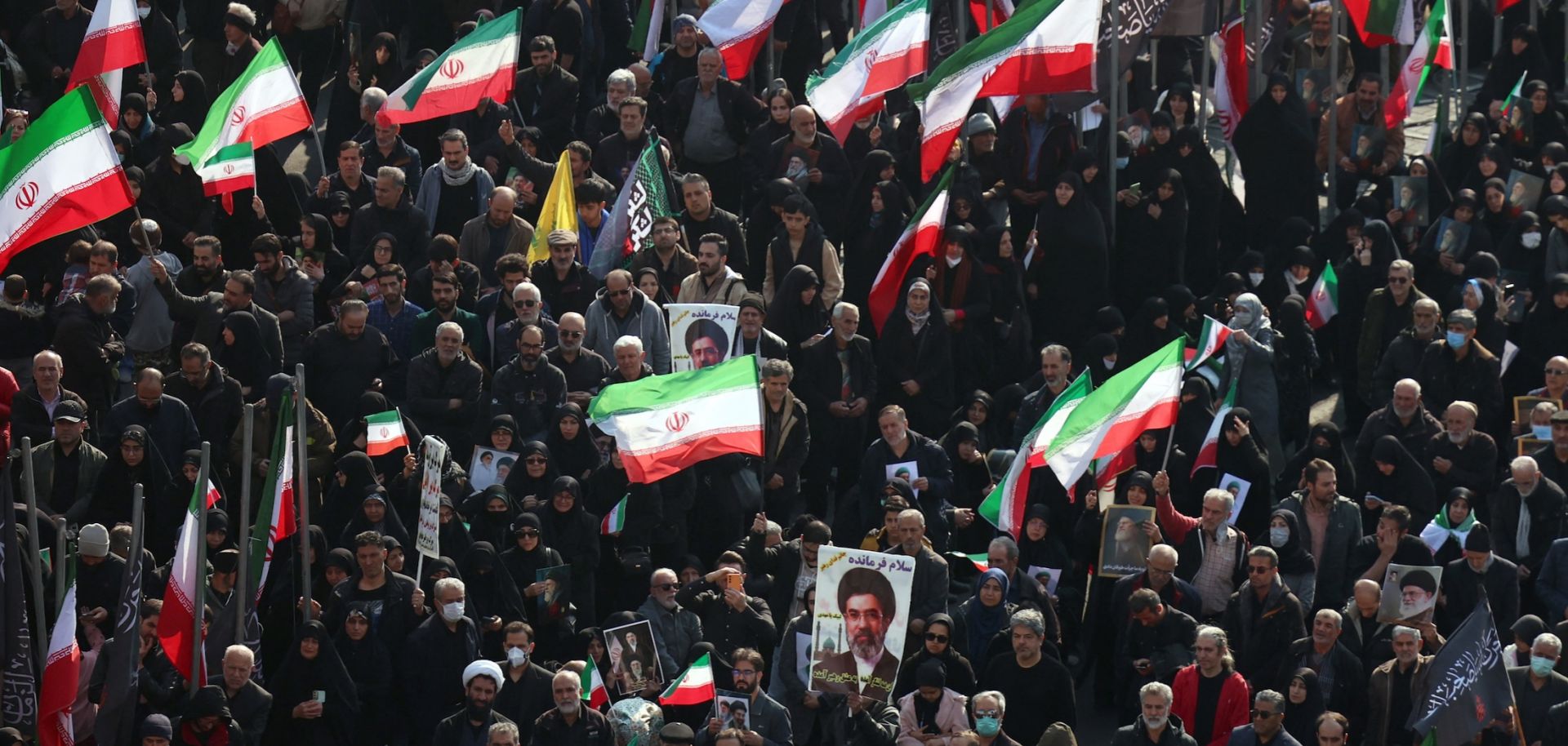
The selection of Mojtaba Khamenei as Iran's new supreme leader will embolden hard-liners, entrench Tehran's resolve to retaliate against U.S. and Israeli attacks, and make potential concessions on Iran's ballistic missile and nuclear programs unlikely. On March 9, Iran's Assembly of Experts, the clerical body tasked with choosing the country's supreme leader, selected Mojtaba Khamenei to succeed his father, Ayatollah Ali Khamenei, who was killed on Feb. 28 during U.S. and Israeli strikes. The assembly subsequently called on Iranians to unite behind Mojtaba, a hard-line, mid-level cleric with deep ties to Iran's powerful Islamic Revolutionary Guard Corps (IRGC). Several key officials — including President Masoud Pezeshkian, Foreign Minister Abbas Aragchi and the secretary of the Supreme National Security Council, Ali Larijani — have since issued statements in support of the decision. However, Mojtaba remains at risk of sharing his father's fate, as Israel previously threatened to kill Iran's next supreme leader, while U.S. President Donald Trump warned that a successor chosen without U.S. approval would not "last long." Following Mojtaba's selection, Trump also said that he was "not happy" with the decision.
- Mojtaba wields significant influence within the IRGC and Iran's security establishment. But unlike his father, who served as Iran's president before becoming the supreme leader, Mojtaba has never been elected to public office. Until now, he has thus lacked a high public profile.
- Prior to Mojtaba's selection as supreme leader, the Israeli military threatened to target the Assembly of Experts members in a post on X, writing, "We warn all those who intend to participate in the successor selection meeting that we will not hesitate to target you either. This is a warning!"
- As Iran's highest authority, the supreme leader is the top decision-maker on all foreign and domestic policies. This individual is also the commander-in-chief of the country's armed forces, including both the military and the IRGC, in addition to serving as a spiritual leader.
Mojtaba's selection will enable Iranian hard-liners to further consolidate power to preserve the regime amid ongoing U.S. and Israeli strikes. Iranian hard-liners have increasingly consolidated their power since the war began on Feb. 28, prioritizing regime preservation. Despite the United States and Israel's expansive strikes, the Iranian system has so far proven resilient, with hard-liners filling high-level military and political positions left vacant by assassinations. The Assembly of Experts' selection of Mojtaba as the supreme leader, which was likely heavily influenced by the IRGC, will further cement this trend. While there are signs of internal disputes between hard-liners and more pragmatic figures, Mojtaba's ascension reduces the risk of larger fractures within the regime by ending succession uncertainty and granting hard-liners broader control over decision-making. Over time, if Mojtaba proves less capable than his father at mediating disputes among different factions, the IRGC may also be able to exert even greater influence with fewer constraints.
- On March 7, President Pezeshkian, a moderate, apologized to Gulf Arab countries that have been targeted by Iran's retaliatory strikes. He stated that Iranian forces had been instructed to limit strikes only to countries that launched direct attacks against Iran. However, Pezeshkian retracted these statements the following day, and Iran has continued its attacks on the Gulf nations.
Mojtaba's ascension will strengthen hard-liners' resolve to continue the war and maintain Iran's nuclear and ballistic missile programs, thereby reducing the likelihood of Tehran making major concessions in any ceasefire agreement or future negotiations. With Mojtaba now at the helm, Iran's political will to continue military operations against the United States, Israel and their regional allies will likely strengthen in the coming weeks. This is unlikely to change even if Mojtaba and/or other senior Iranian officials are assassinated, as the hard-line movement will prioritize regime continuity and likely has succession plans in place that would enable Iran to continue its attacks throughout the Middle East (though Iran's depleted arsenal may constrain the tempo of strikes). Iranian hard-liners' growing influence will likely further embolden the United States and Israel to push for regime change, hoping for a government better aligned with their interests. But with more pragmatic Iranian political elements increasingly sidelined and without a domestic protest movement internally pushing for change, the Iranian regime is unlikely to be toppled. Amid the ongoing U.S. and Israeli attacks, and with a like-minded supreme leader in office, Iranian hard-liners will likely also double down their commitment to preserving the country's nuclear and ballistic missile programs, viewing them as essential for the regime's survival and national security. This means Iran will likely reject any ceasefire agreement resulting from mediation efforts with the United States and Israel that would require significant concessions regarding these programs. Beyond the current conflict, hard-liners' strengthening grip on the Iranian political system also diminishes the prospect of successful future diplomatic engagement with the United States, leaving the door open for additional rounds of U.S. and/or Israeli attacks.
- According to The Washington Post, a U.S. National Intelligence Council report issued about a week before the Feb. 28 attacks assessed that even a large-scale attack against Iran's regime was unlikely to collapse it.
- Khamenei was widely believed to have impeded hard-liners' push to acquire a nuclear weapon. The supreme leader's death and replacement by his son, combined with the IRGC's growing political influence, may thus heighten the possibility of Iran pursuing nuclear weapons as a deterrent against future attacks — a development that would further elevate the risk of future conflict with Israel and/or the United States.
