
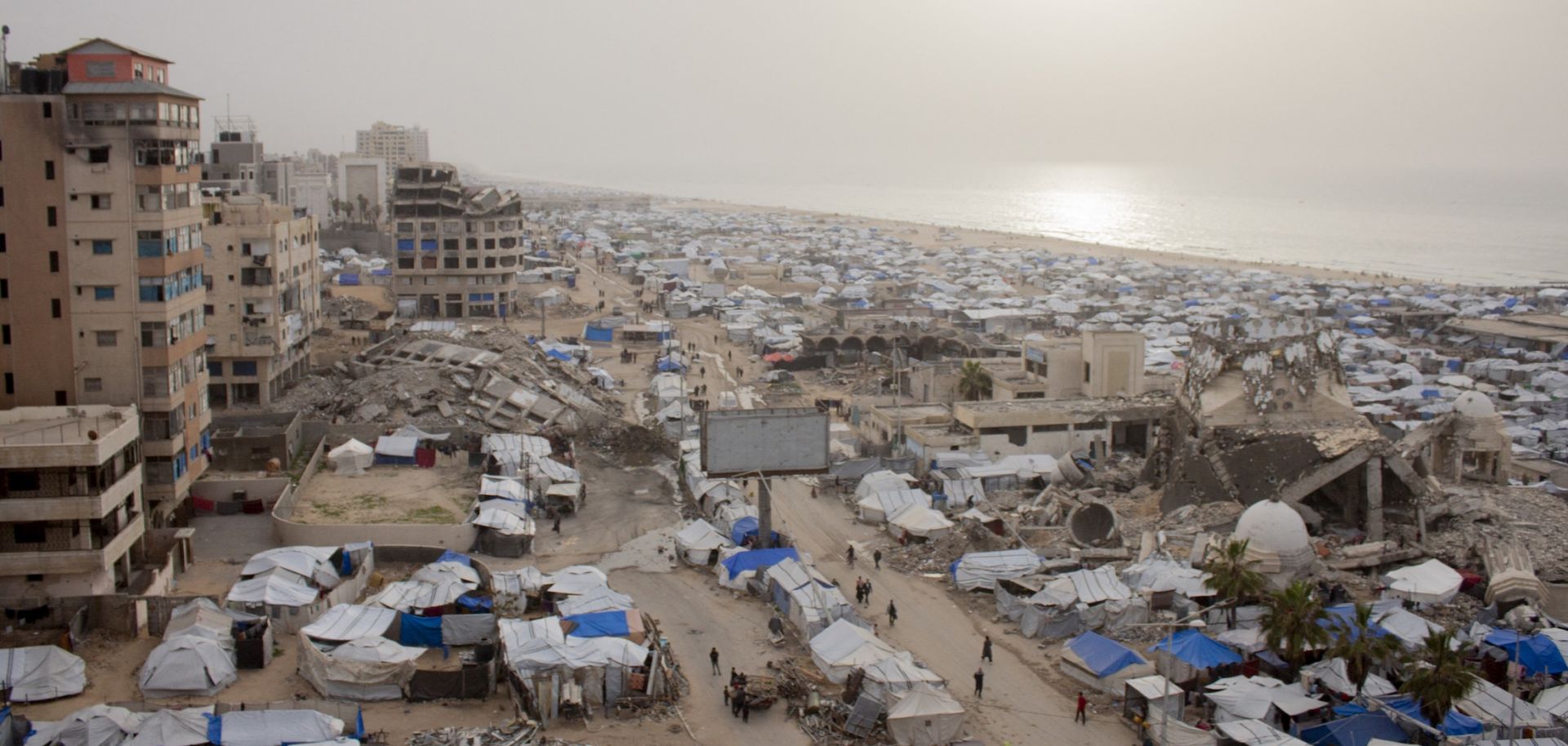
The United States is unlikely to give Israel an open-ended commitment to renew war in Gaza in the near term, which will complicate the Israeli government's re-election path and the sustainability of its Gaza strategy to eject Hamas from the Strip. On Feb. 19, the United States formally inaugurated President Donald Trump's "Board of Peace," an initiative whose main goal is to design post-war policy for Gaza. The board is meant to cap off Trump's pledge to end the war in Gaza and reconstruct the battered Strip. Still, it comes on the backdrop of continued fighting between Israel and Hamas in the territory and deep uncertainty over the viability of reconstruction. Meanwhile, Israel has shown little interest in Trump's overarching vision for peace in Gaza. Although Israel dispatched representatives to the Board of Peace's unveiling, Israeli officials have consistently signaled a divergence with Washington over how to approach Gaza. Israel prefers to exert more military pressure to force Hamas into exile. In contrast, the White House has preferred to stagger such pressure, pushing for ceasefires and diplomacy to extract concessions from Hamas, like the return of hostages and eventually its dissolution as a governing entity in Gaza.
- In January, The Times of Israel reported that Israel was preparing an offensive against Gaza City and other areas of the Strip that the IDF has so far avoided, driven by concerns that Hamas may be holding the remaining hostages in these areas, as well as the Israeli government's skepticism that the group will voluntarily disarm and seek exile. However, in February, The New York Times reported that the United States was prepared to allow Hamas to keep its light arms until later stages in the peace process.
- Israel opposes Hamas retaining arms, partially because of the group's regenerative capabilities. Hamas came back from years of Israeli suppression in the First and Second Intifadas to eventually win the 2005 Palestinian legislative elections and take control of Gaza in 2006, and has since routinely bounced back from recurrent wars with Israel.
Since the Gaza ceasefire entered force in October, the United States and Israel have held differing views on the urgency of disarming Hamas, with Washington prioritizing stability and Israel favoring continued military pressure. Gaza was a centerpiece of Trump's campaign pledge to end wars and bring about a new era of global peace. This drove him to impose a ceasefire in September 2025, despite Israeli concerns over the lack of a clear path for Hamas to give up its role in the Gaza Strip. Due to Israel's heavy reliance on the United States for direct military and economic aid, as well as coordination against Iran, Prime Minister Benjamin Netanyahu's government ultimately had little choice but to comply with Trump's demand for a quick truce. However, Israel has since sought to undermine the ceasefire, including by maintaining its positions in Gaza that have left it in control of approximately half of the territory. Israel has also aggressively enforced security zones around this buffer zone, which has killed up to 600 Palestinians since the ceasefire entered force in October. Hamas officials, meanwhile, have sent conflicting messages in an effort to exploit differing Israeli and U.S. positions regarding Gaza's future. The group has signaled a willingness to discuss a post-Gaza role, while simultaneously refusing to commit to fully disarm and move into exile. By suggesting a readiness to cooperate on securing the Strip, Hamas is seeking to convince Washington that it is Israel, not Hamas, who is standing in the way of lasting peace in Gaza.
- The Israeli government's primary war objective in Gaza remains removing Hamas from the Strip in retaliation for the group's Oct. 7, 2023, attacks on Israel. But the government has been far more vague regarding its plans for Gaza's governance once Hamas is expelled. Some far-right ministers, like National Security Minister Bezalel Smotrich, are pushing for a permanent occupation, while other right-wing ministers prefer to hand off authority to another Palestinian power. Many Israeli military leaders and citizens remain very wary of reoccupying Gaza after Israel's 1967-2005 occupation failed to defuse security threats in the Strip.
- Khaled Meshaal, Hamas' de facto leader and political wing head, rejected disarmament as recently as February, saying such steps would only enable further Israeli encroachment on Palestinian territory. Instead, Meshaal offered a 5-10 year truce with Israel to negotiate an end to Israeli occupation that might then lead to Hamas' disarmament. Hamas spokesman Hazem Qassem also recently said that the group would be open to an international force that temporarily separates Hamas and Israel in Gaza, though only if Hamas retains the ability to govern its portion of the Strip without interference.
The United States is unlikely to greenlight another major Israeli campaign in Gaza in the near term, though a limited operation remains possible after U.S.-Iran tensions de-escalate. With its diplomatic and military efforts in the Middle East now focused on Iran, the White House is less interested in the immediate future of Gaza beyond holding together the ceasefire to maintain the legitimacy of Trump's Board of Peace. Domestic U.S. politics also play a role because the Gaza war is unpopular among both Democrats and Republicans, and criticism of Israeli military actions is increasing just ahead of the U.S. midterm elections in November. Even as Israel prepares for a resumed campaign in Gaza, it too is awaiting the outcome of the current U.S.-Iran confrontation, which could require the use of significant Israeli air assets and trigger Iranian ballistic missile attacks against Israel. Once U.S.-Iran tensions eventually de-escalate, through force and/or diplomacy, the United States will be able to refocus on Gaza, providing Israel with another chance to seek support for a renewed conflict. But while the White House may greenlight a limited operation against Hamas (especially if the United States and Israel believe that their confrontation with Iran has further isolated the group), Washington remains unlikely to support another disruptive, widespread campaign that results in significant casualties.
- American support for Israel's strategy in Gaza has declined, particularly among independents. An October 2025 Pew poll found that 39% of Americans thought Israel had "gone too far" in its operations in Gaza (up from 27% in late 2023), while only 16% said they believed that Israel's approach was the right one.
- Nevertheless, the White House is staffed with Israel hawks, including Secretary of State Marco Rubio, Secretary of Defense Pete Hegseth and Trump himself, who strongly believe in Israel's security on a personal level. Even as the White House grows concerned about public opinion of Israel, it also appears committed to long-term backing for Israel's overall security. This makes the administration receptive to Israeli arguments that Hamas' refusal to disarm undermines the goals of Trump's Board of Peace, thereby warranting resumed military action against the group.
Even with another campaign, Netanyahu's government will struggle to fully defeat Hamas before Israel's October 2026 election, which could result in a new government that adopts a more pragmatic Gaza policy. Even if the United States backs Israel's most optimistic timeline for an offensive in March, the operation would still face significant logistical and political hurdles. While the Israeli military could seize territory, maintaining control would require a large-scale mobilization of additional troops and economic resources, both of which would prove politically difficult ahead of the October elections. With some 2 million Gazans, Israel would likely need up to 40-60,000 troops (at around 35-55 civilians per soldier) to sustain a credible occupation force, far exceeding the estimated 10,000-20,000 Israeli troops currently deployed in the West Bank. To maintain such a force, Israel would also need to draw on emergency funds in its wartime budget, after the government began reducing defense spending this year to improve economic performance ahead of the election. But even if Netanyahu's government secures the troops and funding, another large offensive would likely just push Hamas back underground in Gaza. Hamas' leadership abroad in places like Qatar would also be harder to target following Israel's diplomatically disastrous attack on Hamas targets in Doha in September 2025. As a result, Hamas may still be able to survive as an insurgent force through the Israeli elections in the fall. By then, public sentiment toward the war might sour, making it harder for the Netanyahu government to assemble a fresh coalition. This could, in turn, open the door to a new government that, while potentially still right-wing, would be less focused on Netanyahu's maximalist approach to Gaza and more inclined to agree with the U.S. view that Hamas can retain some presence in the Strip alongside Israeli, Palestinian and international forces.
- Hamas leaders like Khaled Mishaal are still in Doha, where they are protected by not only the Qatari government but now implicitly by the United States, which offered Qatar a fresh defense guarantee following Israel's airstrike in the fall.
- Former Israeli prime minister and right-wing leader Naftali Bennett is currently polling competitively with Netanyahu's coalition. During his brief tenure as prime minister (June 2021-June 2022), Bennett refrained from major escalations against Gaza and acted pragmatically, if hawkishly, against Iran. This contrasts with his more right-wing rhetoric on the campaign trail, including suggesting that Netanyahu's strategy has enabled Hamas' survival.
