
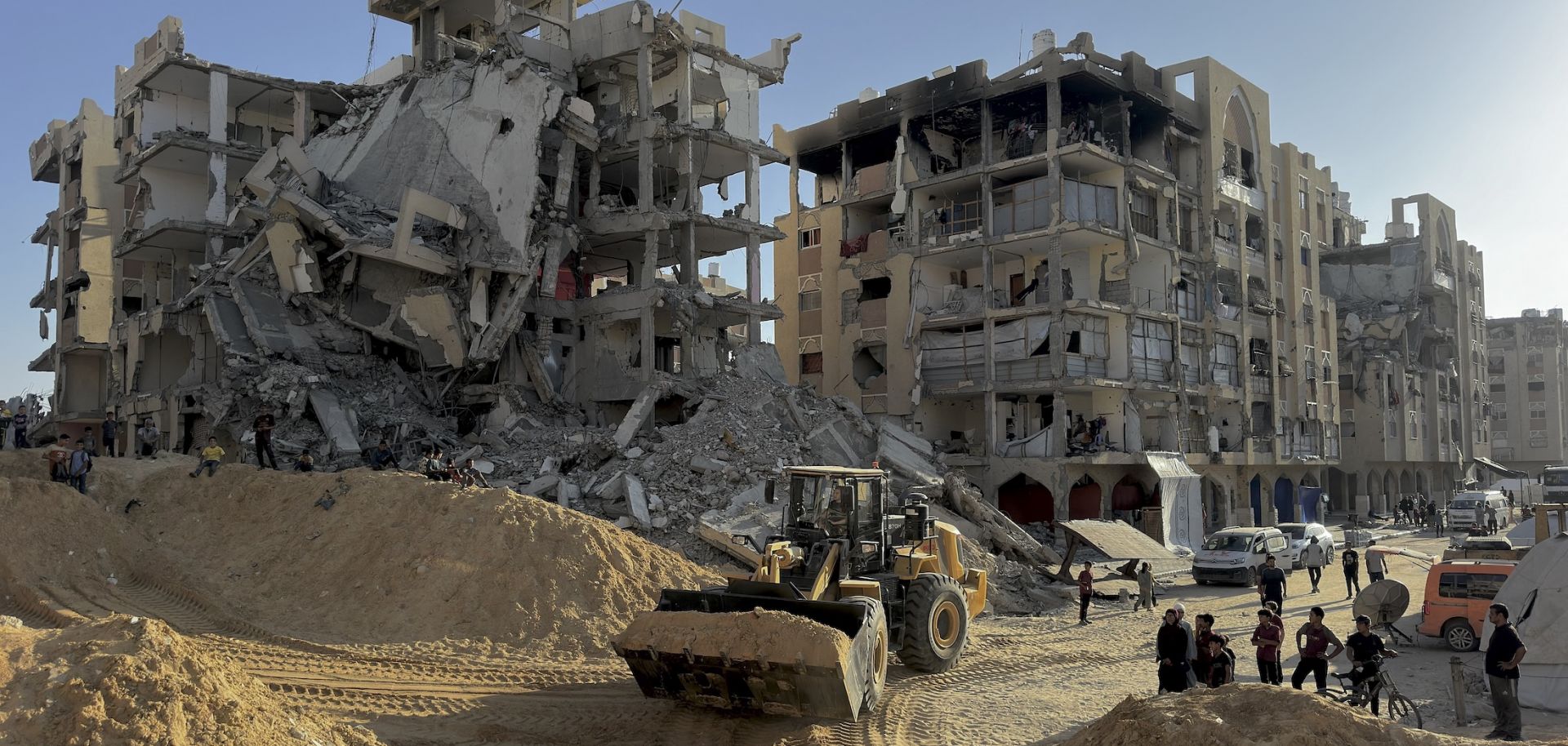
The reconstruction of Gaza will be slow because of conditions on governance by donor countries and security and investment risks, which will likely fuel radicalization and emigration from the Strip. Multiple plans for Gaza's reconstruction have been presented since the Oct. 10 Gaza ceasefire entered into force. On Oct. 16, Mohammed Mustafa, the prime minister of the Palestinian Authority, announced that the Palestinian Authority had formed a $67 billion five-year plan to reconstruct the Gaza Strip, which would require foreign funding. Initially, the plan would focus on increasing humanitarian aid in the Strip but would later expand to reconstruction. Separately, in late October, an Israeli official suggested that reconstruction in the Israeli-controlled portion of the Gaza Strip could begin immediately, implying that there could be dual paths to reconstruction, with quicker progress in the Israeli-controlled area. U.S. and Israeli officials have ruled out allocating reconstruction funds to the Hamas-controlled areas of the Strip.
- U.S. President Donald Trump's 20-point plan, which laid out the framework for the first phase of the ceasefire, mentioned reconstruction only vaguely, with many details requiring additional negotiations.
- As part of the first phase of the ceasefire, the Israel Defense Forces (IDF) withdrew to the so-called "Yellow Line," which divides the Gaza Strip into Hamas-controlled and Israeli-controlled territories. Significant gaps between Hamas and Israel to advance the ceasefire process remain, including disputes over Hamas's disarmament and the future of Gaza governance. However, if the ceasefire progresses to the second phase, the IDF would be expected to fully withdraw from the Strip.
- The projected cost of the Palestinian Authority-backed reconstruction plan largely aligns with independent estimates for the cost of rebuilding Gaza. In November, the United Nations Development Program, World Bank and European Union estimated that rebuilding the Gaza Strip would be a multi-year endeavor costing around $70 billion.
Gulf Arab states have participated in discussions on post-war Gaza governance and reconstruction to influence the future of the region and to appeal to pro-Palestinian populations, but have made few significant commitments. Preliminary discussions for post-war Gaza governance and reconstruction have included several Middle Eastern and European countries, with the United States looking toward Gulf Arab states — particularly Saudi Arabia, the United Arab Emirates and Qatar — to provide most of the funding for the reconstruction process. Many Middle Eastern countries have participated in these discussions not only to influence the future of Gaza — with some advocating and conditioning reconstruction aid on Hamas's disarmament and establishing a credible path toward Palestinian statehood — but also to appeal to their pro-Palestinian populations, many of whom have criticized their governments' responses to the Hamas-Israel conflict. While many Middle Eastern countries, including Turkey, Jordan and Saudi Arabia, are providing humanitarian assistance to Gaza, securing commitments for the far costlier task of reconstruction has been more challenging.
- Several Middle Eastern and European countries have participated in airdrops to distribute humanitarian aid into the Strip, in addition to supporting efforts to increase the flow of aid overland.
- The cost of providing emergency humanitarian assistance, such as food, medicine, fuel and temporary shelters, is a fraction of the more substantial cost of reconstruction. According to the Palestinian Authority-backed plan, addressing urgent humanitarian needs requires $3.5 billion. Long-term recovery and reconstruction would cost over $60 billion.
Gulf donors will reject providing reconstruction aid to a partitioned Gaza to avoid the perception of endorsing an Israeli attempt to divide the Strip. A prerequisite for substantial reform efforts is the stabilization of the Gaza Strip and a viable path toward governance. Saudi Arabia and the United Arab Emirates have predicated any reconstruction support on a plausible path to Palestinian statehood and the disarmament of Hamas, details that are supposed to be negotiated for future phases of the ceasefire. However, according to several European officials, negotiations for the second phase of the ceasefire have stalled, resulting in a de facto partitioned Gaza. If the Strip remains divided, many Middle Eastern countries will reject providing development assistance to the Hamas-controlled and the Israel-controlled portions. Some countries that have provided support to Hamas, such as Qatar and Turkey, would likely be amenable to providing support to the Hamas-controlled side. However, others, such as Saudi Arabia and the United Arab Emirates, would refuse out of fear of strengthening Hamas. On the other hand, providing reconstruction aid to the Israel-controlled side would likely appear as colluding with the Israeli government to divide the Strip and risk public backlash. Over time, Israel would face increasing international pressure to significantly improve living conditions in the Strip, particularly the section it controls, which it would be unlikely to do.
If Gaza is not partitioned, many countries would still resist providing aid to a Hamas-led government, while a Palestinian Authority-led government would face demands to reform and challenges to securing reconstruction funding. Many countries would be concerned that aid to a Hamas-controlled Strip would be misappropriated and used to strengthen the group, risking additional clashes with Israel and regional instability. As for the Palestinian Authority, the Netanyahu government has rejected it taking over the Strip. While the Palestinian Authority would likely garner the most international support for a Palestinian-led government, longstanding rifts exist between Palestinian Authority President Mahmoud Abbas and Gulf Arab countries over issues of alleged corruption and mismanagement, even though there have been some signs of warming ties. Gulf Arab states would likely demand anti-corruption and transparency reforms from the Palestinian Authority as a condition of providing reconstruction aid to Gaza. Implementing reforms will take time and, therefore, slow reconstruction efforts.
- Saudi Arabia, France, Spain and Norway committed to providing $200 million monthly to the Palestinian Authority to offset the revenue loss of Israeli Finance Minister Bezalel Smotrich freezing the transfer of funds, though only for a six-month period.
Global cuts to foreign assistance and Gulf states' increasing prioritization of investment opportunities instead of bailouts will further hamper reconstruction funds, especially while significant security and investment risks in Gaza remain. Even if the obstacles to Gaza governance were overcome, funding and logistical challenges to Gaza reconstruction would remain. For one, aid disbursement patterns have changed. Although European countries and the United States are likely to provide some rebuilding assistance to Gaza, the Trump administration has cut development aid across the globe. Similarly, in recent years, European countries have cut development assistance in favor of funding domestic priorities. Gulf Arab states have increasingly preferred investing in development projects rather than providing bailouts. While Gaza's political and symbolic importance, especially to Gulf Arab states' populations, may overcome some of these investment preferences, substantial concern that reconstruction efforts could be undermined by renewed violence will remain. Saudi Arabia has curbed international spending in favor of advancing domestic priorities such as its Vision 2030 plan. As such, if other obstacles were overcome, Gulf Arab states would be likely to provide some reconstruction aid, though less than the total needed. In addition, other countries, including Syria and Lebanon, are also seeking reconstruction funds, which will likely strain the resources Gulf Arab countries can allocate to Gaza. While Syria and Lebanon both have security risks and reform needs, they have more developed economies and infrastructure than Gaza and therefore carry lower investment risks.
- According to a June OECD report, global official development assistance is forecast to drop by between 9% and 15% in 2025 due to cuts by Western donors, including the United States, France, Germany and the United Kingdom.
- In October 2024, the governor of Saudi Arabia's Public Investment Fund announced that the fund would cut overseas investment from around 30% of its holdings to 18% in order to support domestic projects, especially those affiliated with Vision 2030.
The years-long reconstruction process portends a prolonged period of dire conditions in Gaza that will likely fuel the emigration of Gazans. The reconstruction process in Gaza will likely be a lengthy, challenging process, likely extending years beyond the Palestinian Authority's projected five-year timeline. The reconstruction of Gaza will provide some economic opportunities, especially for businesses in the construction, security and energy sectors. However, many companies will be unwilling to support Gaza's reconstruction process due to the security and reputational risks of cooperation and coordination with Israel and the United States, which would be even more problematic if the Strip was partitioned. As a result, the living conditions in the Gaza Strip will remain poor for years to come. A lack of access to healthcare, persistent food insecurity and a lack of economic opportunities will likely fuel the displacement of Palestinians out of the Gaza Strip. Resentment from the effects of war, dire humanitarian conditions and the extended timeline for reconstruction will likely fuel future radicalization in the Gaza Strip, especially if Palestinian militant organizations use limited aid as leverage to boost recruitment efforts.
- Trump's ceasefire plan prohibits the forceful removal of Palestinians but includes provisions to allow the movement of Gazans in and out of Gaza with the Israeli military's approval.
- According to the Palestinian Bureau of Statistics, the population of Gaza decreased by around 10% between the October 2023 start of the Hamas-Israel war and July 2025 — a figure that has likely grown since due to further fighting, malnutrition and disease.
