
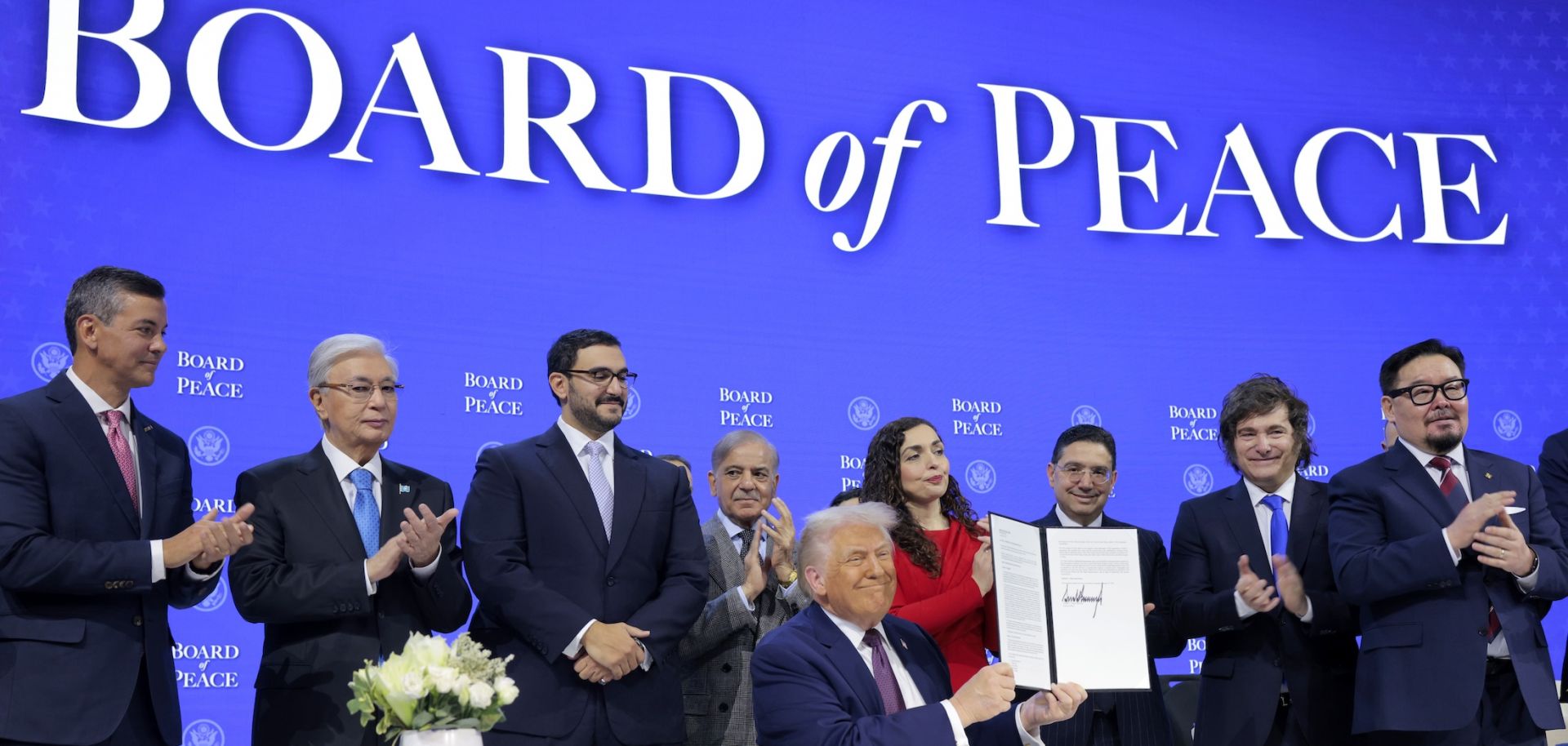
The U.S.-led Board of Peace's immediate priority will be expanding aid in Gaza, but internal divisions, international skepticism and Israeli interference will likely undermine its effectiveness; if the ceasefire collapses, greater Israeli control of the Strip will likely also prevent further political transformation. On Jan. 22, U.S. President Donald Trump formally unveiled the Board of Peace at the World Economic Forum in Davos, Switzerland. The nearly three dozen countries on the board include Saudi Arabia, Egypt, Israel, Argentina, Kosovo, Indonesia, Turkey and Qatar. The Board of Peace will provide high-level oversight to the National Committee for the Administration of Gaza (NCAG), a Palestinian-led technocratic committee tasked with managing the day-to-day operations within Gaza, and will support mobilizing resources for reconstruction and development. Each country participating in the Board of Peace will have a vote on decisions, which will be made with a simple majority. However, the board's charter stipulates that all decisions are subject to the approval of the chairman, Trump, who also has tie-breaking powers. Additionally, Trump can only be removed from the position if he voluntarily resigns or if there is a unanimous vote of the Executive Board that he is incapacitated.
- Trump first announced the formation of the Board of Peace on Jan. 14. The following day, U.S. special envoy to the Middle East, Steve Witz, announced the start of the second phase of the October 2025 Hamas-Israel ceasefire.
- In November 2025, the U.N. Security Council adopted Resolution 2803 and supported Trump's 20-point peace plan as a framework to end the Hamas-Israel conflict. Part of the resolution included the mandate for the Board of Peace as a transitional governing body over the Gaza Strip. The U.N. Security Council authorized the Board of Peace through 2027 to administer Gaza, facilitate the demilitarization of the Strip and support reconstruction efforts, though that mandate could be extended.
- Trump invited around 60 countries to participate in the Board of Peace. Countries willing to pay $1 billion will have permanent appointments, while those that do not pay will serve a fixed three-year term.
- Ali Shaath, a former Palestinian Authority (PA) deputy minister, will lead the NCAG, which also includes some other former PA officials. Hamas and the PA agreed to the NCAG in late 2025, and Israel vetted the committee members. Senior Hamas official Bassem Naim called the NCAG's formation "a step in the right direction." He also said that Hamas was prepared to transfer administrative duties to the transitional government.
The establishment of the Board of Peace and the NCAG signals that the implementation of the Gaza ceasefire is advancing, though the truce is still fragile. The first phase of the Gaza ceasefire primarily centered on halting major fighting within Gaza, increasing humanitarian aid in the Strip and a partial Israeli withdrawal to the Yellow Line (which effectively divides Gaza into two territories, with one controlled by Hamas and the other controlled by Israel). The second phase pushes Hamas' disarmament and a full Israeli withdrawal from Gaza. It also involves installing a transitional Palestinian-led government in Gaza, which aligns with the creation of the Board of Peace and the NCAG. But while Trump announced the start of the ceasefire's second phase, aspects of the first phase remain unresolved, such as the opening of the Rafah border crossing to allow the movement of Palestinians in and out of Gaza and Hamas' return of all of the hostages. Additionally, since Oct. 10, Israel has sporadically conducted attacks against alleged Palestinian militant targets throughout Gaza, indicating that while military operations have slowed, they have not fully ceased. Further complicating matters is Hamas' resistance to disarmament. Israel has given the group a two-month deadline to fully disarm, which began with the formation of the Board of Peace and the creation of the technocratic government in Gaza. However, Hamas appears unlikely to meet that deadline, raising the risk of the ceasefire collapsing. Meanwhile, a Jan. 11 Times of Israel report indicated that the Israeli military has prepared contingency plans for a March offensive in the Gaza Strip, which would primarily involve expanding operations in Gaza City to further solidify Israeli control over the Strip.
- Hamas officials have denied allegations that the group intends to play a role in Gaza's governance following the complete transition of administrative responsibilities to the NCAG. However, Israeli officials are reportedly still concerned that Hamas will take steps to rebuild and strengthen its capacity.
- During a Dec. 29 meeting at Mar-a-Lago, Trump reportedly convinced Israeli Prime Minister Benjamin Netanyahu to advance the Gaza ceasefire, despite Israeli skepticism of the likelihood of Hamas's disarmament. After the meeting, Trump vowed that Hamas would have "hell to pay" if it did not disarm.
Key countries will likely refuse to join the Board of Peace due to concerns about the potential overreach of its U.N. mandate, which, combined with the board's limited resources and internal disputes, could undermine its effectiveness. The Board of Peace is required to update the U.N. Security Council on its actions and progress every six months. But Trump's recent statements alluding to the possibility of replacing the United Nations have raised concerns that the Board of Peace may act outside its U.N. mandate and undermine the international body's authority. These concerns have been raised by several key geopolitical stakeholders, including Western European countries and China. While many of these countries share the Board of Peace's broader aims regarding the Hamas-Israel conflict, most are expected to refrain from backing it, at least until the board's future direction becomes clearer. For other countries, however, Trump's positioning of the Board of Peace as an alternative to the United Nations may be precisely part of its appeal, especially for countries that lack permanent representation and veto power in the U.N. Security Council. Thus, the Board of Peace will likely have mixed support from the broader international community in the short term. That said, the Board of Peace remains highly unlikely to ever replace the United Nations. For one, it does not have anywhere near the same level of resources. Its membership is also large and includes countries with diverse ideologies and strategic goals, which will raise the risk of infighting that could further undermine the board's effectiveness.
Israel is highly likely to wield significant influence over Gaza governance, not only through its role on the Board of Peace, but through its military presence and control of coordination within the Strip. Netanyahu initially criticized membership in Trump's Board of Peace, saying that it was "not coordinated with Israel" and was "contrary to [Israeli] policy." But Israel ultimately joined the board, likely partially in an effort to appease Trump. Israel's decision was likely also driven by a desire to counter the influence of Middle Eastern nations on the board, such as Saudi Arabia, Egypt and the United Arab Emirates (which have all been critical of Israeli military actions in Gaza), and especially Turkey and Qatar (which have previously provided support to Hamas). Despite some tensions between Netanyahu and Trump, Israel-U.S. ties remain close, which will likely give Israel expanded influence over the U.S.-led endeavor, especially since Trump will have special powers as chairman. Furthermore, Israel's military presence in Gaza — combined with the international community's reliance on Israeli coordination for aid delivery, movement in and out of the Strip, and vetting NCAG personnel — gives it substantial leverage. If the board of Peace or the NCAG pursues policies in Gaza contrary to Israeli priorities, Israel will likely use this leverage to obstruct humanitarian aid flows, impose vetting obstacles for entering and exiting the Rafah border crossing, and decrease international cooperation. While such measures could raise U.S.-Israel tensions, the Trump administration is highly unlikely to pressure Israel by threatening to suspend or cut military aid. Additionally, although some NCAG members appear to have distanced themselves sufficiently from their past PA roles to pass Israel's vetting process for the final 15-member committee, the Netanyahu government has consistently opposed the participation of any Hamas or PA members in Gaza's governance. Consequently, it will be extremely challenging to find a significant number of non-affiliated Palestinian civil servants and police officers who meet Israel's vetting standards to support and implement the committee's agenda. This could ultimately undermine the NCAG's effectiveness and create security gaps due to inadequate staffing.
- Turkey-Israel tensions stem from Ankara's criticism of Israeli actions in Gaza and the greater Middle East, and Turkey's expanding influence over the interim Syrian government, which heightens Israeli security concerns.
- On Dec. 25, Israeli Defense Minister Israel Katz said that Israel "will never leave" the Gaza Strip. He stated that Israel would maintain a permanent military presence there and establish a wide security buffer zone around Gaza. Katz also controversially suggested that at some point, Israel would establish Nahal outposts in Gaza that combine military service with community building. He later clarified that these outposts would only be used for security reasons, though they are frequently regarded as precursors to Israeli settlements.
- Israel prohibited more than three dozen international aid organizations — including Doctors Without Borders — from operating in the Gaza Strip beginning on Jan. 1 due to noncompliance with Israel's new vetting requirements, which mandate the disclosure of personnel and funding information.
- The NCAG chair announced the Rafah border crossing will open from Jan. 24-31, a move Israel has yet to confirm and previously resisted despite U.S. pressure.
The Board of Peace and the NCAG will likely first focus on expanding humanitarian aid in Gaza to improve living conditions and, in turn, boost the NCAG's domestic legitimacy. The Board of Peace and the NCAG will likely soon take over aid delivery and disbursement in Gaza, replacing the sidelined United Nations Relief and Works Agency for Palestine Refugees in the Near East (UNRWA) and other international organizations. The widespread concern over humanitarian conditions in the Strip — including persistent acute food insecurity and fatalities from hypothermia due to poor shelter — means aid efforts will have substantial backing. As such, initial steps by the board and NCAG to increase aid, if successful, will improve living conditions and provide the NCAG with domestic legitimacy amid mixed Palestinian reception to the committee, both from some Hamas supporters and those critical of international influence over Palestinian affairs.
- Following Hamas' Oct. 7, 2023, attack, Israeli officials alleged that some of UNRWA staff had ties to the militant group. Since then, Israel has heavily restricted UNRWA operations, while also closing and razing its East Jerusalem headquarters.
- A December 2025 report by the Integrated Food Security Phase Classification, a global food monitoring organization, reported that famine conditions were no longer present in parts of Gaza. However, the report warned that nearly 80% of Gaza's population, roughly 1.6 million people, faced acute levels of food insecurity, and conditions could worsen if fighting resumes.
- On Jan. 22, Trump's son-in-law and Middle East adviser, Jared Kushner, noted that improving living conditions and providing residents with temporary shelter will be the short-term priorities for Gaza. He also outlined a "master plan" for Gaza's phased economic development that includes permanent housing, cultural and religious institutions, and skyscrapers. However, the proposed two- to three-year timeline for this major reconstruction is highly unrealistic due to significant security and logistical challenges. Furthermore, Kushner's suggestion that the private sector should finance the reconstruction will likely face considerable hurdles, given the substantial security and reputational risks associated with investing in Gaza.
If the Gaza ceasefire collapses, the Board of Peace and NCAG may still support humanitarian aid efforts, but they would likely be largely sidelined from meaningful governing transformation. Israel's development of military contingency plans and its skepticism over the Board of Peace's ability to disarm Hamas indicate preparation for renewed conflict in Gaza. While Israel is unlikely to conduct a major offensive without U.S. approval, Netanyahu's government faces growing domestic pressure to further weaken Hamas before the upcoming elections, which are due by October. Trump will also seek progress in Hamas' disarmament — forcibly or diplomatically — since it is part of the second phase of the ceasefire plan. This means the United States would likely give Israel the tacit "green light" needed to conduct an extensive military operation, should Hamas continue to fail to take concrete steps toward disarmament. A renewed Israeli offensive in Gaza would likely involve more frequent, intense and geographically expansive operations. By upending the relative calm after the Oct. 10 ceasefire and once again placing Gazans in harm's way, this would risk inviting international backlash and fueling pro-Palestinian sentiment across the region. The ceasefire's collapse would not necessarily doom the Board of Peace; in fact, Trump would likely emphasize the board's role in pushing for another ceasefire after Israeli military operations slow. However, a return to conflict would likely lead to Israel gaining increased control over Gaza. In this scenario, the Israeli government may permit the NCAG to manage day-to-day affairs, in order to minimize Israel's administrative and bureaucratic involvement in the Strip. But expanded Israeli territorial control and the securitization of Gaza would constrain the Board of Peace and the NCAG's ability to meaningfully transform the Palestinian-led governing structure into a more comprehensive, permanent entity.
